Distributed systems security is about keeping many computers that work as one honest, private and in agreement.
This guide is for students, newcomers to IT and anyone who has met words like "consensus" or "Byzantine fault" and felt lost. You do not need to write code to follow it. Online banking, shopping sites and cloud apps all run on groups of computers like these, so their safety affects everyone.
In short
- A distributed system is a group of computers, called nodes, that share work and data but look like one system to you.
- The nodes must agree on what is true. The method they use to agree is called consensus.
- Most designs survive computers that crash. Surviving computers that lie needs more nodes and more checks.
- The basics: check every node's identity, encrypt traffic between nodes and decide who may join.
What you will learn
- Explain what a distributed system is and why its parts must agree.
- Spot the difference between a node that crashes and a node that lies.
- Check three basic protections for a group of servers.
- Ask sensible questions about who may join a cluster.
- One computer in the group (node)
- a single machine or program that is part of the larger system.
- Agreeing on what is true (consensus)
- the rules nodes follow to settle on the same answer.
- A copy kept elsewhere (replica)
- the same data held on more than one node, so one failure does not lose it.
What is distributed systems security?
Think of a committee that must vote on every decision. Each member keeps their own copy of the minutes. A decision only counts when most members agree, so one absent member does not stop the work.
A distributed system works the same way. It is a set of computers, often in different places, that share data and appear to you as one service.[1] Each computer is called a node. Many systems keep copies of the same data on several nodes, called replicas, so the service keeps running if one breaks.
Security for these systems asks three questions. Is each node really who it says it is? Can outsiders read or change the messages between nodes? And what happens if a node breaks, or starts telling lies?
Where the comparison stops working: committee members know each other's faces. Computers only know each other by digital proof, such as a certificate. If that proof is missing or weak, a stranger can join the meeting and vote.
Why does it matter?
Banks, shops, hospitals and cloud services keep their data in groups like these. If the group is fooled, every part that trusts it can be fooled too.
If you are a computer science student
What could happen: you learn how consensus works on paper, but not how an attacker could abuse it.
Check this: for each design you study, ask "what if one node lies?"
If you are new to IT operations
What could happen: you set up a database cluster with the default settings, and its data is open to anyone on the network.
Check this: confirm that traffic between nodes is encrypted and that nodes prove who they are.
Next: Zero Trust for Beginners
If you manage a team that runs servers
What could happen: all your copies share the same weakness, so one attack reaches every copy at once.
Check this: ask how copies are patched and whether a backup sits outside the group.
What does it look like?
Here is a made-up status card for a small group of database servers. Each line shows one thing a security check would look at.
Example only. All values are made up.
GROUP: orders-db.example.invalid     Nodes: 5
Votes needed to agree:  3 of 5            (1)
node-a   OK      leader                   (2)
node-b   OK
node-c   DOWN                             (3)
node-d   OK
node-e   OK      joined, no ID check      (4)
Traffic between nodes:  NOT ENCRYPTED     (5)
- A majority, three of five, must agree before any change counts.
- One node leads and passes changes to the others.
- One node has crashed. The group can still agree, because four remain.
- A node joined without proving who it is. In a real system, this line would show which certificate it used.
- Messages between nodes travel in plain form, so anyone on the network path could read them.
Why this is risky: node-e might belong to an attacker, and it gets a vote. Unencrypted traffic lets others read or change messages.
The safer way: every node shows a certificate before it can join. All traffic between nodes is encrypted.
How does it work?
Here is how a typical group of servers agrees and stays safe.
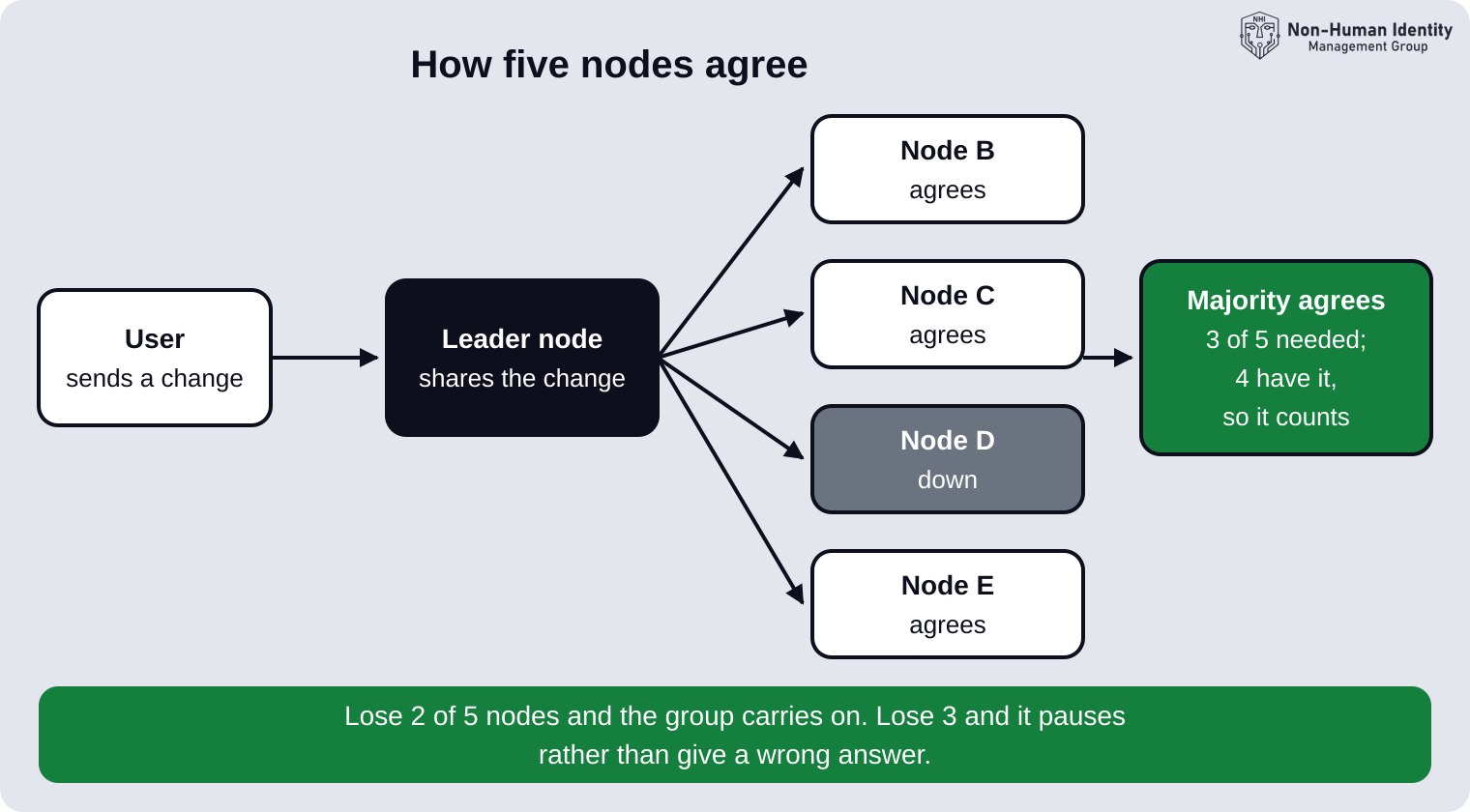
- A change arrives. A user asks the system to save something, such as a new order.
- The leader shares it. One node passes the change to the others, in the same order for everyone.[2]
- A majority agrees. The change counts once most nodes have it. A group of five can keep working with two nodes down.[2]
- Too many failures pause it. If most nodes are lost, the group stops making changes rather than giving wrong answers.[2]
- Security wraps around it. Nodes prove who they are with certificates, and traffic between them is encrypted. Some tools leave this switched off at first, so it needs to be turned on.[3]
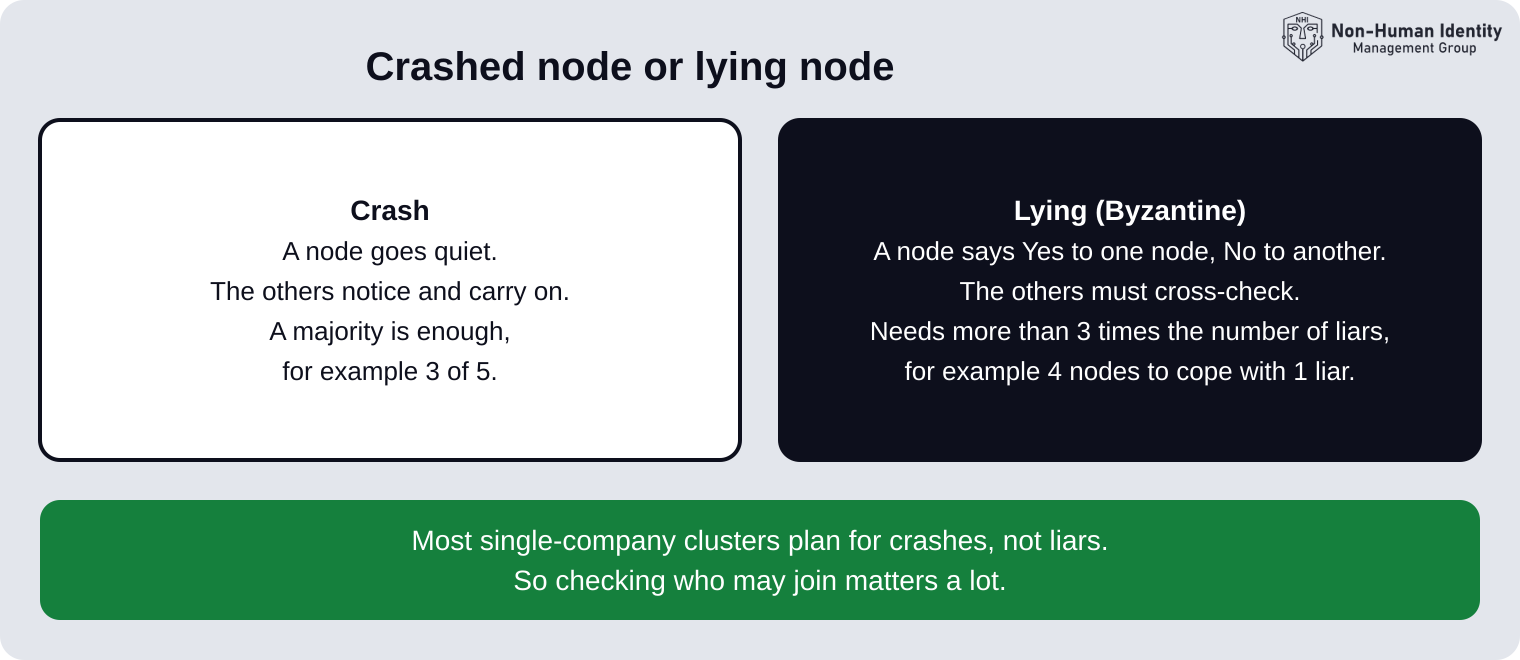
The big difference is between a node that crashes and a node that lies. A crashed node goes quiet. A lying node, often called a Byzantine fault, may tell different nodes different things. The name comes from a 1982 paper that pictured generals, some of them traitors, trying to agree on a plan.[4]
Coping with liars costs more. The CyBOK guide notes that tolerating f lying nodes needs more than three times f nodes in total.[1] So a group that must survive one liar needs at least four nodes. Most single-company clusters are designed for crashes, not liars, which is why keeping strangers out matters so much.
Attackers also try to slip in fake nodes. In a Sybil attack, one attacker creates many fake members to outvote honest ones. In an eclipse attack, fake members surround one honest node so it only hears the attacker's version of events.[1] Both rely on joining cheaply, so checking every node's identity is the first defence.
A worked example
Kaia Wojcik is a second year computer science student. For a group project, her team builds a simple booking app that stores its data on three small servers in the cloud.
The app works. Then her tutor, Milo Sorensen, asks a question. "What happens if one of your servers starts telling lies?"
Kaia thinks of the committee. With three members, two votes make a majority. If one server crashes, the other two can still agree. But a server that lies is different. She learns that coping with one liar needs at least four nodes.
Then she asks a better question. How would a liar get in? She checks the setup. The servers accept any machine that connects, and their messages are not encrypted. She had left the tool's default settings in place.
Kaia makes three changes. Each server now gets its own certificate, a kind of digital ID card. Servers only talk to others that show a valid certificate. And all traffic between them is encrypted.
She also notices that all three servers run the same software version. A single flaw could hit all of them at once. She adds a nightly backup kept outside the group.
In her write-up, she explains that her design handles crashes, not liars. She also explains how she keeps strangers from joining. Milo marks the security section as the strongest part of the project.
Myths and mistakes
| What people think | What is true |
|---|---|
| More copies always means more security. | Copies help with crashes. Identical copies can share the same weakness, so one attack may reach them all.[1] |
| Consensus protects against hackers. | Common designs protect against crashes. A trusted node that has been taken over can still write what it is allowed to write. |
| Servers inside our network can trust each other. | Zero trust advice says no trust should come from network location alone.[5] Each node should prove who it is. |
| Default settings are safe. | Some cluster tools leave security features off by default to make setup easy.[3] |
| Byzantine faults only matter for cryptocurrencies. | They matter wherever members do not fully trust each other, such as systems shared between several companies. |
What can I do this week?
- Draw a system you use or study as boxes for nodes and arrows for messages.
- For each arrow, write down whether the traffic is encrypted.
- For each box, write down how it proves who it is.
- Ask "what if this node lied?" about one design you know.
Checklist
- I can explain what a node, a replica and consensus are.
- I know the difference between a crashed node and a lying node.
- I know a majority vote copes with crashes, not with liars.
- I check that each node proves its identity before it joins.
- I check that traffic between nodes is encrypted.
- I do not assume default settings are secure.
- I keep at least one backup outside the group.
Common questions
What is a Byzantine fault, in plain words?
It is a node that behaves wrongly in any way, including lying. It might tell one node "yes" and another "no". The name comes from a famous 1982 paper about generals, some of them traitors, who must agree on a plan.[4]
Why do clusters often have an odd number of nodes?
Because decisions need a majority. Five nodes need three to agree, so two can fail. Six nodes need four, so still only two can fail. The extra node adds cost without adding much safety against crashes.[2]
Is a blockchain a distributed system?
Yes. A blockchain is a distributed system where members may not trust each other, so it has to cope with liars. Many company databases only need to cope with crashes. See Blockchain and Distributed Ledger Security Guide for more.
How do nodes prove who they are?
Usually with certificates, a kind of digital ID card issued by a trusted authority. Each node shows its certificate when it connects, and checks the other side's too. These machine identities are a type of non-human identity, so they need owners, renewal and care.
What is the CAP idea I keep hearing about?
It says a shared data system cannot promise all three of consistency, availability and coping with a split network at once. It must give up one when the network splits. Attackers may try to cause splits to exploit this.[1]
Where next?
Ready for the detail? Read the practitioner guide: Distributed Systems Security Guide. It goes further into fault models, attacks on peer-to-peer networks, securing consensus clusters and identity between nodes.
Also useful:
- Zero Trust for Beginners
- Non-Human Identities for Beginners
- Blockchain and Distributed Ledger Security Guide
Related NHI Mgmt Group resources: Machine Identities and Certificates for Beginners · Cloud Workload Identities for Beginners
Key terms
- Node
- One computer or program that is part of a larger distributed system.
- Replica
- A copy of the same data kept on another node, so one failure does not lose it.
- Consensus
- The rules a group of nodes follows to agree on the same answer.
- Byzantine fault
- A fault where a node behaves wrongly or dishonestly, such as sending different answers to different nodes.
- Fault tolerance
- The ability of a system to keep working when one part fails.
- Sybil attack
- An attack where one party creates many fake members to gain more votes or influence.
- Mutual TLS
- A secure connection where both sides show a certificate to prove who they are.
Sources and further reading
- Suri, N. Distributed Systems Security Knowledge Area, version 1.0.1. CyBOK (Cyber Security Body of Knowledge), July 2021. https://www.cybok.org/wp-content/uploads/Distributed_Systems_Security_v1.0.1.pdf, accessed 28 Nov 2026.
- The Raft Consensus Algorithm. Raft project. https://raft.github.io/, accessed 28 Nov 2026.
- Transport security model (etcd v3.5 operations guide). etcd project. https://etcd.io/docs/v3.5/op-guide/security/, accessed 28 Nov 2026.
- Lamport, L., Shostak, R. and Pease, M. The Byzantine Generals Problem. ACM Transactions on Programming Languages and Systems, 1982. Microsoft Research publication page. https://www.microsoft.com/en-us/research/publication/byzantine-generals-problem/, accessed 28 Nov 2026.
- NIST SP 800-207, Zero Trust Architecture. National Institute of Standards and Technology, August 2020. https://csrc.nist.gov/pubs/sp/800/207/final, accessed 28 Nov 2026.