Explainable AI means an AI system can give reasons for its results that people can follow and check.
This guide is for anyone who has met an AI decision and wondered "why?". You do not need to build AI to care: if a bank, employer or insurer uses AI to help decide about you, an explanation is how you can understand or challenge the result.
In short
- Explainable AI is about answering "why did the system give this result?" in words people can use.
- There are three common ways to explain: use a simple model, show which inputs mattered most, or say what would change the result.
- A good explanation must be clear to the reader and also true to what the system really did.
- In the EU, people affected by some high-risk AI decisions can ask for an explanation.
What you will learn
- Explain what explainable AI means in one sentence.
- Spot the difference between a useful explanation and a vague one.
- Check whether an AI tool your team uses can explain its results.
- Ask for an explanation when an AI-assisted decision affects you.
- Giving reasons (explainability)
- showing how a system reached a result, in terms people can follow.
- The result (output)
- what the AI system produces, such as a score, a yes or no, or a ranking.
- What went in (inputs)
- the facts the system was given, such as income or years of experience.
What is explainable AI?
Think of a maths teacher who asks you to show your working. A right answer is good. But the working shows how you got there, and it lets the teacher spot a mistake.
Explainable AI asks the same of AI systems. Many AI tools learn patterns from large amounts of past data. They then turn new facts, called inputs, into a result, called an output. That output might be a credit score, a fraud alert or a ranking of job applicants.
Some of these tools are so complex that even their builders struggle to say why one case got one result. People call these black box systems, because you see what goes in and what comes out, but not the reasoning in between.
Explainable AI is the set of methods and habits that open the box a little. It aims to give reasons a person can read, question and act on.
Where the comparison stops working: a pupil writes their own working. With complex AI, a separate tool often writes the explanation afterwards. So it is an estimate of the reasoning, not a copy of it.
Why does it matter?
When AI helps make decisions about people, an explanation is how mistakes and unfairness get found. Without one, a wrong result is hard to spot and hard to challenge.
If an AI decision affects you
What could happen: you are turned down for a loan or a job and nobody can tell you why.
Check this: ask the organisation what role the AI played and what the main reasons were.
If you manage a team that uses AI
What could happen: a customer complains and your staff can only say "the system decided".
Check this: ask the supplier what explanation the tool gives for a single case.
If you are new to data or AI work
What could happen: a model scores well in testing but relies on a clue it should not use.
Check this: look at which inputs the model leans on most before it goes live.
What does it look like?
Here is a made-up letter from a lender. It compares a vague explanation with a useful one.
Example only. All values are made up.
Example Lending Ltd (example.com)  Ref: EXAMPLE-0000
Decision: loan application not approved
Version A: "Our automated system did not approve you."   (1)
Version B:
  Role of AI: a scoring tool rated the application;
  a member of staff made the final decision.          (2)
  Main reasons: short credit history (0 years),
  high monthly repayments compared with income.       (3)
  What could change it: a longer credit history or
  a smaller loan amount.                              (4)
  To ask a person to review: reply to this letter.    (5)
- A vague line. It says AI was used but gives no reasons.
- Says what the AI did and who made the final call.
- The main reasons, in plain words. In a real file, this line would contain the applicant's own facts.
- What would change the result, using things the person could change.
- A route to a human review.
Why this is risky: with Version A, the person cannot tell if the decision was a mistake, and cannot fix anything.
The safer way: say what the AI did and give the main reasons. Then say what would change the result and how to ask for a review.
How does it work?
There is no single method. A US government standards body, NIST, set out four principles for explainable AI in 2021.[1] In plain words, they look like this.
- Give a reason. The system provides evidence or reasons with its result.[1]
- Make it meaningful. The reason makes sense to the person who will read it.[1]
- Keep it accurate. The reason truly reflects how the system reached its result.[1]
- Know the limits. The system works only in the conditions it was built for, and when it is confident enough.[1]
Teams use three common ways to produce the reasons, shown in Figure 1.
- Use a simple model. Some models, like a points card or a short decision tree, can be read directly. The model itself is the explanation.[1]
- Show what mattered most. For complex models, a separate tool estimates how much each input pushed the result. Two well-known tools are called LIME and SHAP.[1]
- Say what would change it. This is called a counterfactual explanation: "if this input were different, the result would have changed".[1]
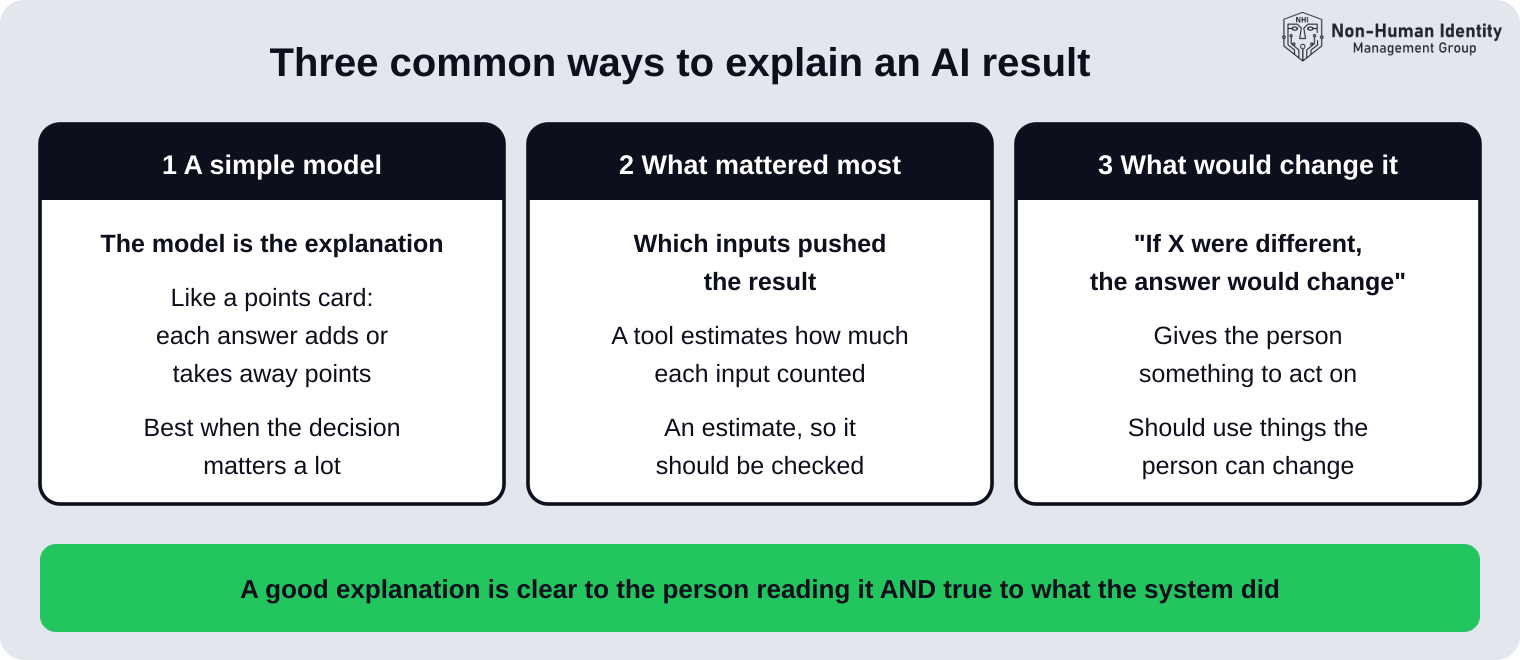
A clear explanation is not always a correct one. NIST notes that an explanation can sound convincing without matching how the system really worked.[1] That is why the "what mattered most" tools are best treated as estimates and checked.
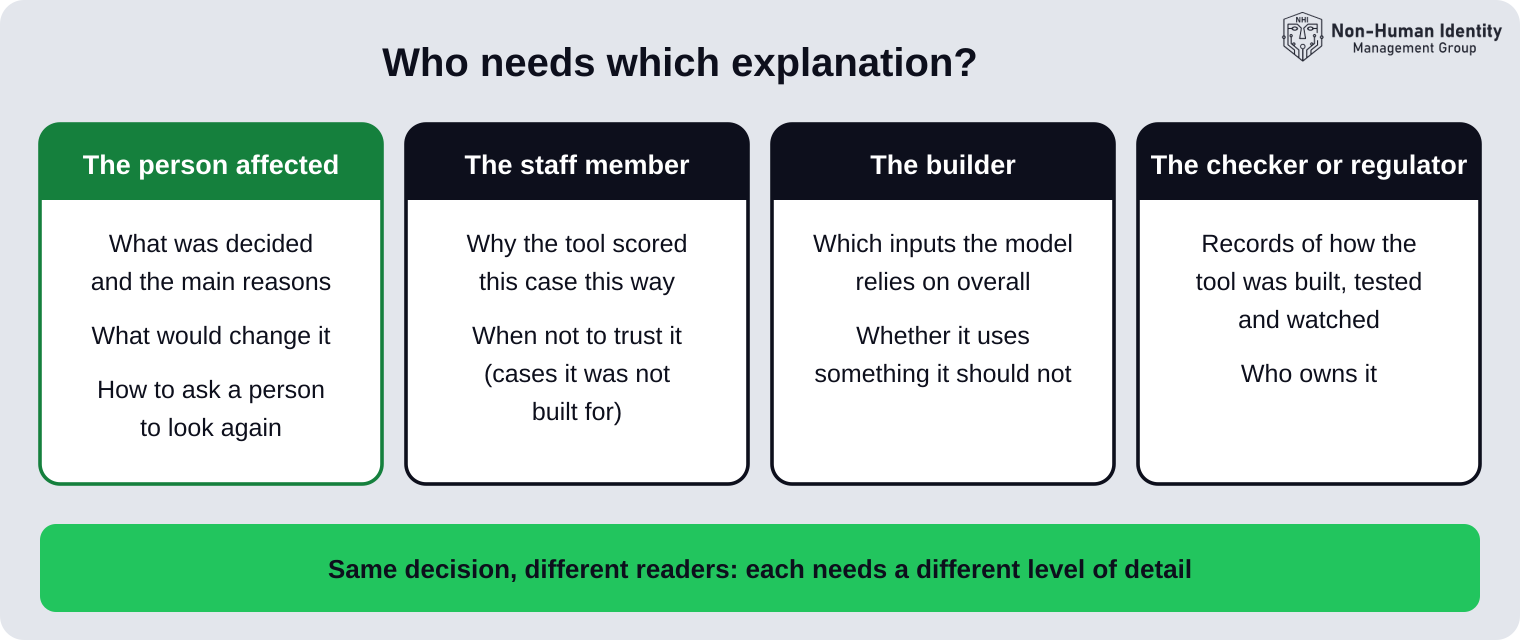
Different people also need different explanations, as Figure 2 shows. The UK data protection regulator, the ICO, wrote guidance on this with the Alan Turing Institute.[2] It lists six kinds of explanation. These cover the reasons, who is responsible, the data used, fairness, safety and performance, and the impact on people.[3] The ICO says the guidance is under review after a 2025 change in UK law.[2]
The law is starting to ask for explanations too. The EU AI Act gives people affected by certain decisions a right to ask for one. It covers decisions based on some high-risk AI systems that have legal or similarly significant effects on them. The organisation using the system must give clear and meaningful explanations of the AI's role and the main elements of the decision.[4] As at 28 November 2026, dates for the high-risk rules have changed during 2026, so check the official text for when this applies. This is general information, not legal advice.
A worked example
Lina Lindahl applies online for a small loan to buy a used car. A few minutes later, she gets a short message: "Your application was not approved." There is no reason given.
Lina is annoyed. She pays her bills on time and has a steady job. She replies and asks why she was refused, and whether a computer made the decision.
At the lender, the request reaches Milo Engel, who looks after customer complaints. He checks the record. A scoring tool rated the application, and a member of staff approved the result without a closer look.
The lender's tool shows which inputs counted most for Lina's score. The biggest one was "time at current address", which was recorded as zero months. Milo checks the form and finds the box was left blank, so the tool treated it as zero. Lina has lived at the same address for six years.
Milo corrects the record and sends the case for a fresh review by a colleague. He writes back to Lina. He explains that a scoring tool was used, that a person makes the final call, and what the main reasons were. He also says the new review approved her loan.
Milo then raises the blank box with his manager. They ask the supplier to flag empty fields for a person to check, not treat them as zero.
The explanation did two jobs. It helped Lina understand the decision, and it helped the lender find and fix a fault.
Myths and mistakes
| What people think | What is true |
|---|---|
| If the AI is accurate, nobody needs an explanation. | A system can be right on average and still wrong for one person. Explanations help find those cases. |
| A chart of which inputs mattered is the full answer. | Those charts are estimates. They help, but a person affected usually needs reasons in plain words. |
| A convincing explanation must be correct. | An explanation can sound right and still not match how the system worked.[1] |
| One explanation fits everyone. | A customer, a staff member and a regulator each need different detail.[1] |
| Explaining a decision means showing the computer code. | Most people need the main reasons and what would change the result, not code. |
What can I do this week?
- List the AI tools your team uses that score, rank or decide about people.
- Pick one tool and ask: can it explain a single result in plain words?
- Read one decision letter or screen your customers see. Does it give reasons and a way to ask for a review?
- Ask the supplier how they check that their explanations match what the tool really does.
- Write down who answers questions when someone asks "why?".
Checklist
- I can explain what explainable AI means in one sentence.
- We know which of our AI tools make or shape decisions about people.
- Each of those tools can explain a single result in plain words.
- People affected are told the AI's role and the main reasons.
- People can ask for a person to review a decision.
- We have checked that explanations match what the tool really does.
- We know the limits: the cases a tool was not built for.
- A named person answers questions about each tool.
Common questions
Is explainable AI the same as transparency?
Not quite. Transparency means being open that AI is used and what it is for. Explainability goes further and shows how a system reached a particular result. A company can be open that it uses AI and still be unable to explain one decision, so both are needed.
Can every AI system be explained?
Not fully. Simple models can be read directly. Complex models usually need separate tools that estimate the reasons, and those estimates can be wrong. For decisions that matter a lot, some teams choose a simpler model that is easier to explain, even if it is a little less accurate.
Can I ask why an AI turned me down?
Often, yes. Start by asking the organisation what role AI played and what the main reasons were. In the EU, people affected by some high-risk AI decisions have a right to ask for an explanation.[4] Data protection laws may also give you rights.
Can chatbots explain their own answers?
They can produce text that looks like reasons, but it may not be how they actually reached the answer. Treat a chatbot's description of its own thinking with care. Sources it quotes, which you can check, are usually more useful than its account of its reasoning.
Does explainable AI make a system fair?
No, but it helps. An explanation can show that a system leans on a clue it should not, such as a postcode that stands in for something else. Finding that is the first step. Fixing it needs testing and changes to the system itself.
Where next?
Ready for the detail? Read the practitioner guide: Explainable and Fair AI Guide. It goes further into choosing an explanation technique, the six explanation types in practice and the legal duties in different countries.
Also useful:
- AI Bias for Beginners
- Responsible AI for Beginners
- EU AI Act Right to Explanation
- Explainability and Interpretability
Related NHI Mgmt Group resources: AI and GDPR Guide · EU AI Act for Beginners · AI Governance for Beginners
Key terms
- Explainable AI
- Methods and habits that make an AI system's results understandable to the people who rely on them.
- Explainability
- Being able to show how a system reached a result, in terms people can follow.
- Interpretability
- How well people can understand why a model produced a particular output.
- Local explainability
- An explanation of one result for one specific case, tied to that case's inputs.
- Counterfactual explanation
- A statement of what would need to be different for the result to change.
- Transparency
- Being open about when AI is used and how a system uses data to reach results.
- Human oversight
- A person can review, approve or correct an AI result before it takes effect.
Sources and further reading
- NISTIR 8312, Four Principles of Explainable Artificial Intelligence. National Institute of Standards and Technology (NIST), September 2021. https://nvlpubs.nist.gov/nistpubs/ir/2021/NIST.IR.8312.pdf, accessed 28 Nov 2026.
- Explaining decisions made with AI. Information Commissioner's Office (ICO) and The Alan Turing Institute. https://ico.org.uk/for-organisations/uk-gdpr-guidance-and-resources/artificial-intelligence/explaining-decisions-made-with-artificial-intelligence/, accessed 28 Nov 2026.
- Explaining decisions made with AI, Part 1: What goes into an explanation? Information Commissioner's Office (ICO). https://ico.org.uk/for-organisations/uk-gdpr-guidance-and-resources/artificial-intelligence/explaining-decisions-made-with-artificial-intelligence/part-1-the-basics-of-explaining-ai/what-goes-into-an-explanation/, accessed 28 Nov 2026.
- AI Act, Article 86: Right to explanation of individual decision-making. European Commission, AI Act Service Desk (based on the consolidated text as at 27 July 2026). https://ai-act-service-desk.ec.europa.eu/en/ai-act/article-86, accessed 28 Nov 2026.