GIAC certifications are hands-on security exams, each one proving a specific skill such as defence, forensics or testing.
This guide is for students, career changers and anyone who has seen letters like GSEC or GCIH on a CV and wondered what they mean. You do not need a technical background to read it. If you fund training for staff, it also explains what you are paying for.
In short
- GIAC is a body that sets and runs security exams. Its exams line up with training courses from SANS, a well-known security training firm.
- There are more than 60 GIAC certifications, each named with a short code and focused on one job skill.
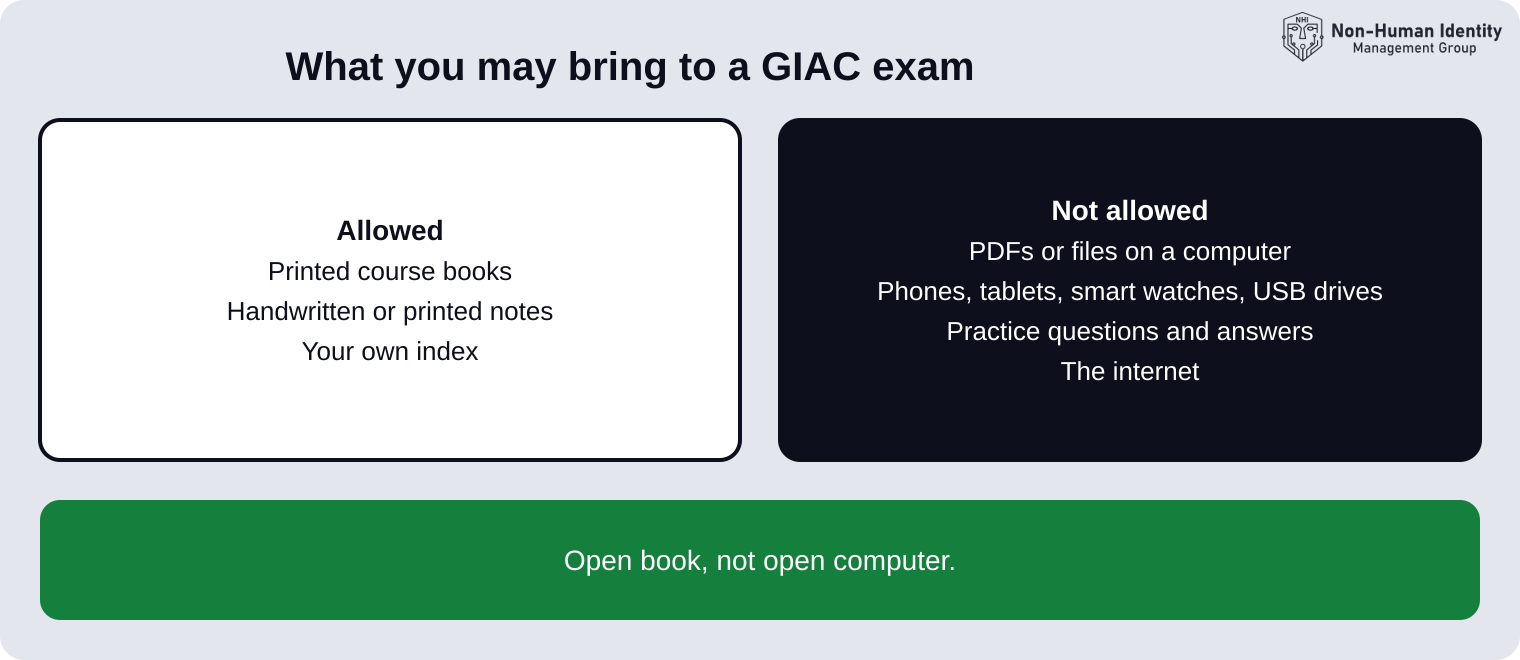
- Exams are open book: you may bring printed course books and your own notes, but nothing electronic.
- Each certification lasts four years. You renew it with learning hours and a fee, or by taking an exam again.
What you will learn
- Explain what GIAC is and how it links to SANS training.
- Spot which kind of job a GIAC code points to.
- Check how the open book exam and renewal work.
- Ask whether a GIAC certification fits your stage and budget.
- Proof of skill (certification)
- a title you earn by passing an exam and meeting set rules.
- Bring your notes (open book exam)
- an exam where you may use printed books and notes while you answer.
- Ongoing learning (CPE)
- hours of learning you log to keep a certification.
What are GIAC certifications?
Think of a driving licence with different categories. Passing your car test does not let you drive a lorry or a motorbike. Each category is a separate test for a separate kind of vehicle.
GIAC certifications work in a similar way. GIAC is a certification body that writes and runs security exams.[1] Instead of one big title, it offers many smaller ones. Each proves a specific skill, such as defending networks, investigating attacks or testing systems.[2]
Each certification has a short code. For example, GSEC stands for GIAC Security Essentials and covers broad basics.[3] Other codes cover narrower jobs. GIAC's exams line up with courses from SANS, a training organisation, so many people take a SANS course first. That course is optional.[3]
Where the comparison stops working: a driving licence is a legal need for driving. No law says you need a GIAC certification to work in security. It is evidence of a skill, which some employers ask for.
Why does it matter?
GIAC codes appear often in adverts for hands-on security jobs. Knowing what they mean helps you choose training and read a CV fairly.
If you are a career changer
What could happen: you pick a specialist exam too early and struggle because you lack the basics.
Check this: start with a broad certificate, then choose a GIAC code that matches the job you want.
If you pay for staff training
What could happen: you fund an expensive course and exam that does not match the person's job.
Check this: match the GIAC focus area to the work the person really does.
What does it look like?
Here is a made-up planning card. Someone might fill one in when choosing a first GIAC exam.
Example only. All values are made up.
MY GIAC PLAN                 Name: A. EXAMPLE
Job I want:          Security analyst          (1)
Focus area:          Cyber defence             (2)
First exam:          GSEC (broad basics)       (3)
Training:            Self-study, own books     (4)
Exam materials:      Printed notes + index     (5)
Renewal due:         4 years after passing     (6)
- Start from the job, not from the list of codes.
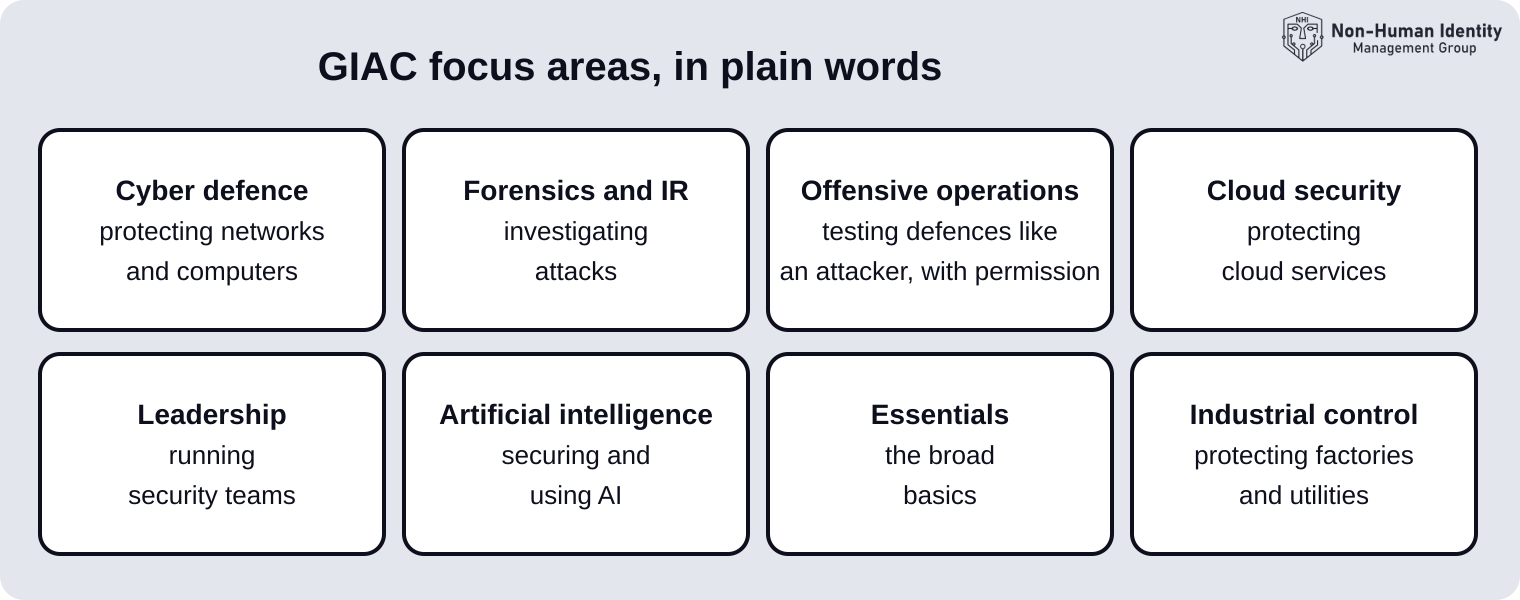
- GIAC groups its exams into focus areas, such as cyber defence or forensics.
- GSEC is one of a few broad, early exams. In a real file, this line would note why this code fits.
- SANS training lines up with the exam but is not required.
- Only printed material is allowed. Files on a laptop or phone are not.
- Plan your learning hours from the start, so renewal is not a rush.
Why this is risky: people often choose a code because it sounds impressive. It may not match the job they want.
The safer way: pick the job first. Then find the focus area, then the code.
How does it work?
Getting and keeping a GIAC certification follows five steps.
- Choose a certification. GIAC groups more than 60 certifications into focus areas.[2] Figure 1 shows the main ones.
- Prepare. You can take an aligned SANS course, but GIAC says experience, college courses or self-study may also be enough.[3]
- Build your notes. The exam is open book. You may bring printed books, notes and an index, but nothing electronic.[4] An index here is your own alphabetical list of topics and page numbers.
- Sit the exam. It is supervised, either online at home or at a test centre.[3] GSEC, for example, has 106 questions over four hours, and some exams include hands-on lab tasks.[3]
- Renew every four years. You log 36 hours of learning, called CPE credits, over the four years and pay a fee. Or you can renew by taking an exam again.[5][6]
Because the exam is open book, preparation is different from many tests. People often spend weeks building a good index. On the day, a clear index helps you find answers quickly.
A worked example
Rania Lomax runs the front desk systems for Quarry Gym, a fictional group of climbing gyms. She looks after the booking computers, the Wi-Fi and staff logins. She wants to move into a security analyst job.
Her manager, Sana Vance, offers to pay for one exam. Rania looks at the GIAC list and feels lost. There are dozens of codes.
She thinks of the driving licence. She does not need every category. She needs the one for the job she wants. Analyst work sits under cyber defence, so she looks there first.
GSEC covers broad basics, which suits her stage. She reads that SANS training is optional. To save money, she studies from books and free material for a few months.
She builds an index as she goes. Each topic gets a line, a book name and a page number. She prints it and puts it in a folder with her notes.
On exam day, she takes the test online with a supervisor watching on camera. When a question on wireless security stumps her, her index points her to the right page.
She passes. Sana asks how she will keep it current. Rania sets a reminder for four years' time and starts a simple log of training hours.
Myths and mistakes
| What people think | What is true |
|---|---|
| You must take a SANS course to sit a GIAC exam. | The course is optional. GIAC says other preparation may be enough.[3] |
| Open book means the exam is easy. | The questions test skill and judgement. Time is limited, so you cannot look up everything. |
| You can bring your laptop notes. | Only printed material is allowed. Electronic files and devices are not.[4] |
| GIAC is one certification. | It is a family of more than 60, each with its own code and focus.[2] |
| Once passed, it lasts for life. | Each certification must be renewed every four years.[5] |
What can I do this week?
- Write down the security job you would like in two years.
- Find the GIAC focus area that matches it on GIAC's website.
- Read the official page for one certification in that area.
- Start a simple index for any topic you are learning, to practise the skill.
Checklist
- I can explain what GIAC is and how it links to SANS.
- I know there are many GIAC certifications, each with its own code.
- I know SANS training is optional.
- I know the exam is open book but not open computer.
- I know each certification must be renewed every four years.
- I have checked the current price and rules on GIAC's website.
Common questions
What is the difference between GIAC and SANS?
SANS mainly runs training courses. GIAC runs the exams and awards the certifications. The two are linked, and GIAC exams line up with SANS courses. But you can sit a GIAC exam without taking the SANS course.[3]
Which GIAC certification should a beginner take first?
Often a broad one, such as GSEC, which covers security basics across networks, computers and the cloud. GIAC lists only a few exams in its essentials area.[2] If GIAC's cost is too high, other entry certificates cover similar ground. See Cyber Security Certifications for Beginners.
How much does renewal cost?
GIAC lists a renewal fee of 499 US dollars, paid once every four years.[5] There is a lower fee for extra certifications renewed close together. Exam and course prices are separate, and they change, so check GIAC's pages before you book.
Do employers recognise GIAC certifications?
Some employers name GIAC codes in job adverts, mostly for hands-on roles. GIAC is accredited against an international standard for bodies that certify people.[1] Still, a certificate supports your experience. It does not replace it. Check what the adverts for your target job ask for.
Where next?
Ready for the detail? Read the practitioner guide: GIAC GSEC Guide. It goes further into the GSEC exam format, its objectives, building an index for the open book exam and the renewal rules.
Also useful:
- Cyber Security Certifications for Beginners
- GIAC vs OffSec Certifications
- GIAC GCIH Guide
- CISSP for Beginners
Related NHI Mgmt Group resources: GIAC Cloud Certifications Compared Guide · Blue Team Certifications Guide · Certification Renewal and CPE Requirements Guide
Key terms
- GIAC
- A certification body that sets and runs hands-on security exams linked to SANS training.
- Certification
- A title you earn by passing an exam and meeting set rules.
- Open book exam
- An exam where you may use printed books and notes, but no electronic devices.
- GSEC
- GIAC Security Essentials, a broad GIAC certification covering security basics.
- Proctored exam
- An exam watched by a supervisor, in person or online, to keep it fair.
- CPE
- Hours of learning you record to keep a certification.
Sources and further reading
- About GIAC. GIAC. https://www.giac.org/about/, accessed 28 Nov 2026.
- GIAC Certifications (listing by focus area). GIAC. https://www.giac.org/certifications/, accessed 28 Nov 2026.
- GIAC Security Essentials (GSEC). GIAC. https://www.giac.org/certifications/security-essentials-gsec/, accessed 28 Nov 2026.
- Proctor Program Overview and Open Book Testing Guidelines. GIAC. https://www.giac.org/knowledge-base/proctor, accessed 28 Nov 2026.
- Renewal. GIAC Knowledge Base. https://www.giac.org/knowledge-base/renewal, accessed 28 Nov 2026.
- CPE Information. GIAC. https://www.giac.org/renewal/cpe-information, accessed 28 Nov 2026.