India's DPDP Act is the national law on how organisations collect, use and protect people's digital personal data.
This guide is for students, IT staff and small firms in India, and for firms abroad with customers in India. You do not need a legal background. If your app, shop or service holds details about people in India, this law is likely to matter to you.
In short
- DPDP stands for Digital Personal Data Protection. The Act was passed in August 2023, and its detailed rules came out in November 2025.
- Most duties for organisations apply from 13 May 2027, so there is still time to prepare.
- Organisations need a person's clear consent, or one of a short list of other reasons, to use their data.
- Every personal data breach must be reported, both to the people affected and to a national board.
What you will learn
- Explain what the DPDP Act is and who it covers.
- Spot the main roles the law gives to people and organisations.
- Check which dates matter for your team.
- Ask the right questions about consent, safety and breaches.
Status: correct as at 28 November 2026, based on the Act and the DPDP Rules 2025 published by India's Ministry of Electronics and Information Technology. Laws change; check the official text.
This guide explains the topic in general terms and is not legal advice.
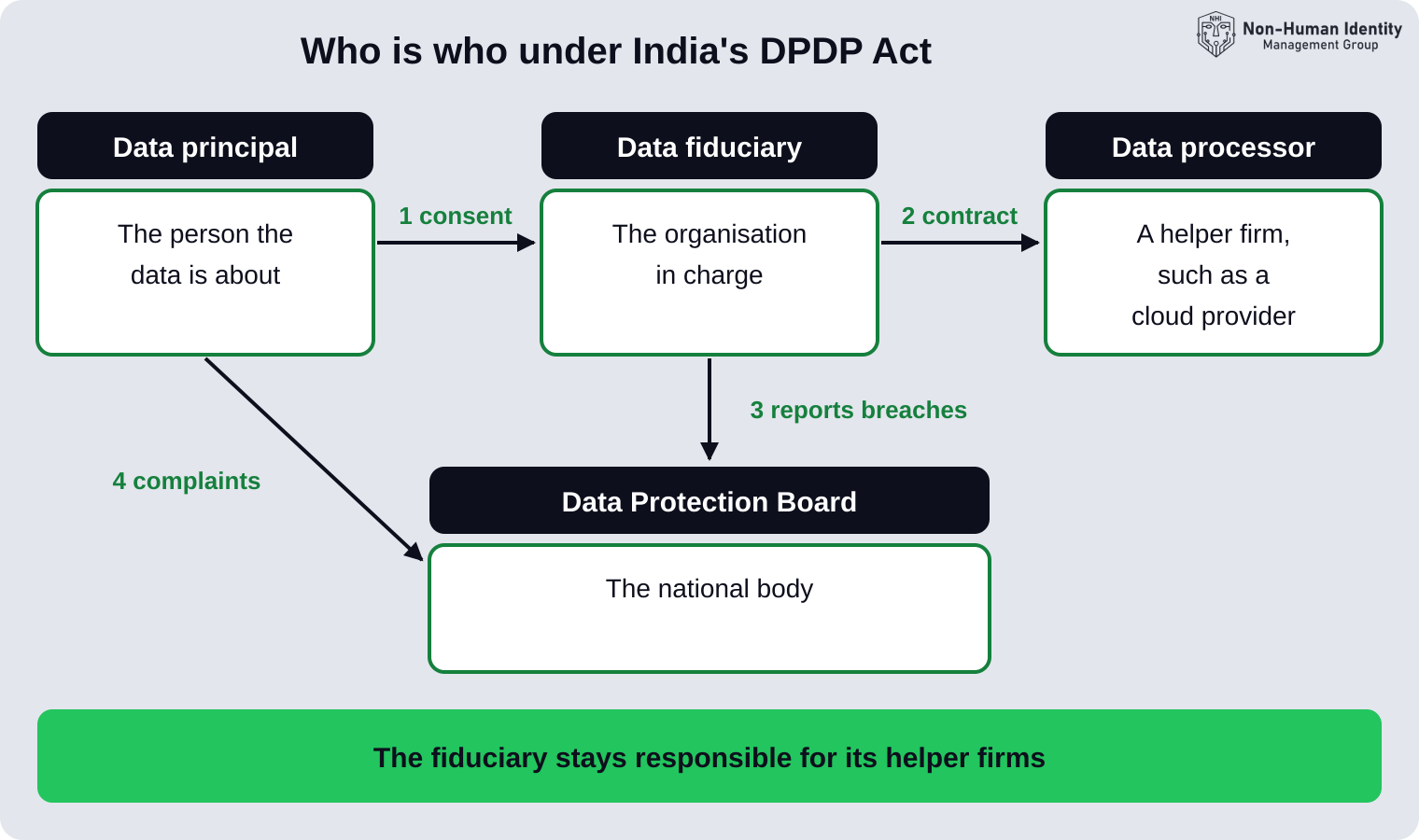
- The person (data principal)
- the individual the personal data is about.
- The organisation in charge (data fiduciary)
- the organisation that decides why and how personal data is used.
- Helper firm (data processor)
- a firm that handles personal data on behalf of the organisation in charge.
What is India's DPDP Act?
Think of a cloakroom at a wedding hall. You hand over your coat, and the staff must look after it, use it only as agreed and give it back when you ask. The DPDP Act treats your personal data in a similar way.
The person the data is about is called the data principal. The organisation holding it is the data fiduciary, a word that means someone trusted to look after something for another person. India's Parliament passed the Act, and the President signed it on 11 August 2023.[1]
The Act covers personal data in digital form. That includes paper records once they are typed or scanned into a computer. It also reaches firms outside India when they offer goods or services to people in India.[1] The detailed rules, called the DPDP Rules 2025, were published on 13 November 2025.[2]
Where the comparison stops working: a cloakroom only holds your coat. An organisation may copy, share and analyse your data, often through helper firms you never meet.
Why does it matter?
Many apps, shops and services hold data about people in India, including firms based elsewhere. The law carries large fines for failing to keep data safe.[1]
If you run a small online business in India
What could happen: your sign-up form uses pre-ticked boxes, so the consent you collect may not count.
Check this: make sure each person actively says yes, and can say no just as easily later.
If you work in IT support
What could happen: a shared admin login for the customer database is leaked, and nobody can tell who used it.
Check this: give each person their own login and each program its own account, and keep records of who opened what.
If you are a student or new to privacy work
What could happen: you assume the DPDP Act is a copy of Europe's GDPR and miss key differences.
Check this: learn the Indian terms and the dates in the rules first.
What does it look like?
Here is a made-up "Am I affected?" card. A small firm might fill it in before it speaks to an adviser.
Example only. All values are made up.
Firm: Example Tutoring Pvt Ltd
[x] We hold names, phone numbers, emails          (1)
[x] Some of our users are under 18                (2)
[x] A cloud firm stores our data for us           (3)
[ ] Consent is a pre-ticked box on sign-up        (4)
[x] We keep login records for at least a year     (5)
Users in India: about 0,000 (fake)
- Ordinary personal data. The firm needs consent or another listed reason to use it.
- Under the Act, anyone under 18 is a child. A parent's checked consent is needed.
- The cloud firm is a helper firm. The tutoring firm stays responsible for it.
- Left unticked here, which is right. A pre-ticked box is not a clear yes.
- Keeping records of who used the data helps the firm look into a breach.
Why this is risky: a firm with child users and a helper firm has several duties, and may not know them all.
The safer way: fill in a card like this, then read the official rules or ask a qualified adviser.
How does it work?
- Have a reason to use the data. The main reason is consent. The Act also lists other "legitimate uses", such as medical emergencies, legal duties and some employment needs.[1]
- Ask clearly and let people change their mind. Consent must be free, specific, informed and given by a clear action. Taking it back must be about as easy as giving it.[1]
- Take extra care with children. For anyone under 18, the organisation needs checked consent from a parent or guardian.[1] There are limited exceptions for things like healthcare, education and real-time safety.[3]
- Keep the data safe. The organisation must take reasonable security steps against a breach. That includes work done by its helper firms.[1]
- Report breaches. A breach means data was seen, changed, lost or shared without permission. People affected must be told in plain language. The national Data Protection Board must be told too, with a detailed report within 72 hours.[2][3]
- Respect people's rights. People can ask what data is held, ask for corrections or deletion, and complain. Complaints must be handled within 90 days at most.[1][2]
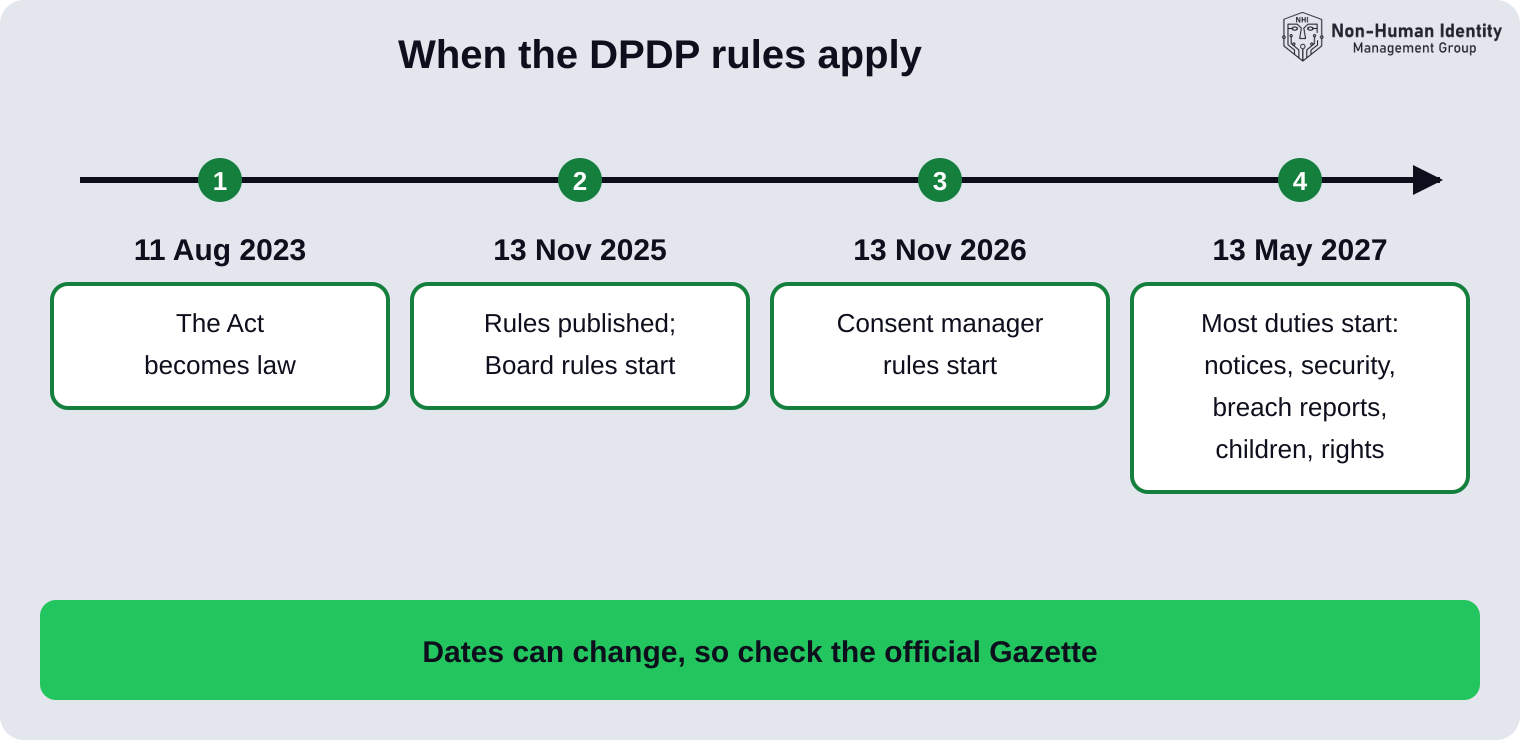
The rules start in phases. Rules on the Board applied straight away. Rules for consent managers, registered firms that help people manage their consents in one place, start a year later. Most duties apply 18 months after publication, which is 13 May 2027.[2]
A worked example
Talia Okafor runs a small online maths tutoring service from Pune. Most of her students are teenagers. Her friend Darius Vance looks after the firm's website and cloud account in his spare time.
Talia reads about the DPDP Rules and asks Darius three questions. First, do they need a parent's consent? Many students are under 18, so yes. Darius changes the sign-up page. A parent now confirms the booking from their own account, and the form explains what data is collected and why.
Second, is the data kept safe? Darius finds that he and two tutors share one admin password. He sets up separate logins with a second check at sign-in, and turns on access records. He also asks the cloud firm what security terms are in its contract.
Third, what if something goes wrong? Talia writes a one-page plan. It says who decides if there is a breach, how families will be told in plain words, and how the Board will be told. She notes the 72-hour deadline for the detailed report.
Finally, she adds a simple way for families to ask for their data, correct it or have it deleted. She then books a call with a qualified adviser to check her plan before May 2027.
Myths and mistakes
| What people think | What is true |
|---|---|
| We are based outside India, so the Act does not apply. | It can reach firms abroad that offer goods or services to people in India. |
| Small breaches do not need reporting. | The Act and rules expect every personal data breach to be reported to the Board and to the people affected. |
| A pre-ticked box counts as consent. | Consent needs a clear action by the person, for a specific purpose. |
| Our cloud provider is responsible for its own security, so we are covered. | The organisation in charge stays responsible for data handled by its helper firms. |
| A child means someone under 13. | Under this Act, a child is anyone under 18. |
What can I do this week?
- List the personal data your team holds and where it is stored.
- Check whether any of your users are under 18.
- Read your sign-up form and privacy notice as a customer would.
- Find out which helper firms handle your data, and what their contracts say about security.
- Write down who would decide, and who would report, if a breach happened.
Checklist
- We know whether we hold digital personal data about people in India.
- Each use of personal data has consent or another listed reason.
- Consent is a clear yes, and withdrawing it is just as easy.
- We have a way to get checked parental consent for users under 18.
- Each person has their own login, each program has its own account, and access is recorded.
- Our helper firms have security terms in their contracts.
- We have a breach plan that covers telling people and the Board.
- People can ask to see, correct or delete their data, and complain.
Common questions
When does the DPDP Act start to apply?
In phases. The Act became law in August 2023, but most duties wait for the rules. The rules were published on 13 November 2025, and most duties apply from 13 May 2027. Check the official Gazette, because dates can change.
How big are the fines?
Large. The highest, for failing to take reasonable security steps, can reach 250 crore rupees, which is 2.5 billion rupees. Failing to report a breach, or breaking the rules on children's data, can each reach 200 crore rupees.[1]
What is the Data Protection Board of India?
It is the national body set up under the Act. It receives breach reports and complaints, and can impose fines. The government describes it as a fully digital body, where people can file and track complaints online.[3]
Is the DPDP Act the same as GDPR?
No, though some ideas are similar. Both need a lawful reason to use data and give people rights. But the Indian law uses its own terms and covers only digital data. It treats everyone under 18 as a child and has its own breach rules.
Does it apply to data I keep for personal reasons?
No, it does not cover personal or household use. Your own phone contacts or family photos are outside it. It also does not cover data that a person has chosen to make public themselves.[1]
Where next?
Ready for the detail? Read the practitioner guide: India DPDP Act Guide. It goes further into the minimum security measures in the rules, the full breach report contents, data retention limits and the extra duties on significant data fiduciaries.
Also useful:
Related NHI Mgmt Group resources: Data Protection Laws Around the World for Beginners · Data Controllers and Processors for Beginners · India Aadhaar and Digital Public Infrastructure
Key terms
- Personal data
- Information about a person who can be identified from it.
- Data principal
- The person the personal data is about. For a child, this includes the parent or guardian.
- Data fiduciary
- The organisation that decides why and how personal data is used.
- Data processor
- A firm that handles personal data on behalf of another organisation.
- Consent
- A person's free, informed and clear agreement to a use of their data.
- Consent manager
- A registered firm that helps people give, review and withdraw consent in one place.
- Personal data breach
- When personal data is seen, changed, lost or shared without permission.
- Data Protection Board of India
- The national body that receives breach reports and complaints under the Act.
Sources and further reading
- The Digital Personal Data Protection Act, 2023 (No. 22 of 2023), see sections 2, 3, 6, 7, 8, 9, 11 to 14 and the Schedule. Ministry of Electronics and Information Technology, Government of India, 11 August 2023. https://www.meity.gov.in/static/uploads/2024/06/2bf1f0e9f04e6fb4f8fef35e82c42aa5.pdf, accessed 28 Nov 2026.
- Digital Personal Data Protection Rules, 2025 (G.S.R. 846(E)), see Rules 1, 7 and 14. Ministry of Electronics and Information Technology, 13 November 2025. https://www.meity.gov.in/static/uploads/2025/11/53450e6e5dc0bfa85ebd78686cadad39.pdf, accessed 28 Nov 2026.
- Government notifies Digital Personal Data Protection Rules, 2025. Press Information Bureau, Ministry of Electronics and Information Technology, 14 November 2025. https://www.pib.gov.in/PressReleasePage.aspx?PRID=2190014, accessed 28 Nov 2026.