A data controller decides why and how personal data is used; a data processor handles it on the controller's behalf.
This guide is for small business owners, people starting a software company and anyone who buys or sells services that touch customer or staff data. If your business uses an online tool that stores names, emails or bookings, you are already in one of these roles.
In short
- The controller decides why personal data is used and the main ways it is used, and carries most of the legal duty.
- The processor uses the data only for the controller, following the controller's written instructions.
- Your role depends on what you actually do with the data, not on what a contract calls you.
- When a controller uses a processor, the law requires a written contract covering set points, such as security and what happens to the data at the end.
What you will learn
- Explain the difference between a controller and a processor in one sentence.
- Check which role your business plays with each supplier.
- Spot the main points a controller and processor contract should cover.
- Ask a supplier the right questions before you share customer data.
Status: correct as at 28 November 2026, based on guidance from the UK Information Commissioner's Office and the European Commission on the UK GDPR and EU GDPR. Laws change; check the official text.
This guide explains the topic in general terms and is not legal advice.
- The one who decides (controller)
- the person or organisation that decides why personal data is used and how.
- The one who follows instructions (processor)
- an organisation that handles personal data only for the controller.
- Information about a person (personal data)
- anything that can identify someone, such as a name, email address or booking record.
What are data controllers and processors?
Think of a homeowner who hires a decorator. The homeowner chooses which rooms to paint and which colours. The decorator does the work, picks the brushes and follows the homeowner's choices.
Personal data works the same way. The controller is like the homeowner. It decides why the data is collected and the main ways it is used. The processor is like the decorator. It handles the data for the controller and follows the controller's instructions.[1]
The European Commission gives a simple example. A brewery hires a payroll company to pay its staff. The brewery is the controller, and the payroll company is the processor.[2]
Sometimes two organisations decide together why and how data is used. They are then joint controllers, and they share the duties.[1]
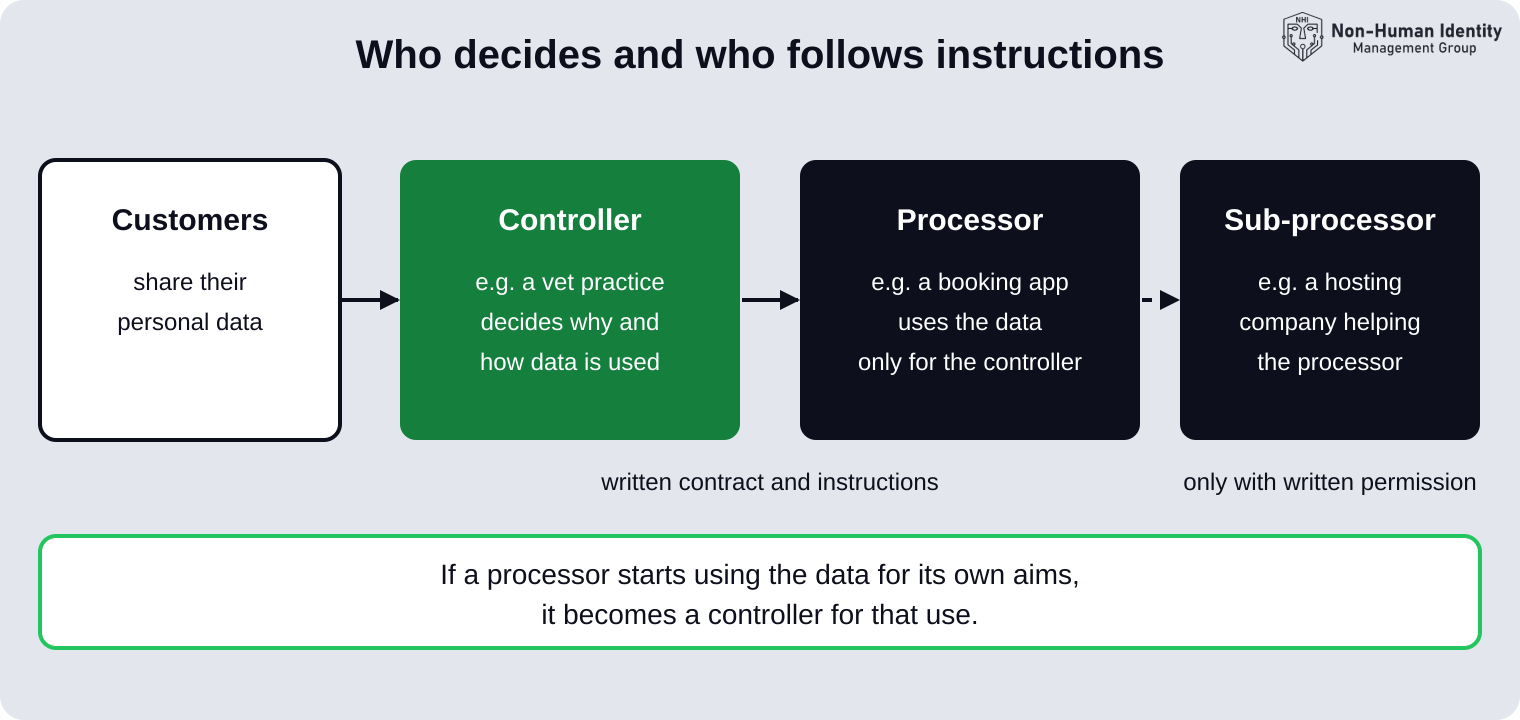
Where the comparison stops working: a decorator who starts using your house for their own business is plainly breaking the deal. A data processor that starts using data for its own purposes becomes a controller for that use, with a controller's duties.[1]
Why does it matter?
The role decides who must answer to customers and to the data regulator. If nobody knows who is in charge, requests and problems can fall through the gaps.
If you run a small business
What could happen: a supplier mishandles your customers' data, and you are still answerable as the controller.
Check this: make sure each supplier that handles your customer data has a written data contract with you.
If you are starting a software company
What could happen: you reuse customer data to build a new feature, and you step into the controller role without meaning to.
Check this: write down what you do with each customer's data, and what you do not do.
Next: GDPR for Beginners
If you work in buying or procurement
What could happen: a contract labels a supplier "processor" when it really decides how the data is used.
Check this: ask who decides why the data is used, and compare the answer with the contract.
What does it look like?
Here is a made-up "Which role am I?" card for one supplier. Answer each question for one use of the data at a time.
Example only. All values are made up.
Supplier: Example Booking App (example.com)
Data: customer names, phone numbers, appointments

Do we choose why this data is collected?       YES  (1)
Does the supplier use it only for us?          YES  (2)
Does the supplier use it for its own aims?     NO   (3)
Is there a signed data contract?               NOT YET (4)

Likely result: we are the controller,
the supplier is our processor.                      (5)
- Deciding why data is collected points to the controller.
- Working only for someone else points to the processor.
- If this were "yes", the supplier would be a controller for that use.
- In a real file, this line would show the date the contract was signed. Here it is missing.
- A likely answer, not a final one. Check with the official guidance or an adviser.
Why this is risky: without a contract, nothing is written down. There are no agreed rules on security, on who can see the data, or on what happens when you stop using the app.
The safer way: sign the supplier's data contract, often called a data processing agreement, before you load customer data. Check it covers the points in the next section.
How does it work?
Here is how the two roles usually fit together in practice.
- The controller decides. It chooses why the data is collected, whose data and what is kept. It must be able to show it follows the data protection rules.[1]
- The controller picks a processor. It hires a supplier, such as a payroll firm, a booking app or an email service.
- They sign a contract. The law sets out what it must cover. That includes acting only on written instructions, keeping data secure and keeping it confidential.[3]
- The processor does the work. It may make day-to-day choices, such as which computers to use, but only for the controller's purpose.[1]
- Helpers need permission. If the processor wants to use another company (a sub-processor), it needs the controller's written permission first.[3]
- The work ends. The controller chooses whether the processor deletes the data or hands it back.[3]
The contract also has to say what data is used, for how long and why. The processor must help the controller respond to people who ask about their data, and must help when there is a data breach.[3]
One business can be a controller for some data and a processor for other data. A software company is usually a controller for its own staff records, and a processor for the customer records it stores for clients.
A worked example
Milo Strand manages Cobble Vets, a fictional vet practice with two branches. The practice wants an online booking app so pet owners can book visits.
Milo picks an app built by a small software firm run by Lars Pajari. Before loading any customer data, Milo asks Lars three questions. Who decides what we collect? Do you use our customers' details for anything else? Who else sees the data?
Lars explains that Cobble Vets chooses the booking fields. His firm stores the bookings and sends reminder texts, only for the practice. It uses a hosting company to run the app. Milo remembers the homeowner and the decorator. Cobble Vets is the controller, and the app firm is the processor.
Lars sends his standard data processing agreement. Milo checks it covers instructions, security, staff confidentiality, the hosting company as a sub-processor, and what happens to the data if the practice leaves. It does, so he signs it.
A month later, Lars suggests using booking data to send pet food offers from his own partners. Milo says no. If the app firm used the data for its own aims, it would become a controller for that use, with a controller's duties.[1]
At the end of the year, Cobble Vets' accountants, Juniper Accountants, ask for staff pay records. Milo learns that an accountant working under its own professional rules is often a controller in its own right, not a processor.[1] He notes this in the practice's list of suppliers.
Myths and mistakes
| What people think | What is true |
|---|---|
| The contract says they are a processor, so they are. | The role follows what each side really does with the data, not the label.[1] |
| Using a supplier hands the legal duty to them. | The controller stays responsible for making sure the rules are followed.[1] |
| Processors cannot make any choices. | Processors can make day-to-day choices, such as which computers to use, as long as they serve the controller's purpose.[1] |
| A processor can bring in any helper it likes. | It needs the controller's written permission first.[3] |
| Every supplier is a processor. | Some, such as accountants and lawyers working under their own professional rules, are often controllers in their own right.[1] |
What can I do this week?
- List the suppliers that hold your customer or staff data.
- For each one, ask who decides why the data is used.
- Check that each processor has signed a data contract with you.
- Ask each processor which other companies it uses to handle your data.
- Write down what should happen to your data when a contract ends.
Checklist
- We know our role, controller, joint controller or processor, for each main use of personal data.
- Every processor we use has a signed data contract.
- Each contract covers instructions, security, confidentiality and sub-processors.
- We know which sub-processors our processors use.
- Each contract says what happens to the data at the end.
- Processors know they must tell us about a data breach.
- We review roles again when a supplier starts doing something new with the data.
Common questions
Is my cloud or software supplier a processor?
Often, yes. A supplier that holds your customers' data only to run its service for you is usually your processor. If it also uses that data for its own aims, such as its own adverts, it is likely to be a controller for that use.
Can one company be both a controller and a processor?
Yes. The role is decided for each use of the data. A software firm is usually a controller for its own staff and sales data. The same firm is a processor for the customer data it stores for its clients.
What is a data processing agreement?
It is the written contract between a controller and a processor. The law sets out what it must cover. That includes following instructions, keeping data safe and secret, and rules on helpers. It also covers help with breaches and what happens to the data at the end.
What are joint controllers?
They are two or more groups that decide together why and how personal data is used. They must agree who does what, such as who answers people's questions. They must also tell people the main points of that deal.[2]
Do processors have any legal duties of their own?
Yes, though fewer than controllers. A processor must follow the controller's instructions, keep the data safe and help the controller meet its duties. If it goes beyond its instructions, it can take on a controller's duties for that use.
Where next?
Ready for the detail? Read the practitioner guide: Controller vs Processor Guide. It goes further into deciding roles from the facts, joint controller arrangements, contract clauses and who is liable when something goes wrong.
Also useful:
- GDPR for Beginners
- Personal Data for Beginners
- Third Party Risk Management for Beginners
- Data Breach Notification for Beginners
Related NHI Mgmt Group resources: Data Processor Due Diligence Questionnaire Template · GDPR Compliance Checklist · Data Protection Impact Assessments for Beginners
Key terms
- Controller
- The person or organisation that decides why and how personal data is used, and carries the main responsibility.
- Processor
- An organisation that handles personal data on behalf of a controller, following its instructions.
- Joint controller
- One of two or more organisations that decide together why and how personal data is used.
- Sub-processor
- Another company a processor uses to help handle the data, with the controller's permission.
- Data processing agreement
- The contract that sets out how a processor may handle personal data for a controller.
- Personal data
- Information that can identify a person directly or indirectly, such as a name or email address.
- Processing
- Anything done with personal data, from collecting and storing it to sharing and deleting it.
Sources and further reading
- What are controllers and processors? Information Commissioner's Office (ICO). https://ico.org.uk/for-organisations/uk-gdpr-guidance-and-resources/controllers-and-processors/controllers-and-processors/what-are-controllers-and-processors/, accessed 28 Nov 2026.
- What is a data controller or a data processor? European Commission. https://commission.europa.eu/law/law-topic/data-protection/rules-business-and-organisations/obligations/controllerprocessor/what-data-controller-or-data-processor_en, accessed 28 Nov 2026.
- What needs to be included in the contract? Information Commissioner's Office (ICO). https://ico.org.uk/for-organisations/uk-gdpr-guidance-and-resources/accountability-and-governance/contracts-and-liabilities-between-controllers-and-processors-multi/what-needs-to-be-included-in-the-contract/, accessed 28 Nov 2026.