An industrial protocol is the shared language that machines in factories and utilities use to talk.
This guide is for students, newcomers to security and network engineers starting work on plant systems. You do not need to be an engineer to be affected: water, power and heating all depend on these machine conversations.
In short
- Industrial protocols carry short commands such as "read this sensor" or "open this valve" between machines.
- Older ones, such as Modbus and classic DNP3, were built for closed networks and do not check who sent a command.
- Newer secure versions, and the newer OPC UA, can check identity and protect messages, but many sites cannot switch quickly.
- Until they can, sites protect old protocols by fencing off the plant network and watching for odd commands.
What you will learn
- Explain what an industrial protocol does in one sentence.
- Spot why an old protocol may obey a stranger's command.
- Explain how secure versions and network fences help.
- Ask the right first questions about a plant network.
- Machine language (industrial protocol)
- the agreed rules for how industrial machines send and answer commands.
- Machine controller (PLC)
- a small rugged computer that runs one part of a process, such as a pump.
- Digital ID card (certificate)
- a file that lets a device prove who it is to another device.
What is an industrial protocol?
Think of an old walkie-talkie channel on a building site. Everyone on the channel hears every message. Anyone with a handset on that channel can shout "stop the crane", and the driver may obey.
Industrial protocols work in a similar way. A control screen in the control room sends a short message to a machine controller, called a PLC (programmable logic controller). The message might say "tell me the tank level" or "start pump 2". The PLC answers or acts.
A few names come up often. Modbus is one of the oldest and most widely used in factories.[1] DNP3 is common in electricity and water networks.[2] OPC UA is a newer protocol that was designed with security features built in.[3]
Where the comparison stops working: on a real building site, the driver may know the voice. A PLC using an old protocol usually has no way to recognise the sender at all. If the message is in the right format, it is treated as genuine.
Why does it matter?
These messages move real things: valves, pumps, motors and heaters. A false command can affect the physical world, not just data.
In January 2024, an attack hit a heating company in Lviv, Ukraine. Ukraine's security service said more than 600 households briefly lost heating and hot water. Researchers at Dragos said the harmful software used Modbus to control equipment, The Record reported.[7]
If you are a network engineer moving into plant work
What could happen: you open a network path for a reporting tool, and it also lets anyone on that path send commands.
Check this: ask which devices may send commands to each controller, not just which ports are open.
If you are a student or new to security
What could happen: you assume plant systems work like office IT, and miss that a valid message is often enough.
Check this: learn the basic idea of commands and replies before you learn the tools.
If you manage a plant or a small utility
What could happen: a supplier's remote link reaches controllers that trust any message they receive.
Check this: ask for a simple list of every remote link and what it can reach.
Next: OT Remote Access Guide
What does it look like?
Here is a made-up, simplified log of messages on a small water site's plant network. Real logs look more technical, but the idea is the same.
Example only. All values are made up.
# plant network log, pump station EXAMPLE-01
09:00  control-screen-1  -> PLC-pump  READ  tank level      reply: 62%
09:05  control-screen-1  -> PLC-pump  READ  tank level      reply: 63%
09:10  unknown-0000      -> PLC-pump  READ  device details  (1)
09:11  unknown-0000      -> PLC-pump  WRITE pump 2 = OFF    (2)
09:11  PLC-pump          -> unknown-0000  OK                (3)
- A device nobody recognises asks the controller what it is.
- The same unknown device sends a command to switch a pump off.
- The controller accepts it, because an old protocol does not ask who is sending.
Why this is risky: the controller obeyed a stranger as if it were the control screen. Older protocols were made for closed networks. A US government report warns that weak identity checks in these protocols let attackers send fake messages.[5]
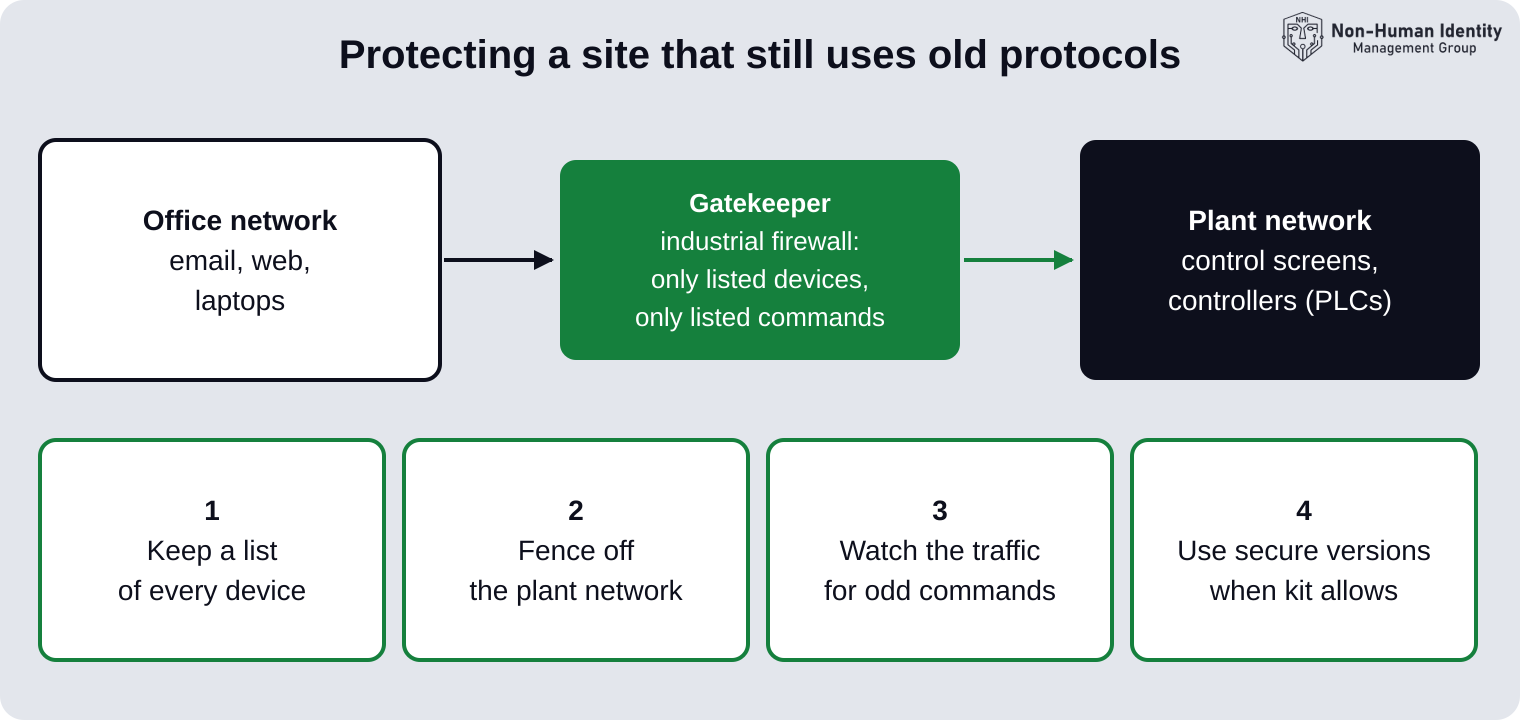
The safer way: only listed devices can reach the controller. A gatekeeper blocks change commands from anywhere else. Monitoring warns you when a new device appears. Where the kit allows, a secure version checks the sender's digital ID first.
How does it work?
Most industrial protocols follow the same simple pattern of question and answer.
- Ask. A control screen or server sends a request, such as "read the temperature" or "set the speed to 50".
- Find the right box. The request names a numbered memory slot inside the controller. Each slot holds a value, such as a level or an on or off switch.
- Act or answer. The controller reads or changes that slot and sends a short reply.
- Repeat. This happens again and again, often every few seconds, so screens stay up to date.
- Check identity (newer versions only). Secure versions wrap each message in protection. They use digital ID cards called certificates so each side can prove who it is. They also detect messages that have been changed on the way.[3][4]
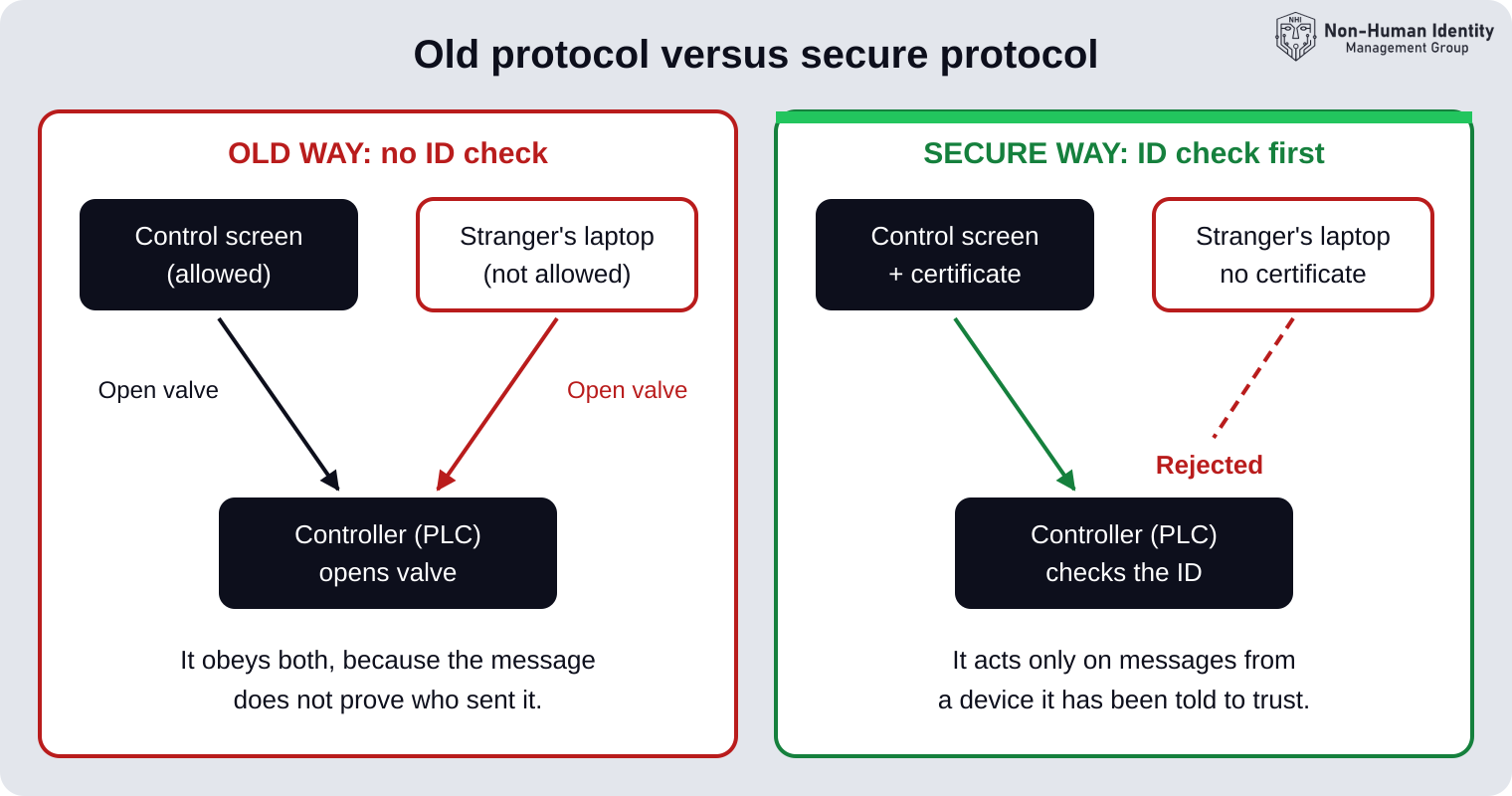
Why not switch everything to the secure versions? Plant equipment can stay in service for decades, and older devices may not support them. Secure versions also need certificates to be issued, renewed and looked after. US government guidance on operational technology covers these trade-offs in detail.[6] A 2026 US government paper looked at this. A news report on it said an upgraded part can cost as much as the original part.[8]
So most sites use layers. They keep the plant network separate from the office network, which is called network segmentation. They put a gatekeeper in between, and they watch the traffic.
A worked example
Idris Varga is a network engineer. He has just moved from the office IT team to the plant team at a fictional water treatment works.
On his first week, a supplier asks him to open a path so a new reporting tool can read tank levels. In the office, Idris would simply allow the right port. His new manager, Leila Strand, stops him.
"The tool only needs to read," Leila says. "But on Modbus, the same path that reads can also write. The controller will not ask who is sending."
Idris remembers the walkie-talkie picture. Giving the tool a handset means it can shout orders too.
So they plan it differently. First, Leila checks the list of devices on the plant network, so they know what the tool will reach. Next, they place the reporting tool in a separate area between the office and the plant. Then they set the industrial firewall to allow only read requests from that one tool, to only the controllers it needs.
Idris asks whether the controllers could use a secure version instead. Leila checks with the maker. The newest controllers can, but two older ones cannot. They add that to the upgrade plan for the next planned shutdown.
Last, they turn on alerts for any new device or any write command from an unexpected address.
A month later, the monitoring flags a laptop a contractor plugged in by mistake. Nothing was changed. The alert simply means someone noticed straight away, which is what the layers were for.
Myths and mistakes
| What people think | What is true |
|---|---|
| Our plant network is not connected to anything, so the protocol does not matter. | Many plants have remote links, laptops and supplier connections. Check what can really reach the controllers. |
| Allowing one port is enough control. | On older protocols, one port can carry both reads and writes. Control which devices and which commands are allowed. |
| OPC UA is secure, so we are fine. | Its security features need to be switched on and set up, including certificates and user logins.[3] |
| We can just update every device this weekend. | Plant changes need testing and planned downtime. Many sites protect old kit with layers while they plan upgrades. |
| Attackers need special malware to cause harm. | Normal, valid commands sent by the wrong person can be enough. Watch who sends which commands. |
What can I do this week?
- Ask which machine languages your site uses, and on which devices.
- Ask for a list of every device that can send commands to a controller.
- Check if any supplier link can reach the plant network directly.
- Ask if your newest kit can use a secure version.
- Read the pages linked below before you change any plant rule.
Checklist
- There is an up-to-date list of plant devices and the protocols each one uses.
- The plant network is kept separate from the office network.
- A gatekeeper limits which devices can talk to controllers.
- Write commands are allowed only from named control systems.
- Monitoring alerts on new devices and unexpected commands.
- Remote and supplier access is approved, recorded and time-limited.
- Secure protocol versions are used where equipment supports them.
- Older equipment has an upgrade plan tied to planned shutdowns.
Common questions
Why do old industrial protocols have no security?
They were designed for closed networks where only trusted machines were connected. Modbus, for example, dates from 1979, long before plants linked to office networks and the internet.[1] Speed and reliability came first. Security was added later as separate secure versions.
Is there a secure version of Modbus?
Yes. Modbus/TCP Security wraps Modbus messages in TLS, the same kind of protection used by secure websites. It uses certificates so each side can prove who it is, and it can carry roles that limit what a sender may do.[4] Both devices must support it.
What is the difference between Modbus, DNP3 and OPC UA?
All three carry commands and readings between industrial machines. Modbus is simple and widely used in factories. DNP3 grew up in electricity networks and is also used in water.[2] OPC UA is newer and was designed with identity checks and encryption built in.[3]
Can I test a plant network with normal IT scanning tools?
Only with care and written approval. Some older plant devices can behave badly when they receive unexpected traffic. Plant teams usually prefer quiet methods, such as listening to traffic, and plan any active test with the engineers. The practitioner guide covers this in more depth.
Do I need to be an engineer to learn this?
No. You can start with the idea of commands and replies, then learn how networks are separated. Many people move into plant security from IT networking. Working with engineers and learning how the process runs is a big part of the job.
Where next?
Ready for the detail? Read the practitioner guide: Industrial Protocol Security Guide. It goes further into each protocol's weak points, the secure version for each one, and how firewalls and monitoring can understand individual commands.
Also useful:
- Industrial Control Systems and SCADA for Beginners
- Purdue Model for Beginners
- OT Network Segmentation: Zones and Conduits
- OT Network Security Monitoring Guide
- OT Security Engineer for Beginners
Related NHI Mgmt Group resources: Industrial Switch and Serial Gateway Hardening Guide · PKI for Beginners · Network Segmentation for Beginners
Key terms
- Industrial protocol
- The agreed rules industrial machines use to send commands and readings to each other.
- Modbus
- An old, simple and widely used industrial protocol that, in its original form, does not check who sent a message.
- DNP3
- An industrial protocol common in electricity and water networks, with an optional secure mode.
- OPC UA
- A newer industrial protocol with identity checks and encryption that sites need to switch on and set up.
- PLC
- A rugged small computer that controls one part of an industrial process, such as a pump or motor.
- Certificate
- A digital ID card that lets a device prove who it is.
- Network segmentation
- Splitting a network into separate areas so trouble in one area cannot easily reach another.
Sources and further reading
- Modbus FAQ. Modbus Organization. https://www.modbus.org/faq.php, accessed 28 Nov 2026.
- Overview of DNP3 Protocol. DNP Users Group. https://www.dnp.org/About/Overview-of-DNP3-Protocol, accessed 28 Nov 2026.
- Unified Architecture (OPC UA). OPC Foundation. https://opcfoundation.org/about/opc-technologies/opc-ua/, accessed 28 Nov 2026.
- MODBUS/TCP Security Protocol Specification, version 36, 30 July 2021. Modbus Organization. https://www.modbus.org/docs/MB-TCP-Security-v36_2021-07-30.pdf, accessed 28 Nov 2026.
- Common Cybersecurity Vulnerabilities in Industrial Control Systems. US Department of Homeland Security, published by CISA, May 2011. https://www.cisa.gov/sites/default/files/recommended_practices/DHS_Common_Cybersecurity_Vulnerabilities_ICS_2010.pdf, accessed 28 Nov 2026.
- NIST SP 800-82 Rev. 3, Guide to Operational Technology (OT) Security. National Institute of Standards and Technology, September 2023. https://csrc.nist.gov/pubs/sp/800/82/r3/final, accessed 28 Nov 2026.
- FrostyGoop malware left 600 Ukrainian households without heat this winter. The Record, 23 July 2024 (news report of Dragos research and a statement by Ukraine's security service). https://therecord.media/frostygoop-malware-ukraine-heat, accessed 28 Nov 2026.
- Why secure OT protocols still struggle to catch on. Help Net Security, 13 February 2026 (news report of a CISA paper on barriers to secure OT communication). https://www.helpnetsecurity.com/2026/02/13/cisa-secure-ot-communication-protocols/, accessed 28 Nov 2026.