A data protection officer advises an organisation on handling personal data lawfully and checks that it does.
This guide is for anyone curious about a privacy job that mixes law, people and plain common sense. You do not need a legal or technical background to read it. If you have ever asked a company what it holds about you, a data protection officer may have handled your request.
In short
- A data protection officer (DPO) is an expert adviser and checker for personal data, the information that relates to a person.
- Under UK and EU data protection law, some organisations must appoint one, such as public bodies.
- The DPO advises, checks, trains staff and is the contact point for the regulator and for the public.
- The DPO must be able to act independently and report to top leaders. People come in from legal, compliance, security, audit and IT roles.
What you will learn
- Explain what a data protection officer does in one sentence.
- Spot the main tasks the law gives the role.
- Check which of your skills the job already uses.
- Ask good questions about a DPO or privacy job before you apply.
Status: correct as at 28 November 2026, based on the UK Information Commissioner's Office guidance on data protection officers and the European Commission's GDPR pages. The ICO says its guidance is under review after the Data (Use and Access) Act. Laws change; check the official text.
This guide explains the topic in general terms and is not legal advice.
- Information about a person (personal data)
- anything that relates to someone who can be identified, such as a name or customer number.
- The privacy watchdog (supervisory authority)
- the public body that enforces data protection law, such as the ICO in the UK.
- Privacy risk check (DPIA)
- a written review of how a new plan could affect people's personal data.
What is a data protection officer?
Think of a referee at a football match. The referee does not play for either side. They know the rules well, they speak up when something is wrong, and both teams must let them do their job.
A data protection officer plays a similar part for personal data. The organisation collects and uses information about people, such as customers, patients or staff. The DPO advises it on doing that lawfully. Then they check that it does.
The role comes from data protection law, called the GDPR in the EU and the UK GDPR in the UK. The law lists the DPO's main tasks. They inform and advise the organisation and its staff, and monitor whether it follows the law. They also give advice on privacy risk checks and work with the regulator.[2]
The DPO is also a contact point for members of the public who have questions about their data or want to use their rights.[2]
Where the comparison stops working: a referee can stop the game. A DPO usually cannot block a decision. They give advice, and leaders decide, but the advice should be heard and written down.
Why does it matter?
Organisations hold a lot of information about people. A DPO helps them use it fairly and spot problems early, before they hurt someone. For many people, it is also a way into privacy work that builds on skills from other jobs.
If you work in legal, compliance or audit
What could happen: you assume privacy jobs are only for lawyers or only for techies, and miss a role that uses your skills.
Check this: read three DPO or privacy officer job adverts and mark the tasks you already do.
If you run a small organisation
What could happen: you are not sure whether the law requires you to have a DPO, and nobody owns privacy questions.
Check this: use the regulator's guidance to see if you must appoint one, and name a privacy lead either way.
Next: UK GDPR for Beginners
If you work in IT or security
What could happen: a new system goes live without anyone asking how it uses personal data.
Check this: find out who your DPO or privacy lead is, and ask them early about new projects.
Next: GDPR for Beginners
What does it look like?
A lot of a DPO's work starts with a simple question: does this law apply to us, and how? Here is a made-up "Do we need a DPO?" card, based on the main triggers in the regulator's guidance.[1]
Example only. All values are made up.
DO WE NEED A DPO?  Org: EXAMPLE Trust (FAKE)
[ ] We are a public authority or body          (1)
[ ] Our core work means watching people
    regularly and on a large scale             (2)
[ ] Our core work uses sensitive data on a
    large scale, such as health records        (3)
[x] None of these, but we use a lot of data    (4)
Privacy lead named: (blank)                    (5)
Reviewed: 00/00/0000
- Public bodies, such as councils, must appoint a DPO, with a narrow exception for courts.
- For example, tracking people's behaviour online as a main part of the business.
- Sensitive data includes health details and criminal records. In a real file, this line would name the data types.
- Many organisations outside the triggers still choose to appoint a DPO or a privacy lead.
- The empty box is the problem: nobody owns privacy questions.
Why this is risky: even if the law does not require a DPO, the data protection rules still apply. With no named lead, questions and requests can fall through the gaps.
The safer way: record the decision and the reason, and name a person who looks after privacy. Check the official guidance, because the details depend on your situation.
How does it work?
Every organisation runs privacy a little differently, but a DPO's year often follows a loop like this one.
- Advise. The DPO tells leaders and staff what the law expects, often through training and short guides.[2]
- Review new plans. When a team plans something risky with personal data, the DPO gives advice on the privacy risk check, called a DPIA.
- Check. They monitor whether the organisation follows the rules, for example with audits (planned checks) and spot reviews.[2]
- Handle questions. They act as a contact point for people asking about their data, and for the regulator.[1]
- Report. They tell the board, the top level of leaders, what is going well and what needs fixing. Then the loop starts again.[1]
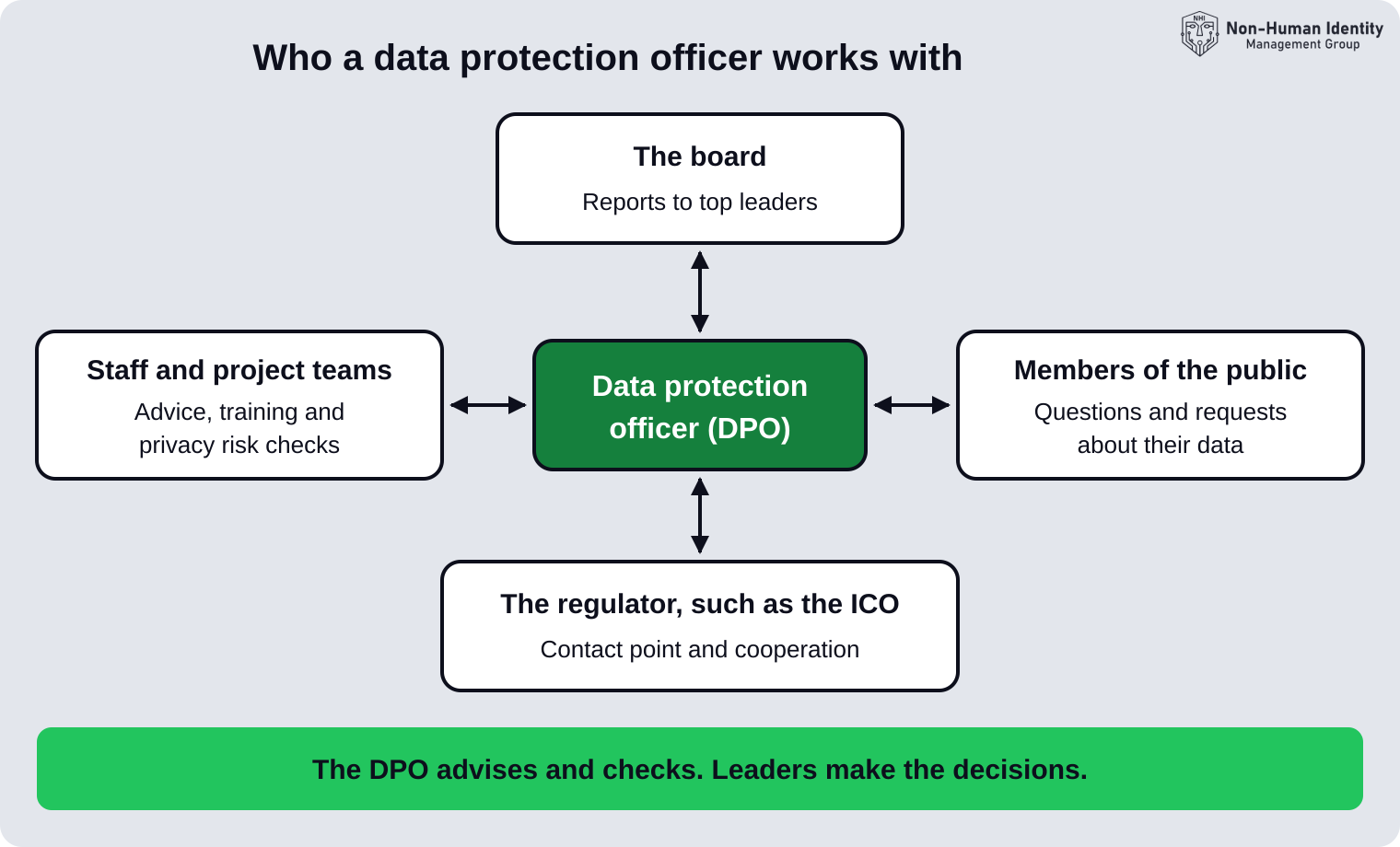
The law also protects the role. The DPO should work independently and report to the highest level of management. They should not be dismissed or penalised for doing their tasks.[1]
A DPO should also avoid a conflict of interest. They should not hold a job where they decide why and how personal data is used. The ICO gives the example that a head of marketing should not also be the DPO.[1]
The DPO can be a member of staff or an outside expert on a service contract. A group of organisations can share one DPO if the role still works well.[1]
Skills and tools
You do not need all of these on day one. Many DPOs build them up from earlier jobs in compliance, audit, security or IT.
- Data protection law and practice. The law expects expert knowledge, matched to how complex the organisation's data use is.
- Privacy risk checks. Helping teams run a DPIA before a risky new plan goes ahead.
- Checking and audits. Planned checks and spot reviews to see whether the rules are followed.
- Training and clear advice. Explaining what the law expects to leaders and staff in plain words.
- Independence. Giving honest advice, even when it is not what leaders want to hear.
A worked example
This story is made up to show what the job can look like.
Anja Becker is the data protection officer for Northgate Housing Trust, a fictional housing charity. Before this, she worked in the trust's complaints team.
Her Monday starts with her inbox. A tenant wants a copy of everything the trust holds about them. Anja logs the request, checks the deadline and asks the housing team to gather the records.
On Tuesday, the repairs team tells her about a new app. Tenants will upload photos of damp and leaks. Anja thinks of the referee. She is not there to block the app, just to make sure the rules are kept.
She asks simple questions. What data will the app collect? Who can see the photos? How long will they be kept? Could a photo show a child or a medical aid? She suggests a privacy risk check, and helps the team write it.
The check finds a gap. Photos would be kept with no end date. Anja advises a time limit and a note in the app telling tenants how their photos are used. The team agrees.
On Thursday, she runs a short training session for new staff on sending emails to the right person.
On Friday, she writes her quarterly note to the board. It lists the requests handled, the app review and one open risk: old paper files in a store room. She recommends a review, and the board agrees a date.
What made the difference: Anja was asked early, so her advice shaped the app before it went live.
Myths and mistakes
| What people think | What is true |
|---|---|
| You must be a lawyer to be a DPO. | Expert knowledge of data protection law and practice is needed, but the law does not require a law degree.[1] |
| Every company must have a DPO. | Only some must, such as public bodies and those whose core work involves large-scale monitoring or sensitive data. Many others choose to.[1] |
| The DPO is to blame if the company breaks the law. | The organisation stays responsible. The DPO advises and checks. |
| The head of IT can just take the job on too. | Maybe not. The DPO should not hold a role that decides how personal data is used, because that creates a conflict of interest.[1] |
| A DPO only deals with data breaches. | Breaches are one part. Advice, training, risk checks and requests from the public take up much of the time. |
What can I do this week?
- Read three DPO or privacy officer job adverts and list the tasks they share.
- Read the ICO's guide to data protection officers from start to finish.
- Find your own employer's privacy notice and look for the DPO's contact details.
- Read our UK GDPR for Beginners guide.
- Ask someone in a privacy, legal or compliance team what a normal week looks like.
Checklist
- I can explain what personal data is.
- I know the main tasks the law gives a DPO.
- I know why a DPO must be able to act independently.
- I can explain what a privacy risk check (DPIA) is for.
- I have looked at real job adverts for the role.
- I can point to times I gave clear advice or handled tricky questions.
- I have checked official sources for pay, not just job boards.
- I have a plan for one first learning step.
Common questions
Do I need a law degree to become a DPO?
No, not by law. The DPO must have expert knowledge of data protection law and practice, matched to how complex the organisation's data use is. Many DPOs come from compliance, audit, security or IT. Privacy courses and certifications can help you build that knowledge.[1]
What is the difference between a DPO and a privacy engineer?
A DPO advises and checks, and must stay independent. A privacy engineer builds privacy into systems, for example by limiting what data an app collects. They often work together. Our practitioner guide covers both roles side by side.
How much does a data protection officer earn?
Pay varies a lot by country, sector and experience, so we do not quote a figure here. Use official career sources for your country, such as the National Careers Service in England, and compare several real job adverts.[3]
Can a DPO work for more than one organisation?
Yes. A DPO can be an outside expert on a service contract, and a group of organisations can share one DPO. The DPO must still be able to do the job well for each of them.[1]
Where can a DPO job lead?
Several paths. DPOs often move into senior privacy roles, such as head of privacy or chief privacy officer, or into wider risk and compliance leadership. See DPO vs CPO for how those two roles differ.
Where next?
Ready for the detail? Read the practitioner guide: Privacy Engineer and DPO Career Guide. It goes further into the skills each role needs, certifications, routes in from security and legal work, and how careers progress.
Also useful:
- Data Protection Officer Interview Questions
- DPIA Guide: Running a Data Protection Impact Assessment
- Subject Access Requests for Beginners
- GRC Analyst for Beginners
Related NHI Mgmt Group resources: Cybersecurity Careers Guide · Career Change into Cyber Security Guide · UK ICO Guidance and Enforcement Guide
Key terms
- Data protection officer (DPO)
- An expert who advises an organisation on data protection law, checks it is followed and acts as the contact point for the regulator and the public.
- Personal data
- Any information that relates to a person who can be identified, such as a name, email address or customer number.
- Data protection impact assessment (DPIA)
- A written review of how a new plan or system could affect people's personal data, done before it starts.
- The public regulator that enforces data protection law, such as the ICO in the UK.
- Data controller
- The organisation that decides why personal data is collected and how it is used.
- Data subject rights
- The rights people have over their personal data, such as asking for a copy or for a correction.
Sources and further reading
- Data protection officers (UK GDPR guidance, Guide to accountability and governance; GDPR Articles 37 to 39). Information Commissioner's Office (UK), latest content update 18 September 2023, guidance under review after the Data (Use and Access) Act. https://ico.org.uk/for-organisations/uk-gdpr-guidance-and-resources/accountability-and-governance/guide-to-accountability-and-governance/data-protection-officers, accessed 28 Nov 2026.
- What are the responsibilities of a Data Protection Officer (DPO)? European Commission. https://commission.europa.eu/law/law-topic/data-protection/rules-business-and-organisations/obligations/data-protection-officers/what-are-responsibilities-data-protection-officer-dpo_en, accessed 28 Nov 2026.
- Explore careers. National Careers Service (England). https://nationalcareers.service.gov.uk/explore-careers, accessed 28 Nov 2026.