NHI governance is the set of rules and checks that decide which software accounts exist and who answers for them.
This guide is for anyone who wants the big picture on keeping software accounts under control. You do not need to be a security expert to be affected: if your business uses cloud services, apps or AI tools, someone needs to decide who looks after the accounts they use.
In short
- Software accounts, such as service accounts, API keys and AI agents, are created every day, often by many teams.
- Governance answers "who decides?": it sets the rules and names a person who answers for each account.
- Five building blocks cover most of it: a short policy, an owner, approval, regular reviews and removal.
- Start small: write five rules, list your most important accounts and ask teams to claim them.
What you will learn
- Explain what NHI governance is in one sentence.
- Spot the difference between a rule and a security task.
- Check whether every important software account has an owner.
- Ask how your organisation handles exceptions to its rules.
- Non-human identity (NHI)
- a digital identity, or the credential behind it, that represents a machine, application, automated process, service or AI agent, so it can authenticate, carry out tasks and connect to other systems without a person.
- Written rules (policy)
- a short, approved document saying what must happen and why.
- Regular check (access review)
- a recorded check that an account still needs the access it has.
What is NHI governance?
Think of a club's membership rules. They say who may join, who vouches for each member, when membership is renewed and when it ends. The rules do not run the club day to day, but everyone knows where they stand.
A non-human identity, or NHI, is an account used by software. One example is a service account that runs a nightly job. Another is an API key, a secret code one program shows another. An AI agent that acts for someone is an NHI too.
Governance means deciding the rules and making sure people follow them. For NHIs, the rules cover how accounts are made and how much access they get. They also say who owns each one, how often it is checked and when it goes.
It helps to separate governance from security tasks. Changing a key or setting up an alert is a task. Deciding that every key must have an owner and a yearly review is governance.
Where the comparison stops working: a club might have a few hundred members who join slowly. Software can create new accounts in seconds, so the rules need to be built into how teams work, often with automation.
Why does it matter?
Many common problems with software accounts come down to missing rules. A community list of the top risks starts with accounts not being removed when they are no longer needed.[2]
If you run a small business
What could happen: a supplier leaves, but the keys they set up still work.
Check this: make "remove access when a supplier leaves" one of your written rules.
If you are new to security work
What could happen: an auditor asks how service accounts are managed, and nobody can answer.
Check this: find out whether a written policy covers software accounts.
If you are a manager
What could happen: something goes wrong and nobody knows who was responsible for the account.
Check this: ask what share of your software accounts has a named owner.
What does it look like?
Here is a made-up page from a register of software accounts, the kind of list governance relies on.
Example only. All values are made up.
account          purpose            owner       last review   status
payroll-export   send pay file      Finance     EXAMPLE-0000  OK
web-backup       nightly backup     IT team     EXAMPLE-0000  OK
crm-sync         copy contacts      (none)      never         (1)
old-report-bot   monthly report     left firm   never         (2)
chat-agent       answer questions   Support     EXAMPLE-0000  exception (3)
- No owner and no review. Nobody can say if this account is still needed.
- The owner has left. The account may still work with nobody watching it.
- An agreed exception to the rules. A full register would also show who approved it and when it ends.
Why this is risky: accounts with no owner or no review can keep their access for years. If one is misused, nobody is there to notice or answer for it.
The safer way: every account has an owner, a purpose and a review date. Accounts without owners are checked, switched off and then removed through a recorded process.
How does it work?
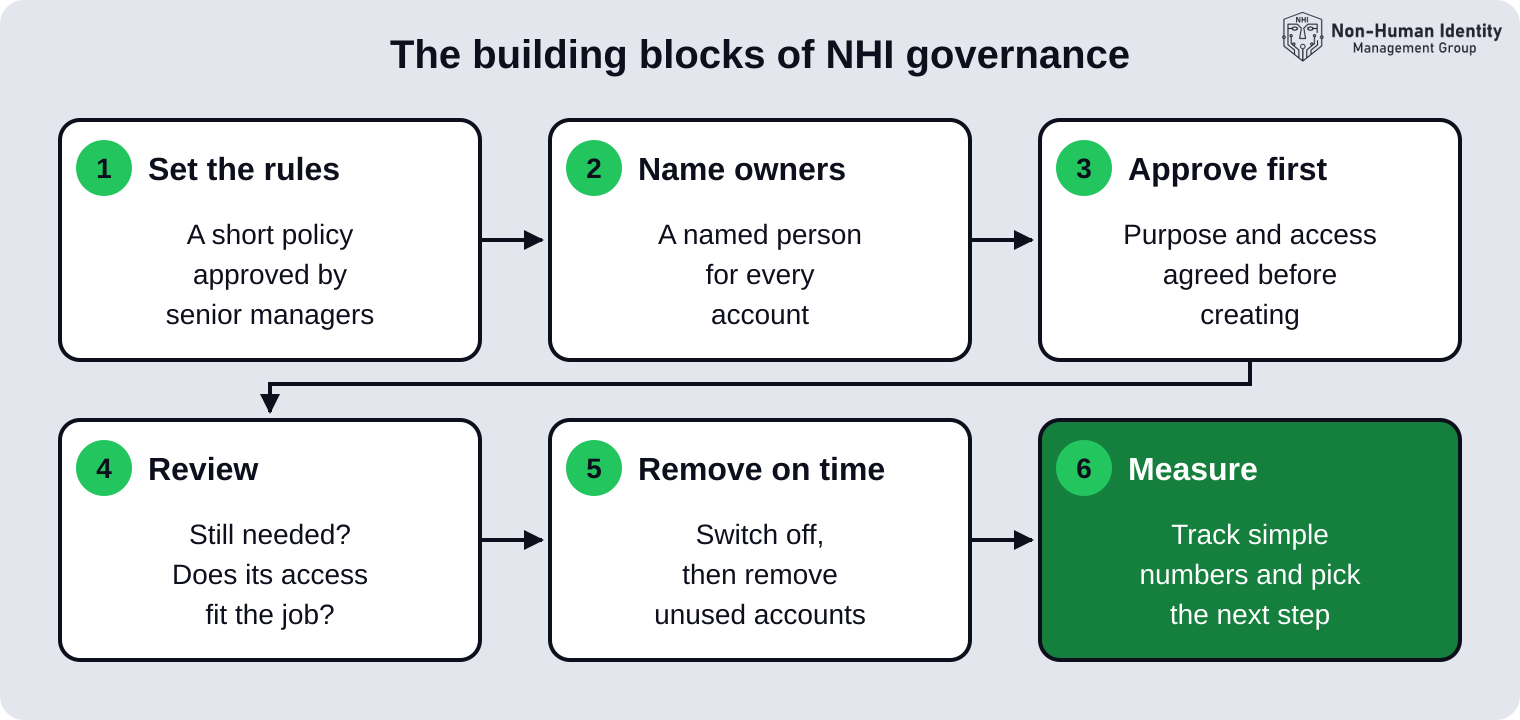
Most NHI governance follows six steps.
- Set the rules. Write a short policy, approved by senior managers. It says every account is recorded, has an owner, gets only the access it needs, and is reviewed and removed on time.
- Name owners. Give every account a named person who answers for it.
- Approve before creating. New accounts are requested, and their purpose and access are agreed and recorded.
- Review on a schedule. Check that each account is still needed and that its access still fits the job.
- Remove on time. Switch off and remove accounts that are no longer used, or whose project has ended.
- Measure and improve. Track a few simple numbers, such as the share of accounts with an owner, and agree the next step.
Big frameworks now name these accounts directly. A widely used US government cyber security framework says organisations should manage identities and access for services and hardware, not just people.[1] It also expects a written policy and clear roles.[1]
Exceptions are normal. When an account cannot meet a rule, record why, who approved it, what extra safeguards apply and when the exception ends. This is called exception management.
To see how far along you are, you can use a maturity model, a scale of levels for judging how well developed your approach is. NHI Mgmt Group's NHI and AI governance maturity model has five levels: ad hoc, developing, defined, managed and optimised.[4] It covers both older software accounts and AI agents. A sensible aim is one level higher than today, starting with your most powerful accounts.
A worked example
Cillian Jaramillo is the new IT lead at a fictional housing charity with 300 staff. An internal audit asks how many software accounts the charity has. Nobody knows.
Cillian thinks of club membership rules. Before counting members, the club needs rules on who may join. So he starts with rules, not tools.
He writes a two-page policy, and the leadership team approves it. Every software account must be recorded with an owner and a purpose. Each must have only the access it needs. Each is reviewed every six months, and the most powerful ones every three months.
Next he lists the accounts on the main cloud platform and the finance system. He finds 180. He asks each team to claim theirs, and they claim 140.
For the 40 left, he checks the records. Many have not been used for months. With approval, he switches them off in small groups, with a note and a date. That way any that turn out to be needed can be switched back on through a recorded change. Two are, and they get owners. The rest are removed a month later.
Six months on, the charity runs its first review. Owners confirm or remove access for their accounts. Cillian reports honest progress: the main systems are now under control, but the developer tools are not yet.
Real cases show why removal rules matter. Cloudflare said an attacker used a token and three service account credentials it had not changed after a supplier incident. It had wrongly believed they were unused.[3] Read our Cloudflare Thanksgiving Breach 2023 page for the full story.
Myths and mistakes
| What people think | What is true |
|---|---|
| Governance means buying a tool. | Tools help, but governance starts with rules and owners. A tool without agreed rules just gives you a longer list. |
| Our joiner and leaver process already covers software accounts. | Those processes were mostly built for people. Software accounts are created by code and have no leaving date, so they often slip through. |
| Once reviewed, an account stays fine. | Access and needs change over time. Reviews need repeating on a schedule. |
| Exceptions mean the policy has failed. | Exceptions are normal. Each one should be approved, recorded, protected with extra safeguards and given an end date. |
| AI agents need a separate rulebook. | AI agents are software accounts too. The same rules apply, with extra care because they can choose their own steps. |
What can I do this week?
- Write down five rules, such as "every account has an owner", and ask a senior manager to approve them.
- List the software accounts on your most important system and ask teams to claim them.
- Note the accounts nobody claims and plan how to check them safely.
- Agree who can approve an exception, how it is recorded and when it ends.
- Take NHI Mgmt Group's free maturity assessment, which takes about five minutes, to see which level you are at today.
Checklist
- We have a short, approved policy that covers software accounts.
- Every account on our main systems has a named owner and purpose.
- New accounts are requested and approved before they are created.
- Access is reviewed on a schedule, more often for powerful accounts.
- Unused and unowned accounts are switched off, then removed through a recorded process.
- Exceptions are approved, recorded and have an end date.
- AI agents are covered by the same policy.
- We report a few simple measures, such as the share of accounts with an owner, to managers.
Common questions
Who should own NHI governance?
Usually the security or identity team writes and runs the policy, with senior approval. Each account then has its own owner in the team that uses it. That split keeps the rules in one place while the people closest to each account answer for it day to day.
How often should software accounts be reviewed?
There is no single figure that every framework sets. We suggest reviewing the most powerful accounts more often, for example every three months, and the rest once or twice a year. Then adjust based on what the reviews find.
What goes in an NHI policy?
It says which accounts it covers and that each one has an owner. It limits access to what is needed. It also sets how keys are handled, how often reviews happen, and how removal and exceptions work. The NHI Policy Template gives a starting point.
Is NHI governance the same as identity governance?
It is part of the same discipline, but it needs its own rules. Software accounts are created by code, have no leaving date and often have no person attached. Rules built only for staff joining and leaving tend to miss them.
How do AI agents fit in?
AI agents are software accounts, so they need owners, limited access, reviews and removal. Because they can choose their own steps and use tools, give each agent its own account and keep its access tight. See AI Agent Identity for Beginners.
Where next?
Ready for the detail? Read the practitioner guide: NHI and AI Governance Maturity Model. It goes further into the five maturity levels, what each level looks like in practice and how to plan the move to the next one.
Also useful:
- NHI Policy Template
- NHI Programme Metrics
- NHI Ownership for Beginners
- NHI Lifecycle Management for Beginners
- NHI Foundation Level Training
Related NHI Mgmt Group resources: NHI Programme Roadmap · NHI Security Checklist · Governance, Risk and Compliance for Beginners
Key terms
- NHI governance
- The rules and checks used to manage software accounts from creation to removal.
- Non-human identity (NHI)
- A digital identity, or the credential behind it, that represents a machine, application, automated process, service or AI agent, so it can authenticate, carry out tasks and connect to other systems without a person.
- Policy
- A short statement of rules, approved by senior managers, saying what must be done and why.
- NHI ownership
- Naming a person who approves, reviews and removes a software account.
- Access review
- A recorded check of whether access is still needed.
- Orphaned account
- An account that is still active with no clear owner or purpose.
- Exception management
- Approving and tracking breaks from the rules, each with a reason, an owner and an end date.
- Maturity model
- A set of levels used to judge how developed a capability is.
Sources and further reading
- The NIST Cybersecurity Framework (CSF) 2.0, NIST CSWP 29 (outcomes PR.AA-01, GV.PO-01, GV.RR-02). National Institute of Standards and Technology, 26 February 2024. https://nvlpubs.nist.gov/nistpubs/CSWP/NIST.CSWP.29.pdf, accessed 28 Nov 2026.
- OWASP Non-Human Identities Top 10, 2025 (NHI1:2025 Improper Offboarding). OWASP Foundation. https://owasp.org/www-project-non-human-identities-top-10/2025/top-10-2025/, accessed 28 Nov 2026.
- Thanksgiving 2023 security incident. The Cloudflare Blog, Cloudflare, 1 February 2024. https://blog.cloudflare.com/thanksgiving-2023-security-incident/, accessed 28 Nov 2026.
- NHI and AI Governance Maturity Model, and NHI and AI Maturity Assessment. NHI Mgmt Group, accessed 28 Nov 2026.