The NHS Data Security and Protection Toolkit is a yearly online self-check of how you protect health and care data.
This guide is for practice managers, small care providers and anyone new to health and care data in England. You do not need an IT team to be affected: if your service uses NHS patient data or systems, the toolkit is likely to apply to you.
In short
- It is a free online form where you answer questions about how you keep data safe.
- Organisations with access to NHS patient data and systems are expected to complete it every year.
- Your result is published as a status, such as Standards Met.
- Larger NHS bodies now answer a longer version; smaller providers keep a simpler one.
What you will learn
- Explain what the toolkit is and why it exists.
- Check whether your organisation is likely to need it.
- Spot the kind of evidence it asks for.
- Ask the right people for help with your first submission.
Status: correct as at 28 November 2026, based on the toolkit's own release notes and help pages. Rules change; check the official toolkit site.
This guide explains the topic in general terms and is not legal advice.
- Marking your own work (self-assessment)
- answering questions about your own security, with evidence to back the answers.
- The toolkit (DSPT)
- the NHS online form used for that self-assessment.
- Your published result (status)
- a label such as Standards Met, which others can look up.
What is the NHS Data Security and Protection Toolkit?
Think of the food hygiene rating on a café window. The café shows it meets the rules, and anyone can see the score before they walk in.
The Data Security and Protection Toolkit, often shortened to DSPT, plays a similar role for health and care data. NHS England calls it an online self-check. It says every group with access to NHS patient data and systems must use it.[1] It took over from an older tool in April 2018.[1]
You answer questions about how you look after data. They cover staff training, passwords, backups and what to do if something goes wrong. The questions are built on ten data security standards. These come from the National Data Guardian, an adviser on health and care data.[1]
Where the comparison stops working: an inspector visits the café. With the toolkit, you mostly mark your own work. Some larger ones must also have an outside audit.[3]
Why does it matter?
Health and care records are some of the most private data there is. The toolkit gives the NHS, and the people you work with, a shared way to see that you are looking after it.
If you run a small care service
What could happen: you cannot join a local shared care record, or use NHS email, until your toolkit is done.[5]
Check this: ask your local council or health contact whether they expect you to complete it.
If you manage a GP practice or clinic
What could happen: the toolkit is due and nobody owns it, so it is rushed or missed.
Check this: name one person to own the submission and a deputy to cover them.
Next: UK GDPR for Beginners
If you are new to health IT work
What could happen: you are asked for evidence and do not know where it lives.
Check this: keep a simple folder of policies, training records and backup tests through the year.
What does it look like?
Here is a made-up "Am I affected?" card. A small care firm might use a quick check like this before it starts.
Example only. All values are made up.
Organisation:  Example Home Care (FAKE-ODS-0000)    (1)
Do we use NHS patient data or systems?      YES  (2)
Do we hold NHS-funded care contracts?       YES
Do we want NHS email or shared records?     YES
Named owner for the toolkit?                NO   (3)
Last year's status:                  not published (4)
- Each group has an NHS code. This one is made up.
- Using NHS patient data or systems is the main sign the toolkit applies.[2]
- Nobody owns the task yet. That is the first gap to fix.
- In a real file, this line would show the status published the year before.
Why this is risky: the firm needs the toolkit, but nobody owns it. It can slip, and partners will not see a current status.
The safer way: name an owner and sign up on the toolkit site. Work through it bit by bit, and keep proof as you go.
How does it work?
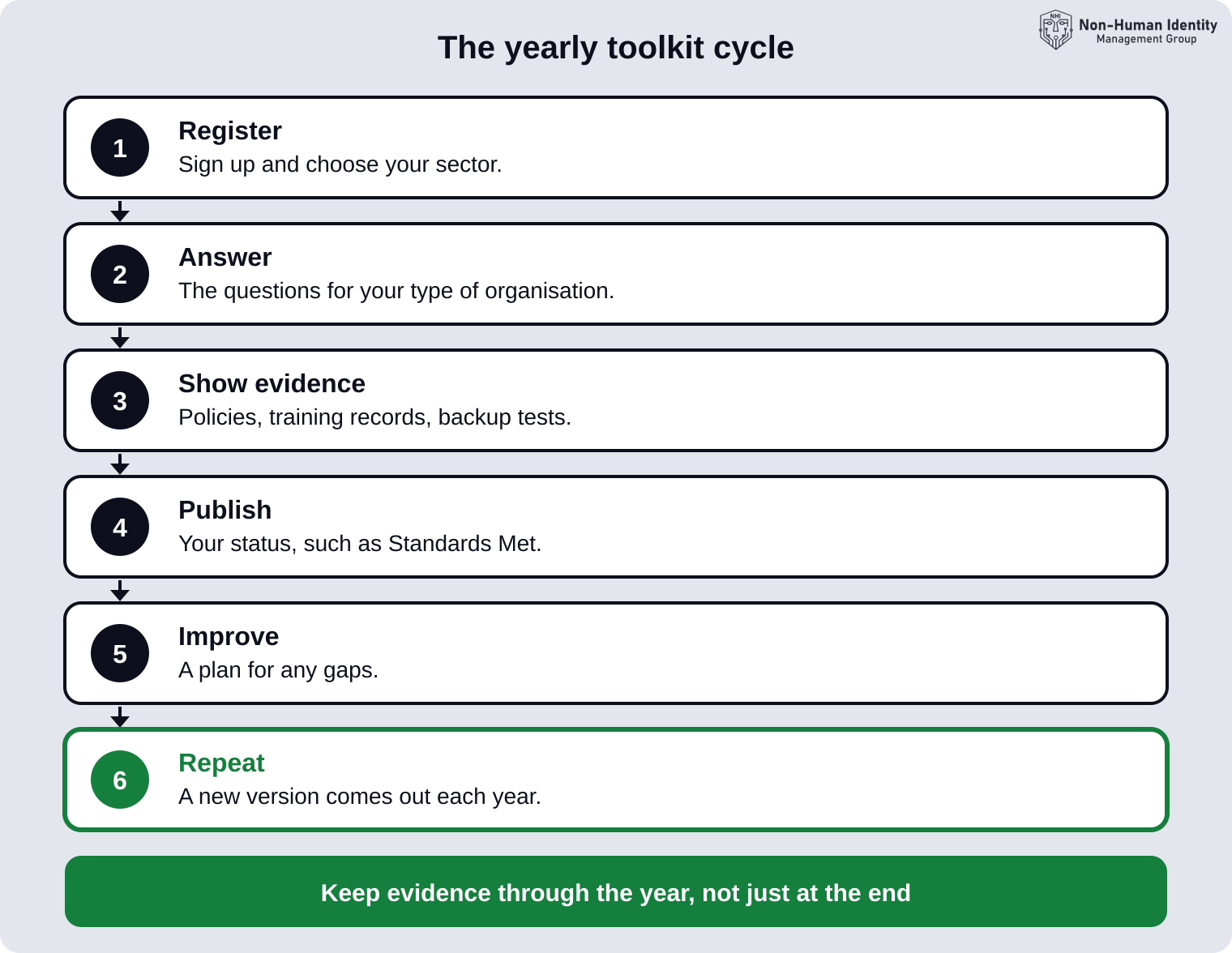
The toolkit follows a yearly cycle. The exact questions depend on what kind of organisation you are.
- Register. You sign up on the toolkit site and choose the sector that matches most of your work.[2]
- Answer. You answer the questions for your organisation type. Since 2023, social care providers can use a simpler page.[4]
- Show evidence. Some answers need proof, such as a training record or a policy.
- Publish. You publish your answers and get a status. Organisations that reach Standards Met or Standards Exceeded can download a certificate.[2]
- Improve. If you fall short, you may publish as Approaching Standards with a plan to close the gaps.[3]
- Repeat. A new version comes out each year. The 2026-27 version, version 9, was released on 1 September 2026.[4]
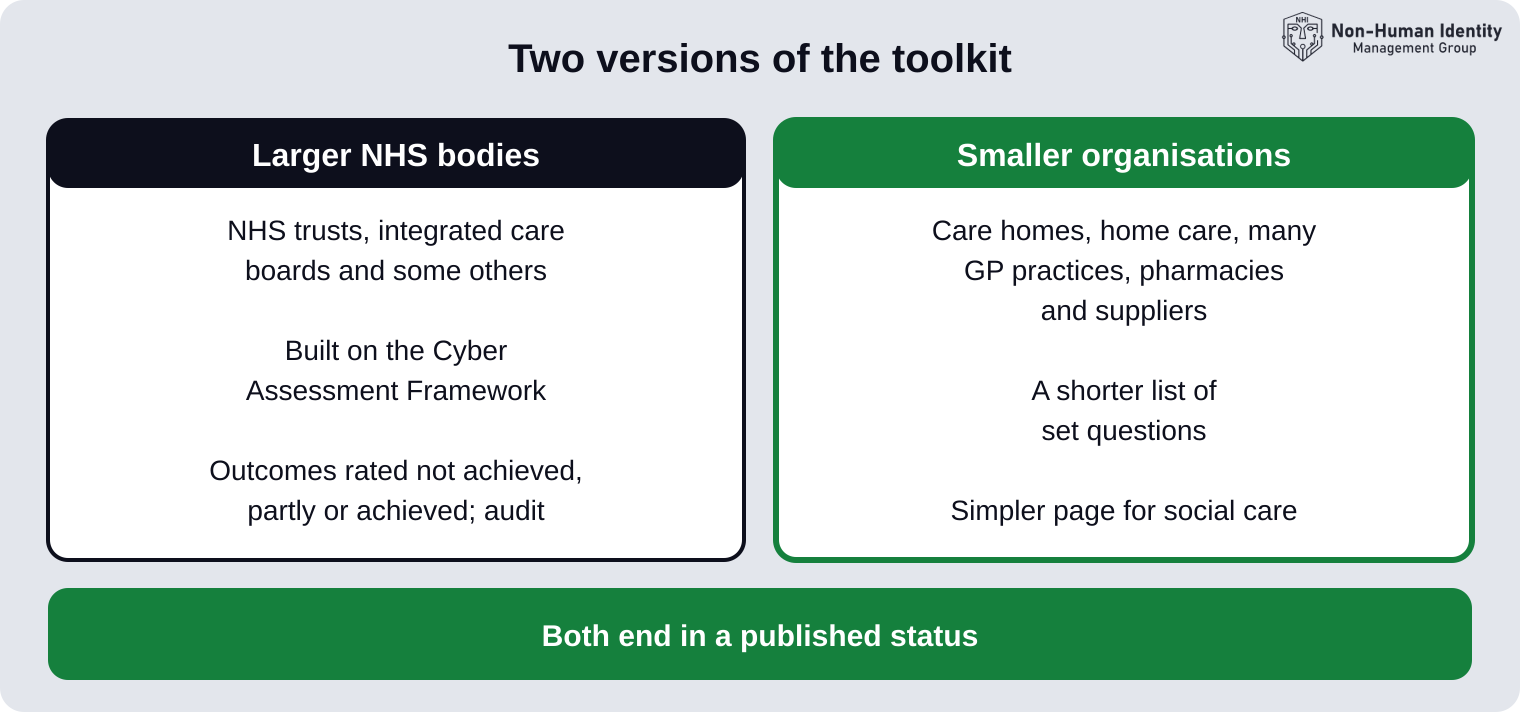
There are now two broad versions. Since September 2024, large bodies such as NHS trusts answer a longer version. It is built on the Cyber Assessment Framework, a UK list of security goals.[3] Other organisations keep a shorter list of set questions.[3]
A worked example
Yara Ilic runs a fictional home care agency with thirty carers. A local NHS team invites her to join a shared care record, so carers can see key details about the people they visit.
The invitation says she must complete the toolkit first. Yara has heard of it but never opened it.
She thinks of the hygiene rating in the café down the road. It is not about being perfect. It is about showing, honestly, that the basics are in place.
She names herself as owner and asks Kofi Marlow, the agency's part-time IT helper, to be her deputy. They register, choose the social care sector, and open the simpler page.
Most questions are about everyday habits. Do carers lock their phones? Has everyone done data security training this year? Are backups tested? Who do you call if a phone is lost?
Some answers are easy. Others show gaps. Two carers have not finished training, and nobody has tested a backup restore. Kofi tests one, and Yara books the training.
Yara publishes. The status is Approaching Standards, with a short plan to close the last gaps. Two months later she updates it, and the agency reaches Standards Met. She sets a reminder to start next year's version early.
Myths and mistakes
| What people think | What is true |
|---|---|
| It is only for hospitals. | It applies to organisations with access to NHS patient data and systems, including many small providers.[1] |
| Once done, it never needs doing again. | It is a yearly self-assessment. Each year brings a new version.[2][4] |
| It is a box-ticking exercise for IT. | Many questions are about people and habits, such as training and how lost devices are reported. |
| Falling short means failing. | Approaching Standards, with a plan, is a recognised step for organisations still closing gaps.[3] |
| Each site needs its own submission. | Independent providers complete it at provider or head office level, not site by site.[2] |
What can I do this week?
- Check if you use NHS patient data or systems.
- Look up whether you already have a published status.
- Name one owner and one deputy for the toolkit.
- Start a simple folder of proof: policies, training records and backup tests.
- Ask your local health or council contact what help they offer.
Checklist
- We know whether the toolkit applies to us.
- We have registered and chosen the right sector.
- One owner and a deputy are named.
- All staff have done data security training this year.
- We have tested restoring a backup.
- We know how to report a data security incident.
- Our status is published and up to date.
- Next year's start date is in the diary.
Common questions
Do I have to complete the toolkit?
Probably, if you have access to NHS patient data or systems. NHS England says all such organisations must use it.[1] If you are unsure, check with the NHS body or council you work with. They may also need it before sharing data with you.
Does it cost anything?
No, the toolkit is free to use. The real cost is time: someone has to answer the questions and gather evidence. Sector support sites, such as Digital Social Care, offer free guides and templates for care providers.[5]
What does Standards Met mean?
It means you have met all the required standards for your type of organisation that year. You can then download a certificate.[2] Approaching Standards means most work is done, with a plan for the rest. Standards Not Met means important gaps remain.
Is this the same as Cyber Essentials?
No. Cyber Essentials is a UK scheme that checks a small set of basic technical controls. The toolkit is wider and is specific to health and care. It covers data handling, training and incidents too. Some organisations do both.
When is it due?
Once a year, by a deadline the toolkit team sets for each version. Dates have changed over the years, so check the toolkit site for the current one. Starting early gives you time to fix gaps before you publish.
Where next?
Ready for the detail? Read the practitioner guide: NHS Data Security and Protection Toolkit. It goes further into the structure, evidence and audit, the identity requirements and how the toolkit maps to other frameworks.
Also useful:
- Healthcare Cyber Security for Beginners
- The NCSC Cyber Assessment Framework for Beginners
- Cyber Essentials for Beginners
- UK GDPR for Beginners
Related NHI Mgmt Group resources: Healthcare Cyber Regulation Map · NHS DTAC Guide
Key terms
- Data Security and Protection Toolkit
- The NHS online self-assessment of how an organisation protects health and care data.
- Self-assessment
- Answering questions about your own security, with evidence to back the answers.
- Cyber Essentials
- A UK scheme that checks a small set of basic security controls.
- UK GDPR
- The UK's main law on how personal data must be handled.
- Information governance
- The rules and habits that control how information is stored, used and shared.
- Data breach
- An incident where personal data is lost, stolen, changed or shared without permission.
Sources and further reading
- Data Security and Protection Toolkit. NHS England Digital, last edited 21 November 2023. https://digital.nhs.uk/data-and-information/looking-after-information/data-security-and-information-governance/data-security-and-protection-toolkit, accessed 28 Nov 2026.
- Frequently asked questions. Data Security and Protection Toolkit, NHS England. https://www.dsptoolkit.nhs.uk/Help/frequently-asked-questions, accessed 28 Nov 2026.
- DSPT changes: the Cyber Assessment Framework aligned DSPT. Data Security and Protection Toolkit, NHS England. https://www.dsptoolkit.nhs.uk/News/DSPT-Changes, accessed 28 Nov 2026.
- Release notes. Data Security and Protection Toolkit, NHS England, last updated 13 October 2026. https://www.dsptoolkit.nhs.uk/News/release-notes, accessed 28 Nov 2026.
- Data Security and Protection Toolkit. Digital Social Care. https://www.digitalsocialcare.co.uk/data-security-protecting-my-information/data-security-and-protection-toolkit/, accessed 28 Nov 2026.