The NIST SSDF is a free US guide listing the habits that help teams build safer software.
This guide is for developers, students, managers and small software firms who keep seeing "SSDF" in customer questionnaires. You do not need to write code to be affected: if you buy or sell software, the SSDF gives both sides shared words for asking how it was built.
In short
- The SSDF groups safe building habits into four areas: prepare the team, protect the code, build it well and fix problems found later.
- It says what a team should achieve, not which tools to buy, and its authors say it is not meant as a checklist.
- Buyers use it to ask suppliers how their software is made, so answers need real evidence.
- Version 1.1 is the final text; a version 1.2 draft was published in December 2025.
What you will learn
- Explain what the SSDF is in one sentence.
- Name its four groups of practices in plain words.
- Spot a weak answer to a customer's SSDF question.
- Check which SSDF habits your team already has.
- Building plan (SDLC)
- the steps a team follows to plan, write, test, release and look after software.
- Safe building habit (practice)
- one thing a team does to make software safer, such as checking code for mistakes.
- Weak spot (vulnerability)
- a flaw in software that someone could use to cause harm.
What is the NIST SSDF?
Think of building rules for houses. They say a home needs safe wiring, a way out in a fire and stairs that will not collapse. They do not tell the builder which brand of brick to buy.
The Secure Software Development Framework, or SSDF, works the same way for software. It comes from NIST, a US government body that writes technical guidance. It is a set of high-level habits that a team can add to whatever way it already builds software.[1]
Each habit is called a practice. Under each practice there are smaller tasks, some example ways to do them and pointers to other guidance. The examples are only ideas; the document says none of them are required.[2]
The aim is fewer weak spots in released software, less harm from the ones that slip through and fixes for their root causes. It also gives makers and buyers shared words, so they can talk about security when software is bought.[1]
Where the comparison stops working: building rules are often law, and an inspector signs the house off. The SSDF is guidance. Nobody signs it off for you, and each team decides which practices fit its own risks.[2]
Why does it matter?
Many software flaws start long before release, in rushed planning, unchecked code or loose access to the build. The SSDF gives teams a short list of places to look, and gives buyers a fair way to ask about them.
If you are learning to code
What could happen: you learn to write features but not to check your own code or your add-ons for weak spots.
Check this: pick one practice, such as reviewing code, and try it on your next project.
If you run a small software firm
What could happen: a large customer sends a security questionnaire full of SSDF terms, and you cannot answer it.
Check this: write down, in plain words, what you already do for each of the four groups.
If you buy software for your organisation
What could happen: you take a supplier's "yes, we follow secure development" at face value.
Check this: ask for one example of evidence for each group, such as how they handle a reported flaw.
What does it look like?
Here is a made-up scenario card. It shows a customer question and two possible answers from a supplier.
Example only. All values are made up.
Customer: Example Council (example.invalid)
Question 7: How do you protect your code from tampering?   (1)

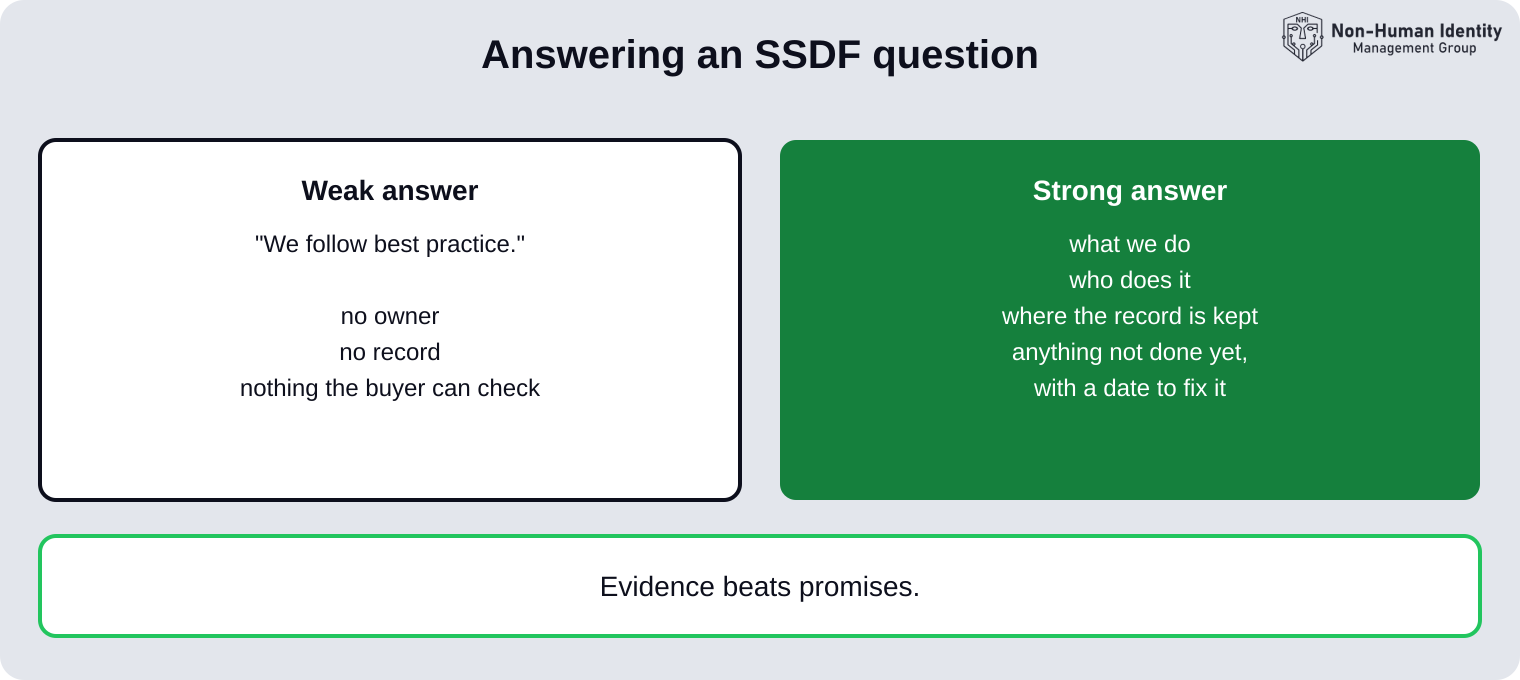
Answer A: "We follow best practice."                          (2)

Answer B: "Code lives in one company account. Only 4 staff    (3)
can approve changes. Two-step login is on for all of them.
Each release is signed. Last access review: EXAMPLE-0000."
- This question matches the "protect the software" group.
- A vague answer. It gives the buyer nothing to check.
- A specific answer. In a real message, this line would point to records the customer could ask to see.
Why this is risky: a vague answer can hide the fact that nobody owns the task. Buyers are getting better at spotting it, and it can cost the deal.
The safer way: answer each question with what you do, who does it and where the record is kept. If you do not do something yet, say so and say when you plan to.
How does it work?
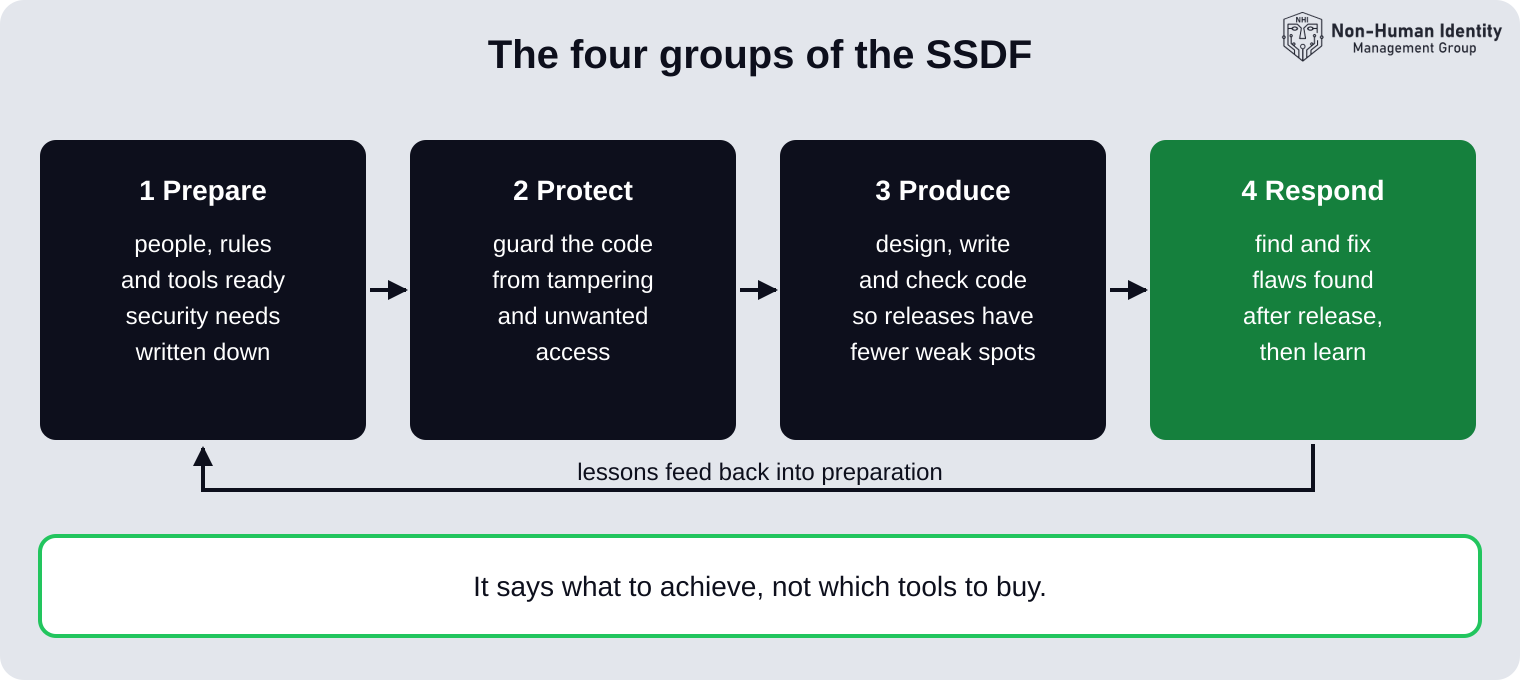
The SSDF sorts its practices into four groups.[3]
- Prepare the organisation. Get people, rules and tools ready. For example, write down the security needs for the software before building starts.[2]
- Protect the software. Guard all the code and its parts against tampering and against people who should not have access.[3]
- Produce well-secured software. Design, write and check the software so that releases have as few weak spots as possible. Reviewing code for mistakes is one practice here.[2]
- Respond to vulnerabilities. Keep looking for weak spots in released software, fix them and stop similar ones coming back.[3]
In version 1.1 these four groups hold 19 practices in total.[2] The document asks each organisation to take a risk-based approach. A team picks the practices that fit what it builds and how much harm a flaw could do.[2]
The SSDF also matters in US government buying. In January 2026 the White House budget office withdrew an earlier rule that made federal suppliers sign a standard secure development form. Agencies may still choose to use that form, and the new memo still points to the SSDF for more information.[4]
A worked example
Idris Bergmann runs Marigold Studio, a fictional firm of eight people that builds booking apps. A large customer sends a questionnaire before renewing its contract. Several questions use SSDF words.
Idris asks his lead developer, Ivo Yeboah, to help. Ivo has heard of the SSDF but never read it. He remembers the house-building rules: they say what a safe house needs, not which bricks to use.
So they do not start by buying anything. They take the four groups and write what Marigold already does under each one.
Under "prepare", they find a gap. Nobody writes down security needs before a new app starts. Under "protect", things look better. All code sits in one company account, and two-step login is on.
Under "produce", Ivo checks every change himself, but nobody checks his. Under "respond", there is no public way for anyone to report a flaw.
They answer the questionnaire honestly. Where they have a gap, they say so and give a date to close it.
Over the next month they add a short security section to each new project plan. A second developer now reviews Ivo's changes. They also publish a page explaining how to report a security problem.
The customer renews. Its reviewer notes that the clear answers and dates made the decision easier than a page of "best practice" would have.
Myths and mistakes
| What people think | What is true |
|---|---|
| The SSDF is a checklist you tick off. | Its authors say it is not meant as a checklist. It describes outcomes, and you choose practices based on risk.[2] |
| You need special tools to follow it. | It does not say how to do each practice. The tool examples are only ideas.[2] |
| It only matters to US government suppliers. | It is written for any software maker, and buyers in many sectors use its words in their questions.[1] |
| You can be "SSDF certified". | The SSDF is guidance from NIST, not a certificate scheme. Be wary of anyone selling a certificate in its name. |
| Security testing at the end covers it. | Testing is one part. The SSDF also covers planning, protecting the code and handling flaws after release.[3] |
What can I do this week?
- Write the four group names on one page and list what your team already does under each.
- Pick the biggest gap and name one person to own it.
- Check who can change your code and turn on two-step login for all of them.
- Agree how someone outside the team can report a security flaw to you.
Checklist
- Security needs are written down before a new project starts.
- Only named people can change the code, and their access is reviewed.
- Every change is checked by someone other than the person who wrote it.
- Add-ons and outside code are tracked and kept up to date.
- Releases can be traced back to the exact code that built them.
- There is a public way to report a security flaw.
- Fixed flaws are reviewed so the same mistake is less likely next time.
- Answers to customer questions point to real records.
Common questions
Is the SSDF a law?
No. It is guidance from NIST, a US government body. Laws and contracts can refer to it, and some customers ask suppliers to show how they follow it. Whether you must follow it depends on your contracts, so check those rather than the SSDF itself.[1]
Which version of the SSDF is current?
Version 1.1, published in February 2022, is the final text. NIST published a draft of version 1.2 in December 2025, and its comment period closed in January 2026. Drafts can change, so check the NIST page for the latest status.[1][5]
Is the SSDF only for big companies?
No. It is written so any team can add it to the way it already works. A small team can start with a few practices that match its biggest risks, then add more over time. The document asks each organisation to choose based on its own risk.[2]
How is the SSDF different from a secure SDLC?
A secure SDLC is your own way of building software safely, step by step. The SSDF is a published list of practices you can add to that process. Think of the SDLC as your kitchen routine and the SSDF as a shared list of good habits.
Is there an SSDF for AI?
Yes. NIST has added a companion profile for building generative AI models. It adds AI-specific tasks on top of the main SSDF rather than replacing it. See our guide to the AI profile for the detail.[3]
Where next?
Ready for the detail? Read the practitioner guide: NIST Secure Software Development Framework (SSDF, SP 800-218) Guide. It goes further into each practice and task, the version 1.2 draft and how US federal attestation has changed.
Also useful:
- Secure Software Development Lifecycle (SSDLC) Guide
- Secure Software Development Lifecycle for Beginners
- NIST SP 800-218A SSDF Community Profile for Generative AI Guide
- NIST SSDF vs OWASP ASVS
- Software Supply Chain Security for Beginners
Related NHI Mgmt Group resources: Software Supply Chain Security Guide · Software Liability and Secure by Design Policy Guide · Threat Modelling for Beginners
Key terms
- Secure Software Development Framework
- A set of practices for building software with security included from planning through to release and upkeep.
- Secure SDLC
- A way of building software that adds security to every stage instead of checking only at the end.
- Practice
- One safe building habit in the SSDF, broken down into smaller tasks.
- Code review
- A person checking a proposed change to the code before it is accepted.
- Attestation
- A signed statement that something is true, such as how software was built.
- Software supply chain
- Everything that shapes the software you run, from its code and add-ons to the tools that build it.
- Secure by design
- Building security in from the start rather than adding it after release.
Sources and further reading
- SP 800-218, Secure Software Development Framework (SSDF) Version 1.1: Recommendations for Mitigating the Risk of Software Vulnerabilities. NIST Computer Security Resource Center, February 2022. https://csrc.nist.gov/pubs/sp/800/218/final, accessed 28 Nov 2026.
- NIST SP 800-218, Secure Software Development Framework Version 1.1 (full text, sections 1 and 2; practices PO.1, PS.1, PW.7, RV.1). National Institute of Standards and Technology, February 2022. https://nvlpubs.nist.gov/nistpubs/SpecialPublications/NIST.SP.800-218.pdf, accessed 28 Nov 2026.
- Secure Software Development Framework project page. NIST Computer Security Resource Center, updated 6 October 2026. https://csrc.nist.gov/projects/ssdf, accessed 28 Nov 2026.
- M-26-05, Adopting a Risk-based Approach to Software and Hardware Security. Office of Management and Budget, The White House, 23 January 2026. https://www.whitehouse.gov/wp-content/uploads/2026/01/M-26-05-Adopting-a-Risk-based-Approach-to-Software-and-Hardware-Security.pdf, accessed 28 Nov 2026.
- SP 800-218 Rev. 1 (Initial Public Draft), Secure Software Development Framework (SSDF) Version 1.2. NIST Computer Security Resource Center, 17 December 2025. https://csrc.nist.gov/pubs/sp/800/218/r1/ipd, accessed 28 Nov 2026.