Operational resilience means a firm can keep its most important services going, or bring them back, when things break.
This guide is for new starters in banks, insurers and payment firms, and for managers who keep hearing the term. You do not need to work in IT to be part of it: the people, buildings and suppliers behind a service all count.
In short
- Operational resilience asks one question: can customers still get the services that matter most when something goes wrong?
- UK financial regulators ask firms to name their important business services and set a limit on how much disruption each one can take.
- Firms then map what each service depends on and test it against bad but realistic events, such as a cyber attack or a supplier failure.
- It is not only an IT job. People, processes, buildings, data and suppliers are all part of the picture.
What you will learn
- Explain operational resilience in one sentence.
- Spot the difference between an important business service and a computer system.
- Explain what an impact tolerance is, with an example.
- Ask your team the right first questions about the service you work on.
Status: correct as at 28 November 2026, based on the Financial Conduct Authority's operational resilience pages and the Prudential Regulation Authority's supervisory statement. Rules change; check the official text.
This guide explains the topic in general terms and is not legal advice.
- Vital service (important business service)
- a service for customers or markets that would cause serious harm if it stopped.
- Disruption limit (impact tolerance)
- the most disruption a service can take before the harm becomes unacceptable, often set as a time.
- Bad but realistic event (severe but plausible scenario)
- a test case that is serious enough to stretch the firm but could really happen.
What is operational resilience?
Think of a bus company in a snowstorm. It cannot run every route. But it promises that the key routes, such as the one to the hospital, will still run at least once an hour.
Operational resilience works the same way for a firm. The firm picks the services customers rely on most, such as making a payment. It decides how long each one could be down before people are badly harmed. Then it plans and tests so it can stay inside that limit, whatever the cause.
The UK financial regulator puts it in a similar way. It is about how firms adapt, respond, recover and learn when disruption hits.[1] The Bank of England sets out the same idea for the banks and insurers it oversees.[5][1]
Where the comparison stops working: a bus company can see the snow coming. Many disruptions arrive with little warning, such as a failed software update or a cyber attack. So firms assume something will break and plan for that, instead of trying to predict every cause.
Why does it matter?
When a vital service stops, the harm lands on real people. They may not be able to pay rent, buy food or reach their savings.
In April 2018, TSB moved its customer data to a new IT platform. The platform had immediate problems that disrupted branch, phone, online and mobile banking. In 2022 the two UK financial regulators fined TSB a total of £48.65m for its failings.[4]
If you are new to a bank or insurer
What could happen: you change a process without knowing it supports a vital service, and slow down its recovery.
Check this: ask which important business services your team supports.
Next: Business Continuity and Disaster Recovery for Beginners
If you manage a team or a supplier
What could happen: a supplier you rely on goes down, and nobody knows how long the service can cope without it.
Check this: find out which suppliers sit behind each vital service, and what happens if one fails.
If you work in IT or security
What could happen: you restore every system in the order it broke, while customers wait for the service that matters most.
Check this: ask which systems support which vital service, so recovery follows the service, not the system.
What does it look like?
Many firms keep a short card for each vital service. Here is a made-up one for a small bank.
Example only. All values are made up.
SERVICE CARD: EXAMPLE Bank, service 03
Service:         Customers send a payment from the app   (1)
Who is harmed:   personal customers, small businesses
Disruption limit: no more than 8 hours                     (2)
Depends on:      payments team, app, core banking system,
                 data centre EXAMPLE-DC1, cloud host FAKE-01 (3)
Last test:       "cloud host down for a day"  result: missed limit  (4)
Fix planned:     second host, ready by Q3 EXAMPLE
- The service is described as something a customer does, not as a computer system.
- The limit is set as a time. The firm should also write down why harm becomes unacceptable at that point.
- The list covers people, processes, technology, buildings and suppliers.
- A failed test is useful. It shows a weakness that the firm can now fix.
Why this is risky: without a card like this, nobody knows how long payments can be down. Nobody knows which supplier failure would hurt most.
The safer way: each vital service has a named owner and a clear limit. It also has a current list of what it needs and a recent test.
How does it work?
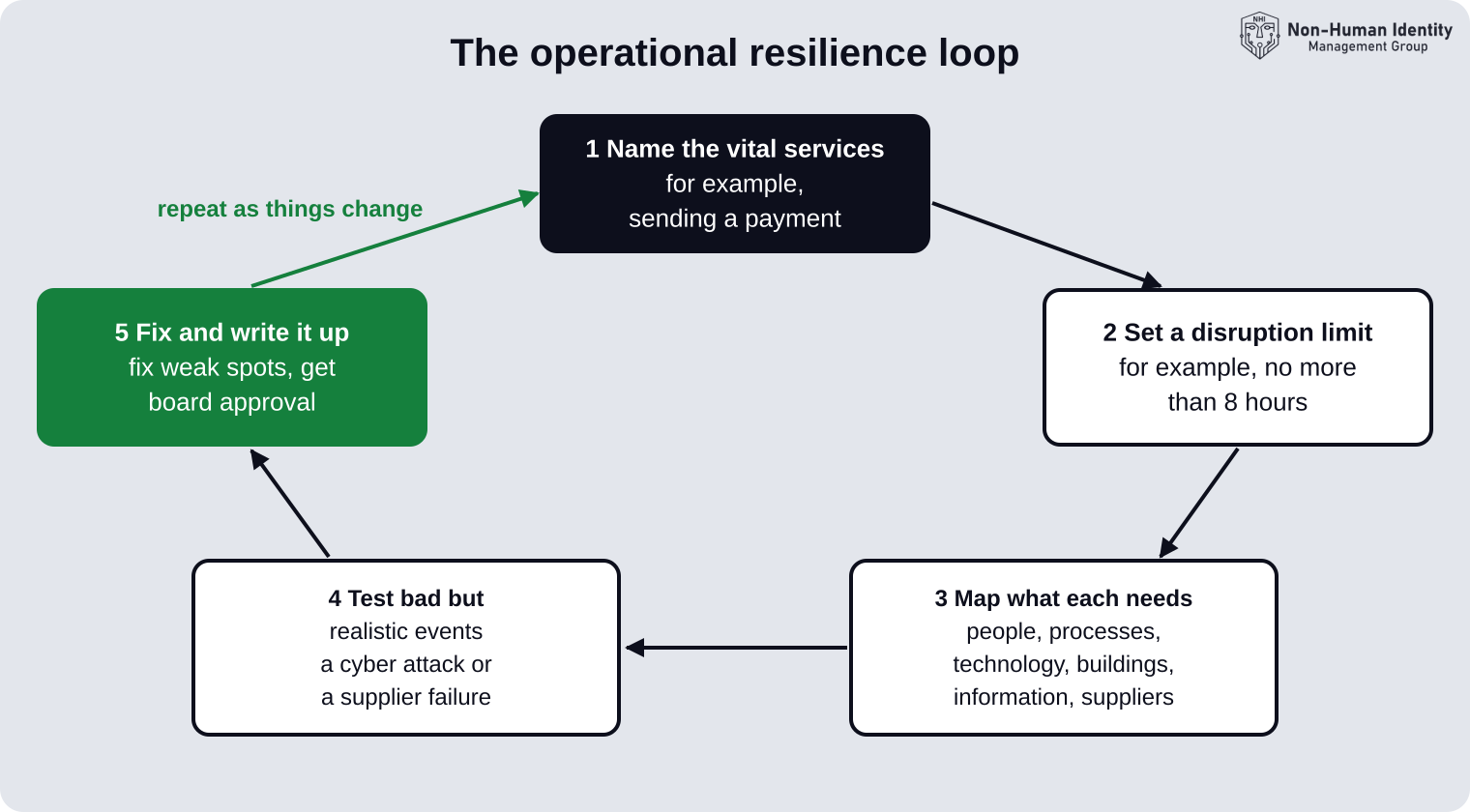
The UK approach for financial firms follows a loop of steps.[2][3]
- Name the vital services. List the services that would cause intolerable harm to customers or markets if they were disrupted.
- Set a disruption limit for each. Decide the maximum disruption each service can take. Most firms set this mainly as a length of time.[3]
- Map what each service needs. Write down the people, processes, technology, buildings and information behind it, including suppliers.[3]
- Test against bad but realistic events. Ask "could we stay inside the limit if this happened?" for a range of serious events.
- Fix, write it up and repeat. Fix the weak spots, record the work in a self-assessment that the board approves and reviews, and test again.[3]
The rules came into force on 31 March 2022. Firms then had until 31 March 2025 to finish mapping and testing, so they could stay within their limits.[1][2] In the UK they apply to banks, building societies, insurers, payment and e-money firms and several other types of firm.[1] In the EU, a separate law called DORA covers similar ground for financial firms.
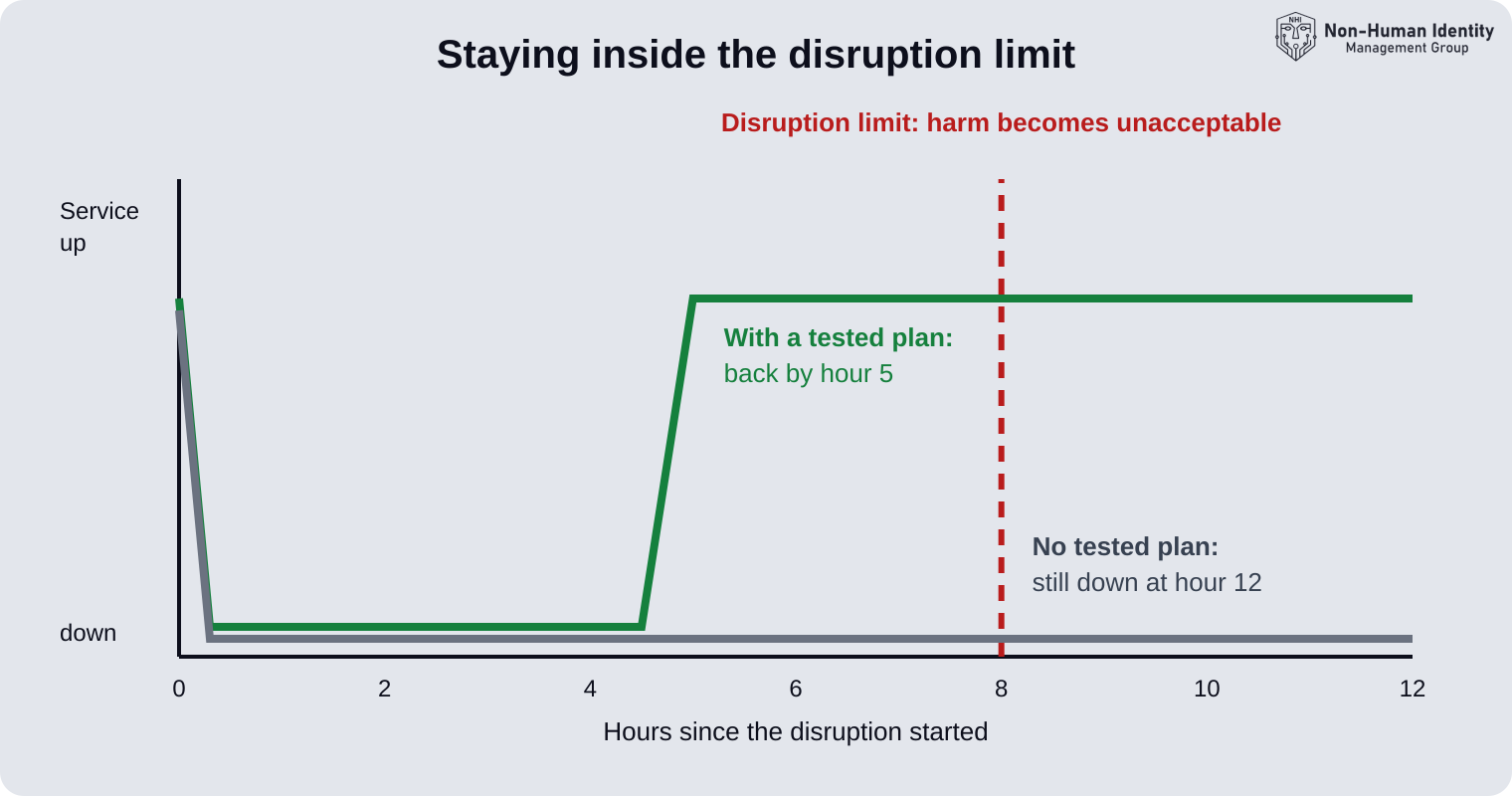
The disruption limit is the key idea. It is not a target for normal days. It marks the point where harm becomes unacceptable, so the firm plans to recover before it gets there.
A worked example
Wanda Thorne has just joined the operations team at a fictional building society. Her manager, Jana Corrigan, owns the "pay a bill from the app" service.
In Wanda's first month, Jana runs a desk test. Everyone sits round a table and talks through a made-up event: the cloud company that hosts the app has a full-day outage.
The service card says the limit is eight hours. Jana asks the team to walk through each hour.
The IT lead says the app could move to a backup host. But nobody has tried it, and he thinks it would take at least a day. The contact centre manager adds that her team cannot take payments by phone, because they use the same app.
Wanda notices something else. The map lists the cloud company, but not the text message firm that sends payment codes. If that firm failed, customers could not confirm payments either.
So the test result is clear: in this event, the society would likely miss its limit. Jana writes up three actions. First, practise the move to the backup host. Next, agree a simple phone payment process for urgent cases. Last, add the text message firm to the map and to the next test.
Three months later they test again. The backup move takes four hours. The result is now inside the limit, and the board sees both tests in the self-assessment.
Wanda had thought resilience meant "IT keeps the servers up". She now sees it as "customers can still pay their bills".
Myths and mistakes
| What people think | What is true |
|---|---|
| Operational resilience is the IT team's job. | It covers people, processes, buildings, data and suppliers too. The board approves and reviews the self-assessment. |
| An important business service is a system, such as the core banking platform. | It is something a customer or market uses, such as making a payment. Systems are what the service depends on. |
| The disruption limit is a target for normal days. | It marks where harm becomes unacceptable. Plans aim to recover well before it. |
| It is the same as business continuity. | They overlap. Continuity plans how to recover. Operational resilience starts from the harm to customers and checks you can stay inside a set limit. |
| A failed test is bad news to hide. | A failed test shows a weakness while there is still time to fix it. Regulators expect firms to record and act on results. |
What can I do this week?
- Ask which important business services your team supports.
- Find out the disruption limit for one of them, and why it was set there.
- Check that your team's systems and suppliers appear on that service's map.
- Ask when the service was last tested, and what the test found.
- Read the practitioner guide below before you take part in a test.
Checklist
- The firm has a list of its important business services.
- Each service has a named owner.
- Each service has a disruption limit, with a short reason for it.
- Each service has a map of its people, processes, technology, buildings, information and suppliers.
- Services are tested against a range of bad but realistic events.
- Weak spots found in tests have owners and deadlines.
- The self-assessment is approved and reviewed by the board.
- Maps and tests are updated when services or suppliers change.
Common questions
What is the difference between operational resilience and cyber resilience?
Cyber resilience is about surviving and recovering from cyber attacks and IT failures. Operational resilience is wider. It covers any cause of disruption, such as a fire, a pandemic or a supplier going bust, and it starts from the harm to customers. Cyber resilience is one important part of it.
What is an impact tolerance, in simple words?
It is the most disruption a vital service can take before the harm to customers or markets becomes unacceptable. UK regulators have seen most firms set it mainly as a time, such as a number of hours. Some firms add other measures, such as how many customers are affected.[3]
Does operational resilience apply outside banking?
Yes, as an idea. The UK rules in this guide apply to banks, insurers, payment firms and other financial firms. But any organisation can use the same steps. Hospitals, energy firms and councils also need their vital services to keep running through disruption.
Who decides what counts as an important business service?
The firm does, and its board approves the result. The firm looks at who would be harmed if the service stopped, how badly and how quickly. The UK regulators then review how firms made these choices and challenge them where needed.
What does "severe but plausible" mean?
It means a test event that is serious enough to stretch the firm, but realistic enough to really happen. Examples include a long outage at a key supplier, a cyber attack or losing a building. Regulators expect firms to test a range of these, with different causes and lengths.[3]
Where next?
Ready for the detail? Read the practitioner guide: UK Financial Operational Resilience Guide. It goes further into the exact regulatory expectations, how to set and justify impact tolerances, and the newer rules on incident and third-party reporting.
Also useful:
- Operational Resilience vs Business Continuity
- DORA for Beginners
- Business Continuity and Disaster Recovery for Beginners
- Operational Resilience Metrics
Related NHI Mgmt Group resources: Operational Resilience Executive Briefing · Cyber Resilience for Beginners · Third Party Risk Management for Beginners
Key terms
- Operational resilience
- The ability to keep vital services running, or bring them back quickly, when disruption happens.
- Important business service
- A service for customers or markets that would cause intolerable harm if it were disrupted.
- Impact tolerance
- The most disruption a vital service can take before the harm becomes unacceptable.
- Mapping
- Writing down the people, processes, technology, buildings, information and suppliers a service depends on.
- Severe but plausible scenario
- A serious but realistic event used to test whether a service can stay inside its limit.
- Business continuity
- Plans to keep essential work going during disruption and recover afterwards.
- Third-party risk management
- Checking and managing the risks that come from suppliers and partners.
Sources and further reading
- Operational resilience. Financial Conduct Authority, page last updated 15 September 2026. https://www.fca.org.uk/firms/operational-resilience, accessed 28 Nov 2026.
- PS21/3: Building operational resilience. Financial Conduct Authority, March 2021. https://www.fca.org.uk/publications/policy-statements/ps21-3-building-operational-resilience, accessed 28 Nov 2026.
- Operational resilience: insights and observations for firms. Financial Conduct Authority, first published 28 May 2024. https://www.fca.org.uk/firms/operational-resilience/insights-observations, accessed 28 Nov 2026.
- TSB fined £48.65m for operational resilience failings. Bank of England (Prudential Regulation Authority, jointly with the Financial Conduct Authority), 20 December 2022. https://www.bankofengland.co.uk/news/2022/december/tsb-fined-for-operational-resilience-failings, accessed 28 Nov 2026.
- SS1/21 Operational resilience: Impact tolerances for important business services. Bank of England, Prudential Regulation Authority, updated March 2022. https://www.bankofengland.co.uk/prudential-regulation/publication/2021/march/operational-resilience-impact-tolerances-for-important-business-services-ss, accessed 28 Nov 2026.