DORA, the Digital Operational Resilience Act, is a European Union law that requires banks, insurers, investment firms and many other financial organisations to withstand, respond to and recover from technology problems and cyber attacks.
Its official name is Regulation (EU) 2022/2554 on digital operational resilience for the financial sector.[1] This guide explains it in plain English for newcomers, students, career changers and managers who are not compliance specialists. It covers who DORA applies to, its five main areas, how incident reporting works, a worked example and simple first steps. For article-by-article detail, follow the links to our practitioner guides.
By the end of this guide you will be able to:
- Explain what DORA is and who it applies to.
- Describe its five main areas of requirements.
- Understand how major incident reporting and supplier oversight work at a high level.
- Identify practical first steps for a team new to DORA.
Status: correct as at 27 November 2026, based on the text of Regulation (EU) 2022/2554 and its delegated regulations on EUR-Lex. Laws change; check the official text.
This guide explains the topic in general terms and is not legal advice.
Key takeaways
- It has applied since 17 January 2025. DORA is an EU regulation, so it applies directly in every EU member state.[2]
- It covers most of the financial sector. The regulation lists 21 types of financial entity, from banks and payment firms to insurers and crypto-asset service providers.[2]
- Five areas sit at its heart. ICT risk management, incident reporting, resilience testing, third-party (supplier) risk and information sharing.
- Senior leaders are accountable. The management body bears the ultimate responsibility for managing the firm's ICT risk.[2]
- Key technology suppliers are overseen too. EU supervisors can designate critical ICT providers and oversee them directly.[2]
What it is, in plain English
Banks and insurers now run almost entirely on technology: apps, data centres, cloud services and payment systems. In DORA's language this is ICT, short for information and communication technology. ICT risk is the chance that this technology fails, is misused or is attacked in a way that harms the business or its customers. Operational resilience is the ability to keep important services running, or bring them back quickly, when that happens.
Before DORA, rules on technology risk in EU finance were spread across many laws and national guidelines. DORA sets one common set of requirements. Article 1 lists them: ICT risk management, reporting major ICT-related incidents, digital operational resilience testing, sharing cyber threat information, and managing ICT third-party risk, plus rules for contracts with ICT providers and an oversight framework for critical providers.[2]
DORA is a regulation, not a directive. A regulation applies as written in every member state, while a directive must first be turned into national law. The detail sits in extra rules called regulatory technical standards (RTS), adopted by the European Commission as delegated regulations, for example on ICT risk management tools and on incident report deadlines.[3][4]
An everyday comparison is a fire safety code for a large building. It does not just say "do not have fires". It says who is responsible, which exits and alarms you need, how often to run drills, how to report a fire, and what you must check about the contractors who service your sprinklers. Where the analogy breaks down: fire codes mostly cover one building, while DORA also reaches into a firm's technology suppliers, including cloud providers that serve many firms at once.
Why it matters to you
- If you run a small business: if you sell technology services to a bank, insurer or other financial firm, expect DORA-driven contract terms, audit rights and questions about your resilience. If you are a small financial firm yourself, DORA applies proportionately to your size and risk.[2]
- If you are new to a security job: in EU finance, DORA shapes incident handling, testing plans, supplier reviews and board reporting, so you will meet it early.
- If you are a manager: DORA places ultimate responsibility for ICT risk on the management body, so leaders need to understand and approve the firm's approach.[2]
Penalties for financial entities are set by each member state, which must lay down rules for appropriate administrative penalties.[2] For critical ICT third-party providers, EU overseers can impose periodic penalty payments of up to 1% of the provider's average daily worldwide turnover in the previous business year.[2]
How it works, step by step
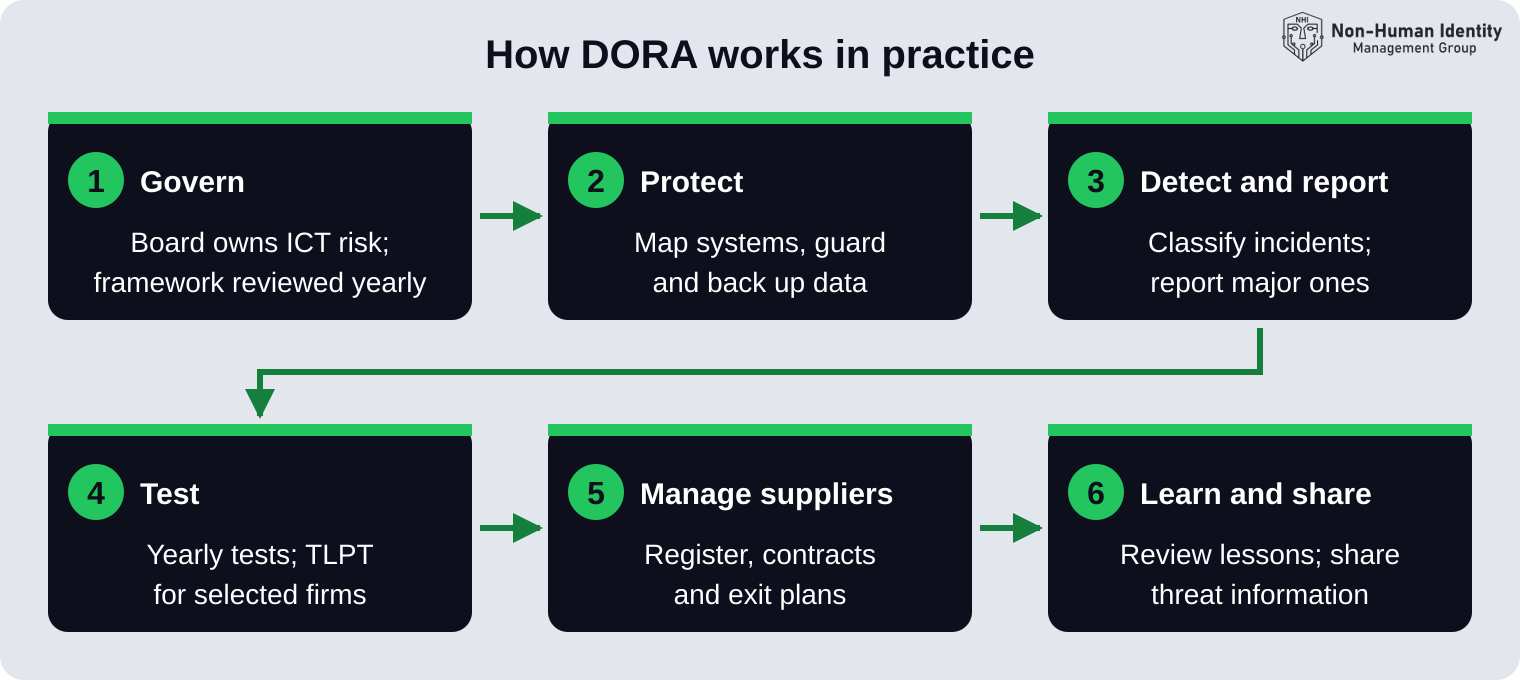
DORA is not a single process, but a firm's work under it usually follows this cycle.
- Govern. The management body sets and approves the approach. Each firm needs a sound, comprehensive and well-documented ICT risk management framework, reviewed at least once a year and after major incidents.[2]
- Identify and protect. Map the systems, data and suppliers that support important business functions, protect them and keep backups. DORA also requires business continuity and response and recovery plans, tested at least yearly.[2]
- Detect, classify and report incidents. Firms need a process to detect, manage and notify ICT-related incidents. They classify each one using criteria such as the number of clients affected, duration, geographical spread, data losses, criticality of services and economic impact, and report major ICT-related incidents to their competent authority (their regulator).[2]
- Test. Firms other than microenterprises run a testing programme, with tests at least yearly on systems that support critical or important functions. Firms identified by their regulator also carry out threat-led penetration testing (TLPT) at least every three years.[2]
- Manage technology suppliers. Keep a register of information on all contracts for ICT services, put key terms into contracts and have tested exit strategies for services that support critical or important functions.[2]
- Learn and share. Review incidents and tests, feed lessons back into the framework, and, if you choose, join arrangements to share cyber threat information with other firms. Sharing is voluntary, but firms must tell their regulator they take part.[2]
The five areas at a glance
| Area | Where in DORA | In plain English | Practitioner guide |
|---|---|---|---|
| ICT risk management | Chapter II, Articles 5 to 16 | Run a documented framework for technology risk, owned by leadership. | DORA ICT Risk Management Framework Guide |
| Incident management and reporting | Chapter III, from Article 17 | Detect, classify and report major ICT incidents on time. | DORA Major ICT Incident Reporting Guide |
| Resilience testing | Chapter IV, Articles 24 to 27 | Test systems regularly; some firms run threat-led tests. | DORA Resilience Testing Guide |
| ICT third-party risk | Chapter V, from Article 28 | Know your technology suppliers, contract well and plan your exit. | DORA Article 28 |
| Information sharing | Chapter VI, Article 45 | Optionally share threat intelligence with other firms. | DORA Guide |
Source for chapters and articles: the regulation text on EUR-Lex.[2]
Incident report deadlines
The deadlines for major incident reports are set in Commission Delegated Regulation (EU) 2025/301.[4]
| Report | When it is due |
|---|---|
| Initial notification | As early as possible, within four hours of classifying the incident as major, and no later than 24 hours after becoming aware of it. |
| Intermediate report | Within 72 hours of the initial notification, with updates when the situation changes and when regular activities are recovered. |
| Final report | No later than one month after the latest intermediate report, once root cause analysis is done and actual impact figures are available. |
Useful distinctions
- DORA is not NIS2. NIS2 is an EU directive on cyber security across many sectors. DORA is the sector-specific law for finance. See NIS2 for Beginners and the DORA and NIS2 Overlap Mapping Guide.
- Proportionality is built in. Firms apply the ICT risk rules in line with their size, overall risk profile and the nature, scale and complexity of their activities.[2] Some smaller firms may use a simplified ICT risk management framework, detailed in Delegated Regulation (EU) 2024/1774.[3]
- Critical providers are designated, not self-declared. The three European Supervisory Authorities (EBA, EIOPA and ESMA) designate critical ICT third-party providers and assign each one a Lead Overseer.[2] They published their first list of designated providers on 18 November 2025, using data from firms' registers of information.[5] Being overseen does not move responsibility away from the financial firm that uses the provider.
- Identity is part of ICT risk. Admin accounts, service accounts and API keys that reach critical systems are part of what DORA expects firms to manage and protect. See Non-Human Identities for Beginners.
A worked example
Northgate Payments is a fictional payment institution in the EU with 120 staff. Its card processing runs on a cloud platform, and a small outside firm provides its fraud monitoring software.
Amira, the head of risk, leads a DORA readiness project. First she asks the board to approve an ICT risk management framework and a yearly review date. Next, her team lists every ICT service the firm buys and marks the ones that support critical functions, such as card processing. That list becomes the start of the register of information. Two contracts are missing clear exit terms, so procurement renegotiates them and the team writes and tests an exit plan for the fraud monitoring tool.
In the spring, a faulty update at the fraud monitoring provider slows card approvals for several hours. Northgate's incident team classifies the incident against its criteria, including clients affected and duration, and decides it is major. They send the initial notification to their regulator within the required time, an intermediate report three days later and a final report once the root cause is confirmed. In the review that follows, they add a manual fallback process for card approvals and a new test scenario. DORA did not stop the outage, but the preparation meant the team knew who to call, what to report and what to fix.
Myths and misunderstandings
| What people think | What is true |
|---|---|
| DORA only applies to big banks. | It lists 21 types of financial entity, including payment firms, insurers, investment firms and crypto-asset service providers, with proportionate rules for smaller ones.[2] |
| DORA is a cyber security checklist for the IT team. | It is about keeping important services running, and the management body bears ultimate responsibility. |
| If our cloud provider is designated as critical, the regulator handles that risk for us. | The provider is overseen, but the financial firm still has to manage its own supplier risk, contracts and exit plans. |
| Every incident must be reported. | Only incidents classified as major under the criteria must be reported. Reporting significant cyber threats is voluntary. |
| Every firm must run threat-led penetration tests. | Only firms identified by their regulator must run TLPT. Others still need a regular testing programme. |
Key terms
- DORA
- The Digital Operational Resilience Act, an EU regulation focused on ICT risk and operational resilience in financial services.
- ICT risk
- The chance that information and communication technology fails, is misused or is compromised in a way that harms operations, data or trust.
- An ICT event that meets DORA's severity criteria and must be reported to the regulator within set deadlines.
- The regulator responsible for supervising a firm under the law.
- Register of information
- The record a firm keeps of all its contracts for ICT services, showing which support critical or important functions.
- Threat-led penetration testing (TLPT)
- An advanced test that simulates realistic attacks based on current threat intelligence.
- Regulatory technical standards (RTS)
- Detailed rules that explain how a regulation is applied in practice.
Common questions
When did DORA start to apply?
It has applied since 17 January 2025.[2]
Does DORA apply outside the EU?
It applies to financial entities in its scope in the EU. Technology providers outside the EU feel its effect through contracts with EU firms, and the oversight framework has its own rules for critical providers. Check the official text or your regulator for your situation.
Is DORA the same as NIS2?
No. NIS2 covers many sectors; DORA is the specific law for finance. Our DORA and NIS2 Overlap Mapping Guide explains how they fit together.
What is a register of information?
A record of all the firm's contracts for ICT services, distinguishing those that support critical or important functions.[2] Supervisors also use these registers to help identify critical providers.[5]
How quickly must a major incident be reported?
The initial notification is due within four hours of classifying the incident as major, and no later than 24 hours after becoming aware of it.[4]
Does ISO 27001 certification mean we meet DORA?
Not on its own. ISO/IEC 27001 helps, but DORA has specific requirements, such as incident report deadlines and the register of information. See DORA vs ISO 27001.
First steps
Three things a team new to DORA can do this week:
- Confirm whether and how DORA applies. Check your firm's entity type against Article 2 and talk to your compliance team or regulator about proportionality.
- List your critical functions and the ICT behind them. Write down the services customers rely on most and the systems and suppliers that support each one.
- Check your incident clock. Walk through a pretend incident and test whether the team could classify it and send an initial notification within the required time.
Checklist
- We know which DORA entity type we are and who our competent authority is.
- The management body has approved our ICT risk management framework.
- The framework has a yearly review date.
- We have a list of critical or important functions and the ICT systems behind them.
- We keep a register of information for all ICT service contracts.
- Contracts for critical services include the key DORA terms and a tested exit plan.
- We have an incident classification process and know the reporting deadlines.
- We run a yearly testing programme and know whether TLPT applies to us.
Check your understanding
1. Who bears ultimate responsibility for ICT risk under DORA?
Answer: the firm's management body.
2. Name the five main areas of DORA.
Answer: ICT risk management, incident management and reporting, resilience testing, ICT third-party risk, and information sharing.
3. Does a firm still manage supplier risk if its cloud provider is designated as critical?
Answer: yes. Oversight of the provider does not remove the firm's own responsibilities.
4. What is the outer deadline for an initial notification of a major incident?
Answer: no later than 24 hours after the firm becomes aware of the incident, and within four hours of classifying it as major.
Suggested learning pathway
- Start with Cyber Resilience for Beginners for the idea behind DORA.
- Then read Third Party Risk Management for Beginners.
- Compare the cross-sector law in NIS2 for Beginners.
- For incident reports in general, see Cyber Incident Reporting for Beginners.
- For the full practitioner overview, read the DORA Guide.
- For supplier contracts and the register, see the DORA ICT Third-Party Risk and Register of Information Guide.
- To check your progress, use the DORA Readiness Checklist.
Standards and references
- Regulation (EU) 2022/2554 of the European Parliament and of the Council of 14 December 2022 on digital operational resilience for the financial sector (document information). EUR-Lex, Publications Office of the European Union. https://eur-lex.europa.eu/eli/reg/2022/2554/oj/eng, accessed 27 Nov 2026.
- Regulation (EU) 2022/2554 (DORA), full text. Official Journal of the European Union, L 333, 27 December 2022, via EUR-Lex. https://eur-lex.europa.eu/legal-content/EN/TXT/HTML/?uri=CELEX:32022R2554, accessed 27 Nov 2026.
- Commission Delegated Regulation (EU) 2024/1774 of 13 March 2024 on regulatory technical standards specifying ICT risk management tools, methods, processes and policies and the simplified ICT risk management framework. EUR-Lex. https://eur-lex.europa.eu/legal-content/EN/TXT/HTML/?uri=CELEX:32024R1774, accessed 27 Nov 2026.
- Commission Delegated Regulation (EU) 2025/301 of 23 October 2024 on regulatory technical standards specifying the content and time limits for the initial notification of, and intermediate and final report on, major ICT-related incidents. EUR-Lex. https://eur-lex.europa.eu/legal-content/EN/TXT/HTML/?uri=CELEX:32025R0301, accessed 27 Nov 2026.
- European Supervisory Authorities designate critical ICT third-party providers under the Digital Operational Resilience Act. EIOPA, 18 November 2025. https://eiopa.europa.eu/european-supervisory-authorities-designate-critical-ict-third-party-providers-under-digital-2025-11-18_en, accessed 27 Nov 2026.
Related NHI Mgmt Group resources: DORA Executive Briefing · DORA Critical ICT Third-Party Provider Oversight Guide · DORA Article 30 Contract Provisions Guide