OSINT means gathering useful information from public sources, such as websites, social media and news.
This guide is for anyone who wants to know what OSINT is and how to make their organisation harder to research. You do not need to be technical to be affected: what you and your workplace post online can help a scammer write a convincing message.
In short
- OSINT is short for open source intelligence: facts anyone can find in public.
- Journalists, researchers and security teams use it. So do criminals planning a scam or attack.
- Small details add up: staff names, job titles, email formats and the tools a firm uses.
- Look at your organisation the way an outsider would, then share less of what helps a scammer.
What you will learn
- Explain what OSINT is in one sentence.
- Spot public details that could help a scammer.
- Check what your organisation shows about itself online.
- Ask colleagues to share a little less, without going silent.
- Public information (open source)
- anything anyone can find without breaking in, such as a website, a post or a public record.
- Research before an attack (reconnaissance)
- the stage where an attacker learns about a target before acting.
- Your trail online (digital footprint)
- the information about you or your organisation that can be found online.
What is OSINT?
Think of a detective who solves a case just by reading noticeboards, local papers and shop windows. Nothing is secret, but put together, it tells a story. OSINT is that kind of detective work, done online.
OSINT stands for open source intelligence. Here "open source" just means public. It is not about open source software.
The sources are things like company websites, job adverts, social media profiles, news stories and public code. Each one may look harmless. The value comes from joining them up.
Many people use OSINT for helpful work. Journalists check facts, and security teams look for what their own firm has left on show. Criminals use the same methods to plan scams. Security experts call this first research stage reconnaissance.[2]
Where the comparison stops working: a detective reads one town's papers. Online, a search can reach years of posts from many places in a short time.
Why does it matter?
The UK's national cyber security agency warns that attackers use details from websites and social media to make scam emails more convincing.[1]
If you post about your job
What could happen: a scammer uses your name, role and boss's name to send a fake request that looks real.
Check this: look at your public profile as a stranger would.
If you run a small business
What could happen: your website lists every staff email, so a scammer can target the person who pays bills.
Check this: ask whether visitors need each detail your website shows.
If you write code or manage IT
What could happen: a password or key left in public code is found and used.
Check this: turn on secret scanning for your code, if your platform offers it.
What does it look like?
Here is how small public details can add up. Every detail is made up.
Example only. All values are made up.
WHAT A STRANGER CAN FIND ABOUT "Example Foods Ltd"
Website:   "Meet the team" page with names and roles  (1)
Email:     [email protected] on the contact page (2)
Job ad:    "Must know FakePay invoicing system"       (3)
Social:    "Off to the trade fair all week!" - CEO    (4)
Code site: settings file with KEY=EXAMPLE-0000-FAKE   (5)
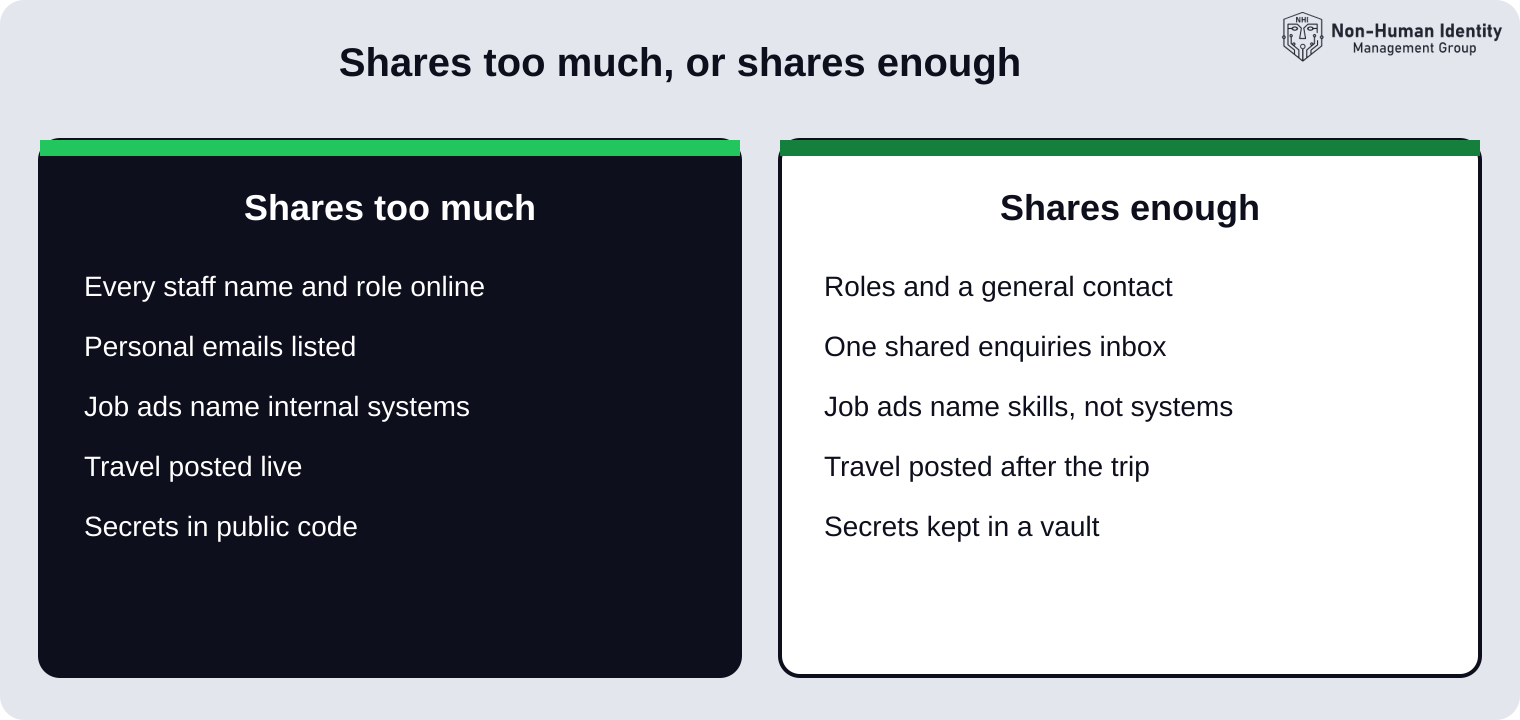
- Names and job titles show who pays bills and who signs them off.
- One email shows the pattern for everyone else's.
- Job adverts reveal which systems the firm uses.
- A post shows when the boss is away and hard to reach.
- A secret left in public code. In a real file, this line would contain a working key.
Why this is risky: together, these let a scammer send a fake "urgent invoice" email to the right person. It can arrive in the right format while the boss is away.
The safer way: share roles, not every name. Use a general contact address. Post travel after the trip. Keep secrets out of code.
How does it work?
This is a simple view so you can spot it and defend against it. It is not a guide to doing it.
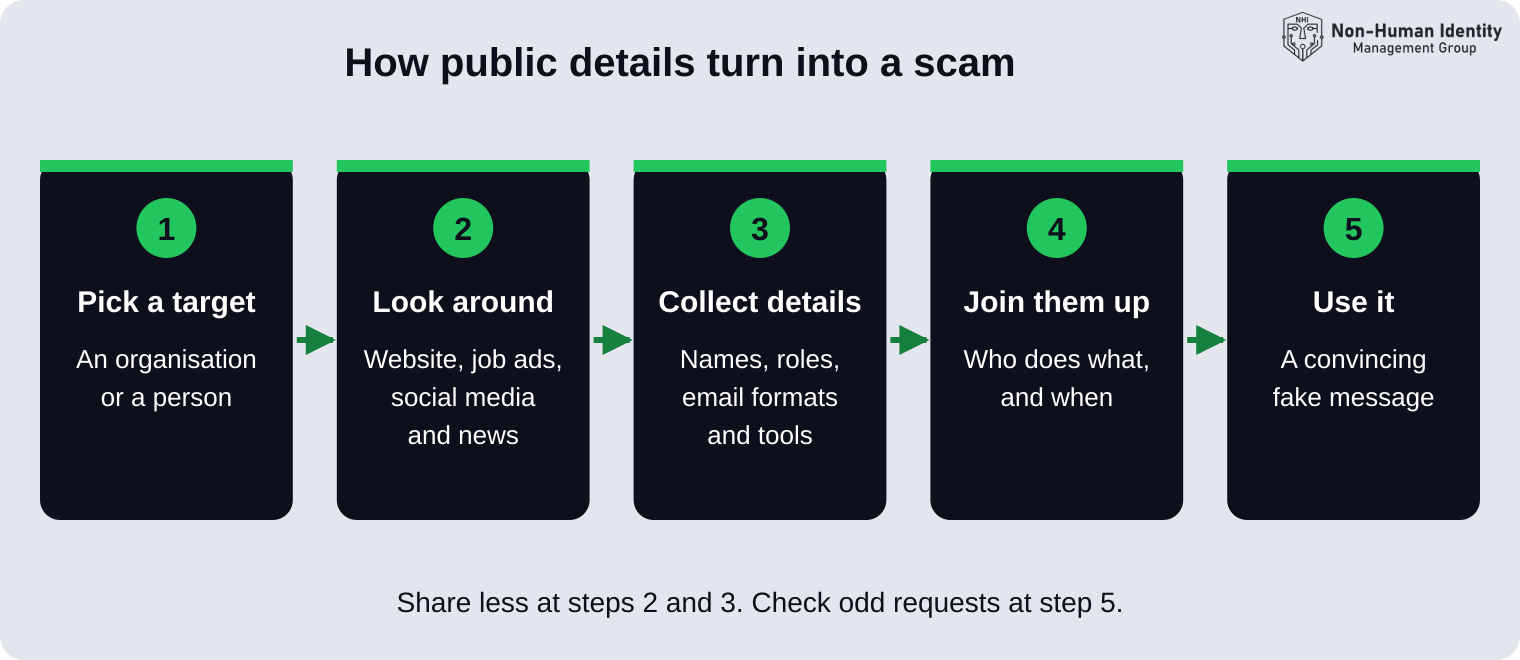
- Pick a target. A criminal chooses an organisation or a person.
- Look around. They read the website, job adverts, social media and news.[2]
- Collect details. They note names, roles, email formats, suppliers and the tools in use.
- Join them up. They build a picture of who does what and when.
- Use it. They write a message that fits, such as a fake invoice or a fake IT request.[1]
Public code is a special case. A password or key left in code that anyone can see may be found by others. Some code sites now scan public code for secrets and alert the company that issued them.[3]
A worked example
This story is made up to show how it can happen.
Ben Okafor manages the office at Bramble Lane Bakery, a small chain with five shops. One morning he gets an email that seems to come from the owner. It asks him to pay a new supplier invoice today, because she is at a trade fair.
The email uses Ben's first name and his job title. It names the bakery's real flour supplier. And the owner really is at a trade fair, as she posted online the day before.
Something feels off, though. The owner never asks for urgent payments by email. Ben calls her on the number he already has. She did not send it.
Later, Ben sits down and searches for the bakery as a stranger would. In ten minutes he finds the team page with every name and role. He finds a job advert that names the supplier and the invoicing system. And he finds the owner's trade fair post.
He and the owner agree some changes. The team page now shows roles and a shared enquiries address. Job adverts describe skills, not suppliers. Travel posts go up after the trip. And any payment change must be confirmed by phone, on a known number.
What made the difference: Ben checked by phone, then looked at his own firm through a scammer's eyes.
Myths and mistakes
| What people think | What is true |
|---|---|
| OSINT means hacking. | It uses public sources only. No breaking in is needed, which is why it is easy to overlook. |
| We are too small for anyone to research us. | Small firms are often easier to research, and scams can be aimed at anyone who pays bills. |
| The answer is to post nothing. | Share what customers need. Cut back on what helps a scammer, such as staff lists and live travel plans.[1] |
| Deleting a post removes it. | Copies may remain in search results, archives or screenshots. Think before posting. |
| Our suppliers' websites are not our problem. | Partners and suppliers can reveal details about you too. Ask them what they publish.[1] |
What can I do this week?
- Search for your organisation's name as a stranger would, and note what you find.
- Check your website's team and contact pages. Remove details visitors do not need.
- Read your current job adverts. Describe skills rather than internal systems.
- Agree that payment or bank changes are confirmed by phone, on a known number.
- Ask whoever looks after your code to turn on secret scanning, if it is offered.
Checklist
- I have searched for my organisation as an outsider would.
- Our website shows roles and a general contact address, not every staff email.
- Job adverts describe skills, not internal tools and suppliers.
- Staff know to post travel plans after a trip, not before.
- Payment changes are checked by phone on a known number.
- We check public code for passwords and keys.
- We look only at our own organisation, or with clear permission.
Common questions
Is OSINT legal?
Reading public information is usually lawful, but how you use it matters. Privacy and data protection laws can still apply to what you collect and keep. We suggest you research only your own organisation, or do so with clear permission, and get advice if unsure.
How do attackers use OSINT?
They use it to plan. Public details help them pick a target, learn who does what, and write a message that sounds real. The UK's national cyber security agency warns that website and social media details make scam emails more convincing.[1]
Does "open source" mean open source software?
No. In OSINT, "open source" means any public source, such as a website, a news story or a social media post. Open source software is a separate idea: software whose code anyone may read and reuse.
What is the quickest way to reduce our exposure?
Start with your own website and job adverts, because you control them. Swap staff lists for roles and a shared inbox. Describe skills rather than internal systems. Then agree that any payment change is checked by phone on a known number.
Where next?
Ready for the detail? Read the practitioner guide: OSINT and Reconnaissance Guide. It goes further into leaked secrets in public code, exposed cloud and internet-facing systems, and how to run a lawful self-assessment programme.
Also useful:
- Your Digital Footprint for Beginners
- Social Engineering for Beginners
- Phishing for Beginners
- Threat Intelligence for Beginners
- Attack Surface Management Guide
Related NHI Mgmt Group resources: OSINT Investigator Career Guide · Penetration Testing for Beginners · Secrets Management for Beginners
Key terms
- Open source intelligence (OSINT)
- Information gathered from public sources, such as websites, social media and public records.
- Reconnaissance
- The stage where an attacker gathers information about a target before acting.
- Digital footprint
- The information about a person or organisation that can be found online.
- Tricking people into giving away information or access, rather than breaking in through technology.
- Spear phishing
- A scam message written for one person or team, often using details found online.
- Attack surface
- All the places an attacker could try to get in or learn something useful.
Sources and further reading
- Phishing attacks: defending your organisation. National Cyber Security Centre (NCSC). https://www.ncsc.gov.uk/guidance/phishing, accessed 28 Nov 2026.
- Reconnaissance (tactic TA0043). MITRE ATT&CK. https://attack.mitre.org/tactics/TA0043/, accessed 28 Nov 2026.
- About secret scanning. GitHub Docs. https://docs.github.com/en/code-security/secret-scanning/introduction/about-secret-scanning, accessed 28 Nov 2026.