Power grid cyber security protects the computers that control how electricity is made, moved and delivered.
This guide is for students, curious members of the public and people starting work at an energy company. You do not need to be an engineer to be affected: almost everything at home and work depends on the grid staying up.
In short
- The grid is a huge network of power stations, power lines and substations, run from control rooms by computers.
- Those control computers can switch real equipment on and off, so an attacker who reaches them could cut power.
- Known attacks usually start in ordinary office IT, often with stolen logins, and then try to move towards the control systems.
- Defences include keeping control networks apart from office networks, tight remote access and practising running things by hand.
What you will learn
- Explain how electricity gets from a power station to a plug socket.
- Spot where computers control the grid, and why that matters.
- Explain how a known grid attack worked, in plain words.
- Ask good first questions if you work for an energy company.
- Power network (the grid)
- the linked power stations, lines and substations that carry electricity to users.
- Voltage-changing site (substation)
- a site where equipment raises or lowers the voltage and switches power between lines.
- Remote control system (SCADA)
- software that lets a control room watch and operate equipment far away.
What is power grid cyber security?
Think of a national motorway network with a control room. Staff in the control room watch the traffic on screens. They can open lanes, close slip roads and change signs from miles away.
The power grid works in a similar way. Electricity flows from power stations along high-voltage lines, through substations, to your street. Grid control rooms use computers to watch the flow and switch equipment remotely. Power grid cyber security is about keeping those computers, and the links to them, out of the wrong hands.
Where the comparison stops working: cars can wait in a queue. Electricity cannot. The amount made has to match the amount used almost every moment, or blackouts can follow.[1] So a grid control system has very little room for error.
Why does it matter?
Power cuts affect heating, water, hospitals, payments and phone networks. Grid systems are a known target for state-backed attackers.
On 23 December 2015, attackers cut power to nearly 225,000 people in western Ukraine. It was one of the first publicly confirmed cyber attacks to cause a blackout.[3]
If you are a student or curious about the grid
What could happen: you read scary headlines and cannot tell what is likely and what is not.
Check this: look for the official report or advisory behind a story, not just the headline.
If you work in an office at an energy company
What could happen: a fake email steals your login, and attackers use it as a first step towards control systems.
Check this: report odd emails and login prompts, even if you think you do not touch the grid.
If you are an engineer or field technician
What could happen: a remote access link set up for convenience gives an outsider a path to substation equipment.
Check this: ask who can connect to your sites remotely, and how that access is approved and recorded.
Next: OT Remote Access Guide
What does it look like?
Here is a made-up control room log from a small electricity company. It shows the kind of signs a team would want to spot early.
Example only. All values are made up.
# control room event log, EXAMPLE Power, night shift
02:10  remote login to control network   user: eng-FAKE01   from: unknown-0000  (1)
02:14  new screen session on control screen CTRL-EXAMPLE-2                  (2)
02:20  command: OPEN breaker  substation EXAMPLE-NORTH  feeder 3            (3)
02:20  command: OPEN breaker  substation EXAMPLE-NORTH  feeder 4
02:21  operator mouse not responding on CTRL-EXAMPLE-2                      (4)
- A valid engineer account logs in at night from a place nobody recognises.
- Someone opens a session on a control screen without an operator asking for it.
- Breakers (big switches) open, cutting power to two areas.
- The operator has lost control of their own screen.
Why this is risky: every command used a real login and a normal control screen. Nothing here needs special malware, so it can look like ordinary work.
The safer way: remote logins need approval and a second check. Out-of-hours access raises an alert. Staff practise switching to manual control.
How does it work?
First, the grid itself. Electricity takes a journey of a few steps.[1]
- Make it. Power stations, wind farms and solar farms generate electricity.
- Move it far. High-voltage lines on tall towers carry it long distances, because high voltage is more efficient over distance.
- Change the voltage. At substations, machines called transformers raise or lower the voltage for the next stage.
- Deliver it locally. Lower-voltage lines carry it down your street to homes and businesses.
- Balance it. Grid operators match supply and demand all the time, using control systems.
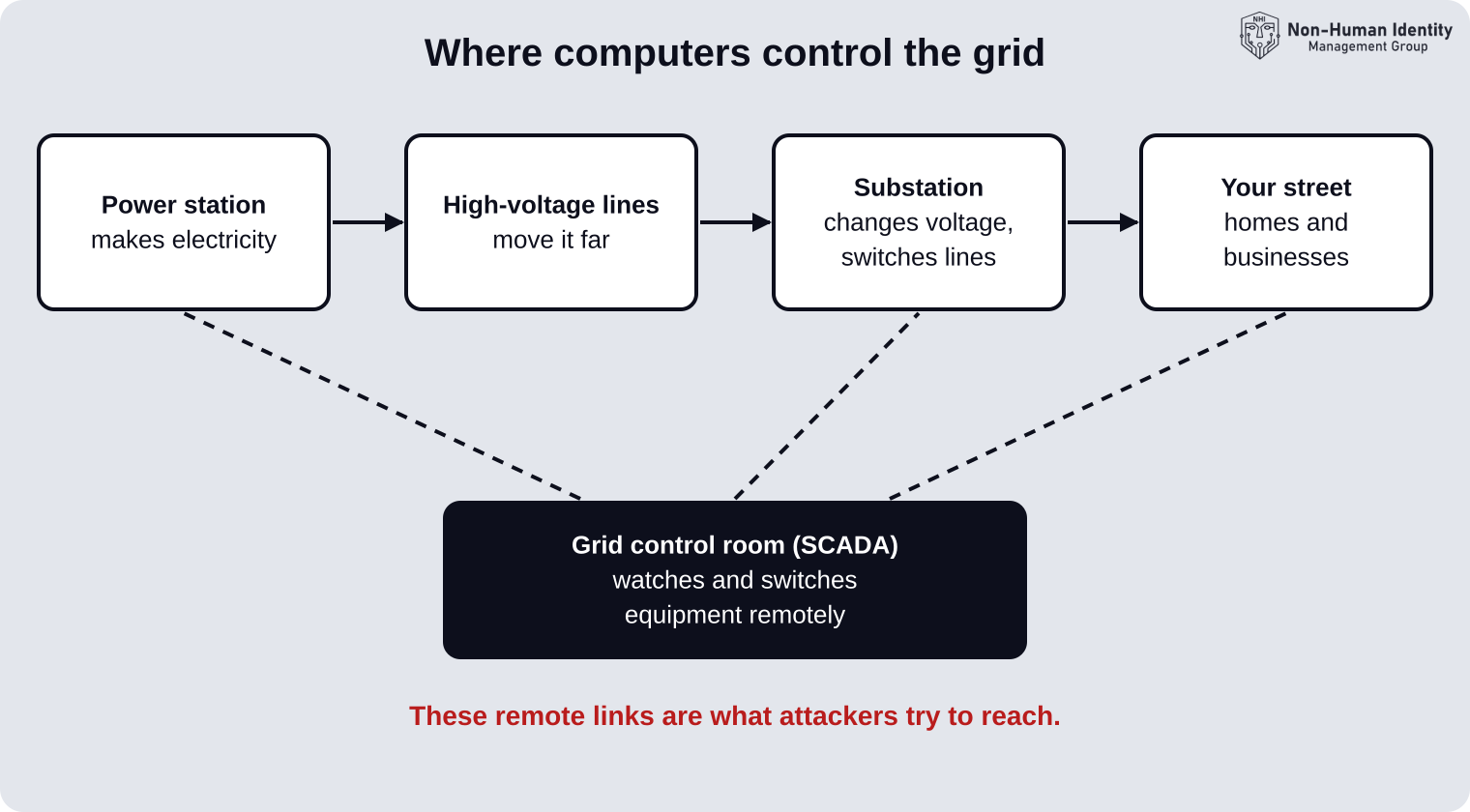
Now the computers. Control rooms use SCADA (supervisory control and data acquisition), software that shows the grid on screens and sends commands to far-off sites. These systems are part of what is called operational technology, meaning computers that control physical things.[2]
Attacks on the grid tend to follow a pattern. In Ukraine in 2015, the attackers first sent targeted emails to staff to steal logins.[3] They then used the control screens to open breakers remotely. They also damaged equipment needed for remote recovery and flooded the phone lines so customers could not report the outage.[4]
More recently, US agencies warned in 2024 that a China-backed group called Volt Typhoon had got into networks in energy, water, transport and communications. They said the group was getting into position to cause disruption in a future crisis. It mostly used valid logins and built-in tools, not malware.[5]
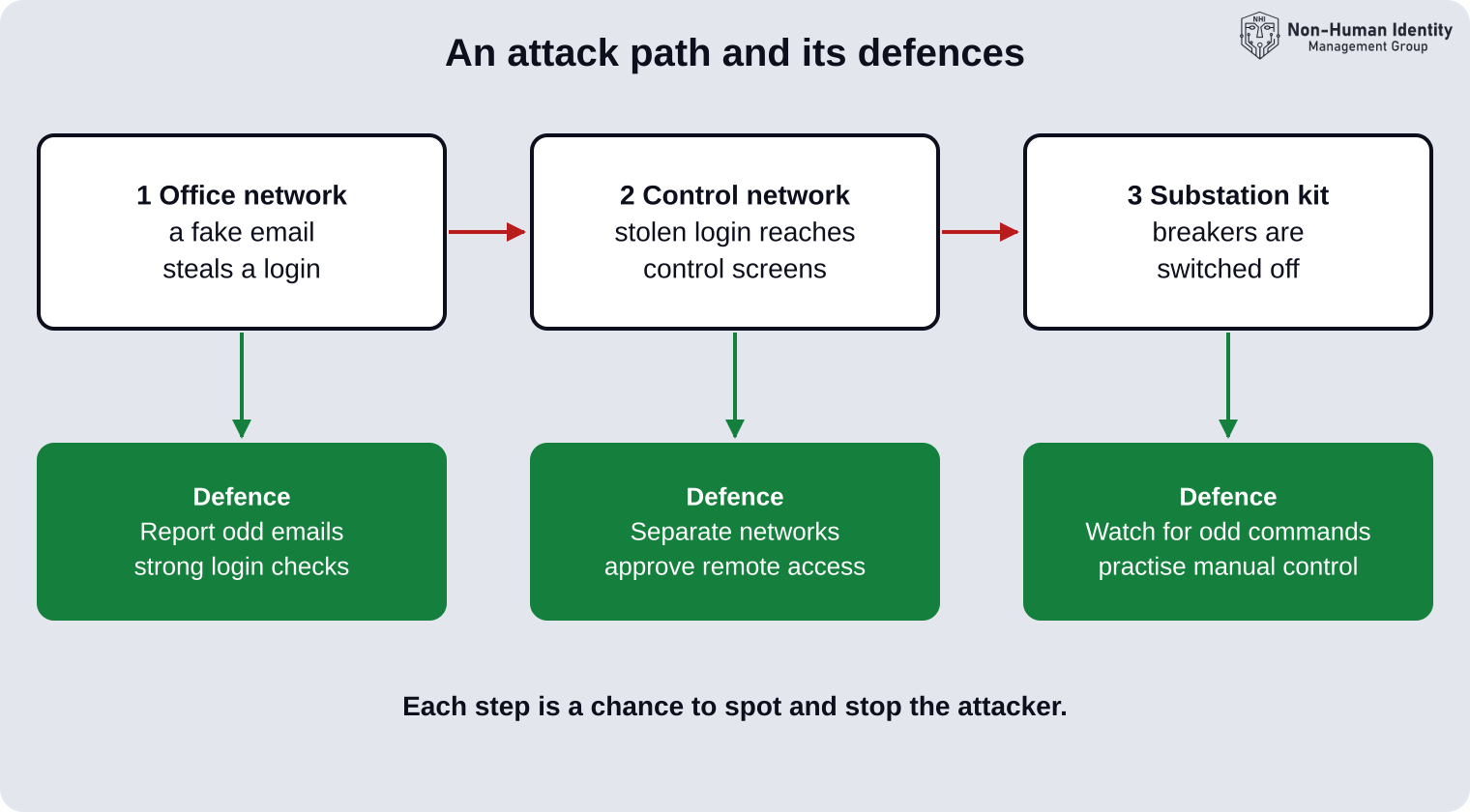
The defences follow the same path. A US government list of top measures for operational technology covers five basics.[6] Keep control systems off the public internet. Change default passwords. Lock down remote access. Separate office and control networks. Practise running the system by hand.
In North America, mandatory cyber security rules apply to the bulk power system. An industry body writes them and the federal energy regulator approves them.[7] Other regions have their own rules.
A worked example
Zane Jovanovic has just started as a junior analyst in the security team at a fictional regional electricity company. His mentor, Bea Osei, has worked in grid control for fifteen years.
On his second week, an alert pops up. An engineer account has logged in to the control network at 2am, from a laptop the team does not recognise.
Zane's first thought is to call it in as a likely attack. Bea agrees it needs action, but she starts with a check. She looks at the remote access log. There is no approved work request for that night.
Bea calls the engineer on his known phone number. He is at home and has not logged in. So they treat the login as stolen.
Bea follows the plan the team practised in a drill. She ends the remote session and disables the account. She asks the control room to watch the affected substations closely and be ready to switch to manual control. Nothing has been switched off.
Next, the team looks for where the login was stolen. They find a fake "password expiry" email that the engineer clicked a week earlier on his office laptop.
In the review, Zane suggests two changes. All remote access to the control network will need a second login check and an approved work request. And out-of-hours logins will alert the control room straight away, not just the security team.
Zane had thought grid security was about clever malware. He now sees that a stolen login and a remote link can be enough, and that quick checks matter.
Myths and mistakes
| What people think | What is true |
|---|---|
| The grid is not connected to the internet, so it is safe. | Control networks often link to office networks, suppliers and remote engineers. Each link is a possible path in. |
| Grid attacks need very advanced hacking tools. | Known attacks have used stolen logins and normal control screens. Valid commands from the wrong person can be enough.[4] |
| Office staff do not affect grid security. | Attacks often begin with an office email or login. Everyone's account can be a first step. |
| A single attack could switch off a whole country at once. | The grid is built with many paths and backups, so it can often route around a failure.[1] Real attacks so far have hit specific areas. |
| Automation means nobody needs manual skills any more. | Being able to run equipment by hand is a key fallback if control systems cannot be trusted.[6] |
What can I do this week?
- If you work at an energy company, ask how to report a suspicious email or login, and save the details.
- Ask whether remote access to control systems needs approval and a second login check.
- Find out when your team last practised running things by hand.
- Read one official advisory, such as the one on Volt Typhoon, to see how real attacks work.
- Read the practitioner guide below if you want the detail on rules and programmes.
Checklist
- Control systems are not reachable from the public internet.
- Office and control networks are kept separate, with a controlled gateway between them.
- Default passwords on control equipment have been changed.
- Remote access is approved, recorded, time-limited and needs a second login check.
- Out-of-hours and unusual logins raise an alert to the right people.
- Staff can report suspicious emails quickly and know how.
- The team practises running key sites by hand.
- Backups of control system settings are kept and tested.
Common questions
Has a cyber attack ever caused a real blackout?
Yes. In December 2015, attackers cut power to nearly 225,000 people in western Ukraine by opening breakers through control systems.[3] MITRE, a US research organisation, says the power was out for about six hours.[4]
What is SCADA, in simple words?
SCADA is software that lets a control room see what equipment far away is doing and send it commands. In the grid, it can show power flows and switch breakers at substations. Because it can change real equipment, it needs strong protection.
Are smart meters part of grid security?
Yes, at the edge of the grid. Smart meters connect homes to the energy company's systems, so they need protecting too. They are a separate topic from the control rooms in this guide. See Smart Meter Security for Beginners for the detail.
Why can energy companies not just patch everything quickly?
Grid equipment often runs for many years and must stay up all the time. Changes need testing, so a fix does not cause an outage itself. That is why companies rely on layers, such as separate networks and tight remote access, while they plan updates.
How do people get into grid security as a career?
Many come from IT security or from engineering. Learning how the grid works matters as much as learning security tools. Working alongside control room staff and engineers is a big part of the job.
Where next?
Ready for the detail? Read the practitioner guide: Electric Utility Cybersecurity Programme Guide. It goes further into the rules utilities follow, how to build a security programme across control and office systems, and how to measure progress.
Also useful:
- Industrial Control Systems and SCADA for Beginners
- Smart Meter Security for Beginners
- The Purdue Model for Beginners
- Energy Sector Threat Actors Guide
Related NHI Mgmt Group resources: Energy Sector Identity and OT Access Guide · Energy Sector Cyber Regulation Map · Critical Infrastructure for Beginners
Key terms
- Power grid
- The linked network of power stations, lines and substations that carries electricity to users.
- Substation
- A site where transformers change the voltage and switches route power between lines.
- SCADA
- Software that lets a control room watch and operate equipment at far-off sites.
- Operational technology
- Computers and devices that watch or control physical processes, such as power flows.
- Breaker
- A large switch that can cut or restore power on a line.
- Critical infrastructure
- Services, such as power and water, whose failure would seriously harm society.
- Network segmentation
- Splitting a network into separate areas so trouble in one area cannot easily spread.
Sources and further reading
- Electricity explained: How electricity is delivered to consumers. US Energy Information Administration. https://www.eia.gov/energyexplained/electricity/delivery-to-consumers.php, accessed 28 Nov 2026.
- NIST SP 800-82 Rev. 3, Guide to Operational Technology (OT) Security. National Institute of Standards and Technology, September 2023. https://csrc.nist.gov/pubs/sp/800/82/r3/final, accessed 28 Nov 2026.
- Power grid cyberattack in Ukraine (2015). Cyber Law Toolkit, NATO Cooperative Cyber Defence Centre of Excellence (case summary citing the US ICS-CERT alert of 25 February 2016). https://cyberlaw.ccdcoe.org/wiki/Power_grid_cyberattack_in_Ukraine_(2015), accessed 28 Nov 2026.
- 2015 Ukraine Electric Power Attack (C0028). MITRE ATT&CK. https://attack.mitre.org/campaigns/C0028/, accessed 28 Nov 2026.
- PRC State-Sponsored Actors Compromise and Maintain Persistent Access to U.S. Critical Infrastructure (AA24-038A). CISA and partner agencies, 7 February 2024, updated 7 March 2024. https://www.cisa.gov/news-events/cybersecurity-advisories/aa24-038a, accessed 28 Nov 2026.
- Primary Mitigations to Reduce Cyber Threats to Operational Technology. CISA and partner agencies. https://www.cisa.gov/resources-tools/resources/primary-mitigations-reduce-cyber-threats-operational-technology, accessed 28 Nov 2026.
- Cyber and Grid Security. Federal Energy Regulatory Commission. https://ferc.gov/cyber-and-grid-security, accessed 28 Nov 2026.