A privacy notice tells people, in plain words, what you do with their personal information.
This guide is for small business owners, website owners, app makers and anyone who asks "do I need a privacy policy?". You do not need a legal team to be affected: if you collect a customer's name or email address, you usually need to tell them what happens to it.
In short
- Under UK and EU data protection law, people have a right to be told how their personal data is used. A privacy notice is how you tell them.
- It says who you are, what you collect, why, who you share it with, how long you keep it, and what rights people have.
- Give it when you collect the details. If you got them from someone else, the deadline is at most one month.
- Keep it short, clear and easy to find, and update it before you start using data in a new way.
What you will learn
- Explain what a privacy notice is and who needs one.
- List the main things a notice should tell people.
- Spot vague or out-of-date wording in a notice.
- Check when and where people see your notice.
Status: correct as at 28 November 2026, based on the UK Information Commissioner's Office guidance on the right to be informed (under review after the Data (Use and Access) Act 2025) and the EU GDPR text. Laws change; check the official text.
This guide explains the topic in general terms and is not legal advice.
- Details about a person (personal data)
- any information that can be linked to a living person, such as a name, email address or photo.
- Privacy statement (privacy notice)
- the public explanation of what you collect, why and what happens to it. Many websites call it a privacy policy.
- Your reason in law (lawful basis)
- the legal reason you rely on to use personal data, such as a contract or consent.
What is a privacy notice?
Think of the ingredients label on a packet of food. It tells you what is inside before you eat it, so you can decide whether it is right for you. A privacy notice does the same for your personal information.
When a shop, website, club or app collects your personal data (details about you), the notice tells you what it collects and why. It also says who else sees it and how long it is kept. It explains your rights, such as asking for a copy or asking for your details to be deleted.
Many websites call this page a "privacy policy". The UK regulator uses the term "privacy information". In this guide, a privacy notice means the public explanation, wherever it appears: on a website, a paper form, a sign or a phone call.
Where the comparison stops working: a food label is printed once. Your notice must change when what you do with data changes, and people should hear about new uses before they start.[1]
Why does it matter?
Being told is a right in itself under UK and EU law. People must get the information when their data is collected, in a form that is short, clear and easy to reach.[1] A clear notice also builds trust, and writing it often shows you what you do not need to collect.
If you run a small business
What could happen: a customer complains to the regulator because nobody told them their details went to a marketing firm.
Check this: make sure your notice names everyone you share customer details with.
Next: UK GDPR for Beginners
If you build websites or apps
What could happen: you add a new analytics tool, but the notice still describes last year's site.
Check this: add "update the privacy notice" to your release checklist.
If you hand over your details
What could happen: you sign up for one thing and start getting messages from companies you have never heard of.
Check this: before you sign up, look for the privacy link and the "who we share with" part.
What does it look like?
Here is a made-up first draft of a notice from a dog grooming business. It has some common problems.
Example only. All values are made up.
PRIVACY POLICY: EXAMPLE Dog Grooming
We may collect some information about you.     (1)
We use it to improve our services.              (2)
We may share it with selected partners.         (3)
We keep data for as long as necessary.          (4)
Contact: [email protected]
Last updated: 2019                              (5)
- "Some information" does not say what is collected. A clear notice lists it, such as name, phone, address and pet details.
- A broad aim like "improve our services" hides the actual uses, such as bookings and reminder texts.
- "Selected partners" does not say who. Name the booking tool, the text message service and anyone else.
- No real time limit. Say how long, or how you decide.
- A notice that has not changed in years may no longer match what the business does.
Why this is risky: the notice tells people almost nothing. It also leaves out their rights and how to complain.[2]
The safer way: be specific. The UK regulator asks organisations to be as precise as they can about what they do with people's data.[3]
Example only. All values are made up.
We collect: your name, phone, address and your dog's details.
Why: to book appointments and send reminder texts (our contract with you).
Shared with: our booking app and text message service, who act for us.
Kept for: 2 years after your last visit, then deleted.
Your rights: ask for a copy, a correction or deletion; complain to the regulator.
How does it work?
Writing a notice is mostly about knowing your own data first. The steps below follow the UK regulator's guidance.[3]
- List what you hold. Write down what personal data you collect, where it comes from, why you use it, who receives it and how long you keep it.
- Find your reason in law. For each use, note the lawful basis, such as a contract, consent or a legal duty.
- Write it for your readers. Use short sentences and everyday words. Explain what people would not expect, rather than hiding it.
- Put it where people look. Show a short version at the point of sign-up, with a link to the full notice. This is called a layered notice. Short pop-ups at the moment of collection are called just-in-time notices.[1]
- Give it at the right time. Tell people when you collect their details. If you got their details from someone else, tell them within a reasonable time, and within one month at most.[1][4]
- Review it. Check it regularly, and update it before any new use of data starts.[1]
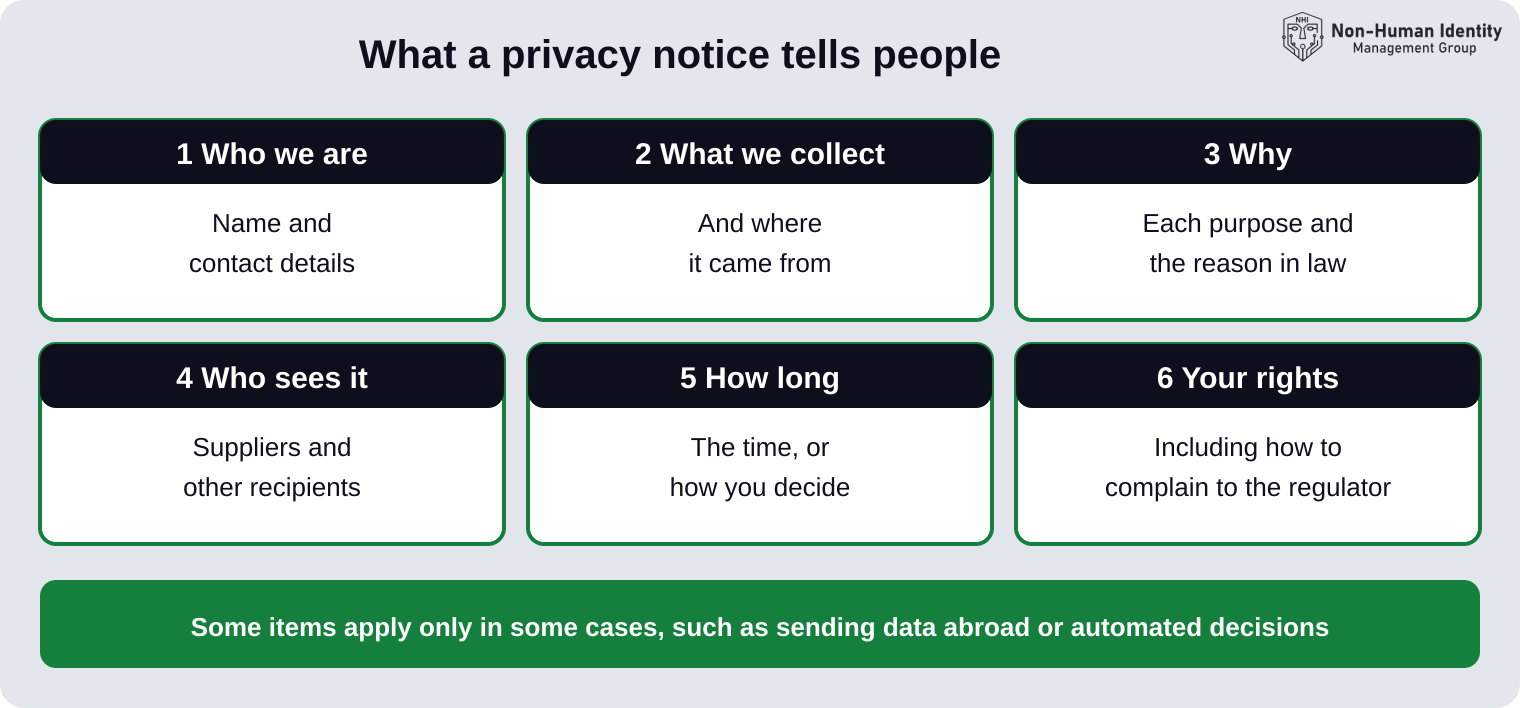
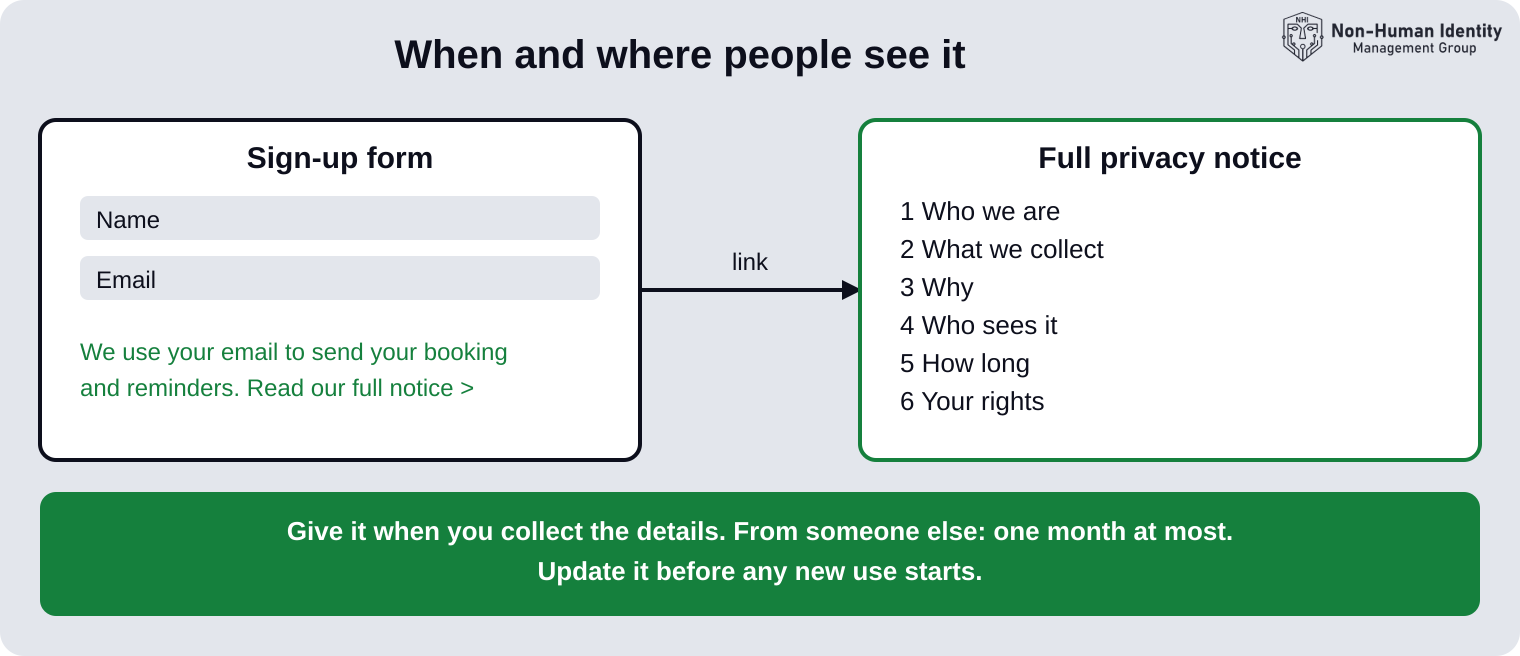
The UK list of what to include has around a dozen items. Some apply to everyone. Examples are who you are, why you use the data, how long you keep it, and people's rights, including the right to complain. Others apply only in some cases, such as sending data abroad, decisions made by computer alone, or contact details for a data protection officer.[2]
Other countries have their own rules. In California, for example, commercial websites that collect personal information from Californians must post a privacy policy.[6] The main idea, telling people clearly, is common to many privacy laws.
A worked example
Nadia Abara runs a small, fictional dog grooming business from a converted garage. She takes bookings through a website and sends reminder texts.
Her website has a privacy page that a friend copied from another site years ago. It mentions "selected partners" and "newsletters". Nadia has never sent a newsletter.
Her cousin, Marek Zeller, works in IT. He asks her a simple question. "If a customer read this, would they know what you actually do?" She reads it again, as a customer would. The answer is no.
Nadia thinks of an ingredients label. A label that lists things that are not in the packet, and misses things that are, is not much use.
So she starts with a list. She collects names, phone numbers, addresses and notes about each dog. She uses them to book appointments and send reminders. Her booking app and a text message service handle the details for her. She keeps records for two years after a last visit.
Then she uses the UK regulator's free notice generator for small businesses, answers its questions and edits the result into her own words.[5] She adds a short line under the booking form, linking to the full notice.
Last, she puts a reminder in her diary to review the notice each spring, and before she adds anything new.
A month later, a customer asks to have his details deleted. He found how to ask in the notice, and Nadia knows exactly where his records are.
Myths and mistakes
| What people think | What is true |
|---|---|
| Small businesses do not need a privacy notice. | Size alone does not exempt you. If you collect personal data, you usually need to tell people how you use it.[1] |
| Copying another website's policy is fine. | Your notice must describe what you do. A copied one may list things you never do and miss things you do. |
| Longer and more legal is safer. | The information should be concise and in clear, plain language.[1] |
| A notice is the same as asking for consent. | A notice tells people what happens. Consent is a separate choice, and only one of several reasons in law. |
| Write it once and forget it. | Review it regularly, and update it before you start using data in a new way.[1] |
What can I do this week?
- Read your own notice as a customer would, and mark anything vague.
- Write a one-page list of the personal data you hold and who you share it with.
- Check that a link to the notice sits next to every form that collects details.
- If you are a UK small business, try the regulator's free notice generator.
- Add "check the privacy notice" to your list for any new tool or supplier.
Checklist
- Our notice names us and says how to contact us.
- It lists what we collect and why, with our reason in law.
- It names who we share details with, or the types of recipient.
- It says how long we keep each kind of data.
- It explains people's rights and how to complain to the regulator.
- A short version or link appears wherever we collect details.
- The wording is plain and specific, with no "may" or "some" where we know the answer.
- We review it regularly and before any new use of data.
Common questions
Do I need a privacy policy on my website?
Usually, yes, if the site collects personal data, for example through a contact form, bookings or analytics. In the UK and EU, people must be told how their data is used. Other countries, such as the US state of California, have their own rules for website policies.
Is a privacy notice the same as a privacy policy?
Mostly, yes. Many websites call the public page a "privacy policy". Some firms keep "privacy policy" for the internal rules staff follow, and "privacy notice" for what the public reads. What matters is that people get the information they need.
Do I need a separate notice for my staff?
Often, yes. Staff data is personal data too, and staff should be told how it is used. The UK regulator's free generator makes separate notices for customers and suppliers, and for staff and volunteers.[5]
Does the cookie banner count as my privacy notice?
No. A cookie banner asks for choices about cookies and similar tracking. Your privacy notice explains everything you do with personal data. The banner should link to the notice, and the notice should describe the cookies and tools you use.
What if I get someone's details from another company?
You still need to tell them. Say what you hold and where it came from. Do it within a reasonable time and within one month at most, or earlier if you contact them or pass their details on first.[4]
Where next?
Ready for the detail? Read the practitioner template: Privacy Notice Template. It goes further with a section-by-section notice to adapt, guidance on when to give it, and common mistakes.
Also useful:
- Data Privacy for Beginners
- UK GDPR for Beginners
- Cookie Consent Banners for Beginners
- Subject Access Requests for Beginners
- Privacy by Design for Beginners
Related NHI Mgmt Group resources: GDPR Compliance Checklist · Cookie and Tracking Technology Compliance Guide · Mobile App Privacy Labels
Key terms
- Privacy notice
- A public statement of what personal data is collected, why, who receives it, how long it is kept and what rights people have.
- Personal data
- Any information that can be linked to a living person.
- Lawful basis
- The legal reason an organisation relies on to use personal data.
- Data controller
- The organisation that decides why and how personal data is used, and so writes the notice.
- Data processor
- A supplier that handles personal data on a controller's behalf, such as a booking app.
- Subject access request
- A request from a person for a copy of the personal data an organisation holds about them.
Sources and further reading
- The right to be informed. Information Commissioner's Office (UK). https://ico.org.uk/for-organisations/uk-gdpr-guidance-and-resources/individual-rights/the-right-to-be-informed/, accessed 28 Nov 2026.
- What privacy information should we provide? Information Commissioner's Office (UK). https://ico.org.uk/for-organisations/uk-gdpr-guidance-and-resources/individual-rights/the-right-to-be-informed/what-privacy-information-should-we-provide/, accessed 28 Nov 2026.
- How should we draft our privacy information? Information Commissioner's Office (UK). https://ico.org.uk/for-organisations/uk-gdpr-guidance-and-resources/individual-rights/the-right-to-be-informed/how-should-we-draft-our-privacy-information/, accessed 28 Nov 2026.
- General Data Protection Regulation (EU) 2016/679, Article 14: Information to be provided where personal data have not been obtained from the data subject. Text via gdpr-info.eu. https://gdpr-info.eu/art-14-gdpr/, accessed 28 Nov 2026. Official text: EUR-Lex.
- New tool helps small businesses create privacy notices. Information Commissioner's Office (UK), 20 August 2024. https://ico.org.uk/about-the-ico/media-centre/news-and-blogs/2024/08/new-tool-helps-small-businesses-create-privacy-notices/, accessed 28 Nov 2026.
- Privacy Laws: California Online Privacy Protection Act. State of California Department of Justice, Office of the Attorney General. https://oag.ca.gov/privacy/privacy-laws, accessed 28 Nov 2026.