A privacy programme is the set of people, rules and routines an organisation uses to look after personal information.
This guide is for managers, career changers and anyone new to privacy work who keeps hearing the phrase. You do not need to be a lawyer: if your team handles customer or staff details, you are already part of how privacy is run.
In short
- A privacy programme is an ongoing routine, not a single document or a one-off project.
- Most programmes have four parts: written rules, people with clear roles, everyday processes and regular reviews.
- Leaders stay responsible. A named privacy lead advises and keeps the work moving.
- It should match the size of the organisation. A small firm can keep it light.
What you will learn
- Explain what a privacy programme is in one sentence.
- Name the four parts most programmes have.
- Spot the warning signs of a programme that exists only on paper.
- Ask who owns privacy in your own team.
Status: correct as at 28 November 2026, based on guidance from the UK Information Commissioner's Office and Singapore's Personal Data Protection Commission. Laws change; check the official text.
This guide explains the topic in general terms and is not legal advice.
- Details about a person (personal information)
- anything that can identify someone, such as a name, email address or customer number.
- Privacy lead (data protection officer)
- the person who advises the organisation on privacy and checks the work gets done.
- Data map (record of processing)
- a list of what personal information is held, where it lives and why.
What is a privacy programme?
Think of a restaurant's food hygiene routine. Nobody passes a hygiene check by cleaning once before the inspector arrives. There are daily habits, named people, written records and regular checks.
A privacy programme works the same way for personal information. It helps an organisation collect only what it needs and use it fairly. It also keeps the data safe and deletes it when it is no longer needed.
Privacy laws in many countries expect this. In the UK, the regulator says you must follow the law and be able to show that you do. This is called accountability (being responsible and able to prove it).[1] A programme is how you build that proof day by day.
Privacy is wider than security. Security asks if the data is safe from attackers. Privacy also asks if we should collect it at all. Data can be well protected and still be used unfairly.
Where the comparison stops working: a kitchen inspector visits on a schedule. Privacy problems often show up without warning, through a complaint, a lost laptop or a customer asking what you hold about them. So the routine has to be ready at any time.
Why does it matter?
Without a programme, privacy depends on whoever happens to remember. Requests get missed, old data piles up and nobody knows what to do when something goes wrong.
If you manage a team
What could happen: your team keeps customer details in a shared sheet nobody owns, and it is sent to the wrong person.
Check this: ask who owns each list of personal details your team uses.
If you are moving into privacy work
What could happen: you are handed "privacy" with no plan, no budget and no idea where the data is.
Check this: start with the four parts in this guide and find out which ones already exist.
If you work in IT or security
What could happen: you protect systems well, but nobody tells you which ones hold personal information.
Check this: agree with the privacy lead how you will share the data map and breach steps.
If you run a small business
What could happen: a customer asks what you hold about them and you cannot find it all.
Check this: write a one-page list of the personal details you keep and where.
What does it look like?
Here is a made-up one-page summary that a privacy lead might keep for a small firm. It is a quick way to see whether the programme is real or only on paper.
Example only. All values are made up.
Privacy programme summary: Example Travel Ltd (fictional)
Owner at board level:  Managing Director           (1)
Privacy lead:          EXAMPLE NAME, Operations     (2)
Data map last checked: 00 Month 0000                (3)
Privacy notice:        on website, reviewed yearly
Staff trained:         18 of 20                     (4)
Requests this year:    3 received, 3 answered on time
Breaches this year:    1 (email sent to wrong client), logged
Next review:           00 Month 0000                (5)
- A senior person stays responsible, even when someone else does the daily work.
- One named person people can go to with questions.
- The date the list of personal data was last checked. An old date is a warning sign.
- Two people have not been trained yet. That is a task, not a failure.
- A review date shows the programme is a loop, not a one-off.
Why this is risky: many firms have a policy document but no named owner, no data map and no review date. When a request or a breach arrives, nobody knows who acts.
The safer way: keep a short summary like this, update it on a set date and share it with leaders. The ICO says smaller organisations can take a lighter approach, as long as it fits their risks.[1]
How does it work?
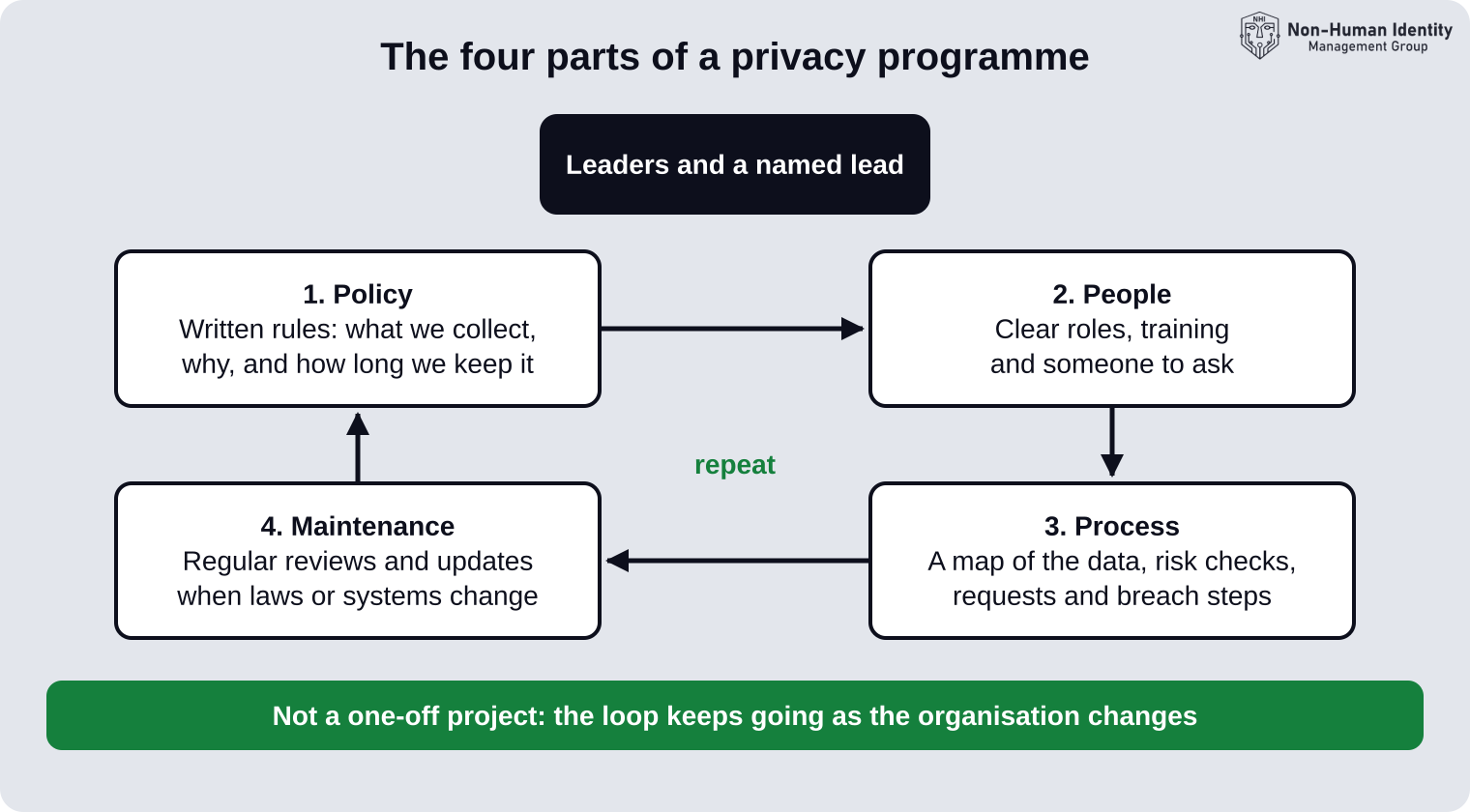
Different guides use different words, but most programmes have the same building blocks. Singapore's data regulator, for example, describes four: policy, people, process and maintenance.[3]
- Leaders set the direction. Senior managers appoint a privacy lead, approve the rules and give the work time and money.[3]
- Policy. Written rules say what personal information you collect, why, who can see it and how long you keep it.
- People. Everyone knows their part. Staff get training, and the privacy lead is the person to ask.[3]
- Process. Everyday routines turn the rules into action. These include a data map, risk checks before new projects, answering people's requests and handling breaches.[1]
- Maintenance. The programme is reviewed regularly and updated when laws, systems or suppliers change.[3]
Who does what? A data protection officer (DPO) is a privacy advisor that some organisations must appoint by law. In the UK this applies to public bodies and to firms whose main work involves large-scale monitoring of people or large amounts of sensitive data. A DPO advises and checks, reports to the most senior level and is not personally liable. The organisation stays responsible.[2] Firms that do not need a DPO often still name a privacy lead.
Some organisations also use a free framework to plan the work. The US standards body NIST publishes a voluntary Privacy Framework to help organisations find and manage privacy risk.[4]
A worked example
Wanda Jensen runs Fernlea Physio, a fictional clinic with three sites and 25 staff. Her new operations manager, Bodhi Pajari, is told he now "looks after privacy".
Bodhi remembers the food hygiene routine. One clean before an inspection is not enough. So he starts by finding out what already exists.
He finds a privacy notice on the website, written four years ago. There is no list of where patient details are kept. Nobody is sure who answers when a patient asks for a copy of their records.
First, he asks Wanda to confirm in writing that she owns privacy at the top, and that he is the privacy lead. They agree two hours a week for the work.
Next, he builds a simple data map. It lists the booking system, the notes app, a payroll service and a shared drive. He finds an old spreadsheet of former patients that nobody needs, and the team deletes it under a new retention rule.
Then he writes three short processes. One covers answering a request. One covers details sent to the wrong person. One covers checking a new supplier.
He runs a 30-minute training session at each site. He puts a review date in the diary for six months' time.
Three weeks later, a receptionist emails a letter to the wrong patient. She knows what to do, tells Bodhi straight away and it is logged the same day. The routine is working.
Myths and mistakes
| What people think | What is true |
|---|---|
| A privacy policy on the website is our programme. | A notice is one part. A programme also needs owners, a data map, processes and reviews. |
| Privacy is the IT team's job. | IT and security protect systems. Privacy also covers what you collect and why, which is a business decision. |
| The privacy lead is to blame if something goes wrong. | The organisation stays responsible. In the UK, a DPO is not personally liable for compliance.[2] |
| Only big companies need a programme. | Small firms need one too, but it can be lighter and simpler.[1] |
| Once it is set up, it is done. | Laws, systems and suppliers change. Plan regular reviews. |
What can I do this week?
- Find out who owns privacy at senior level and who the privacy lead is.
- List the main places your team keeps personal information.
- Check when your privacy notice was last reviewed.
- Ask what your team should do if details are sent to the wrong person.
- Put a date in the diary to review what you find.
Checklist
- A senior person is responsible for privacy, in writing.
- A named privacy lead or DPO is known to staff.
- Written privacy rules exist and match how the team really works.
- A data map shows what personal information is held, where and why.
- Staff are trained when they join and at set times after that.
- There is a simple process for people's requests about their data.
- There is a simple process for breaches, and every breach is logged.
- New projects and suppliers get a privacy check before they start.
- The programme has a review date.
Common questions
Is a privacy programme the same as a privacy policy?
No. A privacy policy or notice is a document that tells people how you use their information. A programme is the whole routine behind it: the people, rules, processes and reviews that make sure what the notice says is actually true.
Does every organisation need a data protection officer?
No. In the UK, public bodies must have a DPO. So must firms whose main work involves monitoring lots of people or handling lots of sensitive data. Others can choose to appoint one, or name a privacy lead instead. Check the rules in your own country.
Who should the privacy lead report to?
Ideally to a senior leader who can make decisions and fund the work. The UK regulator says a DPO should report to the highest management level. A privacy lead buried deep in one team often struggles to get problems fixed elsewhere.
How is privacy different from security?
Security keeps information safe from loss, theft and tampering. Privacy also asks whether you should collect or use the information at all, and whether people know about it. The two overlap a lot, so privacy and security teams need to work closely together.
Where should a small business start?
Start with a list. Write down what personal information you keep, where it lives, why you have it and who can see it. Then name one person to look after privacy and set a date to review it. That is the seed of a programme.
Where next?
Ready for the detail? Read the practitioner guide: Privacy Programme Guide for Security Teams. It goes further into the legal duties that land on security teams, how to choose a privacy framework and how to measure whether the programme works.
Also useful:
- Data Privacy for Beginners
- Data Protection Officer for Beginners
- Data Mapping for Beginners
- Data Protection Impact Assessments for Beginners
- Privacy Programme Maturity Model
Related NHI Mgmt Group resources: Privacy Programme Health Check · Privacy Programme Metrics · Record of Processing Activities (ROPA) Template
Key terms
- Privacy programme
- The people, rules and routines an organisation uses to look after personal information.
- Personal information
- Any information about a person who can be identified.
- Accountability
- Being responsible for following privacy law and being able to show that you do.
- Data protection officer (DPO)
- A privacy advisor that some organisations must appoint, who advises, checks and reports to senior leaders.
- Record of processing
- A list of the personal information an organisation holds, where it is and why it is used.
- Privacy impact assessment
- A check of privacy risks before a new system or project goes ahead.
Sources and further reading
- Guide to accountability and governance. Information Commissioner's Office (ICO). https://ico.org.uk/for-organisations/uk-gdpr-guidance-and-resources/accountability-and-governance/guide-to-accountability-and-governance/, accessed 28 Nov 2026.
- Data protection officers. Information Commissioner's Office (ICO). https://ico.org.uk/for-organisations/uk-gdpr-guidance-and-resources/accountability-and-governance/guide-to-accountability-and-governance/data-protection-officers/, accessed 28 Nov 2026.
- Guide to Developing a Data Protection Management Programme. Personal Data Protection Commission Singapore, 15 July 2019. https://www.pdpc.gov.sg/-/media/Files/PDPC/PDF-Files/Other-Guides/DPMP/Guide-to-Developing-a-Data-Protection-Management-Programme-15-July-2019.pdf, accessed 28 Nov 2026.
- NIST Privacy Framework. National Institute of Standards and Technology. https://www.nist.gov/privacy-framework, accessed 28 Nov 2026.