Data mapping means finding out what personal data you hold, where it is kept and where it goes.
This guide is for small business owners, people new to privacy work and IT generalists. You do not need to be a lawyer to do it: if your business keeps names, emails or customer records, you already have data to map.
In short
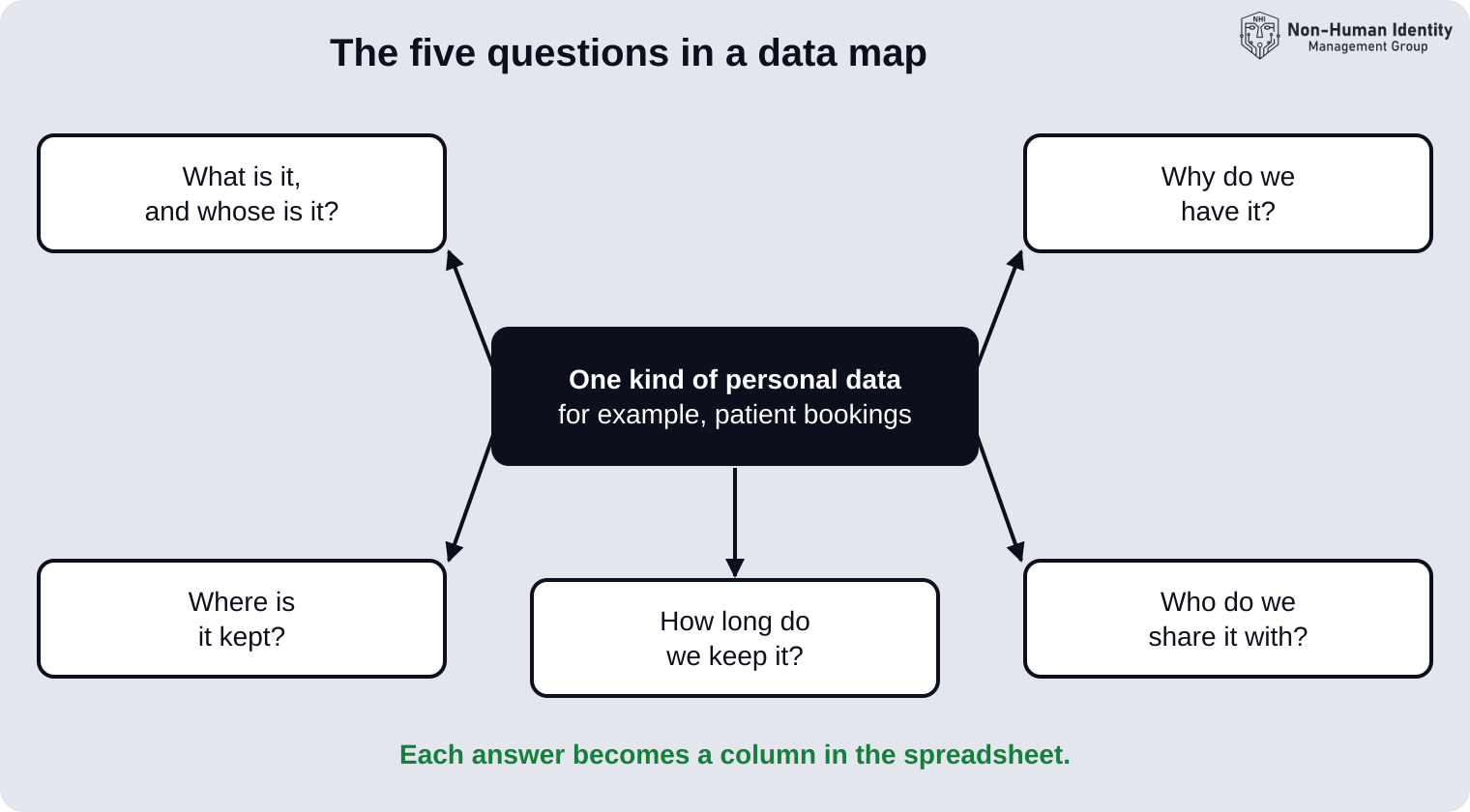
- A data map lists the personal data you hold, why you hold it, where it sits, who you share it with and how long you keep it.
- Under UK data protection law, most organisations must keep a written record of how they use personal data. A data map is the first step towards it.
- The map helps you answer customers' requests, write your privacy notice and spot data you no longer need.
- Start small: ask each team a few plain questions, write the answers in a spreadsheet and review it when things change.
What you will learn
- Explain what a data map is in one sentence.
- Spot the five questions every entry in a data map answers.
- Check whether your organisation needs a formal written record.
- Ask your teams the right questions to build a first map.
Status: correct as at 28 November 2026, based on the UK Information Commissioner's Office (ICO) guidance on documentation. The ICO says this guidance is under review after the Data (Use and Access) Act. Laws change; check the official text.[5]
This guide explains the topic in general terms and is not legal advice.
- Information about a person (personal data)
- anything that can identify someone, such as a name, email address or patient number.
- Written record of data use (ROPA)
- short for record of processing activities, the formal list the law asks many organisations to keep.
- Extra-sensitive data (special category data)
- information such as health records, which the law protects more strongly.
What is data mapping?
Think of a shop's stock list. A good one says what each item is and where it came from. It also says which shelf it is on, who buys it and when it goes out of date.
A data map is the same list for personal data. For each kind of data, it notes what it is and why you have it. It also notes where it is stored, who receives it and how long you keep it.
The ICO describes this as an information audit or data-mapping exercise. It is the first step towards the written record the law asks for.[1] That record is called a ROPA, short for record of processing activities.
Where the comparison stops working: stock sits on a shelf where you can see it. Personal data gets copied into emails, spreadsheets and apps without anyone noticing. So a data map has to go looking for copies, not just count what is in the main system.
Why does it matter?
You cannot protect, share or delete data you do not know you have. A data map also helps you answer people's requests and write your privacy notice.[2]
If you run a small business
What could happen: a customer asks for a copy of their data, and nobody knows which systems hold it.
Check this: list every app and folder where customer names or emails are kept.
If you are new to privacy work
What could happen: you are asked for the written record, and the only one is several years out of date.
Check this: find out who owns the record and when it was last reviewed.
Next: UK GDPR for Beginners
If you look after IT
What could happen: a new app starts copying customer data to a supplier, and the data map never hears about it.
Check this: add a data map update to your steps for buying or connecting a new app.
What does it look like?
A data map is often just a spreadsheet. Here is one made-up row for a small dental practice.
Example only. All values are made up.
Activity:      Booking appointments
Why:           To book and remind patients        (1)
Whose data:    Patients
What data:     Name, phone, email, treatment type (2)
Stored in:     EXAMPLE-booking-app, reception PC  (3)
Shared with:   Text reminder supplier             (4)
Kept for:      Not decided                        (5)
- The reason you use the data. Each reason gets its own row.
- Treatment type is health information, which the law protects more strongly.
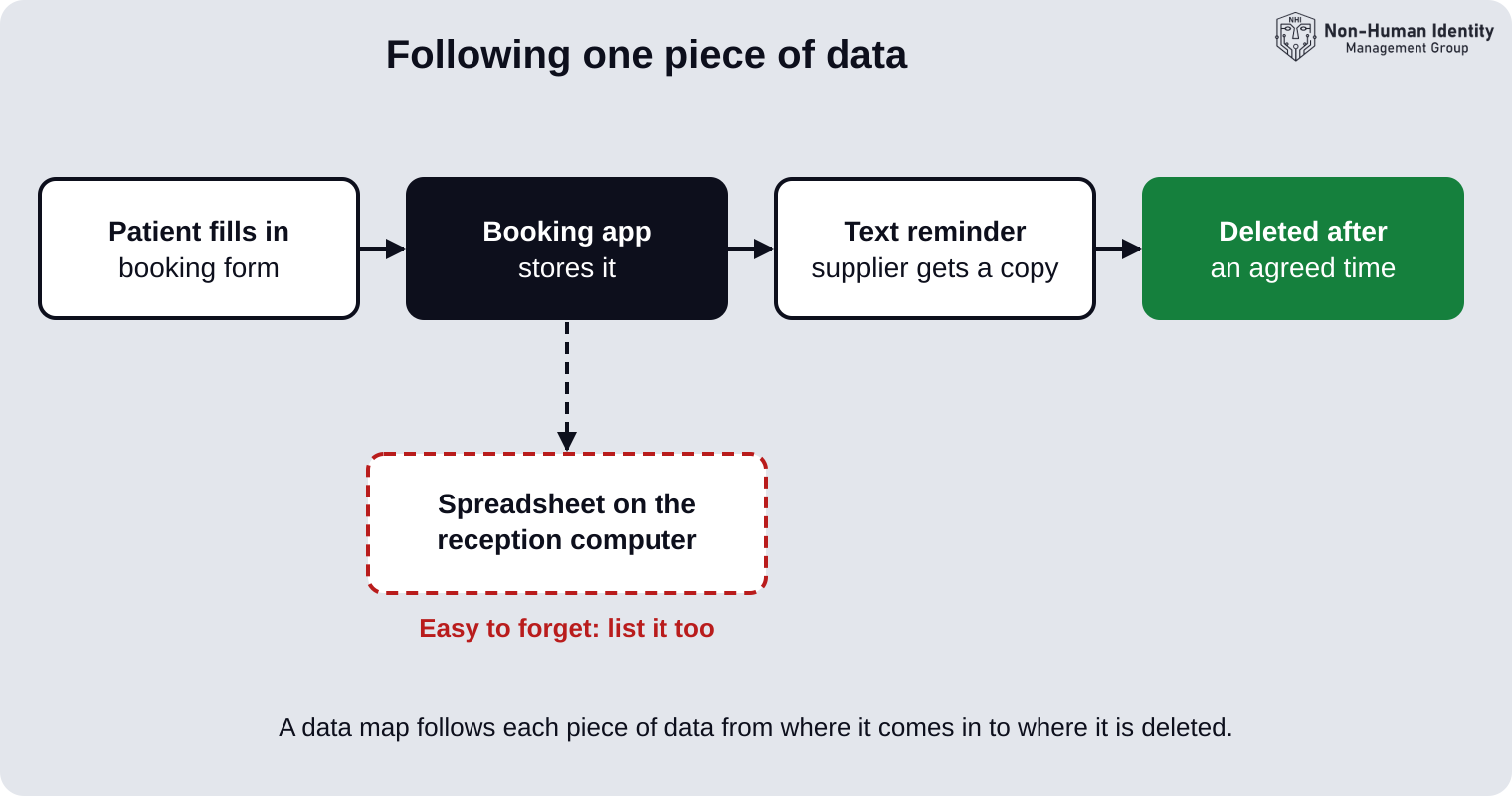
- A copy on the reception PC is easy to forget. In a real file, this line would list every place a copy is kept.
- The supplier that sends text reminders also receives the data.
- No time limit has been set, so the data may be kept longer than needed.
Why this is risky: the map shows health data in an extra place, shared with a supplier, with no plan to delete it.
The safer way: the row is complete. Every copy is listed, the supplier has a contract that covers the data, and a time limit is set.[1][3]
How does it work?
The ICO suggests these broad steps for building a first map.[1]
- Get backing. Ask a senior person to support the work, so teams make time for it.
- Ask plain questions. Send each team a short list of questions with no jargon. Ask what data they use, about whom and why. Ask who gets it, how long it is kept and how it is protected.
- Talk and check. Meet the teams. Compare what they say with your policies and supplier contracts, because practice and paperwork often differ.
- Write it down. Record the answers in a spreadsheet or tool. Link each reason to its data, people, recipients and time limit.
- Keep it alive. Treat the map as a living document. Update it when you add a new app, supplier or use of data, and review it regularly.
Do I have to keep a written record?
Under UK law, most organisations must keep some written record of how they use personal data.[3]
- If you employ 250 or more people, you must record all of it.
- If you employ fewer, you must still record some uses. These are uses that are regular, likely to put people at risk, or involve health, criminal or other sensitive data.
- The ICO calls recording the rest good practice, even where it is not required.
In practice, most small businesses use some data regularly, such as payroll or customer lists. So most end up with at least a short record. The ICO offers free spreadsheet templates.[1]
A worked example
Zola Lomax runs Sorrel Dental, a fictional dental practice with eight staff. A patient emails asking for a copy of everything the practice holds about her.
Zola asks Hugo Wojcik, the practice manager, where the patient's data is kept. He names the booking app and the clinical records system. Then he remembers a spreadsheet of reminders on the reception computer.
Zola thinks of a stock list. If the shop does not know which shelves hold an item, nobody can find it quickly.
Because the practice holds health data, Hugo checks the ICO guidance. Even small organisations must record uses that involve health data.[3] He downloads the ICO's free template.
He sends each person a short list of plain questions. The answers turn up two surprises. The text reminder supplier receives patient phone numbers, but nobody has checked its contract. And old reminder spreadsheets go back six years.
Hugo fills in one row per activity: bookings, treatment records, payroll and marketing emails. Zola agrees time limits with advice from the practice's professional body. Old spreadsheets that are past their time limit are deleted.
The patient's request is answered in good time. Hugo puts a note in the calendar to review the map every six months, and whenever a new app is added.
Myths and mistakes
| What people think | What is true |
|---|---|
| Small businesses do not need a record. | Fewer than 250 staff only narrows it. Regular, risky or sensitive uses still need recording.[3] |
| Data mapping is an IT job. | IT knows the systems. Each team knows why it uses the data. You need both.[1] |
| Once the map is done, it is done. | The ICO calls it a living document. New apps and suppliers change it.[1] |
| Listing the main systems is enough. | Copies in email, spreadsheets and shared folders count too, and they are the easiest to miss. |
| A vague row like "customer data, various uses" will do. | The ICO asks for detail, linking each purpose to its data, people, recipients and time limit.[1] |
What can I do this week?
- List every app, folder and spreadsheet that holds customer, staff or supplier details.
- Download the ICO's free template for controllers.
- Fill in one row for your most common activity, such as bookings or orders.
- Ask each team five plain questions: what data, why, where, who gets it, how long.
- Put a date in the calendar to review the map.
Checklist
- We know who is responsible for our data map.
- Each activity that uses personal data has its own row.
- Each row says what data, whose, why, where it is kept and who receives it.
- Each row has a time limit for keeping the data.
- Copies in spreadsheets, email and shared folders are included.
- Sensitive data, such as health information, is clearly marked.
- Suppliers that receive data are listed and have a contract.
- The map is updated when we add an app, a supplier or a new use.
- The map is reviewed on a set date.
Common questions
Is a data map the same as a ROPA?
Not quite. A data map is the fact-finding: what data you have and where it goes. A ROPA is the formal written record the law asks for, built from what the map finds. Many small organisations keep both in one spreadsheet.[1]
What must the written record include?
It covers who you are and why you use the data. It lists whose data, what kinds and who receives it. It notes any transfers abroad. Where possible, it adds time limits and a short note on security. The ICO lists the full set.[4]
Do I need special software?
No. The ICO says the record can be on paper or electronic, and offers spreadsheet templates. Electronic records are easier to keep up to date. Larger organisations sometimes use privacy tools, but a well kept spreadsheet is a sound start.[1]
How often should I update it?
Whenever something changes, and at a regular review. Adding an app, a supplier or a new use of data should trigger an update. The ICO describes the record as a living document to review regularly, rather than a one-off task.[1]
Does the regulator check my data map?
For most organisations the written record is a legal requirement, so you should be ready to show it. It also helps you prove you follow the rules more widely. Keeping it current is far easier than rebuilding it in a hurry.[2]
Where next?
Ready for the detail? Read the practitioner guide: Data Mapping and ROPA Guide. It goes further into what the written record must contain, how to find hidden data and trace its flow, and how to choose tools.
Also useful:
- Record of Processing Activities (ROPA) Template
- Data Classification for Beginners
- Data Retention and Secure Deletion for Beginners
- DPIA for Beginners
Related NHI Mgmt Group resources: GDPR for Beginners · Data Privacy for Beginners · Data Breach Notification for Beginners
Key terms
- Data mapping
- Finding out what personal data an organisation holds, where it is kept and where it flows.
- Personal data
- Any information that relates to an identified or identifiable living person.
- RoPA
- A written record of how an organisation uses personal data, which many organisations must keep by law.
- Special category data
- Sensitive personal data, such as health information, that the law protects more strongly.
- Processor
- A supplier that handles personal data on your behalf, such as a text reminder service.
- Data retention
- How long data is kept before it is deleted.
- Privacy notice
- The statement that tells people what you do with their data.
Sources and further reading
- How do we document our processing activities? Information Commissioner's Office (ICO), UK GDPR guidance. https://ico.org.uk/for-organisations/uk-gdpr-guidance-and-resources/accountability-and-governance/documentation/how-do-we-document-our-processing-activities/, accessed 28 Nov 2026.
- What is documentation? Information Commissioner's Office (ICO), UK GDPR guidance. https://ico.org.uk/for-organisations/uk-gdpr-guidance-and-resources/accountability-and-governance/documentation/what-is-documentation/, accessed 28 Nov 2026.
- Who needs to document their processing activities? Information Commissioner's Office (ICO), UK GDPR guidance. https://ico.org.uk/for-organisations/uk-gdpr-guidance-and-resources/accountability-and-governance/documentation/who-needs-to-document-their-processing-activities/, accessed 28 Nov 2026.
- What do we need to document under Article 30 of the UK GDPR? Information Commissioner's Office (ICO). https://ico.org.uk/for-organisations/uk-gdpr-guidance-and-resources/accountability-and-governance/documentation/what-do-we-need-to-document-under-article-30-of-the-gdpr/, accessed 28 Nov 2026.
- Documentation (guidance overview, including the note that it is under review after the Data (Use and Access) Act). Information Commissioner's Office (ICO). https://ico.org.uk/for-organisations/uk-gdpr-guidance-and-resources/accountability-and-governance/documentation/, accessed 28 Nov 2026.