A security strategy is a plan for how an organisation will protect what matters most over the next few years.
This guide is for managers, new security staff and students who keep hearing the phrase and want to know what it means in practice. You do not need to be a security expert to take part: if you run a team or approve budgets, the strategy decides what gets fixed first and what you are asked to fund.
In short
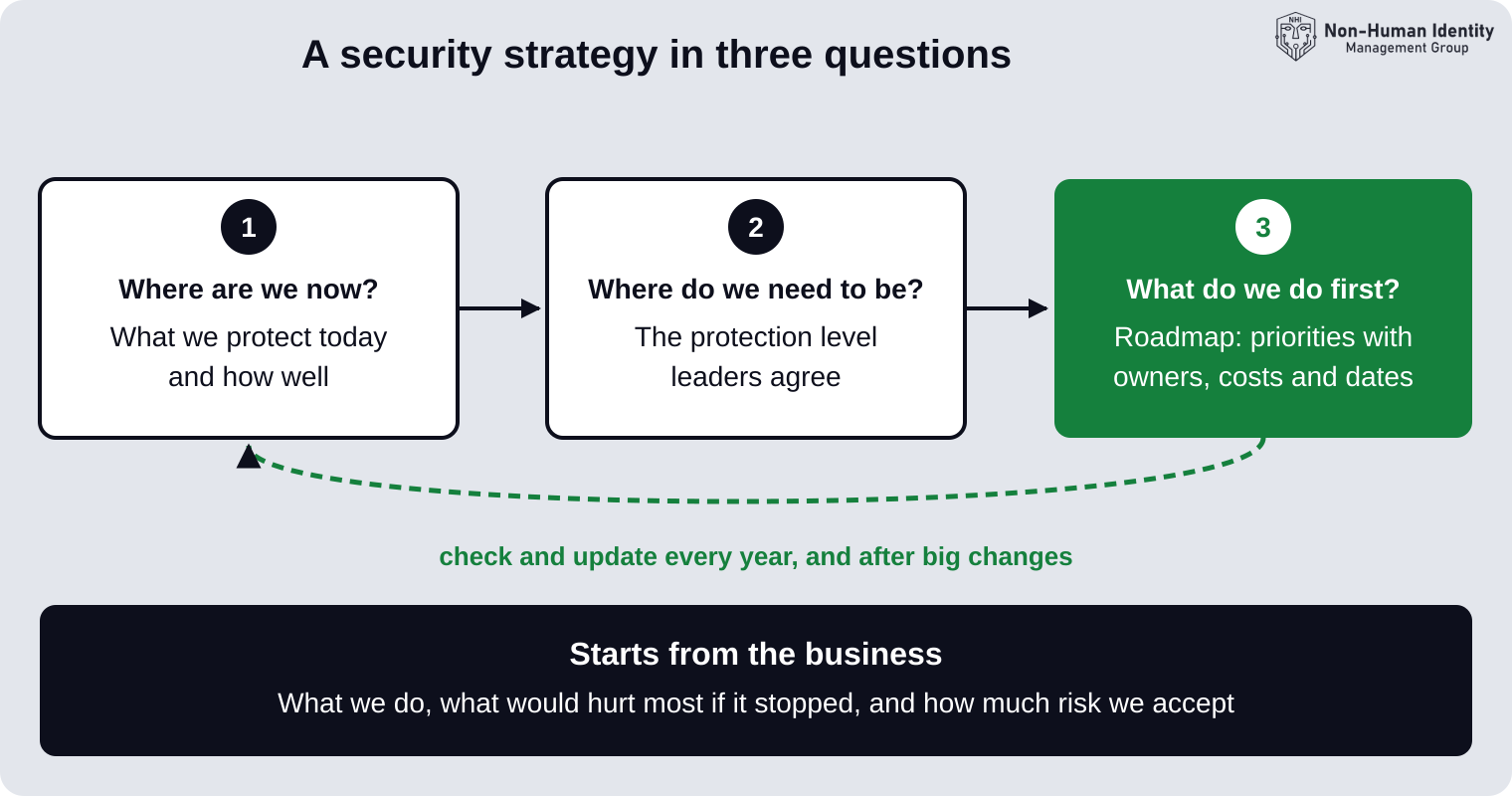
- A security strategy answers three questions: where are we now, where do we need to be, and what do we do first?
- It starts from the business: what the organisation does, what would hurt most if it stopped, and how much risk leaders accept.
- It turns into a roadmap: a short list of priorities, in order, with owners, costs and dates.
- It is checked and updated, at least once a year and after any big change or incident.
What you will learn
- Explain what a security strategy is, and how it differs from a policy or a to-do list.
- Spot the three questions every strategy should answer.
- Check whether your organisation's plan has owners, priorities and dates.
- Ask useful questions when a strategy or budget is put in front of you.
- Where we are now (current state)
- an honest picture of how well protected the organisation is today.
- Where we need to be (target state)
- the level of protection leaders agree the organisation needs.
- Route plan (roadmap)
- the ordered list of projects that moves the organisation from one to the other.
What is a security strategy?
Think of planning a long car journey. You need to know where you are starting, where you are going and which roads to take. You also need to know how much fuel and time you have.
A security strategy is the same kind of plan for protecting an organisation. It looks at what the organisation does and what would hurt most if it went wrong. It then sets out what to improve, in what order, over the next few years.
It sits above the day-to-day work. A security policy is a written rule, such as "everyone uses a second sign-in check". A roadmap is the timetable of projects. The strategy explains why those rules and projects were chosen, and why in that order.
A well-known US government framework uses the same idea. It suggests writing down a picture of today, called a current profile, and a picture of where you want to be, called a target profile. The gaps between them become the work.[1]
Where the comparison stops working: roads stay where they are. In security, the threats, the technology and the business all keep changing. So the plan needs checking along the way, not just at the start.
Why does it matter?
Without a strategy, security work tends to follow the latest scare or the loudest supplier. Money gets spent, but the biggest risks may stay untouched. A strategy helps leaders spend on what matters most and explain why.
If you run a small business
What could happen: you buy several security tools, but nobody checks whether the backups would work.
Check this: write down the three things that would hurt most if they stopped, and protect those first.
If you sit on a board or senior team
What could happen: you approve a large budget without knowing what it will change.
Check this: ask which risks the plan reduces, by when, and how you will know.
If you are new to security work
What could happen: you work hard on tasks that do not connect to what the organisation cares about.
Check this: ask to see the strategy, and find which goal your work supports.
If you manage a team
What could happen: your team is handed security tasks with no warning and no budget.
Check this: ask where your team appears on the roadmap and what is expected of it.
What does it look like?
A real strategy may be a short document or a slide pack. Here is a made-up one-page summary for a small firm.
Example only. All values are made up.
EXAMPLE Ltd security strategy, 3-year summary
Business goal: keep bookings and payments running   (1)
Most important: booking system, customer data, email
Where we are now: no tested backups; MFA on 40%     (2)
Where we need to be: tested backups; MFA for all
Year 1: MFA for all staff; test a backup restore    (3)
Year 2: staff training; list every supplier
Year 3: 24-hour alerting on key systems
Owner: EXAMPLE-Head-of-IT   Review: every 12 months (4)
- The plan starts with what the business does, not with tools.
- An honest picture of today. In a real file, this line would contain figures the team has checked.
- The roadmap. Each year has a small number of priorities, in order.
- A named owner and a review date, so the plan stays current.
Why this is risky: without the "where we are now" line, nobody can tell whether the plan is working. Without an owner and a review date, plans tend to sit in a drawer.
The safer way: keep the summary to one page and agree it with senior leaders. Link each priority to a risk, and check progress on a set date.
How does it work?
Most strategies are built in roughly the same five steps.
- Understand the business. What does the organisation do, what would hurt most if it stopped, and what laws or customers set rules it must meet?
- Agree how much risk is acceptable. Leaders decide what they are willing to live with. This is called risk appetite.
- Look at where you are now. Check how well the important things are protected today. Many teams use a framework (a ready-made list of good practice) as a checklist.[3]
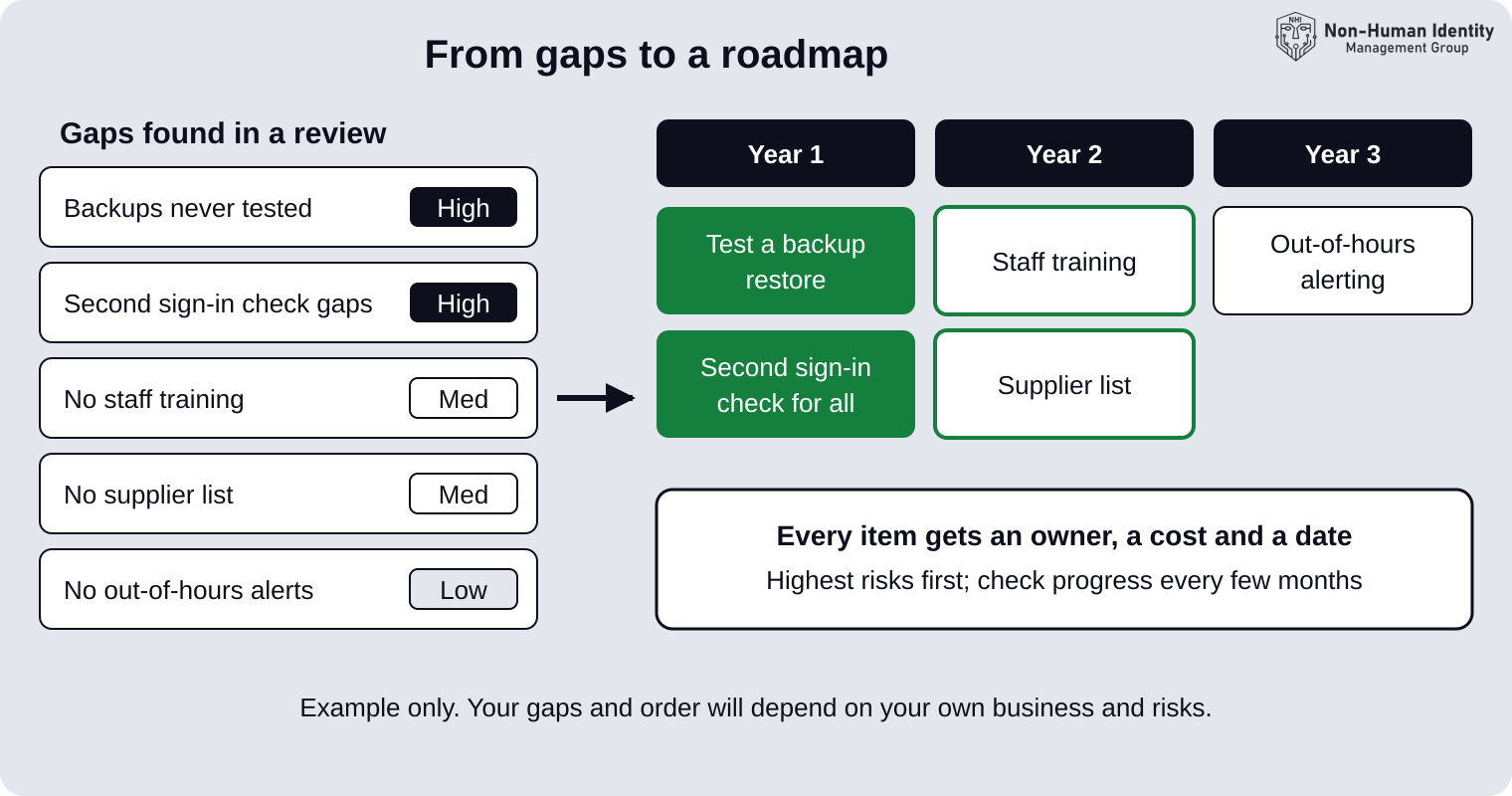
- Choose where you need to be and plan the route. Compare today with the target, rank the gaps by risk, and turn the top ones into a roadmap with owners, costs and dates.
- Run it, measure it and review it. Report progress to senior leaders. Revisit the plan each year, and after big changes or incidents.
Boards have a part to play too. The UK's National Cyber Security Centre publishes a toolkit for boards. It helps them build security into how the organisation is run, and suggests questions to ask their teams.[2]
A worked example
Petra Castell has just joined Cobble Lettings, a fictional letting agent with 40 staff, as its first IT and security lead. The managing director, Zane Corrigan, asks her for "a security strategy" by the end of the quarter.
Petra starts like a driver planning a journey: where are we, and where are we going? She spends two weeks talking to people, not buying tools.
She learns that the firm lives on two things: its online lettings system and the tenants' personal details. If either were lost or leaked, the firm would struggle to trade. Those become the "most important" list.
Next she looks at where the firm is now. Backups exist but have never been tested. Only some staff use a second sign-in check. Nobody keeps a list of the suppliers who can reach the firm's systems.
Petra meets Zane to agree the target. He is clear that the lettings system being down for a week would be unacceptable. A day might be survivable.
She writes a one-page plan. Year 1 covers a second sign-in check for everyone and a real backup restore test. Year 2 covers staff training and a supplier list. Year 3 adds out-of-hours alerting. Each item has an owner and a rough cost.
Zane approves year 1 and asks for a short progress update every three months. Petra adds a line at the bottom: "Review every year, and after any major incident or change."
Six months later, the backup test fails on the first try. Because it is on the plan, the fix is funded straight away.
Myths and mistakes
| What people think | What is true |
|---|---|
| A strategy is a list of tools to buy. | A strategy starts from the business and its risks. Tools come later, if they help close a gap. |
| The longer the document, the better the strategy. | A short plan that leaders read and agree is usually more useful than a long one nobody opens. |
| Security strategy is the IT team's job alone. | Senior leaders set the risk appetite and approve the money. A UK government toolkit puts board involvement at the centre.[2] |
| Once written, the strategy is done. | Threats and the business change. Review the plan regularly and after major changes or incidents. |
| We should fix everything at once. | Few organisations can. Ranking gaps by risk means the most serious ones get fixed first. |
What can I do this week?
- Write down the three systems or kinds of data your organisation could least afford to lose.
- Ask whether a security strategy or roadmap exists, and who owns it.
- Find out when it was last reviewed, and whether senior leaders signed it off.
- Pick one priority on it and ask how progress is measured.
Checklist
- The strategy names what matters most to the business.
- Senior leaders have agreed how much risk is acceptable.
- There is an honest description of where things stand today.
- There is a clear target for where the organisation needs to be.
- Gaps are ranked by risk, and the top ones are on a roadmap.
- Each roadmap item has an owner, a rough cost and a date.
- Progress is reported to senior leaders on a set schedule.
- The plan is reviewed at least once a year and after major changes.
Common questions
What is the difference between a security strategy and a security policy?
A strategy is the plan, and a policy is a rule. The strategy says what the organisation will improve and why, over a few years. A policy says what people must do today, such as using a second sign-in check. Good policies usually come out of the strategy.
How long should a security strategy cover?
Often around three years, with a more detailed plan for the first year. That is long enough to make real progress and short enough to stay relevant. Many organisations check the plan every year and change it after big events, such as a merger or a serious incident.
Does a small business need a security strategy?
Yes, but it can be very short. A single page listing what matters most, the main gaps and the next few fixes is a strategy. The point is to choose priorities on purpose, rather than react to whatever comes up next.
Who writes the security strategy?
Usually the senior security leader, often called a CISO, or the head of IT in smaller firms. They should write it with business leaders, not alone. Senior leaders or the board agree the risk appetite and sign off the plan and budget.
Do I have to use a framework to write one?
No, but it helps. A framework is a ready-made list of good practice. It makes it easier to check where you are now and to spot gaps. Many teams use one as a checklist, then shape the plan around their own business.
Where next?
Ready for the detail? Read the practitioner guide: Security Strategy and Roadmap Guide. It goes further into building current and target profiles, ranking gaps and turning them into a funded three-year roadmap.
Also useful:
- Cyber Risk Management for Beginners
- NIST Cybersecurity Framework for Beginners
- The CISO Role for Beginners
- Board Cyber Risk Reporting Guide
Related NHI Mgmt Group resources: CISO Guide: First 90 Days · Security Metrics and KPIs Programme Guide · Governance, Risk and Compliance for Beginners
Key terms
- Security strategy
- A plan for how an organisation will protect what matters most over the next few years.
- Roadmap
- The ordered timetable of projects that carries out the strategy.
- Risk appetite
- How much and what kind of risk leaders are willing to accept to reach their goals.
- Current profile
- A written picture of how well the organisation is protected today.
- Target profile
- A written picture of the protection the organisation has chosen to aim for.
- Risk register
- A list of known risks, how likely and serious each is, and who owns it.
- NIST Cybersecurity Framework
- A free US government framework of good security outcomes, used by organisations of all sizes.
Sources and further reading
- The NIST Cybersecurity Framework (CSF) 2.0 (NIST CSWP 29). National Institute of Standards and Technology, 26 February 2024. https://nvlpubs.nist.gov/nistpubs/CSWP/NIST.CSWP.29.pdf, accessed 28 Nov 2026.
- Cyber Security Toolkit for Boards. National Cyber Security Centre (UK), published 30 March 2023, reviewed 8 April 2025. https://www.ncsc.gov.uk/collection/board-toolkit, accessed 28 Nov 2026.
- Cybersecurity Framework. National Institute of Standards and Technology. https://www.nist.gov/cyberframework, accessed 28 Nov 2026.