Risk treatment is choosing what to do about a risk: avoid it, reduce it, transfer it or accept it.
This guide is for students, people new to security or risk work, and anyone asked to sign off a risk. You do not need a technical job to be affected: managers and business owners make these choices every time they approve a project or renew insurance.
In short
- There are four common choices: stop the activity (avoid), add safeguards (reduce), pass on some of the cost (transfer) or live with it on purpose (accept).
- Most real decisions mix two or more choices, for example reduce first, then insure what is left.
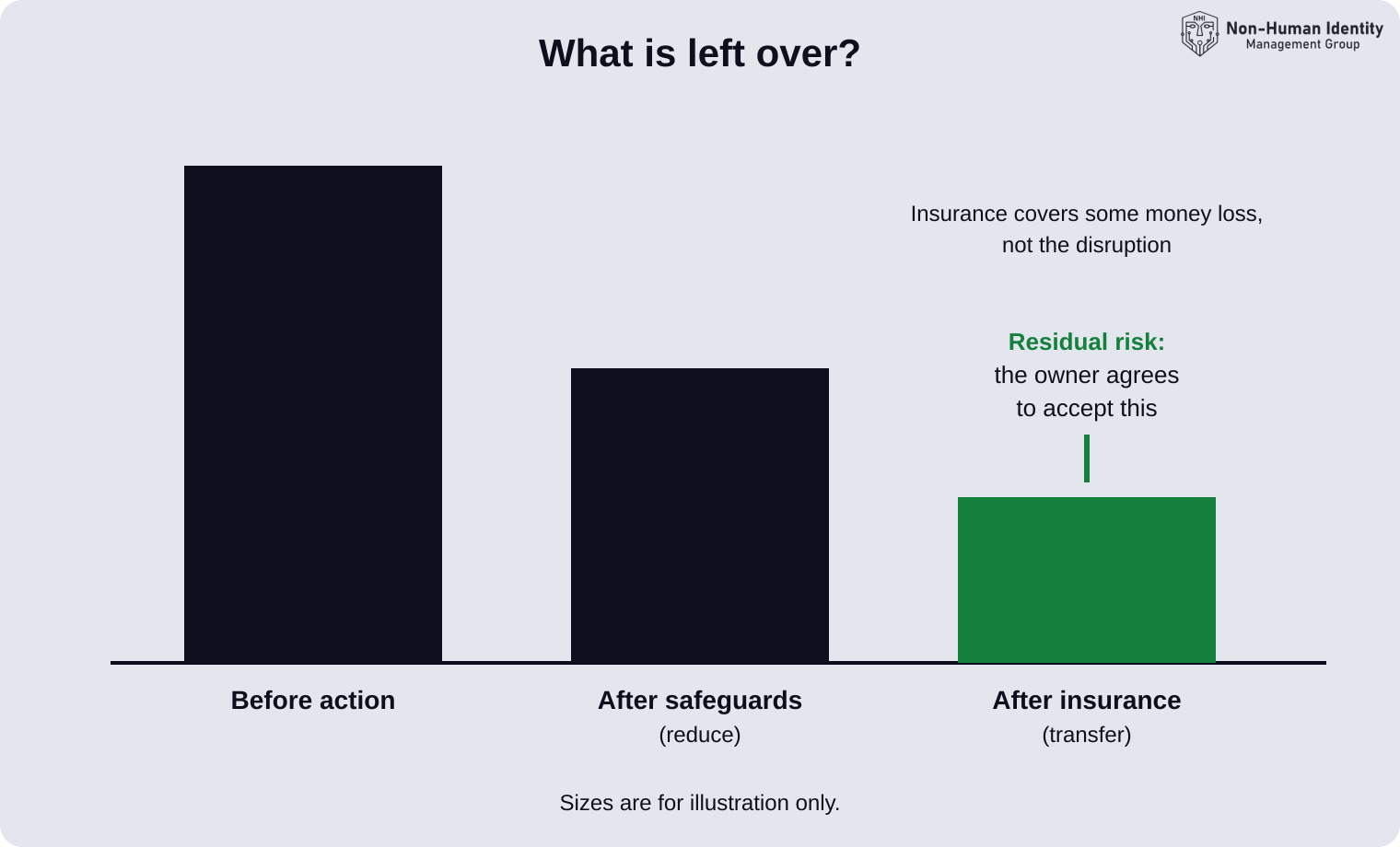
- Some risk is almost always left over. That leftover is called residual risk, and someone must agree to carry it.
- Insurance and contracts pass on some money loss, not the whole problem. The business still lives with the disruption.
What you will learn
- Explain the four risk treatment options in plain words.
- Spot which option a real decision uses, including mixes.
- Check that an accepted risk has an owner and a review date.
- Ask what risk is left over after a safeguard is added.
- Plan for a risk (risk treatment)
- the decision about what to do with a risk once you know about it.
- What is left over (residual risk)
- the risk that remains after you have taken action.
- Person in charge (risk owner)
- the person who answers for a risk and the decision made about it.
What is risk treatment?
Think of planning a family holiday abroad. You could decide not to go at all. You could get the right jabs and lock your bags. You could buy travel insurance. And you accept that it might rain.
Those are the four choices of risk treatment. In security, the "holiday" might be a new app, an old computer you still use, or a supplier you rely on.
- Avoid: stop or never start the risky activity.
- Reduce: add a safeguard so the bad event is less likely or less harmful. Some guides call this mitigate.
- Transfer: pass some of the cost to someone else, usually an insurer or a supplier. Some guides call this share.
- Accept: knowingly live with the risk, because it is small or the fix costs too much.
Where the comparison stops working: a holiday is one trip with a clear end. Security risks change as systems, attackers and the business change, so each choice needs checking again later.
Why does it matter?
A risk that is found but never treated is just a worry on a list. The choice decides where money and effort go, and who answers if things go wrong.
If you run a small business
What could happen: you buy cyber insurance and assume you are covered, but the policy excludes the kind of loss you suffer.
Check this: read what your policy leaves out, and keep basic safeguards in place.
If you are studying for a security exam
What could happen: a question describes a firm that buys insurance, and you need to name the option as transfer.
Check this: practise naming the option in everyday examples, including mixes.
If you are new to a risk or compliance job
What could happen: a risk was "accepted" years ago, and nobody remembers who agreed or why.
Check this: make sure every accepted risk has a named owner, a reason and a review date.
What does it look like?
Here is a made-up decision card, the kind of note a team keeps for each risk.
Example only. All values are made up.
Risk:        Old booking PC no longer gets security updates
Rating:      High before action                      (1)
Option:      Reduce, then accept what is left        (2)
Actions:     Unplug it from the internet, move
             bookings to a new system by June        (3)
Left over:   Low, until the PC is retired            (4)
Owner:       EXAMPLE Practice Manager                (5)
Review by:   30 June                                 (6)
- How serious the risk is before anything is done.
- The chosen options. Mixes are normal.
- The safeguards, with a date.
- The residual risk once the actions are done.
- The person who agrees to carry what is left. In a real file, this line would name a person, not a team.
- When the decision must be looked at again.
Why this is risky: without an owner and a date, "accept" quietly becomes "forget".
The safer way: write down the option, the actions, what is left over, who agreed and when to check again.
How does it work?
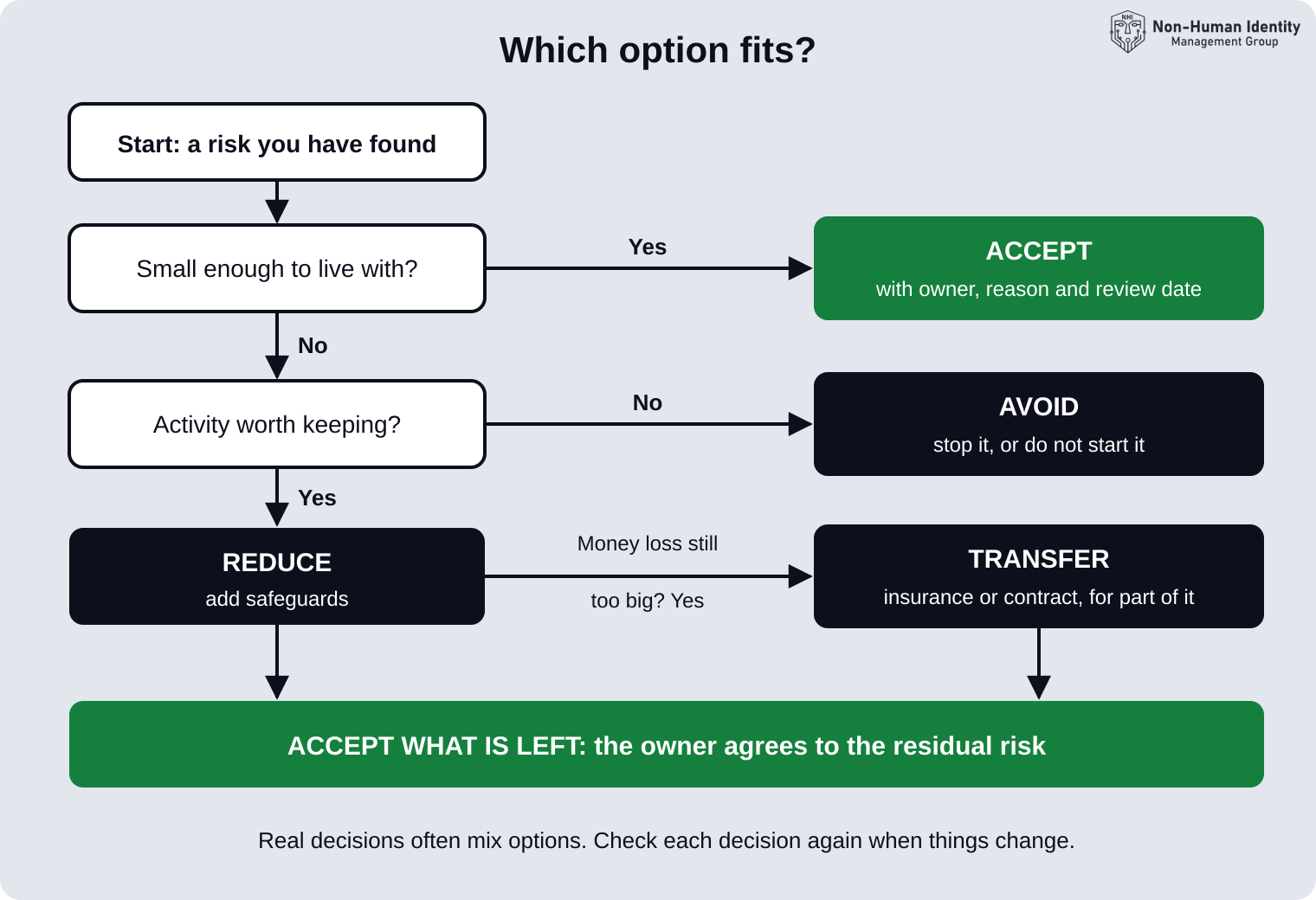
US government security guidance describes the same set of responses: accepting, avoiding, mitigating, sharing or transferring risk.[1] Here is a simple way to choose.
- Start with the risk. Know what could go wrong, how likely it is and how bad it would be. This usually comes from a risk assessment.
- Compare it with what the business will put up with. This limit is called risk appetite. If the risk is already small enough, accepting it may be fine.
- Ask if the activity is worth it. If the risk is too big and the activity is not essential, avoiding it may be best.
- Look for safeguards. If the activity matters, reduce the risk with safeguards. They should cost less than the harm they help to avoid.
- Pass on part of the cost if it helps. Insurance or a contract can cover some money loss. Policies have exclusions, so some losses may not be paid.[3]
- Agree what is left. Residual risk is the risk that remains after responses are carried out.[2] The risk owner accepts it, and the decision is recorded in a list of risks called a risk register.[4]
A worked example
This story is made up to show how it can happen.
Dana Quist manages a dental practice with eight staff. A review lists three risks. Dana must decide what to do with each one.
The first is an old booking PC that no longer gets security updates. Bookings matter, so avoiding the activity is not an option. Dana reduces the risk instead. The PC is taken off the internet, and bookings move to a new system within three months.
Until then, some risk is left. Dana accepts it in writing, with her name and a review date at the end of June.
The second risk is a free online file-sharing site that one dentist uses for patient X-rays. Nobody needs it, because the practice system can already share images. Dana avoids the risk: the site is no longer used.
The third risk is ransomware, harmful software that locks files and asks for money. Dana reduces it with tested backups and two-step sign-in, a second check such as a code on a phone.
She also talks to Cyrus Rosen, the practice's insurance broker, about cyber insurance to cover some of the costs. Cyrus points out the exclusions in the policy wording. Dana notes that insurance would not give back lost days with patients.
At the next team meeting, Dana shows each risk, the option chosen, what is left over and who owns it.
Myths and mistakes
| What people think | What is true |
|---|---|
| Accepting a risk means ignoring it. | Accepting is a recorded decision by the right person, with a reason and a review date. |
| Buying insurance means the risk is gone. | Insurance can pay for some losses. Exclusions apply, and the disruption still lands on you.[3] |
| You must pick just one option. | Most decisions mix options, such as reduce, then transfer, then accept what is left. |
| After safeguards, the risk is zero. | Some residual risk usually remains after controls are applied.[2] |
| Avoiding is always the safest choice. | Avoiding also removes the benefit of the activity. Use it when the activity is not worth the risk. |
What can I do this week?
- Pick three risks you know about at work or home and name the option used for each.
- Find one "accepted" risk and check it has an owner and a review date.
- Read the exclusions list in any cyber or business insurance policy you rely on.
- Ask what risk is left over after your most recent safeguard was added.
Checklist
- Each known risk has a chosen option, not just a rating.
- Mixed options are written down part by part.
- Each accepted risk has a named owner, a reason and a review date.
- Residual risk is stated for every treated risk.
- Insurance exclusions have been read and noted.
- Avoided activities have really stopped, not just been discouraged.
- Decisions are reviewed when the business or the systems change.
Common questions
What are the four risk treatment options?
Avoid, reduce, transfer and accept. Avoid means stopping the activity. Reduce means adding safeguards. Transfer means passing some cost to an insurer or supplier. Accept means living with the risk on purpose. Some frameworks use the words mitigate and share for reduce and transfer.
Is mitigate the same as reduce?
Yes, in everyday use. Both mean adding safeguards that make a bad event less likely or less harmful. US government guidance uses the word mitigating. Other guides and exam books say reduce or modify. The idea underneath is the same.
Does insurance transfer all of the risk?
No. Insurance can pay for some losses, but policies have exclusions, and some costs, such as internal staff time, are typically not covered.[3] The business still lives with the disruption, the upset customers and the work of recovering.
Who is allowed to accept a risk?
Someone with the authority to carry it, usually a manager or senior leader who owns the area at risk. Many organisations set limits, so bigger risks need more senior sign-off. The decision should be written down with a reason and a date to review it.
What is residual risk?
It is the risk left over after you have acted. Safeguards and insurance shrink a risk, but rarely remove it completely. The owner should know what is left and agree to accept it, or ask for more action.
Where next?
Ready for the detail? Read the practitioner guide: Risk Treatment Plan Template. It goes further into the fields each treatment action needs, who may approve residual risk at each level, and how progress is tracked.
Also useful:
- Accept vs Transfer vs Mitigate vs Avoid
- Cyber Risk Management for Beginners
- Cyber Insurance for Beginners
- Cyber Risk Appetite Statement Template
Related NHI Mgmt Group resources: GRC and Cyber Compliance Glossary · GRC Analyst Career Guide · Risk Treatment Plan vs Statement of Applicability
Key terms
- Risk treatment
- The planned response to a risk: avoiding, reducing, sharing or accepting it.
- Risk avoidance
- Removing a risk by stopping, or never starting, the activity that causes it.
- Risk mitigation
- Reducing how likely or how harmful a risk is, usually by adding safeguards.
- Risk transfer
- Passing some of the money impact of a risk to another party, such as an insurer.
- Risk acceptance
- A formal, owned decision to live with a risk rather than act on it now.
- Residual risk
- The risk that remains after safeguards and other responses are in place.
- Risk appetite
- How much and what kind of risk an organisation is prepared to take.
- Risk register
- A list of known risks with their ratings, owners and chosen responses.
Sources and further reading
- Risk response (glossary entry, from NIST SP 800-39 and others). Computer Security Resource Center, National Institute of Standards and Technology (NIST). https://csrc.nist.gov/glossary/term/risk_response, accessed 28 Nov 2026.
- Residual risk (glossary entry, from CNSSI 4009-2022, NIST SP 800-30 Rev. 1 and NISTIR 8286). Computer Security Resource Center, NIST. https://csrc.nist.gov/glossary/term/residual_risk, accessed 28 Nov 2026.
- Cyber insurance guidance. National Cyber Security Centre (UK). https://www.ncsc.gov.uk/guidance/cyber-insurance-guidance, accessed 28 Nov 2026.
- NIST IR 8286B, Prioritizing Cybersecurity Risk for Enterprise Risk Management. NIST, February 2025. https://csrc.nist.gov/pubs/ir/8286/b/upd1/final, accessed 28 Nov 2026.