HITRUST is a security certification that shows a supplier has been checked against a shared list of controls.
This guide is for people at small healthcare suppliers, students and managers who have been asked "Are you HITRUST certified?" and want to know what it means. You do not need to be a hospital to meet it: software firms, billing companies and other suppliers are often asked for it.
In short
- HITRUST is a company that runs a security framework, the HITRUST CSF, and certifies organisations against it.
- There are three main levels: e1 (basic), i1 (middle) and r2 (most detailed).
- An approved outside assessor tests your controls, and HITRUST checks the assessor's work before the report is issued.
- HITRUST is a voluntary industry certification. It is not required by US health privacy law, and it does not replace your duties under that law.
What you will learn
- Explain what HITRUST is in one sentence.
- Tell the e1, i1 and r2 levels apart.
- Check which level a customer is really asking for.
- Ask the right questions before you start.
Status: correct as at 28 November 2026, based on HITRUST's own website and guidance from the US Department of Health and Human Services. Rules and programmes change; check the official sources.
This guide explains the topic in general terms and is not legal advice.
- Shared list of controls (HITRUST CSF)
- a large set of security checks built from many standards and laws.
- Approved checker (External Assessor)
- an outside firm that HITRUST allows to test organisations against the list.
- Security check (control)
- one thing you do to protect data, such as locking accounts after failed logins.
What is HITRUST?
Think of a home survey before you buy a house. An approved surveyor visits, checks the building against a standard list and writes a dated report. HITRUST works in a similar way for an organisation's security.
HITRUST is the name of a company and of its certificate. Its main tool, the HITRUST CSF, is a big list of security checks. It pulls rules from more than 60 other lists and standards into one place.[1] These include world security standards, US government advice and US health privacy law.[2]
Health buyers often ask suppliers for it. One report can answer many of their questions at once.
Where the comparison stops working: a house survey looks at one building on one day. A HITRUST certificate covers a set part of your firm, called the scope. It must also be renewed to stay current.
Why does it matter?
Hospitals and health insurers share patient data with many suppliers. They need a way to check those suppliers, and many use HITRUST as one option.
If you run a small healthcare supplier
What could happen: a contract stalls because a buyer asks for HITRUST and you do not know which level they mean.
Check this: ask the buyer in writing which level and which systems they expect.
If you buy services for a hospital
What could happen: you accept a certificate that covers a different system from the one you are buying.
Check this: read the scope in the report, and check the date.
If you are studying security or compliance
What could happen: you mix up HITRUST with the law, and give wrong advice in an interview or a first job.
Check this: learn the difference between a law you must follow and a certification you choose.
Next: HIPAA for Beginners
What does it look like?
Here is a made-up scenario card of the kind a supplier might get from a new customer.
Example only. All values are made up.
From: [email protected]
To:   [email protected]
Subject: Security review for contract EXAMPLE-0000

Before we sign, please send one of:
 - a current HITRUST certification           (1)
 - for this service, at least the i1 level   (2)
 - covering the app and the cloud it runs on (3)
Reply by 01/01/2000.
- The buyer wants a report that has not run out.
- The buyer names the level. Without that line, you would need to ask.
- This is the scope: the systems the report must cover.
Why this is risky: a supplier who guesses may spend months on the wrong level, or on systems the buyer does not care about.
The safer way: confirm the level, scope and deadline in writing first. Then ask whether any report you already hold, or a lighter level, would be accepted for now.
How does it work?
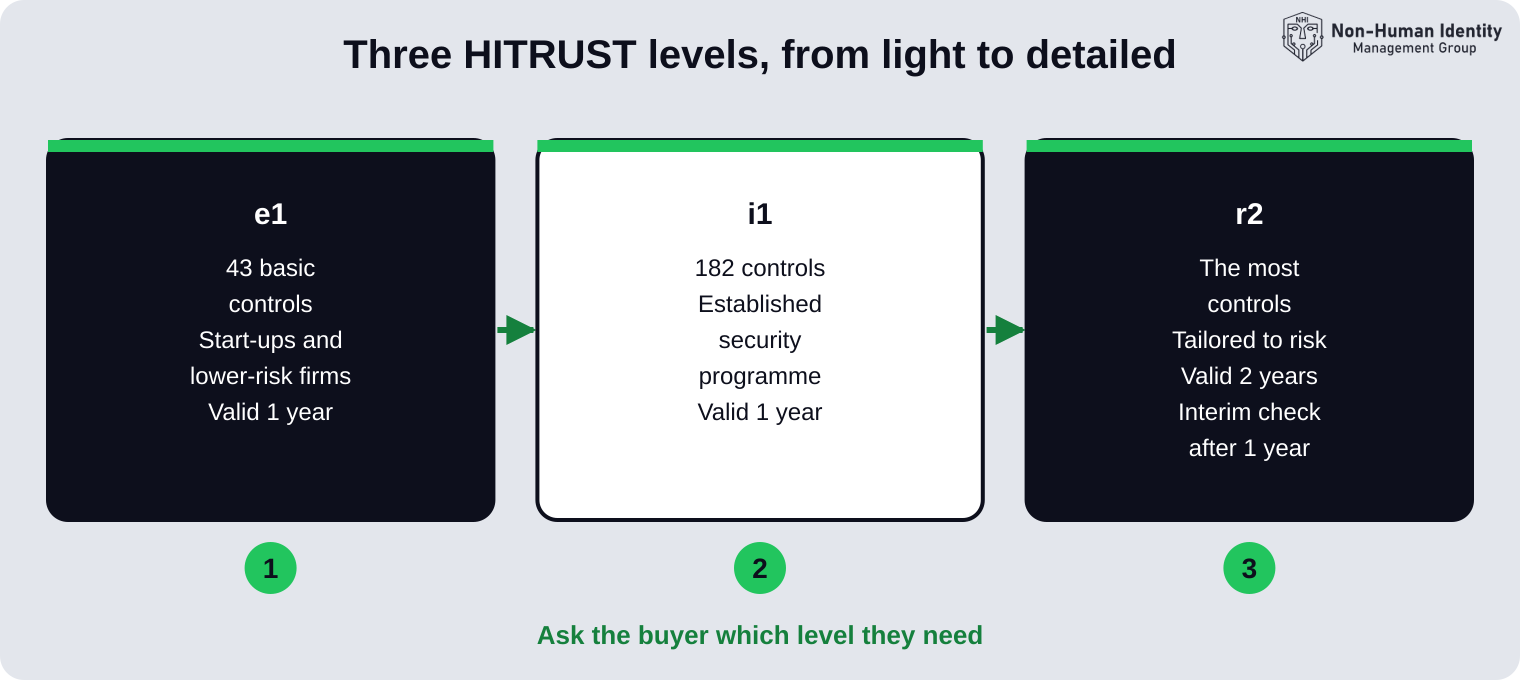
There are three main levels, and each one asks for more than the last.[1]
- e1: 43 basic controls. Aimed at start-ups and lower-risk firms. Valid for one year.[1][3]
- i1: 182 controls. Aimed at firms with an established security programme. Valid for one year.[1]
- r2: the most controls, tailored to the firm's risks and chosen standards. Valid for two years, with an interim check after one year.[1][4]
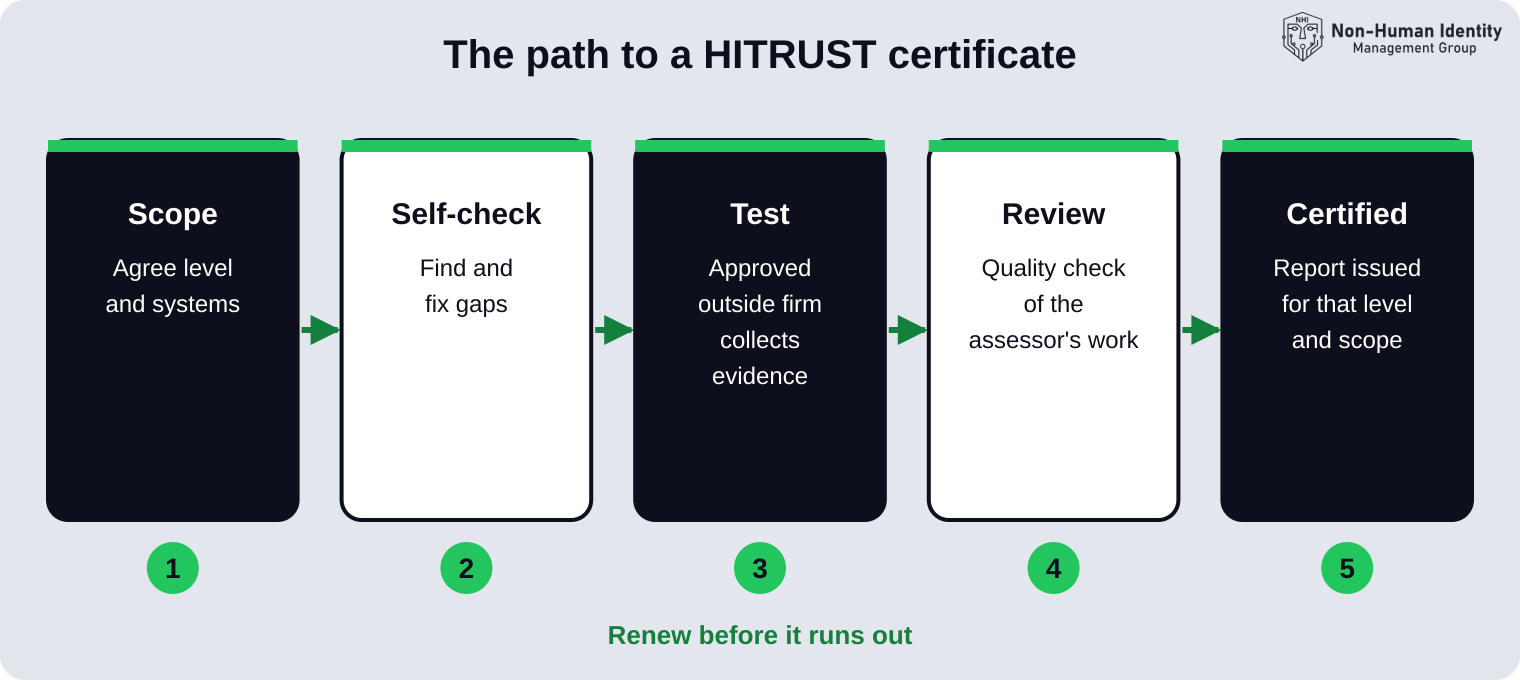
The journey to a certificate usually follows these steps:
- Agree the level and scope. Decide which systems, sites and teams are covered.
- Check yourself first. Compare what you do today with the controls, and fix the gaps.
- An approved assessor tests. An External Assessor, a firm HITRUST has approved, tests your controls and collects evidence.[1]
- HITRUST checks the work. A HITRUST quality reviewer re-checks a sample of the assessor's work and raises questions to answer.[5]
- Report and certificate. HITRUST prepares the report. If the controls meet the bar, the organisation is certified for that level and scope.[5]
- Keep it current. Renew before it runs out, and keep the controls working in between.
A worked example
Petra Jovanovic runs a small, fictional company that makes appointment software for clinics. It has fifteen staff and stores patient names and appointment times in the cloud.
A hospital group wants to buy her software. Odile Haddad, who checks suppliers for the hospital, sends a security review request. It says "HITRUST certification required."
Petra remembers the house survey idea. Before anyone visits, you need to know which building is being surveyed. So she asks Odile two questions: which level, and which systems?
Odile replies that an e1 is enough for the first year, covering the app and its cloud hosting. Her team will ask for i1 at renewal.
Petra compares her controls with the e1 list. She finds two gaps. Not every account has multi-factor sign-in, and there is no written incident plan. Her team fixes both over a few weeks.
She then hires an approved assessor, who tests the controls and sends the work to HITRUST. HITRUST's reviewer asks one question about how backups are tested, and Petra's team answers it.
Some weeks later, the report arrives. Petra sends it to Odile, along with a short note on the scope and the date it runs out. She also adds a reminder to plan for the i1 next year.
Myths and mistakes
| What people think | What is true |
|---|---|
| HITRUST is required by HIPAA. | The US health department says it does not endorse or recognise private certifications for its Security Rule.[6] HITRUST is a voluntary choice. |
| Being certified means we are HIPAA compliant. | A certification does not remove your legal duties. The regulator can still find a problem later.[6] |
| Any HITRUST level will do. | Buyers often ask for a specific level. Ask before you start. |
| The certificate covers the whole company. | It covers the scope that was tested. Read the scope. |
| Once certified, we are done. | e1 and i1 last one year, and r2 two years with an interim check.[1] |
What can I do this week?
- Ask each customer who wants HITRUST which level and scope they need, in writing.
- List the systems that hold patient or customer health data.
- Read the e1 overview on the HITRUST website to see what the basic level covers.
- Find out which other reports you already hold, such as a SOC 2 report or an international security certificate.
- Pick one owner for the work, and agree a rough date.
Checklist
- We know which HITRUST level each customer expects.
- The scope (systems, sites, teams) is written down and agreed.
- We have compared our controls with the level's list and fixed the gaps.
- We have chosen an approved External Assessor.
- One person owns the work and the renewal date.
- Staff know that the certificate does not replace our legal duties.
- We share the report with its scope and expiry date, not just the word "certified".
Common questions
Is HITRUST the same as HIPAA?
No. HIPAA is a US law that protects health information. HITRUST is a private certification that many firms use to show their security is checked. A HITRUST report can help show good practice, but it does not replace what the law asks of you.
Which HITRUST level should we start with?
Start with the level your customers ask for. If they do not say, ask. HITRUST aims e1 at start-ups and lower-risk firms, and i1 at firms with an established programme. The r2 is for firms that need the most detailed check.
Can we certify ourselves?
No, not for a certificate. An approved External Assessor must test your controls, and HITRUST reviews the work before the report is issued. You can and should check yourself first, so you find gaps before you pay for the test.
How long does a HITRUST certificate last?
e1 and i1 certificates last one year. An r2 lasts two years, with an interim check after the first year. Plan the renewal early, because the work starts well before the date it runs out.
Do we need HITRUST if we already have another security report?
Ask your buyers first. Some healthcare customers accept other reports, and some ask for HITRUST by name. If you do need HITRUST, work you did for other reports can often help, as many controls overlap.
Where next?
Ready for the detail? Read the practitioner guide: HITRUST CSF Guide. It goes further into how the framework is built, how controls are scored and how to plan scope and evidence for each level.
Also useful:
- HIPAA vs HITRUST
- HIPAA for Beginners
- Security Certifications for Businesses for Beginners
- SOC 2 for Beginners
- Answering Security Questionnaires as a Small Supplier
Related NHI Mgmt Group resources: HITRUST AI Security Certification Guide · Healthcare Identity Security Guide · HIPAA Business Associate Agreements Guide
Key terms
- HITRUST
- A company and certification that checks organisations against one combined list of security controls.
- HITRUST CSF
- HITRUST's framework, a library of controls built from many standards and laws.
- External Assessor
- An outside firm approved by HITRUST to test an organisation's controls.
- Security control
- One thing an organisation does to lower the chance or harm of misuse of its systems or data.
- HIPAA
- A US law that protects health information held by healthcare organisations and their partners.
- Third-party risk management
- Checking suppliers for the risks they bring, before and during the contract.
Sources and further reading
- Assessments and Certifications. HITRUST. https://hitrustalliance.net/assessments-and-certifications, accessed 28 Nov 2026.
- HITRUST Framework (HITRUST CSF). HITRUST. https://hitrustalliance.net/hitrust-framework, accessed 28 Nov 2026.
- HITRUST e1 Assessment. HITRUST. https://hitrustalliance.net/assessments-and-certifications/e1, accessed 28 Nov 2026.
- HITRUST r2 Assessment. HITRUST. https://hitrustalliance.net/assessments-and-certifications/r2, accessed 28 Nov 2026.
- HITRUST Assessment Handbook: Quality assurance process. HITRUST. https://www.manula.com/manuals/hitrust/hitrust-assessment-handbook/1/en/topic/quality-assurance-process, accessed 28 Nov 2026.
- Are we required to certify our organization's compliance with the standards? (FAQ 2003). US Department of Health and Human Services. https://www.hhs.gov/hipaa/for-professionals/faq/2003/are-we-required-to-certify-our-organizations-compliance-with-the-standards/, accessed 28 Nov 2026.