A knowledge cutoff is the date after which an AI model learned little or nothing from its training.
This guide is for anyone who uses a chat assistant and has wondered why it got recent news wrong. If your work relies on AI answers about prices, laws, products or security warnings, the date behind those answers matters.
In short
- An AI model learns from text collected up to a certain date. After that, its built-in knowledge stops.
- Models are usually released months after their cutoff, so even a brand new model can miss recent events.
- Asked about later events, a model may say it does not know, or it may give an out-of-date answer that sounds sure.
- Web search and document lookup can bring in newer facts. Check whether your tool used them, and check its sources.
What you will learn
- Explain what a knowledge cutoff is in one sentence.
- Spot an answer that may be out of date.
- Check whether an AI tool searched the web before answering.
- Ask the right question when an AI answer depends on recent facts.
- "Correct as of" date (knowledge cutoff)
- the date after which a model's training gave it little or no information.
- Looking things up first (grounding)
- when an AI tool finds pages or documents and bases its answer on them, not on memory alone.
What is a knowledge cutoff?
Think of a printed travel guidebook. On the first page it says "correct as of" a date. It is still useful, but you would not trust it for this week's train times or a café that opened last month.
An AI model is similar. A large language model, the kind of AI behind chat assistants, learns by reading a huge amount of text. That text was collected up to a certain date. Once training ends, what the model "knows" is fixed. That date is its knowledge cutoff.
Ask about something that happened later, and the model cannot know it from training alone. It may say so. Or it may guess, using older patterns, and sound just as sure as usual.
Where the comparison stops working: a guidebook prints its date on the cover. Many AI tools do not show their cutoff on screen, and some makers do not publish one at all.
Why does it matter?
An out-of-date answer can look exactly like a correct one. Anthropic says a model's knowledge is "most extensive and reliable" up to its cutoff. That suggests less is known about the last weeks before it.[1]
If you use AI for study or homework help
What could happen: you quote a "latest" fact that changed months ago.
Check this: for anything recent, ask for sources and open them.
If you run a small business
What could happen: an AI answer about tax rates, rules or supplier prices is out of date.
Check this: confirm money and legal answers on the official website.
If you are new to IT work
What could happen: an AI assistant does not know about a recent security warning for software you look after.
Check this: check the software maker's own security notices, not only the AI answer.
What does it look like?
Here is a made-up chat. The tool has no web search turned on.
Example only. All values are made up.
You:  What is the newest version of ExampleApp?
AI:   The newest version is ExampleApp 4.0.        (1)
You:  When was that released?
AI:   It came out recently, in early last year.    (2)
You:  Did you check the web for this?
AI:   No, this is from my training.                (3)
- In a real message, this line would contain the newest version the model saw in training, which may not be the newest today.
- "Recently" means recent to the model's training, not to you.
- The tool did not look anything up, so the answer can only be as fresh as the cutoff.
Why this is risky: the answer sounds sure and gives no date, so it is easy to trust.
The safer way: use a tool that can search, or give it the current facts yourself. Then check the sources it shows.
How does it work?
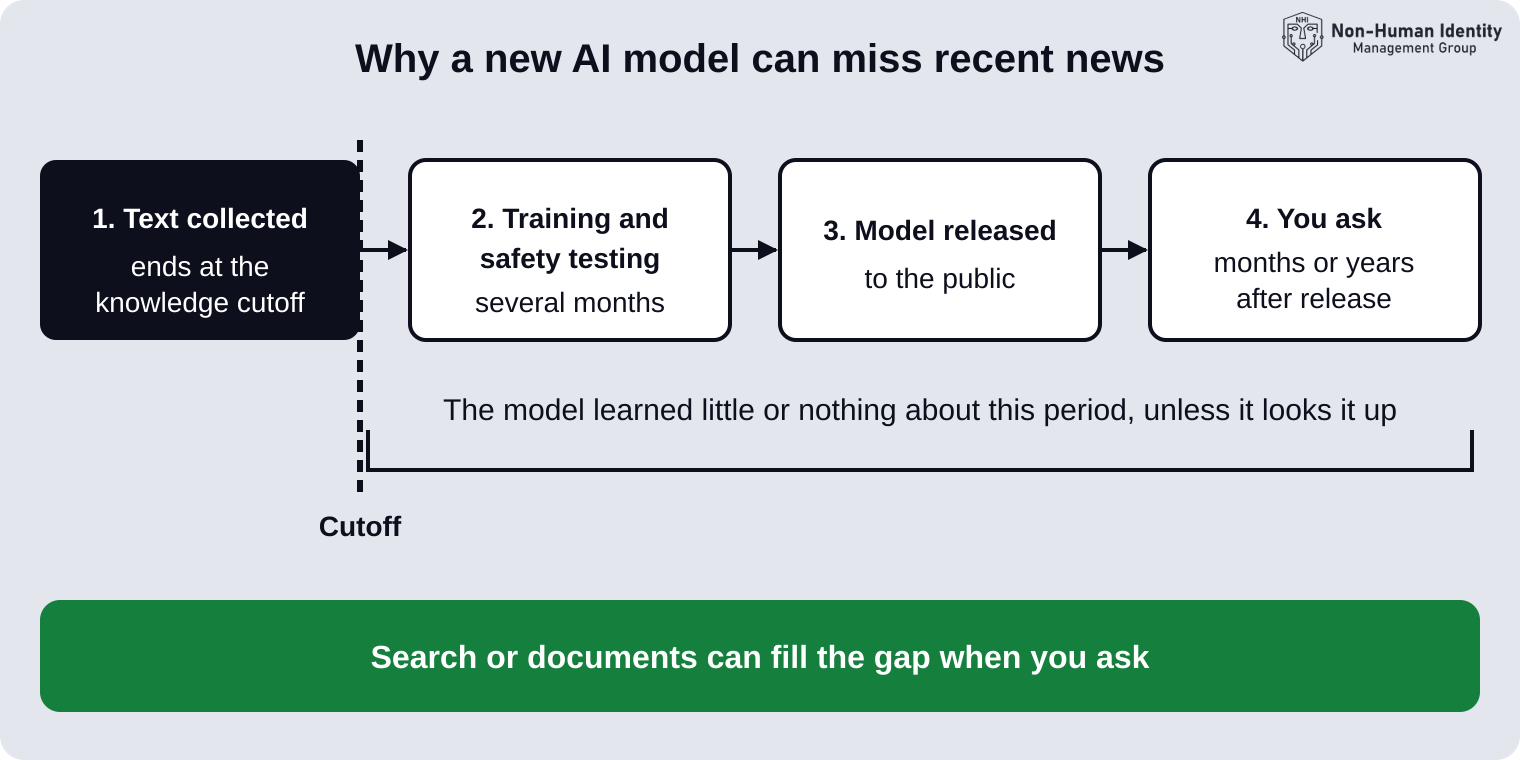
A model's knowledge goes through a few stages before it reaches you.
- Collecting. The maker gathers text up to a chosen date. That is the cutoff.
- Training and testing. The model learns from the text, then is checked for safety and quality. This takes months.
- Release. The model goes public. Upstage, for example, gives February 2026 as the cutoff for one model released in August 2026.[2]
- Use. People keep using the model for months or years after release, so the gap grows.
- Filling the gap. Some tools look things up when you ask, so newer facts can appear in the answer.
How does looking things up help? With web search turned on, the tool searches, reads some pages and writes its answer from them. Anthropic says its web search tool lets a model answer with up-to-date information beyond its knowledge cutoff, and includes citations to the sources.[3] Google describes its search grounding the same way. It says basing answers on real-world information helps reduce made-up answers and lets the tool show its sources.[4] This is called grounding, basing an answer on found sources rather than memory alone.
A company can do something similar with its own files. This is called retrieval-augmented generation, where the tool looks up trusted documents before answering.
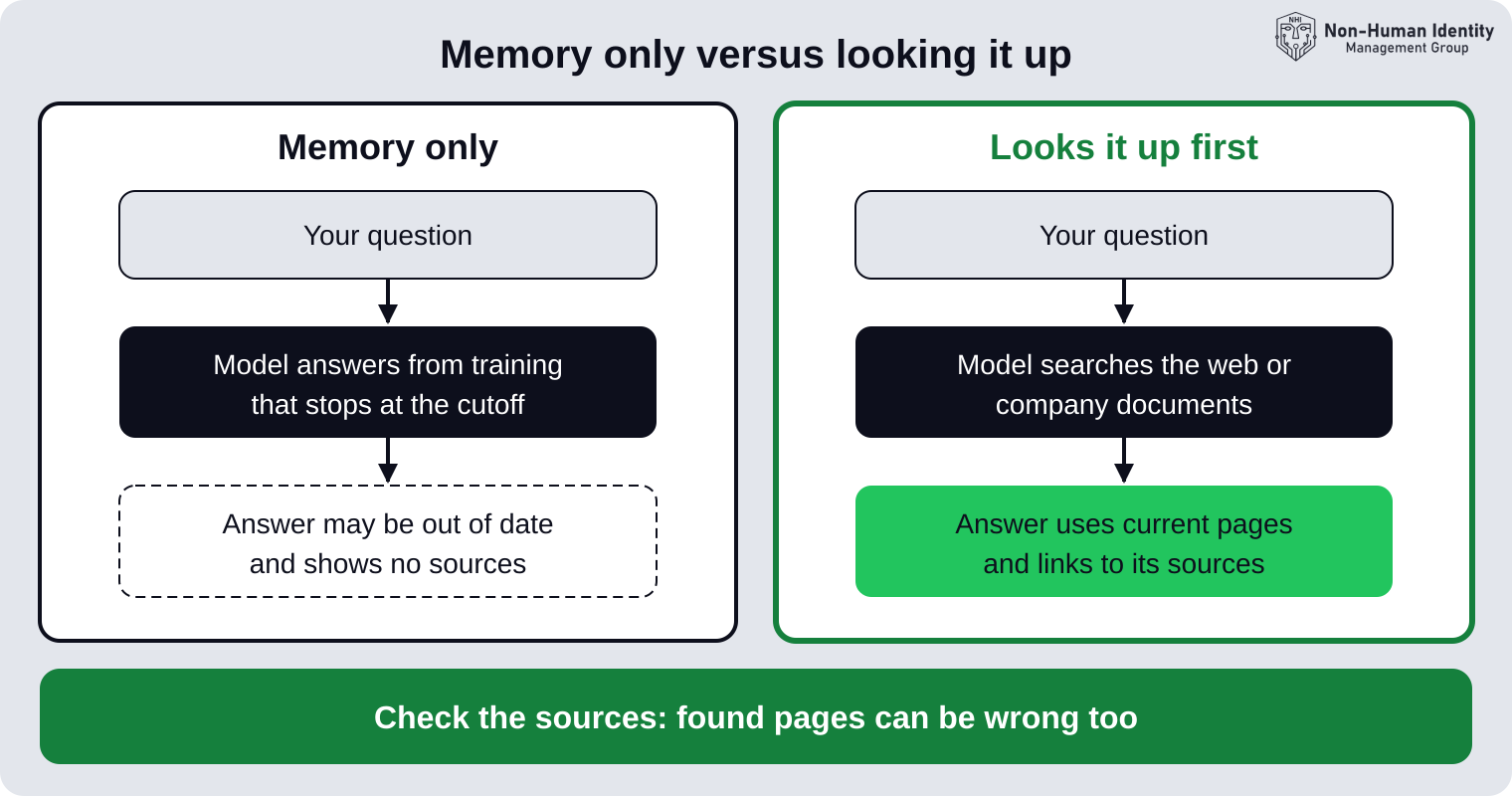
Looking things up is not perfect. The pages a tool finds can be wrong, old or even planted to mislead it. So the sources still need a quick check.
A worked example
Lars Brandt runs a small, fictional bike repair shop. He uses an AI chat assistant to draft his customer emails and answer quick questions.
One morning he asks it for the current rules on electric bike speed limits, for a sign in his shop. The answer is clear and confident.
His part-time assistant, Odile Zeller, is studying for a business course where they covered AI tools. She asks, "Did it search for that, or is it from memory?"
Lars scrolls up. There are no links and no sign that it searched. He remembers the guidebook. The answer could be correct, but it could also be from before a change.
Odile turns on the tool's web search setting and asks again. This time the answer has links. One goes to the government's official page on electric bikes. She opens it and reads the rules there.
In this case the rules match the first answer. But Lars now sees why it is worth checking. For the sign, he copies the wording from the official page, not from the AI answer.
They agree a simple habit for the shop. For anything about laws, prices or safety, they ask the tool to search and they open at least one official source before using the answer.
Myths and mistakes
| What people think | What is true |
|---|---|
| A brand new model knows this month's news. | Models are often released months after their cutoff.[2] New does not mean up to date. |
| The AI will tell me if it does not know. | Sometimes it does. Sometimes it gives an older answer that sounds sure. Ask whether it searched. |
| The model knows everything up to its cutoff equally well. | Coverage is often thinner close to the cutoff, because less had been written about recent events by then.[1] |
| If the tool searched, the answer must be right. | Found pages can be wrong or out of date. Open the sources and check them. |
| Asking the AI for its cutoff date gives a reliable answer. | Models can be unsure about their own cutoff. Check the maker's published model page instead. |
What can I do this week?
- Find out whether the AI tool you use can search the web, and how to turn it on.
- Look up your tool's model on the maker's website and note its published cutoff, if it gives one.
- For recent facts, ask the tool to show sources, and open at least one.
- When you give an AI a task about current events, paste in the latest facts yourself.
Checklist
- I know roughly what my AI tool's knowledge cutoff is, or that the maker does not publish one.
- I know whether my tool searched the web for a given answer.
- I check sources for anything about laws, prices, health or safety.
- I confirm security warnings on the software maker's own pages.
- I treat confident answers about recent events with extra care.
- My team knows which AI tools may search the web, and which may not.
Common questions
How do I find an AI model's knowledge cutoff?
Check the maker's official model page or documentation. Many makers publish a cutoff date there, though the label varies, and some publish none. Asking the chatbot itself is less reliable, because models can be unsure about their own cutoff date.
Why do AI models have a knowledge cutoff at all?
Because training uses a fixed set of text gathered up to a date. Training and safety testing then take months, and the model cannot keep learning from the web after it is released. Newer facts have to be supplied when you ask, by search, documents or you.
Does web search remove the cutoff problem?
It helps a lot, but it does not remove every risk. Search lets the tool read current pages and show its sources. Those pages can still be wrong, old or written to mislead, so checking at least one trusted source is still wise.
Is an out-of-date answer the same as a hallucination?
Not quite. An out-of-date answer was true at some point but has since changed. A hallucination is an answer the model made up that was never true. Both can sound equally confident, so checking sources helps with both.
Can I tell the AI today's news myself?
Yes. Pasting current facts or a document into your question is a simple way to fill the gap. The model will usually use what you give it. Make sure what you paste is accurate and does not include passwords or private data.
Where next?
Ready for the detail? Read the practitioner guide: Knowledge Cutoff Explained. It goes further into the labels different makers use, the stated cutoff dates for current models, and how search grounding and document lookup compare.
Also useful:
- How Large Language Models Work
- AI Search Engines for Beginners
- Retrieval-Augmented Generation for Beginners
- AI Hallucinations for Beginners
Related NHI Mgmt Group resources: AI Hallucination Business Risk Guide · AI Crawler and Grounding Controls Tracker · AI Search Poisoning for Beginners
Key terms
- Knowledge cutoff
- The date after which a model's training gave it little or no information about events.
- Training data
- The text and other material a model learned its patterns from.
- Large language model
- An AI system trained on large amounts of text to predict and write language.
- Grounding
- Basing an AI answer on sources found at the time, such as web pages or company documents.
- Retrieval-augmented generation
- A way of building AI tools that look up trusted documents before answering.
- Hallucination
- An AI answer that sounds right but is wrong or made up.
Sources and further reading
- Transparency Hub. Anthropic. https://www.anthropic.com/transparency, accessed 28 Nov 2026.
- Solar Pro 4 model documentation. Upstage Console docs, Upstage. https://console.upstage.ai/docs/models/solar-pro-4, accessed 28 Nov 2026.
- Web search tool. Claude Platform documentation, Anthropic. https://platform.claude.com/docs/en/agents-and-tools/tool-use/web-search-tool, accessed 28 Nov 2026.
- Grounding with Google Search. Gemini API documentation, Google. https://ai.google.dev/gemini-api/docs/google-search, accessed 28 Nov 2026.