Security culture is what people at work really do about security when nobody is checking.
This guide is for managers, team leaders, students and anyone new to security who wants to know why good rules are often ignored. You do not need a technical background. If you lead even a small team, the way you react to mistakes shapes how safe your organisation is.
In short
- Security culture is the shared sense of what is normal at work about security, not a training course.
- People copy what leaders and colleagues do, more than what the policy says.
- If people fear blame, they tend to hide mistakes. If they feel safe, they report them early.
- Rules that get in the way of work tend to be bypassed, so fix the rule, not just the person.
What you will learn
- Explain what security culture is and how it differs from awareness training.
- Spot signs of a weak culture, such as hidden mistakes and quiet workarounds.
- Check how your team reacts when someone reports a problem.
- Ask for rules that people can follow in their real work.
- Unwritten rules (social norms)
- the habits a group picks up by watching each other, such as "we always hold the door".
- Feeling safe to speak up (psychological safety)
- believing you will not be punished or made fun of for raising a worry or a mistake.
- Shortcut round a rule (workaround)
- a way people get their job done that skips a security step.
What is security culture?
Think of a busy restaurant kitchen. The hygiene rules are pinned on the wall. What keeps the food safe is what the cooks do on a hectic Friday night, when the inspector is not there.
Security culture works the same way. It is about the everyday choices people make with passwords, emails, visitors and data. The UK's national cyber security agency puts it simply. It is the shared sense of what is normal and valued at work about security.[1]
Culture is different from awareness. Awareness is what people know, for example how to spot a fake email. Culture decides whether they act on it when it is awkward or slow. Someone can pass every quiz and still let a stranger follow them through a door, because holding the door feels polite.
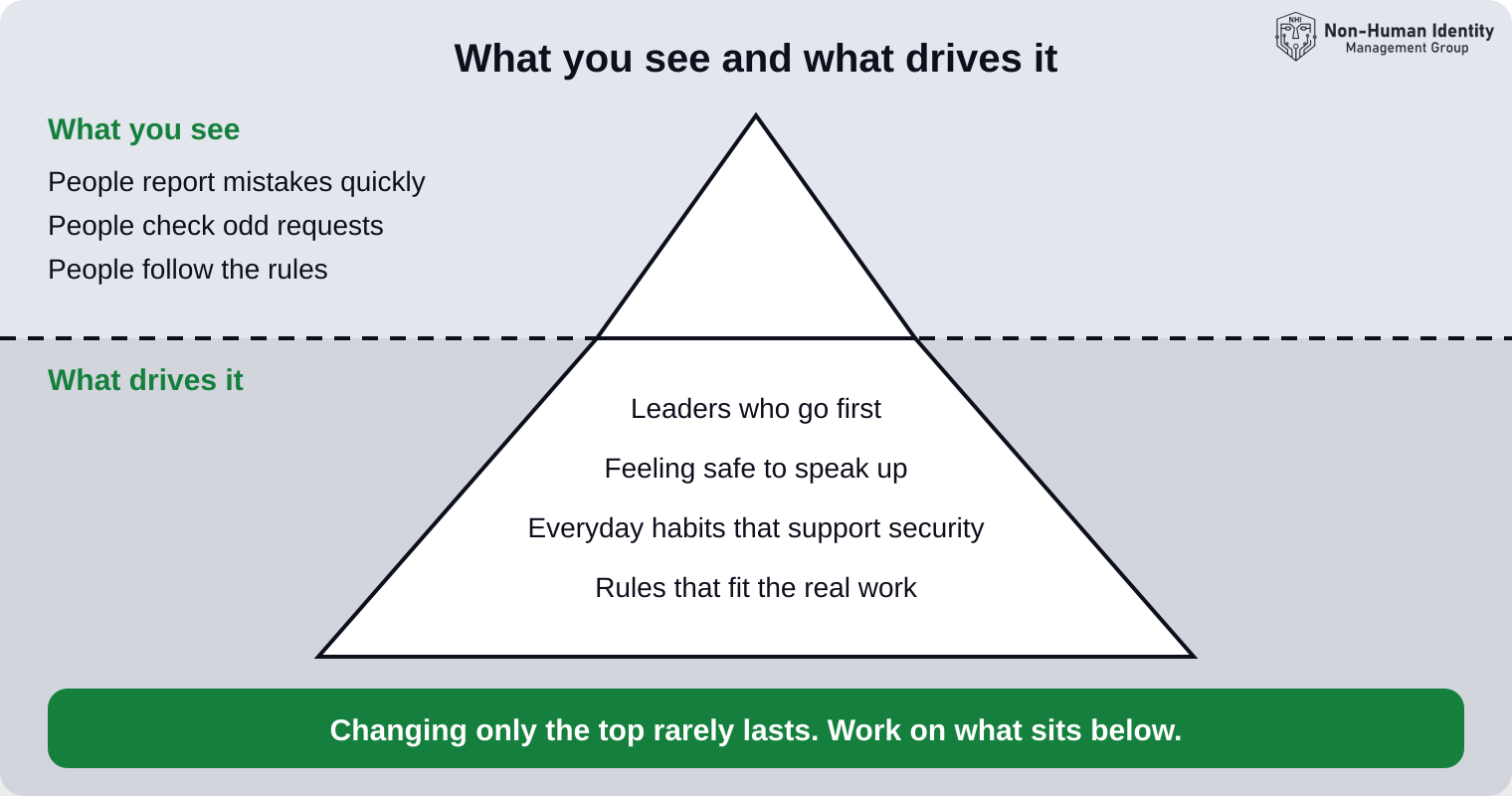
The same agency uses a picture of an iceberg. The behaviours you can see sit above the water. Below the water are the beliefs and attitudes that drive them.[2] Changing only the visible part rarely lasts.
Where the comparison stops working: a kitchen gets a hygiene inspection and a score. Security culture has no single score, and most of it happens in quiet moments that nobody records.
Why does it matter?
Many attacks need one person to click, pay or let someone in. Whether that person stops, asks or reports depends a lot on the culture around them.
If you lead a team
What could happen: you skip a security step "just this once", and your team learns that the rule is optional.
Check this: do you follow the same rules you ask your team to follow?
If you run a small business
What could happen: a member of staff clicks a bad link, feels embarrassed and says nothing until the problem has spread.
Check this: would your staff tell you about a mistake on the same day?
If you are new to a security job
What could happen: you write a strict rule that slows people down, and they quietly find a way round it.
Check this: ask the people who must follow a rule whether it works in their day.
What does it look like?
Culture is easiest to see in small, ordinary moments. Here is a made-up scenario card that compares two offices. You can use cards like this to start a team chat.
Example only. All values are made up.
Scenario: a staff member clicked a link in a fake email

Office A                          Office B
Manager: "How could you?"  (1)    Manager: "Thanks for telling me."  (4)
Staff tell nobody next time (2)   IT changes the password the same day (5)
Shared login on a sticky note (3) Rule changed so it fits the work  (6)
- Blame for an honest mistake.
- The lesson people learn: keep quiet.
- A workaround, because the proper way was too slow.
- Thanks for speaking up, even though a mistake was made.
- A fast fix, because the report came early.
- The team asks why people used a shortcut, and fixes the cause.
Why this is risky: in Office A, the next mistake is likely to stay hidden until it causes real harm. The sticky note shows a rule that does not fit how people work.
The safer way: Office B treats a report as useful news. It thanks the person, fixes the problem and then looks at why the shortcut existed.
How does it work?
The NCSC sets out six principles for a healthy security culture.[1] In plain words, they work like this.
- Security helps the work. Security is shown as something that helps the organisation reach its goals, not a list of "no".[1]
- People feel safe to speak up. Incidents are looked at to learn, not to blame, and honest mistakes are not punished. There are quick, easy ways to ask questions or report.[3]
- Change is welcomed. The organisation adapts to new threats and new ways of working.[1]
- Everyday habits support security. Unwritten rules can help or hurt. Some risky habits come from good values, like being polite or helpful. Telling people to stop rarely works on its own, so the fix is a safer way that fits those values.[4]
- Leaders go first. Leaders show secure behaviour, because staff tend to copy them. The NCSC suggests leaders share their own past security mistakes and how they fixed them.[5]
- Rules are clear and workable. Rules are easy to find and understand, tested with the people who use them and updated when they no longer fit.[6]
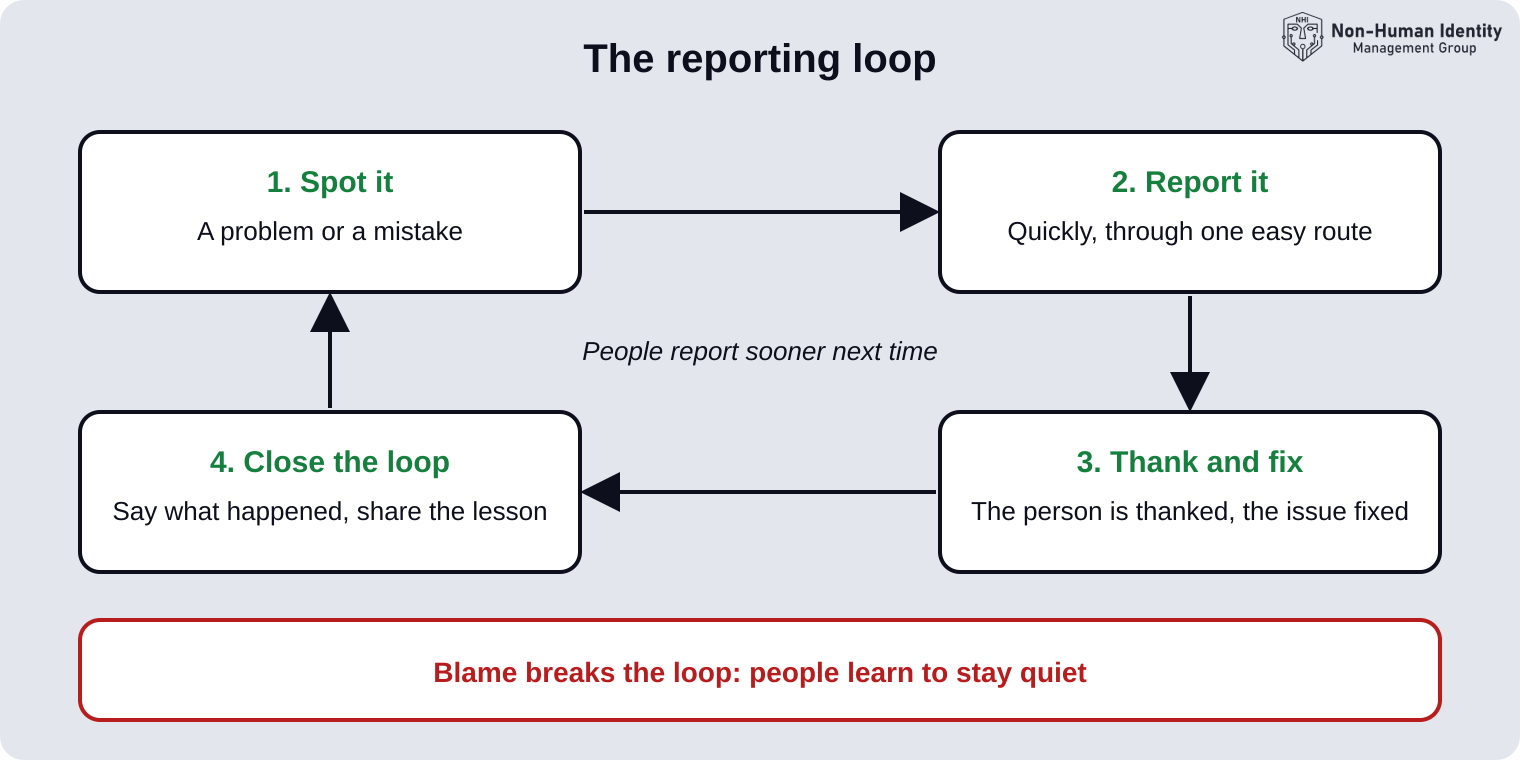
The NCSC also says that thanking people for a report, and telling them what was done, creates a positive loop that encourages more reports.[3]
A worked example
Nadia Ulrich runs Cobble Opticians, a fictional chain of three shops with twenty staff. Her shops handle patient records and card payments.
One morning a receptionist, Kofi Yilmaz, comes to her looking worried. Yesterday he typed his work password into a page that looked like the booking system. He now thinks it was fake.
Nadia remembers the kitchen. What matters is what people do on a busy day, not the poster. So her first words are "Thank you for telling me." She calls their IT supplier, who resets Kofi's password and checks the sign-in records. They find no unusual logins in the records available to them.
Later, Nadia asks the team a simple question. "When did you last skip a security step, and why?" Nobody is in trouble for answering.
The answers surprise her. Staff share one login for the booking screen, because separate logins take too long at the counter. Some hold the back door open for delivery drivers to be polite.
Nadia does not just tell people to stop. She asks the supplier to set up quick personal logins at each counter. She agrees that deliveries come to the front desk, where someone can greet the driver.
At the next team meeting, Nadia shares a mistake of her own: she once forwarded a work file to her personal email. She explains the safer way she uses now.
A month later, two staff report odd emails soon after they arrive. Nadia thanks both of them in the team chat.
Myths and mistakes
| What people think | What is true |
|---|---|
| A yearly training course gives us a good security culture. | Training builds knowledge. Culture is what people do day to day, and it is shaped by leaders, habits and rules. |
| Punishing mistakes makes people more careful. | Fear of blame tends to make people hide mistakes. The NCSC advises not punishing honest mistakes.[3] |
| People who break rules just do not care. | Many shortcuts come from good intentions, like being helpful, or from rules that do not fit the work.[4] |
| Security culture is the security team's job. | Every leader shapes it, because staff tend to copy what leaders do.[5] |
| More rules mean more security. | Rules that are too detailed or out of date can work against security. Clear, workable rules help more.[6] |
What can I do this week?
- Thank the next person who reports a problem, even if they made the mistake.
- Ask your team which security step slows them down most, and why.
- Check that there is one quick, easy way to report a worry, and that people know it.
- Share one security mistake of your own and what you learned from it.
- Follow the same rules you ask others to follow, starting today.
Checklist
- Honest mistakes are not punished, and people know this.
- There is one quick, easy way to report a security worry.
- People who report are thanked and told what happened.
- Leaders follow the same security rules as everyone else.
- Security rules are easy to find and written in plain words.
- It is clear which rules are a must and which are advice.
- Rules are checked with the people who use them and updated.
- Shortcuts are treated as a sign that a rule may need fixing.
Common questions
What is the difference between security awareness and security culture?
Awareness is what people know. Culture is what they really do. Training can teach someone to spot a fake email. Culture decides if they report it or keep quiet. Both matter. See Security Awareness for Beginners for the habits side.
Who is responsible for security culture?
Everyone shapes it, but leaders have the biggest effect. Staff tend to copy what managers do. So a leader who skips a rule teaches others to skip it too. The UK's cyber security agency says leaders should own the effect they have on culture.
Can a small business have a security culture?
Yes, every organisation has one, whether it plans it or not. In a small team, culture is often set by the owner's own habits and reactions. Thanking people for reports and fixing awkward rules can make a big difference quickly.
How do I know if our security culture is good?
Look at what people do, not just test scores. Signs of a healthy culture include quick reports of mistakes, few shortcuts and people asking questions without worry. Our Security Culture Measurement Guide covers ways to track this over time.
Should people who keep making mistakes face consequences?
Honest mistakes should not be punished, because blame tends to make people hide problems. Breaking rules on purpose is a different matter, and is usually handled under normal workplace rules. We suggest first asking if the rule or the tools made the mistake likely.
Where next?
Ready for the detail? Read the practitioner guide: Security Culture. It goes further into the NCSC principles, leadership behaviours, a phased culture programme and how to measure progress.
Also useful:
- Security Awareness for Beginners
- Reporting Security Incidents at Work for Beginners
- Social Engineering for Beginners
- Security Champions Programme Guide
Related NHI Mgmt Group resources: Security Culture Measurement Guide · Human Risk and Security Culture Executive Briefing · Security Awareness and Human Risk Management Guide
Key terms
- Security culture
- The shared sense at work of what is normal and valued about security.
- Security awareness
- What people know about security risks and how to respond to them.
- Psychological safety
- Believing you will not be punished or made fun of for raising a worry, question or mistake.
- Just culture
- A way of handling mistakes that looks for the cause and treats people fairly, rather than blaming them.
- The unwritten rules a group follows, picked up by watching each other.
- Workaround
- A shortcut people use to get work done that skips a security step.
- Security champion
- A team member who helps colleagues with everyday security questions.
Sources and further reading
- Cyber security culture principles. National Cyber Security Centre (NCSC), 4 June 2025. https://www.ncsc.gov.uk/collection/cyber-security-culture-principles, accessed 28 Nov 2026.
- The cyber security culture iceberg. National Cyber Security Centre (NCSC). https://www.ncsc.gov.uk/collection/cyber-security-culture-principles/the-cyber-security-culture-iceberg, accessed 28 Nov 2026.
- Principle 2: Build the safety, trust and processes to encourage openness around security. National Cyber Security Centre (NCSC). https://www.ncsc.gov.uk/collection/cyber-security-culture-principles/principle-2, accessed 28 Nov 2026.
- Principle 4: The organisation's social norms promote secure behaviours. National Cyber Security Centre (NCSC). https://www.ncsc.gov.uk/collection/cyber-security-culture-principles/principle-4, accessed 28 Nov 2026.
- Principle 5: Leaders take responsibility for the impact they have on security culture. National Cyber Security Centre (NCSC). https://www.ncsc.gov.uk/collection/cyber-security-culture-principles/principle-5, accessed 28 Nov 2026.
- Principle 6: Provide well-maintained cyber security rules and guidelines, which are accessible and easy to understand. National Cyber Security Centre (NCSC). https://www.ncsc.gov.uk/collection/cyber-security-culture-principles/principle-6, accessed 28 Nov 2026.