The SWIFT Customer Security Programme is a set of security rules every bank on the Swift network must follow.
This guide is for students, new bank staff and anyone who hears "CSP" or "attestation" at work and wants the plain story. You do not need to be technical: if you work near payments, the rules shape the computers and accounts you use.
In short
- Swift is the messaging network banks use to send payment instructions to each other across borders.
- The programme began in 2016, after criminals used banks' own Swift computers to send fake payment orders.
- Each bank protects its own Swift setup with a list of controls. Some are a must, others are advised.
- Every year each bank tells Swift how well it meets the controls, backed by an independent check. This is called attesting.
What you will learn
- Explain what the Swift programme is and why it exists.
- Tell the difference between a must-do control and an advised one.
- Explain what a yearly attestation is and who can see it.
- Ask useful questions about the Swift setup where you work.
Status: correct as at 28 November 2026, based on Swift's official programme pages. Swift updates its controls every year; check the current version.
This guide explains the topic in general terms and is not legal advice.
- Bank messaging network (Swift)
- a network that carries payment instructions between banks.
- Yearly self-report (attestation)
- a bank's formal statement of how well it meets each control.
- Rule to put in place (control)
- one specific security measure, such as limiting who can log in.
What is the SWIFT Customer Security Programme?
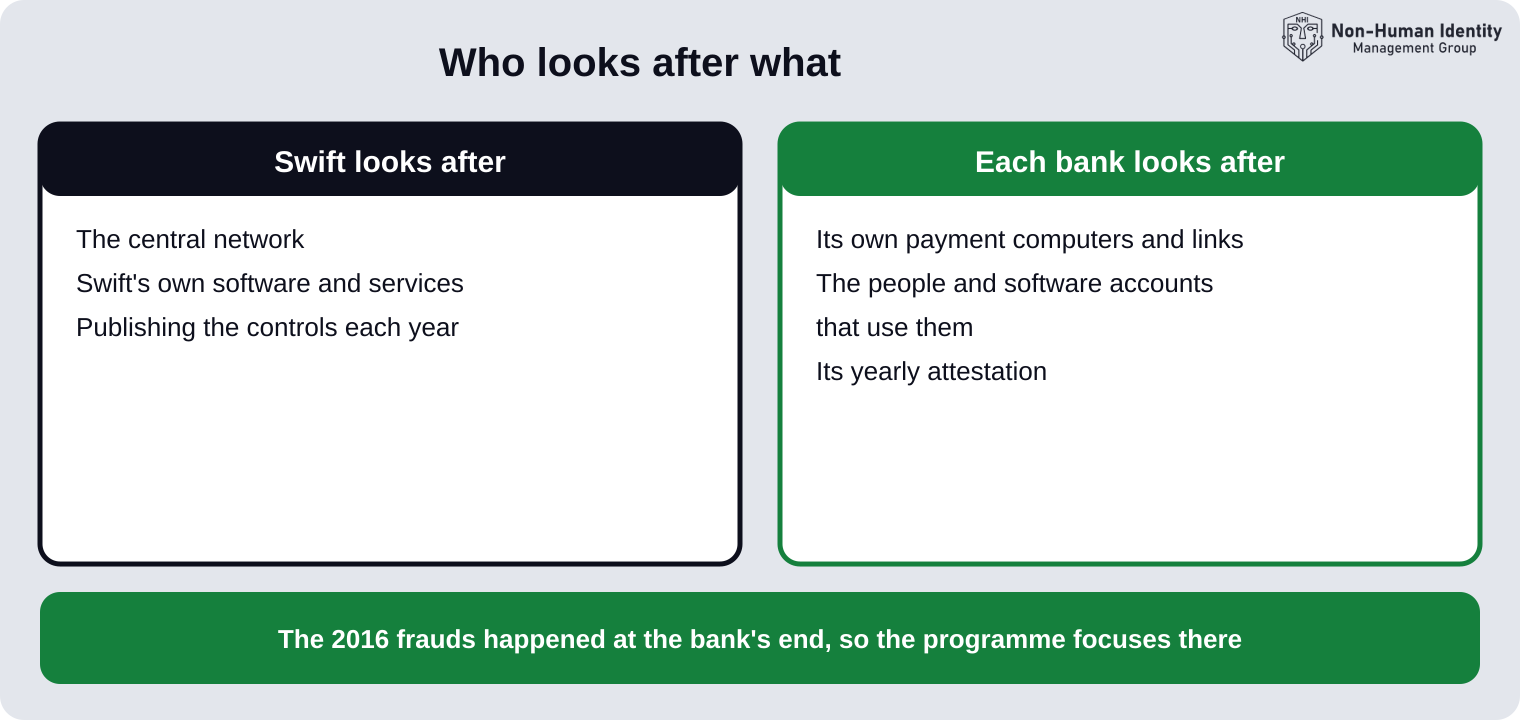
Think of a shared postal service for banks. The post office keeps its vans and sorting rooms safe. But each bank keeps its own mail room, where staff write and stamp the letters.
Swift is like that post office. It looks after the central network. Each bank looks after its own end, which Swift calls the bank's local setup. The Customer Security Programme, or CSP, is the set of rules for that local end.[1]
The rules sit in a document called the Customer Security Controls Framework. It lists controls (specific security measures) under three goals: secure your environment, know and limit access, and detect and respond.[2]
Where the comparison stops working: a letter that looks right is not checked again at the sorting office. A fake payment order sent from a bank's own mail room can look just like a real one. That is why the bank's end matters so much.
Why does it matter?
In February 2016, criminals stole 81 million US dollars from Bangladesh Bank. US prosecutors say the attackers got in through phishing emails, reached computers linked to Swift and sent fake payment messages that looked genuine.[3] Swift launched the programme in May 2016, saying fraud had happened in customers' local setups while its own network was not compromised.[4]
If you are new to a bank's IT or payments team
What could happen: a shortcut you take on a payment computer becomes a finding the bank must report.
Check this: ask which computers and accounts are "in scope" for Swift, and follow the extra rules for them.
If you manage risk or compliance
What could happen: a weak attestation is seen by partner banks and supervisors.
Check this: know your submission date and who signs it off.
If you are a student or job seeker
What could happen: you meet "CSP" or "CSCF" in an interview and have no picture of it.
Check this: learn the three goals and the yearly cycle on this page.
What does it look like?
Here is a made-up page from a small bank's yearly summary, the kind of thing a team reviews before it attests.
Example only. All values are made up.
Example Bank (FAKE) - Swift attestation summary, cycle 0000
Architecture type: EXAMPLE            (1)
Mandatory control: limit admin accounts      Met          (2)
Mandatory control: two-step sign-in          Met
Mandatory control: patch payment computers   Not met, fix by 00/00   (3)
Advisory control: extra monitoring           Not met (optional)      (4)
Independent check: second line team, 00/00/0000              (5)
- The bank first works out its type of setup. Swift uses five types. The type decides which controls apply.[2]
- Mandatory controls are the ones every bank in that type is expected to meet.
- A control that is not met yet is still reported. The bank gives a date to fix it.[1]
- Advisory controls are recommended, not required. Swift reviews the list every year, so a control's status can change.
- In a real file, this line would name the team that checked the answers. That team must not be the people who run the systems.[1]
Why this is risky: staff might tick "Met" without proof. Then the bank tells its partners something untrue. The gap also stays open.
The safer way: each answer links to proof, such as a list of admin accounts. The independent team checks the proof before the bank sends it.
How does it work?
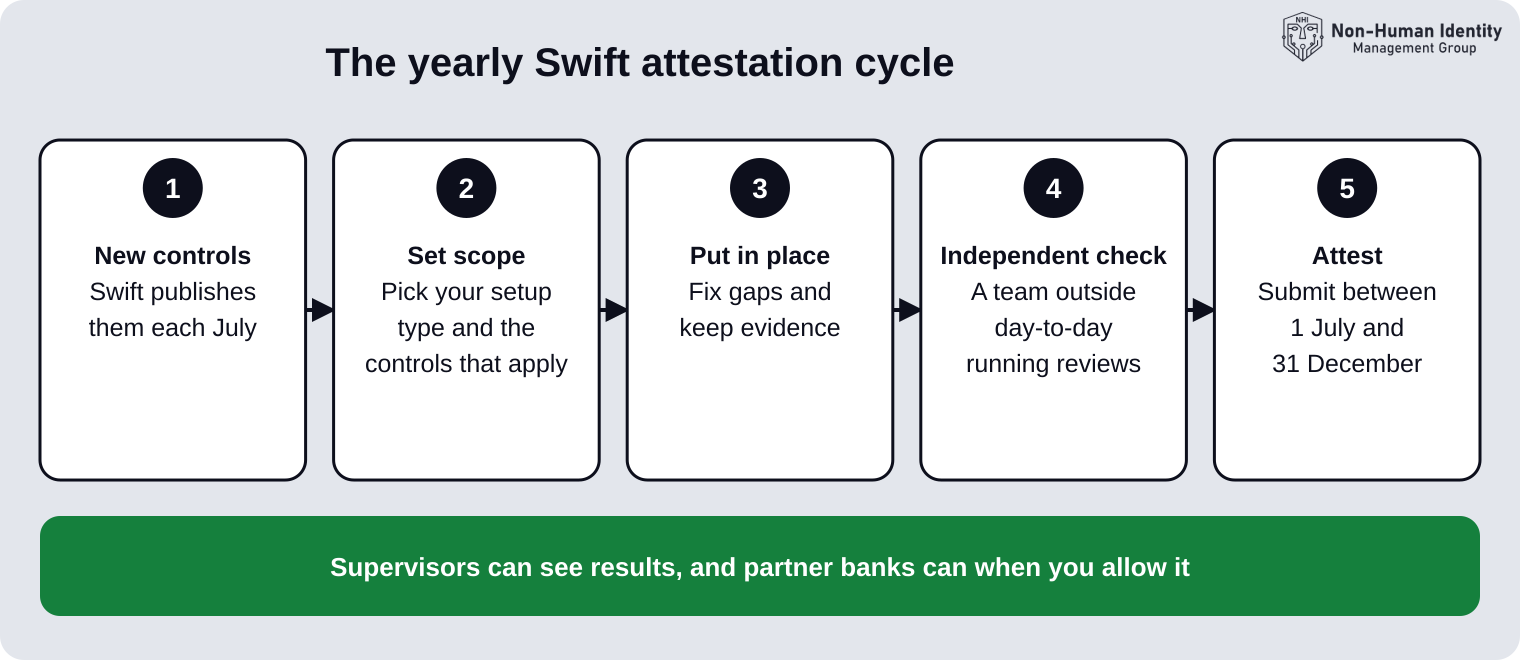
The programme runs as a yearly cycle.
- Swift publishes the controls. A new version comes out each July, a year before it takes effect, so banks have time to prepare.[2]
- The bank sets its scope. It works out which of the five setup types it has, and so which controls apply.[2]
- The bank puts controls in place. Examples include limiting powerful admin accounts and asking for a second check at sign-in.
- An independent team checks. This can be an internal team outside day-to-day running, or an outside assessor.[1]
- The bank attests. Between 1 July and 31 December it records its level for each control in Swift's online tool, called KYC-SA.[2]
- Others can look. Supervisors can see the results, and partner banks can see them when the bank grants access.[1]
Many controls are about who and what can use the payment computers. That includes people and software accounts, called service accounts, which programs use to connect. The practitioner guide covers these in detail.
A worked example
Uma Strand has just joined a small fictional bank, Northgate Trade Bank, as a junior risk analyst. Her first big task is the Swift attestation.
Her manager hands her last year's summary. Most mandatory controls say "Met". One, about updating the payment computers, says "Not met" with a fix date that has now passed.
Uma remembers the post office picture. Swift guards the vans. The bank guards its own mail room. She walks over to the payments IT team and asks to see proof for each "Met".
The team shows her the admin account list and the sign-in settings. For the updates, they show a plan but no finished work. Uma does not change the answer to "Met". She records it as not met, with a new, realistic date.
Next, the bank's internal audit team, which does not run the systems, reviews the evidence. The reviewer, Bruno Lomax, asks for one more screenshot and then signs off.
Uma submits the attestation in November, well before 31 December. Her manager is pleased. An honest "not met" with a plan is better than a "Met" that nobody can prove. Partner banks and supervisors may read it, after all.
Uma adds one note for next year. She will start the evidence check in July, when Swift's new version lands, not in the autumn rush.
Myths and mistakes
| What people think | What is true |
|---|---|
| Swift protects everything, so banks do not need to. | Swift protects its network. Each bank is responsible for its own local setup.[1] |
| Advisory controls can be ignored for ever. | They are optional for now, but Swift reviews the controls each year. Planning early helps. |
| Attestation is a private form only Swift reads. | Supervisors can see it, and partner banks can when access is granted.[1] |
| The team that runs the systems can check its own work. | The check must come from a team independent of day-to-day running, inside or outside the bank.[1] |
| Once we attest, we are done for the year. | Controls change each July, and gaps need fixing. Swift asks banks to update the attestation once a gap is closed.[1] |
What can I do this week?
- Ask who owns the Swift attestation where you work, and when it is due.
- Find out which setup type your bank has and which computers are in scope.
- Read the three goals of the controls framework on Swift's site.
- Check that each "Met" answer from last year has evidence behind it.
Checklist
- We know our setup type and which controls apply.
- Every mandatory control is met, or has a fix date we can keep.
- We have looked at the advisory controls and decided which to adopt.
- Each answer links to evidence.
- An independent team has checked the answers.
- The attestation is submitted before 31 December.
- Admin accounts and software accounts on payment computers are listed and owned.
Common questions
Is the Swift programme a law?
No, it is a set of rules from Swift, the company that runs the network. Swift calls it mandatory for its users. Banking supervisors can see the results, and they may apply their own laws and rules on top. Check with your compliance team for your country.
What is the difference between mandatory and advisory controls?
Mandatory controls are expected of every bank with that setup type. Advisory controls are recommended good practice that banks can choose to adopt. Swift publishes each new version a year early, which gives banks time to prepare.
When is the attestation due?
Swift gives users from 1 July to 31 December each year to submit an attestation against the latest mandatory controls. Many teams plan to finish early, because the independent check also takes time.
Who can see our attestation?
Supervisors can see the results. Partner banks can see them when your bank grants access through Swift's tools. That is why an honest, evidenced answer matters more than a perfect-looking one.
Does this apply to small banks?
Yes. It applies to Swift users of every size. The setup type matters more than size, because it decides which controls apply. Smaller banks that use a service provider still need to understand their own part.
Where next?
Ready for the detail? Read the practitioner guide: SWIFT Customer Security Programme (CSP) Guide. It goes further into the five setup types, the control families and what changed in the latest version.
Also useful:
Related NHI Mgmt Group resources: SWIFT Customer Security Programme (CSP) Guide · Non-Human Identities for Beginners
Key terms
- Swift
- A network that carries payment instructions and other messages between banks.
- Control
- One specific security measure a bank must or should put in place.
- Attestation
- A formal statement that something is true, backed by evidence.
- Independent assessment
- A review by people who do not run the systems being checked.
- Service account
- An account used by a program, not a person, to connect to other systems.
- Multi-factor authentication
- Signing in with two or more separate checks, not just a password.
Sources and further reading
- Customer Security Programme (CSP). Swift. https://www.swift.com/myswift/customer-security-programme-csp, accessed 28 Nov 2026.
- Security controls. Swift. https://www.swift.com/myswift/customer-security-programme-csp/security-controls, accessed 28 Nov 2026.
- North Korean Regime-Backed Programmer Charged With Conspiracy to Conduct Multiple Cyber Attacks and Intrusions. US Department of Justice, 6 September 2018. https://www.justice.gov/opa/pr/north-korean-regime-backed-programmer-charged-conspiracy-conduct-multiple-cyber-attacks-and, accessed 28 Nov 2026.
- Swift launches Customer Security Programme to reinforce the security of the global banking system. Swift, 27 May 2016. https://www.swift.com/insights/press-releases/swift-launches-customer-security-programme-to-reinforce-the-security-of-the-global-banking-system, accessed 28 Nov 2026.