A bug bounty hunter finds security flaws in a company's systems, with its published permission, and reports them for rewards.
This guide is for anyone curious about bug bounty hunting as a job or a side project. You do not need a technical background to read it. If your organisation runs a bug bounty, these are the people who will send you reports.
In short
- A bug bounty hunter looks for weak spots in systems a company has opened up for testing, then reports them.
- The company's published rules give the permission and set the limits. Testing outside them can be a crime.
- Usually only the first person to report a new, valid flaw is paid. Many reports earn nothing.
- Most hunters start part time, learn on free practice sites, and build a record of clear reports.
What you will learn
- Explain what a bug bounty hunter does in one sentence.
- Spot the rules that decide what a hunter may test.
- Describe the path of a report, from finding to reward.
- Check whether this kind of work could suit you.
- Security flaw (vulnerability)
- a weak spot in a system that an attacker could use.
- Reward scheme (bug bounty programme)
- a company's public offer to pay people who report flaws by its rules.
- What you may test (scope)
- the list of systems the rules allow you to test.
What is a bug bounty hunter?
Think of a shop that puts up a notice: "Spot a fault in our shop? Tell us and we may reward you." Anyone may look, but only in the areas the notice lists. The first person to point out a new fault gets the reward.
A bug bounty hunter answers that kind of notice for software. A company publishes a bug bounty programme, a written offer with rules. The rules say which websites or apps may be tested, which methods are banned and what each type of flaw may earn.
The hunter studies those systems and looks for a vulnerability, a weak spot an attacker could use. When they find one, they write a report that shows the problem and why it matters. The company checks it, fixes it and decides on any reward.
Most hunters are freelancers. Many do it part time alongside a job in IT, software or security. Programmes are often run through bug bounty platforms, websites that host many companies' programmes in one place.
Where the comparison stops working: a shop fault is easy to show and hard to copy. A software flaw can be found by several people in the same week, and it can do real harm if handled carelessly.
Why does it matter?
Hunters give companies many extra pairs of eyes. For the hunter, the rules are everything.
If you want to try bug bounty hunting
What could happen: you test a site that has no programme, or a system outside the scope, and break the law.
Check this: read the full programme rules before you test anything, and keep a copy.
If your company runs a programme
What could happen: reports pile up, hunters wait weeks for replies and your best finders move on.
Check this: ask who reads new reports and how quickly they reply.
If you are choosing a security career
What could happen: you expect a steady wage, but bounty income can vary a lot from month to month.
Check this: compare bounty work with salaried testing jobs before you decide.
What does it look like?
Every programme publishes a brief, a short page of rules. Here is a made-up one.
Example only. All values are made up.
BUG BOUNTY BRIEF  EXAMPLE-0000
Company:      Example Travel Ltd (FAKE)
In scope:     www.example.com, app.example.com          (1)
Out of scope: payments.example.com, staff email          (2)
Not allowed:  overloading the site, tricking staff        (3)
Use only:     test accounts you create yourself           (4)
Rewards:      first valid report only, EXAMPLE amounts    (5)
Going public: only with our written OK                    (6)
- In a real file, this line would list each site or app hunters may test.
- Systems hunters must leave alone, even if they look interesting.
- Banned methods, such as flooding the site with traffic or fooling staff.
- Hunters test with their own accounts, not other people's.
- Only the first person to report a new, valid flaw is usually paid.
- Hunters may not talk about the flaw in public until the company agrees.
Why this is risky: skipping the brief is the most common way to get into trouble. In the UK, using a computer to reach data you know you are not allowed to reach is a crime.[1] The brief is what makes your access allowed.
The safer way: read the whole brief and test only what it lists. Stop if you see other people's data, and report through the channel the brief names.
How does it work?
Each programme differs, but a report usually moves through stages like these.
- Read the rules. The hunter picks a programme and reads its brief. The brief's own terms come first, ahead of the platform's general terms.[2]
- Test within scope. They study the listed systems and look for flaws. They use their own test accounts and avoid anything that could slow or harm the service.[2]
- Write the report. They explain the flaw, the steps to see it and the harm it could cause. Reports go through the approved channel, usually the platform.[3]
- Triage. The company, or the platform, checks the report. Triage means sorting reports: is it real, is it new and how serious is it?
- Fix and reward. The company fixes the flaw. On one large platform, the reward goes to the first eligible person to report a new issue, and the issue must lead to a fix.[2]
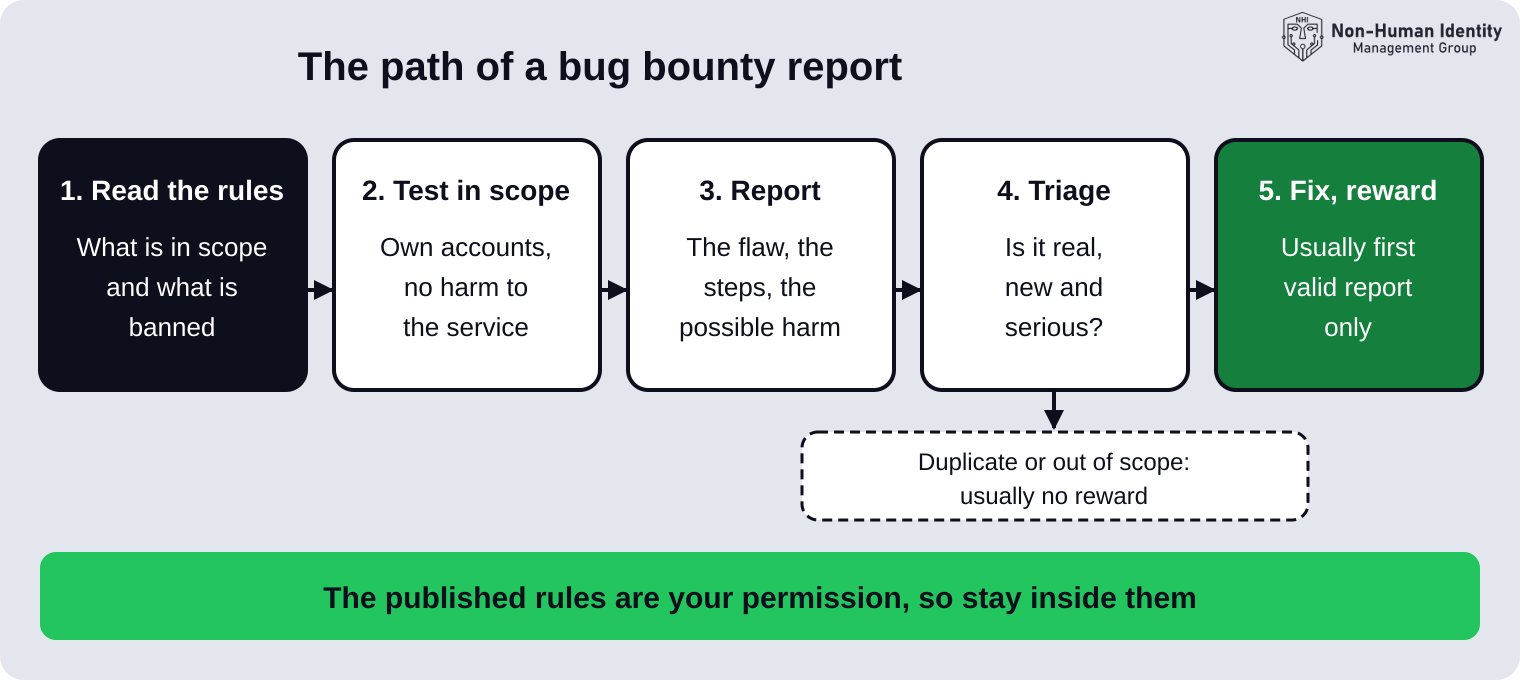
A report on the same flaw that someone sent earlier is called a duplicate. Duplicates are usually not paid. Reports on systems outside the scope are usually marked invalid.[2] So hunters spend a lot of time on reports that earn nothing.
Keeping quiet matters too. Platforms ask hunters to get the company's approval before sharing any details in public.[3] Using the threat of going public to push for a bigger reward is banned.[3]
Not every company pays. Many simply publish a way to report flaws, called a vulnerability disclosure policy. The UK cyber security agency suggests a contact address, a short policy and a small text file on the website that says where to report.[4]
Skills and tools
- How the web works. How browsers, websites and apps talk to each other, and how logins work.
- Common flaw types. The usual mistakes in websites, such as pages that show data to the wrong person.
- Testing tools. A browser's built-in developer tools, and a tool that shows the traffic between browser and site.
- Clear writing. A report the company can follow step by step, with the likely harm explained in plain words.
- Patience and good notes. Hours of looking may find nothing. Good notes help you pick up where you left off.
Free practice sites let you learn these skills legally. One well-known example is a free web security academy with hands-on practice labs.[5]
Routes in
There is no single route. Some hunters come from software or IT support jobs. Others study security on their own and start with simple, public programmes. Some use bounty work to build a record, then move into salaried testing jobs. Others keep it as a side income.
Hunters work closely with others. They hand findings to a company's triage team and its developers. Their work overlaps with penetration testers, who are hired for a fixed job, and application security engineers, who help fix the flaws.
A worked example
Yara Costa works in IT support for a school, and on weekday evenings she hunts for bugs. This is a fictional story.
On Tuesday she picks a public programme run by Sandpiper Travel, also fictional. She reads the brief twice. The booking site is in scope, but the payment pages are not. She saves a copy of the rules, like keeping the shop's notice before looking for faults.
She makes two test accounts of her own. Each booking page has a booking number in its web address. While signed in to her first account, she swaps in the booking number from her second account. The page shows the second account's booking. That could mean customers can see each other's trips.
She stops there and does not try any other customers' numbers. The brief says to avoid other people's data, so she tests only with her own two accounts.
That night she writes her report. It says what the flaw is, gives the steps using her two accounts, and explains the possible harm in plain words. She sends it through the platform.
Two days later Xavier Dlamini, who reads reports for Sandpiper Travel, replies. He has confirmed the flaw. It is not a duplicate. The team fixes it the next week, and Yara receives a reward.
Her previous two reports had been duplicates and earned nothing. Yara says the clear write-up and stopping early were what made this one count.
Myths and mistakes
| What people think | What is true |
|---|---|
| If I mean well, I can test any website. | Only test where a programme gives permission, and only within its scope.[1] |
| Every valid flaw gets paid. | Usually only the first valid report on a new flaw is paid. Duplicates often earn nothing.[2] |
| Bug bounty hunting is easy money. | Income can be uneven. Many hunters keep a day job while they learn. |
| Once fixed, I can post about it. | Get the company's approval before sharing any details in public.[3] |
| Finding more data proves the flaw better. | Stop as soon as you can show the problem. Avoid other people's data. |
What can I do this week?
- Read our Bug Bounties for Beginners guide.
- Open one public programme brief and list what is in scope and what is banned.
- Sign up to a free, legal practice site and finish one beginner lab.
- Read a platform's code of conduct from start to end.
- Write a practice report for a lab flaw, in plain words.
Checklist
- I can explain what a bug bounty hunter does in one sentence.
- I know the programme rules are my permission to test.
- I test only systems listed as in scope.
- I use my own test accounts and avoid other people's data.
- I know duplicates and out of scope reports are usually not paid.
- I get approval before sharing any details in public.
- I practise on legal training sites first.
- I have checked official sources for pay, not just social media posts.
Common questions
Is bug bounty hunting legal?
Yes, when you follow a programme's published rules. Those rules give you permission. Testing outside them, or on sites with no programme, can be a crime. In the US, federal prosecutors have been told not to charge good-faith security research, but that policy is not a full legal shield.[6]
Do I need a degree or certificate?
Usually not. Programmes judge your reports, not your qualifications. Many hunters learn from free practice sites and public write-ups. A degree or certificate can still help if you later want a salaried security job, such as penetration testing.
How much do bug bounty hunters earn?
It varies widely, so we do not quote a figure. Income depends on skill, time spent and luck with duplicates. For salaried security work, use official sources such as the US government's job outlook pages[7] or the UK National Careers Service.[8]
How is a bug bounty hunter different from a penetration tester?
A penetration tester is hired for a fixed job, with a contract, dates and a set fee. A bug bounty hunter chooses which public programmes to work on and is usually paid per valid, first report. See Bug Bounty vs Penetration Testing.
What if I find a flaw by accident on a site with no programme?
Stop, and do not dig further. Look for a way to report it, such as a security contact or a disclosure policy on the website. Report only what you saw, and do not ask for payment.[4]
Where next?
Ready for the detail? Read the practitioner guide: Bug Bounty Hunter Career. It goes further into legal boundaries, core skills and tools, what a strong report contains, certifications and how hunters progress.
Also useful:
- Bug Bounties for Beginners
- Penetration Tester for Beginners
- Bug Bounty vs Penetration Testing
- Bug Bounty and Vulnerability Disclosure Guide
Related NHI Mgmt Group resources: Cybersecurity Careers Guide · Bug Bounty Triage Operations Guide · AI Bug Bounty Programmes Guide
Key terms
- Bug bounty programme
- A company's published offer to reward people who report security flaws by its rules.
- Vulnerability
- A flaw in code, settings or design that could be abused.
- Vulnerability disclosure policy
- A published page that tells people how to report security flaws, with or without a reward.
- Scope
- The boundary of what an activity covers. In a bug bounty, the systems hunters may test.
- Duplicate
- A report on a flaw that someone else has already reported.
- Triage
- Sorting reports or alerts by how urgent and serious they are, so teams act on the right ones first.
- Penetration testing
- An allowed test, under contract, that tries to use weak spots the way an attacker would.
Sources and further reading
- Computer Misuse Act 1990, section 1: unauthorised access to computer material. legislation.gov.uk, The National Archives. https://www.legislation.gov.uk/ukpga/1990/18/section/1, accessed 28 Nov 2026.
- Standard Disclosure Terms. Bugcrowd. https://www.bugcrowd.com/resource/standard-disclosure-terms/, accessed 28 Nov 2026.
- Code of Conduct. HackerOne. https://www.hackerone.com/policies/code-of-conduct, accessed 28 Nov 2026.
- The NCSC's Vulnerability Disclosure Toolkit. National Cyber Security Centre (UK), published 14 September 2020, last reviewed 7 November 2024. https://www.ncsc.gov.uk/information/vulnerability-disclosure-toolkit, accessed 28 Nov 2026.
- Web Security Academy. PortSwigger. https://portswigger.net/web-security, accessed 28 Nov 2026.
- Department of Justice Announces New Policy for Charging Cases under the Computer Fraud and Abuse Act. US Department of Justice, 19 May 2022. https://www.justice.gov/archives/opa/pr/department-justice-announces-new-policy-charging-cases-under-computer-fraud-and-abuse-act, accessed 28 Nov 2026.
- Information Security Analysts, Occupational Outlook Handbook. US Bureau of Labor Statistics. https://www.bls.gov/ooh/computer-and-information-technology/information-security-analysts.htm, accessed 28 Nov 2026.
- Explore careers. National Careers Service (England). https://nationalcareers.service.gov.uk/explore-careers, accessed 28 Nov 2026.