An application security engineer helps software teams find and fix security flaws in apps and websites.
This guide is for anyone curious about the job, or thinking about it as a career. You do not need to write code to read it. If your organisation builds its own website or app, someone should be doing this work, even if it is not their job title.
In short
- An application security engineer, often called an AppSec engineer, helps developers build software that is harder to attack.
- They work at every stage: design, building, testing, release and after launch.
- Much of the job is advice, review and teaching, not just running scanning tools.
- People often come in from software development, testing or another security role.
What you will learn
- Explain what an application security engineer does in one sentence.
- Spot where security fits into the way software is built.
- Explain why tools alone are not enough.
- Ask good questions about the role or a job advert.
- A weak spot (vulnerability)
- a flaw in software that an attacker could use.
- Asking what could go wrong (threat modelling)
- a planned way to think through risks before something is built.
- Checking someone's code (code review)
- a person reading new code to spot mistakes before it is used.
What is an application security engineer?
Think of a structural engineer on a building project. They check the plans before work starts, visit the site as the walls go up, and point out problems early. The builders still do the building.
An application security engineer does the same for software. An application, or app, is any program people use, from a shopping website to a banking app. The engineer helps the developers who build it to spot weak spots, called vulnerabilities, and fix them.
They do this in many ways. They talk through risks at the design stage. They review code, set up scanning tools and help decide which problems to fix first. They also teach developers safe habits.
Where the comparison stops working: a building stays mostly the same once it is finished. Software keeps changing, often every week, so the checks need to keep going too.
Why does it matter?
Many attacks start with a flaw in a website or app. A well known list, written by a volunteer group, sets out the most serious risks to web apps.[1] The AppSec engineer helps teams avoid them.
If you are a developer
What could happen: a small coding mistake lets a stranger read other people's details.
Check this: ask who reviews your code for security, and how to get help early.
If you are thinking about this career
What could happen: you learn to run scanners but cannot explain a finding to a developer, so nothing gets fixed.
Check this: practise explaining one common flaw in plain words.
If you run a business with its own app
What could happen: security is checked only at the end, so problems are found late and launches slip.
Check this: ask your developers or supplier when security checks happen during a project.
What does it look like?
When an AppSec engineer finds a problem, they write it up so a developer can fix it. Here is a made-up finding in plain words.
Example only. All values are made up.
FINDING  EXAMPLE-0000
App:      bookings.example.com                       (1)
Problem:  changing the number in the page address
          shows another customer's booking             (2)
Risk:     High: personal details could be seen       (3)
Fix:      check the booking belongs to the person
          who is signed in, every time                (4)
Owner:    web team, EXAMPLE NAME, due in 2 weeks      (5)
- Which app or website has the problem. In a real file, this line would name the exact page.
- What is wrong, in plain words a developer can follow.
- How serious it is, and why.
- What to change. The engineer suggests the fix; the developer makes it.
- Who will fix it, and by when.
Why this is risky: a finding with no clear fix or owner often sits in a list and never gets dealt with.
The safer way: describe each problem plainly, suggest a fix, agree an owner and date, then check that it was fixed.
How does it work?
Every team works in its own way, but AppSec work often touches each of these stages.
- Design. The engineer helps the team ask "what could go wrong?" before building. This is called threat modelling.
- Build. They share safe coding habits and review risky changes to the code.
- Test. They set up scanners, which are tools that check code or a running app for known kinds of flaw.
- Release. They help the team agree which problems must be fixed before launch.
- Run. After launch, they handle reports of new flaws and help the team learn from them.
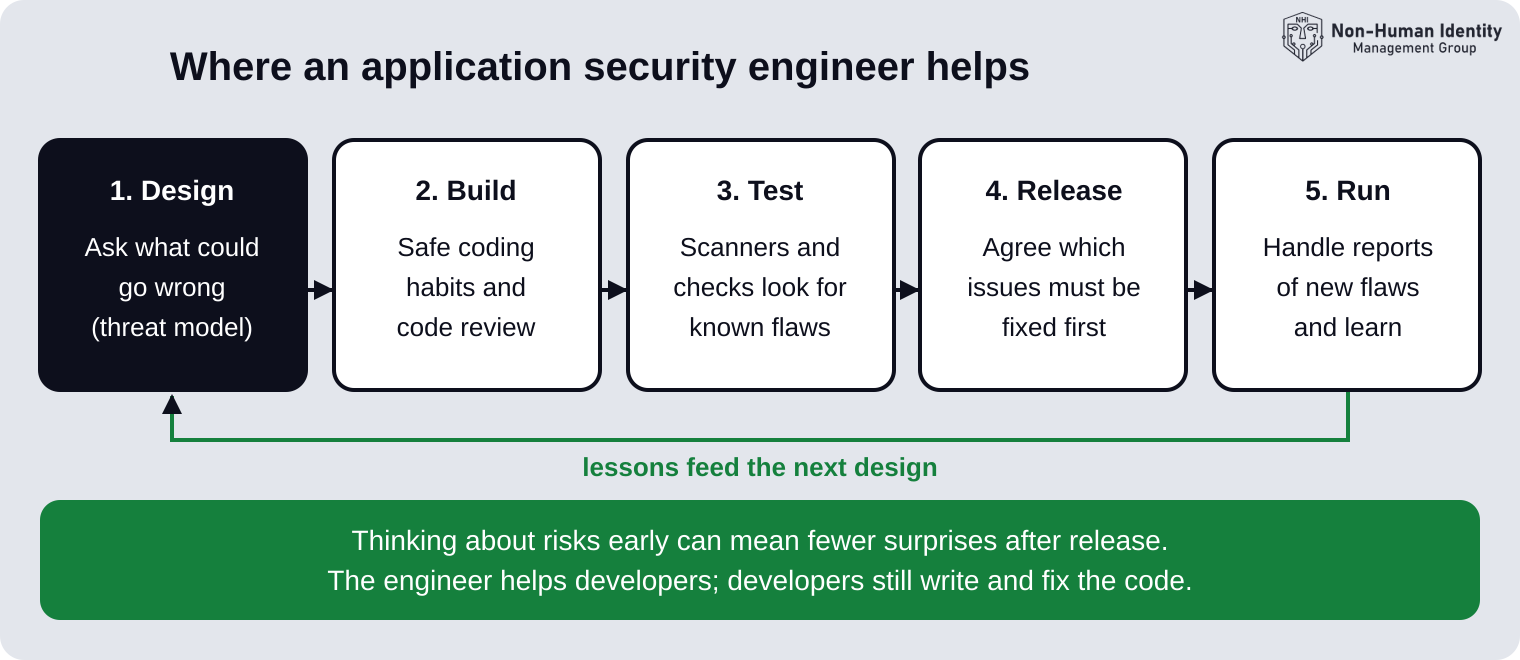
This idea of building security into each stage is set out in a US government framework for secure software development.[2] The US cyber agency also asks makers to treat customer security as a core business need, which it calls "secure by design".[3]
Tools help, but they do not do the whole job. A scanner can only find the kinds of flaw it was built to look for. It can also flag things that are not real problems. So the engineer checks results and explains them.
In bigger firms, one AppSec engineer may support many development teams. They often train a "security champion" in each team, a developer who takes a special interest in security.
Skills and tools
- Reading code. Enough to follow what developers wrote and talk to them in their own words.
- Threat modelling. Asking "what could go wrong?" with the team before anything is built.
- Scanners. Tools such as SAST, which reads source code for known kinds of flaw. The engineer checks and explains the results.
- The OWASP Top 10. A well known list of the most serious risks to web apps.[1]
- Clear writing and teaching. Findings with a plain fix and an owner, plus short sessions that build safe habits.
A worked example
Saanvi Rao is an application security engineer at Copperleaf Studio, a fictional firm that builds booking apps for small businesses. On Monday, Ruben Jansen, a developer, asks her to look at a new feature.
The feature lets customers view past bookings. Saanvi thinks of the structural engineer: better to check the plan now than knock down a wall later. She and Ruben spend half an hour asking what could go wrong.
They spot one risk. If the app trusts the booking number in the page address, a customer might see someone else's booking. Ruben adds a check that each booking belongs to the person signed in.
On Wednesday the code is ready. Saanvi reviews the risky parts and the scanner runs its checks. The scanner flags two possible issues. She looks at both. One is a real mistake in how errors are shown. The other is a false alarm, and she records why.
Ruben fixes the error message the same day. Saanvi tests the booking page with two made-up customer accounts. Each one sees only its own bookings.
On Friday Saanvi runs a short session for the whole team on the problem they avoided. Two other developers find the same pattern in older pages and plan fixes.
Ruben says the most useful part was not the scanner. It was the half hour of questions before he wrote any code.
Myths and mistakes
| What people think | What is true |
|---|---|
| AppSec engineers fix all the security bugs. | Developers usually fix them. The engineer finds, explains and helps decide what comes first. |
| A scanner finds every problem. | Scanners find known kinds of flaw. Design reviews and people still catch things tools miss. |
| Security is checked at the end, just before launch. | Checks at each stage tend to find problems earlier, when they are easier to change. |
| You must be an expert coder to start. | Being able to read code helps. Many people start in testing or support and build coding skills over time. |
| The job is mainly saying no. | Good AppSec engineers help teams ship safely, with clear advice and practical fixes. |
What can I do this week?
- Read our Application Security for Beginners guide.
- Read The OWASP Top 10 for Beginners and pick one risk to understand well.
- Read two AppSec engineer job adverts and note the skills they share.
- Try to explain one common flaw to a friend in plain words.
Checklist
- I can explain what an application security engineer does in one sentence.
- I can name the stages of building software where security fits.
- I know what threat modelling and code review mean.
- I understand why scanners alone are not enough.
- I know developers usually make the fixes, with the engineer's help.
- I have checked official sources for pay, not just job boards.
- I have a plan for one first learning step.
Common questions
Do I need to be a developer first?
Not always, but it helps a lot. Many AppSec engineers used to be developers or software testers. It is important to read code and talk to developers in their own words. You can build these skills over time, as you learn about security.
How is this different from a penetration tester?
A penetration tester usually tests a finished system for a short time and then writes a report. An AppSec engineer works with developers over many months, from design to release. Some AppSec engineers do testing as well. See Penetration Tester for Beginners.
Is AppSec the same as DevSecOps?
They overlap a lot. DevSecOps is a way of working that adds security checks to the fast, automatic way many teams now release their software. AppSec engineers often help to set it up. See DevSecOps for Beginners.
Where next?
Ready for the detail? Read the practitioner guide: Application Security Engineer Career Guide. It goes further into core skills and tools, certifications, how to measure your effectiveness and how the role progresses.
Also useful:
- Application Security for Beginners
- Secure Coding for Beginners
- Threat Modelling for Beginners
- Application Security Engineer Interview Questions
- DevSecOps Engineer for Beginners
Related NHI Mgmt Group resources: Cybersecurity Careers Guide · Application Security Guide · Secure Code Review Guide
Key terms
- Application security
- The work of keeping apps and websites safe from attack, from design to everyday use.
- Vulnerability
- A flaw in code, settings or design that could be abused.
- Threat modelling
- A structured way to work out how a system could be attacked and what to do about it.
- Code review
- A person reading new code to spot mistakes, including security flaws, before it is used.
- SAST
- A tool that reads source code to look for known kinds of security flaw.
- Security champion
- A team member who takes a special interest in security and helps their team with it.
- OWASP Top 10
- A widely used list of the most serious security risks to web applications.
Sources and further reading
- OWASP Top 10 (current release: OWASP Top 10 2025). OWASP Foundation. https://owasp.org/www-project-top-ten/, accessed 28 Nov 2026.
- Secure Software Development Framework (SSDF) Version 1.1, NIST SP 800-218. National Institute of Standards and Technology, February 2022. https://csrc.nist.gov/pubs/sp/800/218/final, accessed 28 Nov 2026.
- Secure by Design, Secure by Default. Cybersecurity and Infrastructure Security Agency (US). https://www.cisa.gov/securebydesign, accessed 28 Nov 2026.
- Information Security Analysts, Occupational Outlook Handbook. US Bureau of Labor Statistics. https://www.bls.gov/ooh/computer-and-information-technology/information-security-analysts.htm, accessed 28 Nov 2026.
- Explore careers. National Careers Service (England). https://nationalcareers.service.gov.uk/explore-careers, accessed 28 Nov 2026.