A cryptographer is a person who designs, tests and builds the maths that keeps data secret and trustworthy.
This guide is for students, career changers and anyone who wonders who makes the padlock in their web browser work. You do not need to be good at maths to read it. Every time you pay online or send a private message, you rely on work cryptographers did.
In short
- Cryptographers design the methods that scramble data and prove who sent it, then try hard to break them.
- Some do research, often with a maths degree or more. Others are engineers who build and check these methods in real products.
- A big task right now is moving the world to new methods that should resist future quantum computers.
- People get in through maths or computing degrees, government schemes, apprenticeships and software jobs.
What you will learn
- Explain what a cryptographer does in one sentence.
- Spot the difference between research and engineering jobs in cryptography.
- Check which subjects and skills lead into the work.
- Ask good questions about a cryptography job before you apply.
- Scrambling data (encryption)
- turning readable data into a jumble that only someone with the right key can turn back.
- Set of steps (algorithm)
- a fixed recipe a computer follows, such as the recipe for scrambling data.
- Secret value (key)
- the piece of information that locks and unlocks scrambled data.
What is a cryptographer?
Think of an engineer who designs bridges. Millions of people cross the bridge without seeing the sums behind it. The engineer checks those sums again and again, because one mistake could bring it down.
A cryptographer does the same for the hidden maths in computers. They work on encryption, which scrambles data so only the right person can read it. They also work on digital signatures, which prove who sent something and that nobody changed it on the way.
There are two broad kinds of job. Research cryptographers invent new methods and look for weak spots in old ones. Cryptography engineers build those methods into real software and hardware, and check they were built correctly. Many people do a bit of both.
Governments employ cryptographers too. The UK's intelligence and security agency names cryptographers among the staff who help protect the country.[1]
Where the comparison stops working: a weak bridge shows cracks you can see. A weak method for scrambling data can look fine for years, until someone finds the flaw and quietly uses it.
For a plain look at the subject itself, read Encryption for Beginners. This page is about the job and the people who do it.
Why does it matter?
Banks, shops, phone calls and app updates all rely on these methods. When one is found to be weak, it must be swapped out on millions of devices. That takes skilled people.
If you are a student who likes maths
What could happen: you think maths only leads to teaching or banking, and miss a job that uses it every day.
Check this: look for university courses that teach codes and number puzzles.
If you write software
What could happen: you write your own code to scramble data, and it has a hidden flaw.
Check this: ask which tested code library your team uses to scramble data.
If you are changing career
What could happen: you think the field is only for people with a doctorate. Many jobs need careful builders and testers too.
Check this: read job adverts for a "cryptography engineer" and list the skills they share.
What does it look like?
Much of the work is checking how a product uses its secret keys. Here is a made-up page from such a review.
Example only. All values are made up.
REVIEW 0000-EXAMPLE    Product: FakePay app
Reviewer: A. Example
Item 1: Card data scrambled before storage   OK      (1)
Item 2: Key stored in the app's settings file  FIX   (2)
Item 3: Old method EXAMPLE-OLD-0 still used    FIX   (3)
Item 4: Library version 0.0-FAKE, maintained   OK    (4)
Question: Is customer card data safe at rest?        (5)
- Good news is recorded too, so the team knows what to keep.
- In a real file, this line would name where the key was found. A key kept next to the data it protects is easy to steal.
- An older method that experts no longer advise. It needs replacing with a current one.
- A tested, maintained library is usually safer than code a team writes itself.
- The question the client wants answered. It keeps the review focused.
Why this is risky: strong scrambling helps little if the key sits beside the data. An out of date method is a risk too.
The safer way: keep keys in a separate locked store. Use current methods from a tested library. Write down each finding with its fix.
How does it work?
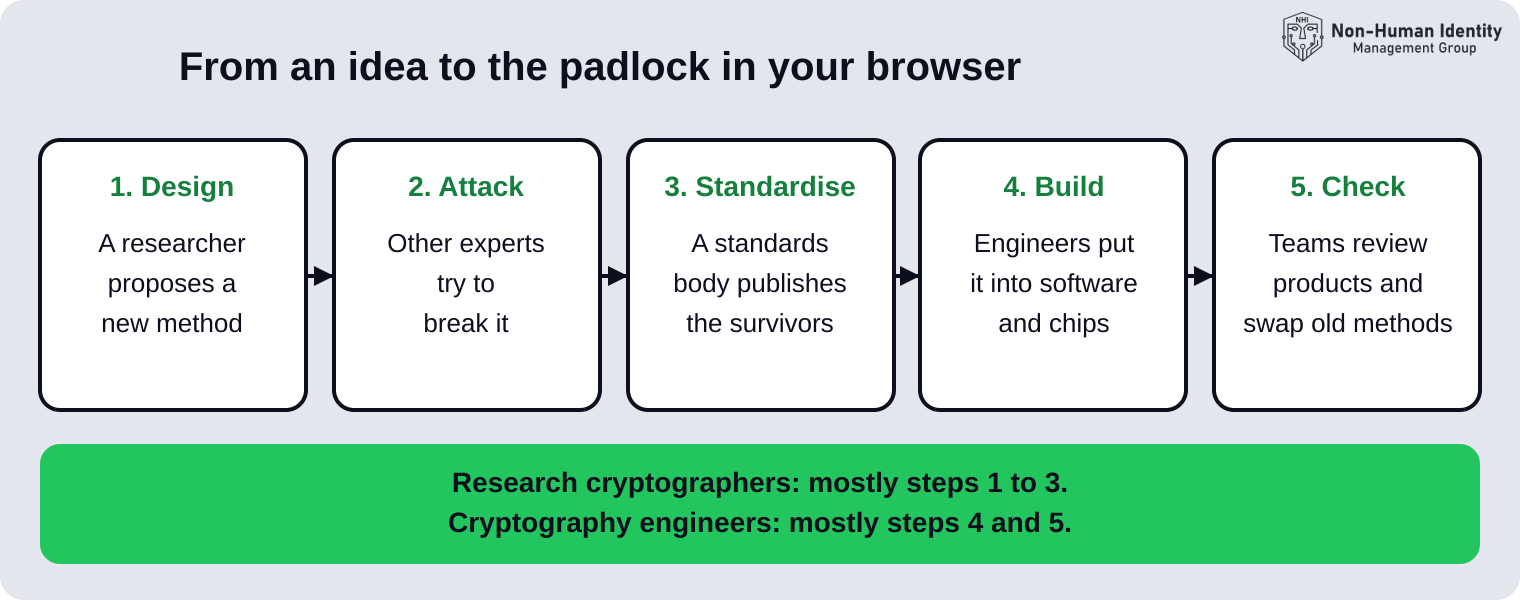
A new method for scrambling data goes on a long journey before it reaches your phone. Cryptographers work at every stage.
- Design. Researchers propose a new algorithm, a fixed set of steps, and write up why they think it is secure.
- Attack. Other experts try to break it. This is called cryptanalysis, and it can go on for years.
- Standardise. Bodies such as the US standards agency NIST publish the methods that survive. In August 2024 NIST published three new standards built to resist future quantum computers.[3]
- Build. Engineers write the method into software libraries and chips, carefully, because small coding slips can leak secrets.
- Check and replace. Teams review products, find old methods and swap them for new ones over time.
The quantum change is creating a lot of work. A quantum computer is a new kind of machine that could one day break many of today's methods. NIST says such machines may be years or decades away, but advises starting the move now.[3] The UK's National Cyber Security Centre suggests organisations finish moving their systems by 2035.[4] Someone has to find the old methods, plan the swap and test it.
Skills and tools
In plain words, these are the skills job adverts and employers tend to ask for:
- Maths, especially number theory, algebra and probability, for research roles.[1]
- Programming, for engineering roles, with great care over small details.
- Patience and a habit of trying to break your own ideas.
- Clear writing, because findings must make sense to managers and other teams.
Cryptographers use maths software, programming languages and well-known encryption libraries. Each employer has its own set. Learning the ideas first makes any tool easier to pick up later.
Routes in
There is no single way in. Common routes include:
- A degree in maths, computer science or a related subject. Research jobs in the US often ask for a master's degree or a doctorate, as is usual for mathematicians.[2]
- Government schemes. The UK agency GCHQ takes some people as apprentices, some on the strength of their degrees, and runs summer placements.[1]
- Starting as a software developer or security engineer, then moving across into cryptography work.
- Working on open source encryption libraries, which lets others see your careful work.
Government jobs in this area usually need security checks, and some have nationality rules. Check each employer's own pages.
How the role connects to others
Cryptographers work with software developers, security architects and the teams who look after keys and certificates. In big firms they may sit in a small specialist team. In smaller firms, a security engineer may cover this work alongside other tasks.
A worked example
Mira Iyer is a cryptography engineer at a fictional software firm. She studied maths, then spent two years as a developer before moving across.
On Monday, a client called Meadow Pharmacy, a fictional chain of chemists, asks a question. Their online prescription system is old. Is the customer data still well protected?
Mira thinks of the bridge engineer. The bridge is busy every day. She has to check the sums without closing it.
She starts by listing every place the system scrambles data or checks a signature. She finds the card data is scrambled with a current method. That is good news, and she writes it down.
Then she spots a problem. The key that unlocks the data is kept in the same settings file as the system's other options. Anyone who can read that file could unlock the data.
She also finds one older method still in use for signing messages. It is not broken today, but it is one that experts plan to retire as quantum computers improve.
Her colleague, Lars Ilic, checks her notes. He repeats two of her checks and gets the same results.
On Friday, Mira explains her report to the pharmacy's IT manager in plain words. First, move the key into a separate locked store. Second, plan to replace the older method over the next year. Mira's part is done, and the pharmacy's team starts on the fixes.
Myths and mistakes
| What people think | What is true |
|---|---|
| Cryptographers spend all day cracking secret codes, like in films. | Most of the work is designing, building and checking methods, with lots of careful writing. |
| You need a doctorate. | Many research jobs ask for one, but engineering and review roles often hire people with a degree and coding skill.[2] |
| Strong encryption means the data is safe. | A strong method can still fail if the key is stored badly or the code has a slip. |
| It is fine to invent your own scrambling method. | Home-made methods are rarely tested by other experts. Use published standards and maintained libraries. |
| Quantum computers have already broken encryption. | NIST says such machines may be years or decades away, but planning the change takes a long time.[3] |
What can I do this week?
- Read three cryptography job adverts and list the tasks they share.
- Read the NIST post-quantum project page to see what the field is working on now.[3]
- Try a free online course or puzzle book on simple codes and ciphers.
- Read our Quantum Computing and Security for Beginners guide.
Checklist
- I can explain what a cryptographer does in one sentence.
- I know the difference between encryption and a digital signature.
- I know the difference between research and engineering roles.
- I know why quantum computers are creating new work.
- I have looked at real job adverts for the role.
- I have checked whether the jobs I like need security checks.
- I have checked official sources for pay, not just job boards.
Common questions
Do I need to be brilliant at maths?
For research jobs, yes, maths matters a lot. Many people in them hold a master's degree or a doctorate. For engineering jobs, careful coding matters more. You still need to grasp the ideas, but you build on methods that others made and tested.[2]
Is a cryptographer the same as a hacker?
No. A cryptographer makes and checks the methods that keep data safe. They do try to break methods, but only to test them, in the open and with permission. The aim is to find flaws before criminals do, then fix the method or replace it.
Who employs cryptographers?
Many kinds of employer. Governments and spy agencies hire them. In the US, the federal government is the biggest employer of mathematicians.[2] Universities, banks, tech firms, chip makers and security firms also hire people for this work.
How much does a cryptographer earn?
Pay varies a lot by country, sector and experience, so we do not quote a figure here. Use official sources. In the US, the government's job pages for mathematicians give a guide.[2] Job adverts in your area also help.
Where can the job lead?
Many paths. Engineers can become lead engineers or security designers. Researchers can lead a team or teach at a university. The move to quantum-safe methods is also creating new planning jobs in many large firms.[4]
Where next?
Ready for the detail? Read the practitioner guide: Cryptography and PQC Engineer Career Guide. It goes further into the two engineering tracks, the skills to build and how to prepare for interviews.
Also useful:
- Cryptography Basics Guide
- Encryption for Beginners
- Quantum Computing and Security for Beginners
- Key Management for Beginners
Related NHI Mgmt Group resources: Cybersecurity Careers Guide · Cryptography Glossary · Post-Quantum Algorithms Compared
Key terms
- Encryption
- Scrambling data so that only someone with the right key can read it.
- Encryption key
- The secret value used to lock and unlock scrambled data.
- Digital signature
- A maths-based seal that shows who sent something and that it was not changed.
- Hash function
- A method that turns data into a short fingerprint, used to check it has not changed.
- Public-key cryptography
- Methods that use a pair of keys: one you can share and one you keep private.
- Post-quantum cryptography
- Newer methods designed to stay secure even against future quantum computers.
- Cryptographic agility
- Being able to swap one method for another without rebuilding a whole system.
Sources and further reading
- Working at GCHQ. Government Communications Headquarters (UK). https://www.gchq.gov.uk/working-at-gchq, accessed 28 Nov 2026.
- Mathematicians and Statisticians, Occupational Outlook Handbook. US Bureau of Labor Statistics. https://www.bls.gov/ooh/math/mathematicians-and-statisticians.htm, accessed 28 Nov 2026.
- Post-Quantum Cryptography project. NIST Computer Security Resource Center (page updated 27 Oct 2026). https://csrc.nist.gov/projects/post-quantum-cryptography, accessed 28 Nov 2026.
- Timelines for migration to post-quantum cryptography. National Cyber Security Centre (UK), 20 Mar 2025. https://www.ncsc.gov.uk/guidance/pqc-migration-timelines, accessed 28 Nov 2026.