A cybersecurity trainer teaches people how to stay safe online and how to do security work well.
This guide is for teachers, trainers, students and career changers who wonder whether they could teach security. You do not need to be an expert hacker to read it. If you have ever sat through a phishing lesson at work, a cybersecurity trainer probably planned it.
In short
- A cybersecurity trainer finds out what people need to learn, builds lessons and checks whether the lessons worked.
- Learners range from all staff in an office to security teams, developers and students.
- Most trainers combine teaching skill with real security knowledge. Many keep a hands-on specialism.
- People come in from school teaching, IT support, security jobs and corporate training teams.
What you will learn
- Explain what a cybersecurity trainer does in one sentence.
- Spot the steps that turn a lesson into real change.
- Check which teaching or security skills you already have.
- Ask good questions about a trainer job before you apply.
- Finding out what people need (needs assessment)
- checking what learners already know and what they must be able to do.
- Staying alert to online tricks (security awareness)
- knowing the common scams and risks, and what to do about them.
- Practice space (lab)
- a safe, separate set of computers where learners can try things without harming real systems.
What is a cybersecurity trainer?
Think of a driving instructor. They do not just explain the rules of the road. They watch how you drive, give you practice in safe places and check you are ready before you go out alone.
A cybersecurity trainer does the same for online safety and security work. They teach people to spot scams, handle data safely and use security tools well.
The work is wider than standing in front of a class. A US government guide to cyber jobs lists the tasks. They include finding out what learners need, writing course materials and running hands-on exercises. They also include checking whether training meets its goals.[1] A related role focuses on designing and reviewing the courses themselves.[2]
Where the comparison stops working: road rules change slowly. Online tricks change often, so a trainer has to keep updating lessons and their own knowledge.
Why does it matter?
Many attacks start with a person being tricked, such as clicking a fake link. Good training helps people notice and report these tricks. It also helps organisations grow the security staff they need.
If you are a school teacher
What could happen: you assume your skills only fit a classroom, and miss a role that needs them badly.
Check this: list the lesson planning, marking and feedback skills you use every week.
If you run a small business
What could happen: staff never get any security training, and one fake invoice email costs you money.
Check this: plan a short session for your team on how to spot and report a suspicious email.
Next: Phishing for Beginners
If you work in IT or security
What could happen: you are asked to train new starters and fill an hour with slides nobody remembers.
Check this: write down what each learner should be able to do at the end, before you make any slides.
What does it look like?
Much of a trainer's work starts with a simple lesson plan. Here is a made-up one for a short staff session.
Example only. All values are made up.
LESSON PLAN 0000-EXAMPLE
Audience:  Front desk staff (FAKE TEAM)
Goal:      Spot and report a fake invoice email      (1)
Time:      30 minutes
Activity:  Sort 6 sample emails into safe / suspect  (2)
Check:     Short quiz, then a practice email later   (3)
Feedback:  (not planned)                             (4)
- One clear goal, written as something learners can do.
- A hands-on task, not just slides. In a real file, this line would contain links to the practice emails.
- A way to see whether the learning stuck, both on the day and later.
- The feedback box. Here it is empty, so the trainer will not learn what to improve.
Why this is risky: without feedback and a later check, a trainer cannot tell whether the session changed anything, and may repeat a weak lesson.
The safer way: ask learners what was unclear, look at report rates after the session and change the plan.
How does it work?
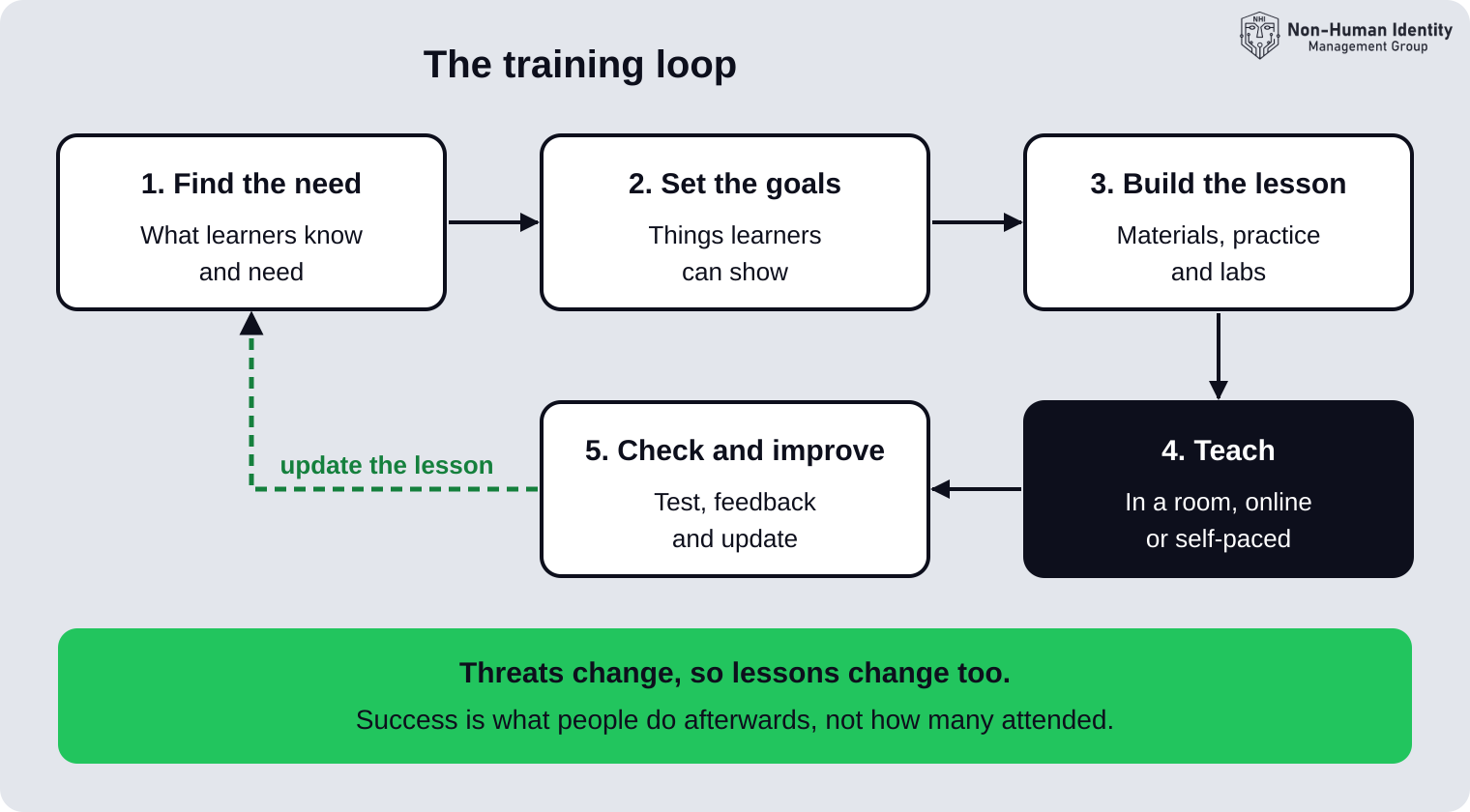
Every trainer works a little differently, but most training follows a loop like this one.
- Find the need. The trainer asks what learners already know and what they must be able to do.
- Set the goals. They write a few clear goals, each one something a learner can show.
- Build the lesson. They make materials, practice tasks and sometimes a lab where learners can try things safely.
- Teach. They run the session in a room, online or as a short course people take in their own time.
- Check and improve. They test what learners can do, gather feedback and update the lesson.
Skills and tools
- Teaching skill. Explaining clearly, reading the room and adjusting the pace.
- Security knowledge. Enough real experience that learners trust you. Many trainers keep one specialism, such as network defence or secure coding.
- Course design. Writing goals, tasks and fair tests.
- Measuring results. Using quizzes, practice tasks and feedback to see what worked.
- Everyday tools. Slides, video calls, online course platforms and practice labs. Some trainers also run practice phishing emails, which are fake scam emails sent with the organisation's approval to help staff learn.
Trainers work in several places. Some are in a company's security or training team. Others work for training providers, colleges, universities or public sector skills programmes. Europe's skills framework has a profile for this work, which shows how employers describe it.[3]
A worked example
Kaia Rosen used to teach IT at a secondary school. Now she is a cybersecurity trainer for a training firm. Her new client is Thistle Gym, a fictional chain of fitness clubs.
The gym manager, Talia Lomax, explains the problem. Last month, two front desk staff paid fake invoices sent by email. Talia wants training before it happens again.
Kaia thinks of the driving instructor. Before any lesson, she needs to see how people really drive. She spends a morning on the front desk and asks staff how they check invoices.
She finds the real gap. Staff know scams exist. But nobody knows who to tell when an email looks odd.
Kaia sets one goal: every staff member can spot a fake invoice and report it in under a minute. She builds a 30 minute session. Staff sort six made-up emails into safe and suspect. Then they practise the report button together.
She runs the session at three clubs. One learner asks a question she cannot answer about card payments. She notes it and checks with the payment provider afterwards.
A month later, with Talia's approval, Kaia sends a practice fake invoice email. Most staff report it, and fewer click it than in the first test. Kaia adds two new examples to the lesson for the staff who missed it.
Myths and mistakes
| What people think | What is true |
|---|---|
| Trainers just read out slides. | Much of the work is finding needs, designing practice tasks and checking results.[1] |
| You must be a top hacker to teach security. | You need real knowledge of what you teach. Many trainers teach beginners and staff, not experts. |
| Once a year is enough training. | Online tricks change through the year, so many teams add short, regular sessions and practice. |
| Catching people out with fake emails teaches them. | Practice emails help when they are approved, fair and followed by kind, useful feedback. |
| High attendance means the training worked. | What counts is what people do afterwards, such as reporting suspicious emails. |
What can I do this week?
- Plan a 15 minute lesson on spotting a scam email for friends or family, with one clear goal.
- Read three cybersecurity trainer or instructor job adverts and list the skills they share.
- Read our Security Awareness for Beginners guide.
- Ask someone who runs training at work how they check whether it worked.
Checklist
- I can explain what a cybersecurity trainer does in one sentence.
- I know the difference between teaching staff awareness and teaching security professionals.
- I can write a learning goal as something a learner can show.
- I have a security topic I know well enough to teach.
- I have looked at real job adverts for the role.
- I have checked official sources for pay, not just job boards.
- I have one first learning step planned.
Common questions
Can a school teacher become a cybersecurity trainer?
Yes, often. Teachers already plan lessons, manage groups and give feedback. The gap is usually security knowledge. A short course, some hands-on practice and one area you know well can help you make the move. Some teachers start by running security sessions in their own school.
Do I need to be a security expert first?
Not for every job. Teaching staff to spot scams needs less depth than teaching security teams. For technical courses, learners expect the trainer to have done the work. Many trainers build experience in a security job first, then move into teaching.
What is the difference between awareness training and technical training?
Awareness training is for everyone and covers everyday risks, such as scam emails and weak passwords. Technical training is for people who do security or IT work, and teaches tools and skills in depth, often with labs. Many trainers do both at different points in their careers.
How much does a cybersecurity trainer earn?
Pay varies by country, employer and experience, so we do not give a figure here. Use official sources. In the US, see the government's job outlook pages.[4] In the UK, see the National Careers Service.[5]
Where can the job lead?
There are several paths. Trainers often move into leading a training team, designing whole courses, running awareness work for a large firm or teaching at a college. Some return to hands-on security work with stronger speaking skills, which helps in most senior jobs.
Where next?
Ready for the detail? Read the practitioner guide: Cybersecurity Educator and Trainer Career Guide. It goes further into the official role profiles, the settings trainers work in, the credentials employers look for and how careers progress.
Also useful:
- Running Security Awareness Training for Beginners
- Security Awareness for Beginners
- Phishing for Beginners
- Neurodiversity and Awareness Training
- SOC Analyst for Beginners
Related NHI Mgmt Group resources: Cybersecurity Careers Guide · Career Change into Cyber Security Guide · Non-Human Identities for Beginners
Key terms
- Security awareness
- Knowing the common online risks and scams, and what to do about them.
- Security awareness training
- Lessons that help everyday staff spot and report security risks.
- Phishing
- A fake message that tries to trick someone into clicking, paying or sharing details.
- Phishing simulation
- An approved practice scam email sent to staff to help them learn to spot the real thing.
- Needs assessment
- Finding out what learners already know and what they need to be able to do.
- Learning goal
- A short statement of what a learner should be able to do after a lesson.
Sources and further reading
- NICE Framework, Cybersecurity Instruction work role (tasks). CISA National Initiative for Cybersecurity Careers and Studies. https://niccs.cisa.gov/tools/nice-framework/work-role/cybersecurity-instruction, accessed 28 Nov 2026.
- NICE Framework, Cybersecurity Curriculum Development work role. CISA National Initiative for Cybersecurity Careers and Studies. https://niccs.cisa.gov/tools/nice-framework/work-role/cybersecurity-curriculum-development, accessed 28 Nov 2026.
- European Cybersecurity Skills Framework (ECSF). European Union Agency for Cybersecurity (ENISA). https://www.enisa.europa.eu/topics/skills-and-competences/skills-development/european-cybersecurity-skills-framework-ecsf, accessed 28 Nov 2026.
- Information Security Analysts, Occupational Outlook Handbook. US Bureau of Labor Statistics, last modified 27 August 2026. https://www.bls.gov/ooh/computer-and-information-technology/information-security-analysts.htm, accessed 28 Nov 2026.
- Explore careers. National Careers Service (England). https://nationalcareers.service.gov.uk/explore-careers, accessed 28 Nov 2026.