A SOC analyst is a person who watches an organisation's security alerts and decides which ones need action.
This guide is for anyone thinking about a first job in cyber security, or curious about what the people in a security team do all day. You do not need a technical background to read it. If your company pays for a security monitoring service, these are the people on the other end.
In short
- A SOC analyst works in a security operations centre (SOC), the team that spots and handles attacks.
- Most of the day is sorting alerts: deciding what is harmless, what needs a closer look and what must go to a senior colleague.
- Good notes, curiosity and calm matter as much as deep technical skill at the start.
- People come in from help desk jobs, apprenticeships, degrees and career changes. Many start on shifts.
What you will learn
- Explain what a SOC analyst does in one sentence.
- Spot the main steps in handling a security alert.
- Check which skills you already have that the job uses.
- Ask good questions about a SOC job before you apply.
- Security team room (SOC)
- the team that watches for attacks and responds to them, also called a security operations centre.
- Warning message (alert)
- a message from a security tool saying something might be wrong.
- Sorting by urgency (triage)
- deciding quickly which alerts need action first.
What is a SOC analyst?
Think of an emergency call handler. Calls come in all day. Some are serious, many are not, and the handler decides which ones need a crew sent out.
A SOC analyst does the same job for computer security. Security tools watch an organisation's computers, accounts and networks. When a tool sees something odd, it raises an alert (a warning message). The analyst looks at each alert and decides what it means.
Many alerts turn out to be harmless. A security tool might flag a staff member logging in from a hotel abroad. The analyst checks, and it is just a business trip. An alert that looks harmful but is not is called a false positive.
When an alert does look real, the analyst gathers the facts and passes it on. This is called escalation (handing a case to someone more senior). The team that does all this is the security operations centre, or SOC. Its job is to spot attacks that get past other defences and limit the damage.[1]
Where the comparison stops working: a caller usually knows something is wrong. In a SOC, nobody may have noticed yet. The alert can be the very first sign of an attack.
Why does it matter?
Attackers often get past the first lock. The SOC is there to notice them early, before small problems become big ones.[1] For many people, it is also a common first step into cyber security work.
If you are thinking of a career change
What could happen: you apply for "cyber security" jobs without knowing which ones fit, and lose heart.
Check this: read real SOC job adverts and note the tasks and shift patterns they list.
If you work on an IT help desk
What could happen: you already sort and log problems every day, but do not see how close that is to SOC work.
Check this: ask your security team if you can sit with them for a shift.
Next: SIEM for Beginners
If you buy a monitoring service for your business
What could happen: you pay for alerts to be watched, but nobody agreed who calls whom when something is real.
Check this: ask your provider who will contact you, how and in what time.
What does it look like?
Most of an analyst's day is spent in a list of alerts. Here is a made-up alert, as it might appear on screen.
Example only. All values are made up.
ALERT 0000-EXAMPLE   Priority: Medium            (1)
Rule:    Sign-in from a new country               (2)
User:    [email protected]
From:    203.0.113.0 (test address, FAKE)
Time:    09:14
Status:  New, not yet assigned                    (3)
Notes:   (empty)                                  (4)
- The tool guesses how urgent this is. The analyst may change it.
- The rule that fired. In a real screen, this line would name the check the tool ran.
- Nobody owns the alert yet. The analyst picks it up.
- The notes box. This is where the analyst writes what they checked and why.
Why this is risky: an alert like this is easy to close in a hurry as "probably travel". If the sign-in was really an attacker using a stolen password, closing it lets them carry on.
The safer way: check before closing. Did the person really travel? Did anything strange happen after the sign-in? Write the answers in the notes, so the next person can see the reasoning.
How does it work?
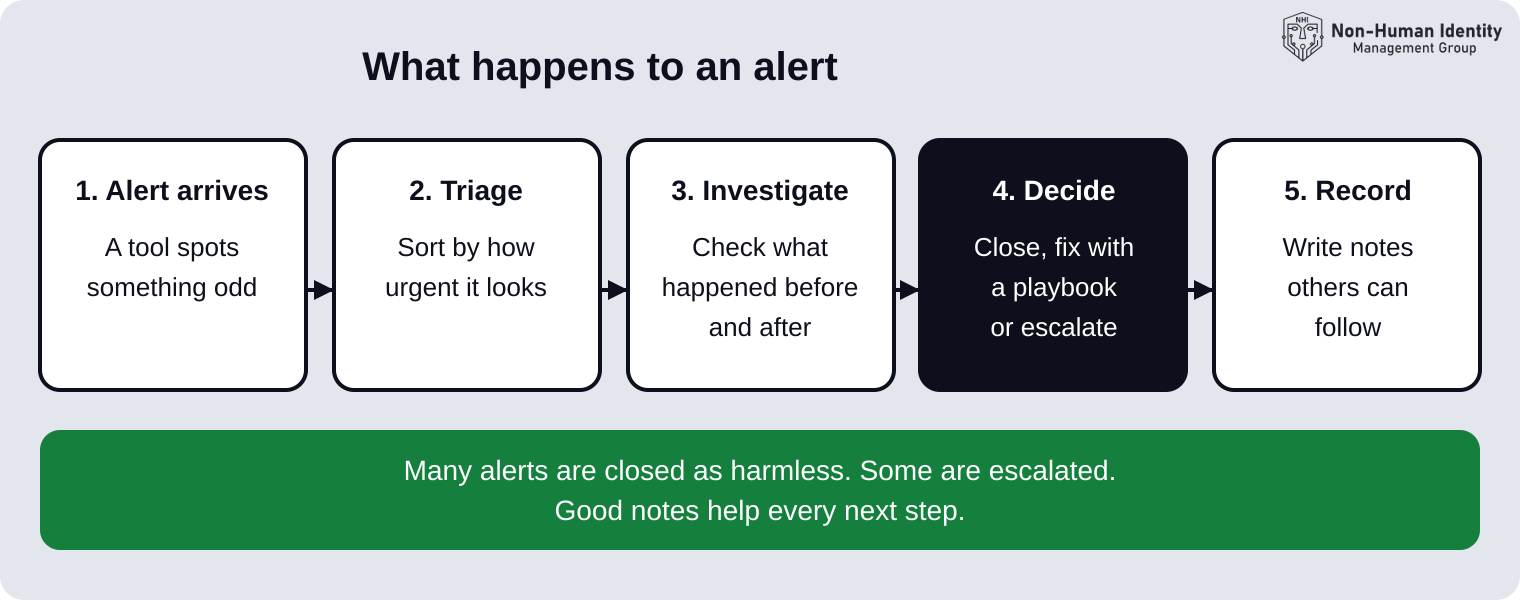
Each SOC has its own rules, but alert handling usually follows a pattern like this.
- The alert arrives. A security tool spots something odd and adds it to the list. Many teams use a SIEM, a tool that gathers security records from many systems in one place.
- Triage. The analyst sorts and ranks alerts so the most urgent ones get looked at first.[2]
- Investigate. They look at the records around the alert. Who was involved? What happened just before and after?
- Decide. They close it as harmless, fix it using a written set of steps called a playbook, or escalate it.
- Record. They write up what they found. Reports on attacks and attempted attacks are part of the job.[3]
Each review is often short, depending on the team's rules and how many alerts arrive.[2] Automation now handles some of the sorting. Even so, people still make the harder calls.[2]
Analysts also do other work. They keep up with new attack methods, help improve the tools and suggest fixes to managers.[3] In a bigger team, a junior analyst handles the first sort. More experienced colleagues take escalated cases, hunt for hidden attackers or lead the response.
A worked example
Yusuf Demir is in his first year as a SOC analyst at Pinecrest Insurance, a fictional firm. Before this, he spent two years on the IT help desk.
His shift starts at 7am. The night analyst, Aisha Grant, hands over. She tells him about two open cases and one tool that went quiet overnight.
By 9am there are thirty new alerts. Most are routine. A printer is talking to an unusual address. Yusuf checks, and it is a planned software update, so he closes it with a note.
At 9:14 an alert says a claims manager signed in from another country. Yusuf thinks of the call handler: is this a real emergency? He checks the travel calendar. The manager is in the office today, not abroad.
He looks wider. Just after the sign-in, someone set up a rule to forward the manager's email to an outside address. That does not look like normal work.
Yusuf follows the team's playbook. He writes down what he found and escalates the case to the senior analyst on shift. She locks the account and starts the response.
The rest of the day is quieter. Yusuf tunes a noisy rule that keeps flagging the printer. He spends half an hour on a training course. At 3pm he hands over to the late shift and explains the case in plain words.
His manager later tells him the notes made the response faster. Nobody had to repeat his checks.
Myths and mistakes
| What people think | What is true |
|---|---|
| SOC analysts are hackers in hoodies. | Most of the work is careful checking, clear notes and teamwork. |
| You need a computer science degree. | Many employers want a degree, but some take people with training and certifications instead.[3] |
| Every alert is an attack. | Many are harmless. Telling them apart is the skill. |
| Closing alerts fast is the goal. | Closing them correctly, with notes, matters more than speed. |
| AI will do the whole job soon. | Automation helps with sorting, but people still make the harder judgements.[2] |
What can I do this week?
- Read three SOC analyst job adverts and list the tasks they share.
- Learn what a log is by opening the event records on your own computer.
- Read our SIEM for Beginners guide.
- Ask someone who works in a SOC what a normal shift looks like.
Checklist
- I can explain what a SOC does in one sentence.
- I know what an alert, triage and escalation mean.
- I have looked at real job adverts for the role.
- I know whether the jobs near me involve shift work.
- I have checked official sources for pay, not just job boards.
- I can show I keep clear notes, from work, study or a hobby.
- I have a plan for one first learning step.
Common questions
Do I need a degree to become a SOC analyst?
Not always. In the US, the usual route is a degree in computing or a related subject. Some people start instead with a school qualification plus industry training and certifications.[3] Apprenticeships and help desk jobs are other common ways in.
Is SOC work done in shifts?
Often, yes. Attacks can happen at any hour, so many SOCs watch alerts around the clock. That can mean early, late or night shifts. Some teams use a provider for nights instead. Ask about the shift pattern before you accept a job.
How much does a SOC analyst earn?
Pay varies a lot by country, sector and experience, so we do not quote a figure here. Use official sources. In the US, see the government's job outlook page for information security analysts.[3] In the UK, see the National Careers Service.[4]
Is the job stressful?
It can be. A large number of alerts can wear people down, which is called alert fatigue. Good teams tune noisy rules, share the load and plan breaks. Ask how a team handles this at interview.
Where can a SOC analyst job lead?
Many paths. Analysts often move into senior SOC roles, incident response, threat hunting or security engineering. The alert work teaches how attacks look in real records, which helps in most security jobs. See SOC Analyst vs Security Engineer.
Where next?
Ready for the detail? Read the practitioner guide: SOC Analyst Career Guide. It goes further into the skills employers test, certifications, home lab practice and how analysts progress.
Also useful:
- SOC Analyst Interview Questions and Answers
- SIEM for Beginners
- Incident Response for Beginners
- Threat Hunting for Beginners
- Security Logging for Beginners
- Incident Responder for Beginners
- Security Engineer for Beginners
Related NHI Mgmt Group resources: Cybersecurity Careers Guide · SOC Analyst Onboarding and Training Plan Template · Building a SOC from Scratch Guide
Key terms
- SOC
- A security operations centre: the team that watches for attacks, checks alerts and responds.
- Alert triage
- Sorting alerts to decide which need a closer look, which go up the chain and which can be closed.
- False positive
- An alert that looks like a problem but turns out to be harmless.
- Escalation
- Passing an alert or case to a more senior person when it cannot be handled at the current level.
- SIEM
- A tool that collects security records from many systems in one place and raises alerts.
- Playbook
- A written set of steps for handling one kind of alert or incident.
- Alert fatigue
- When so many low-value alerts arrive that important ones get harder to notice.
Sources and further reading
- Building a Security Operations Centre (SOC). National Cyber Security Centre (UK). https://www.ncsc.gov.uk/collection/building-a-security-operations-centre, accessed 28 Nov 2026.
- Knerler, K., Parker, I. and Zimmerman, C. 11 Strategies of a World-Class Cybersecurity Operations Center. The MITRE Corporation, 2022. https://www.mitre.org/sites/default/files/2022-04/11-strategies-of-a-world-class-cybersecurity-operations-center.pdf, accessed 28 Nov 2026.
- Information Security Analysts, Occupational Outlook Handbook. US Bureau of Labor Statistics, last modified 27 August 2026. https://www.bls.gov/ooh/computer-and-information-technology/information-security-analysts.htm, accessed 28 Nov 2026.
- Explore careers. National Careers Service (England). https://nationalcareers.service.gov.uk/explore-careers, accessed 28 Nov 2026.