A database administrator looks after the systems that store an organisation's data, keeping them safe, fast and backed up.
This guide is for students, career changers and people in IT support who are curious about the job. You do not need to know how to code to follow it. If your business keeps customer records, orders or stock lists, someone is looking after that data, even if their title is different.
In short
- Database administrators, or DBAs, keep an organisation's stored data available, accurate and secure.
- Their day includes backups, checking performance, applying updates and deciding who may see which data.
- Most people get in through a computing degree, an apprenticeship or a move from IT support.
- DBAs hold powerful access, so good teams limit it, record it and review it.
What you will learn
- Explain what a database administrator does in one sentence.
- Describe a typical day, from backups to access requests.
- Spot the skills from your own work that fit the role.
- Explain why a DBA's own access needs care.
- Organised data store (database)
- a system that keeps information in a tidy, searchable way, such as customer records.
- Spare copy (backup)
- a copy of data kept somewhere else, so it can be put back if the original is lost.
- Database question language (SQL)
- the common language people use to ask a database for data or change it.
What is a database administrator?
Think of the head librarian in a big library. They decide where each book goes and who may borrow rare ones. They also keep a record of what is out. A DBA does this for an organisation's data.
The US Bureau of Labor Statistics says DBAs and database architects "create or organize systems to store and secure data".[1] In plain words, they make sure the data is there when people need it. They also make sure it is correct and seen only by the right people.
Some DBAs look after the technical side, such as installing upgrades and fixes. Others focus on the database behind one particular app, and may write or fix code for it.[1]
Where the comparison stops working: a librarian can see an empty shelf. A copied database leaves the original in place, so a DBA relies on records and alerts to notice misuse.
Why does it matter?
Almost every app keeps its data in a database. If the database is slow, lost or leaked, the business feels it straight away.
If you are a student or career changer
What could happen: you see job adverts full of product names and assume the role is out of reach.
Check this: look past the products at the basics: SQL, careful habits and clear thinking.
If you run a small business
What could happen: your customer list sits in one place with no tested spare copy, and one fault wipes it.
Check this: ask your supplier when your data was last backed up and whether a restore was tested.
If you manage a technical team
What could happen: several people share one all-powerful database login, so nobody knows who changed what.
Check this: ask whether each person and each app has its own account, with only the access it needs.
What does it look like?
Many DBAs start the day with a short status note like this made-up one.
Example only. All values are made up.
Database:        orders-db.example.invalid
Last night's backup:   finished OK              (1)
Last restore test:     5 weeks ago              (2)
Slowest query today:   stock report, 40 seconds (3)
Pending updates:       1 security fix           (4)
Access requests:       2 waiting for approval   (5)
Shared admin login:    still in use by 3 people (6)
- The nightly spare copy worked.
- Nobody has proved the copy can be put back for a while.
- A slow report. Speeding it up is part of the job.
- A fix from the database maker that still needs to go in.
- People asking to see data. Each needs a reason and an approver.
- One login shared by several people. In a real file, this line would name the account they share.
Why this is risky: an untested backup may fail when it is needed. A shared login means no clear record of who did what.
The safer way: test restores on a regular schedule, give each person their own login, and approve and record every access request.
How does it work?
The UK National Careers Service and the US Bureau of Labor Statistics describe similar core tasks.[1][2]
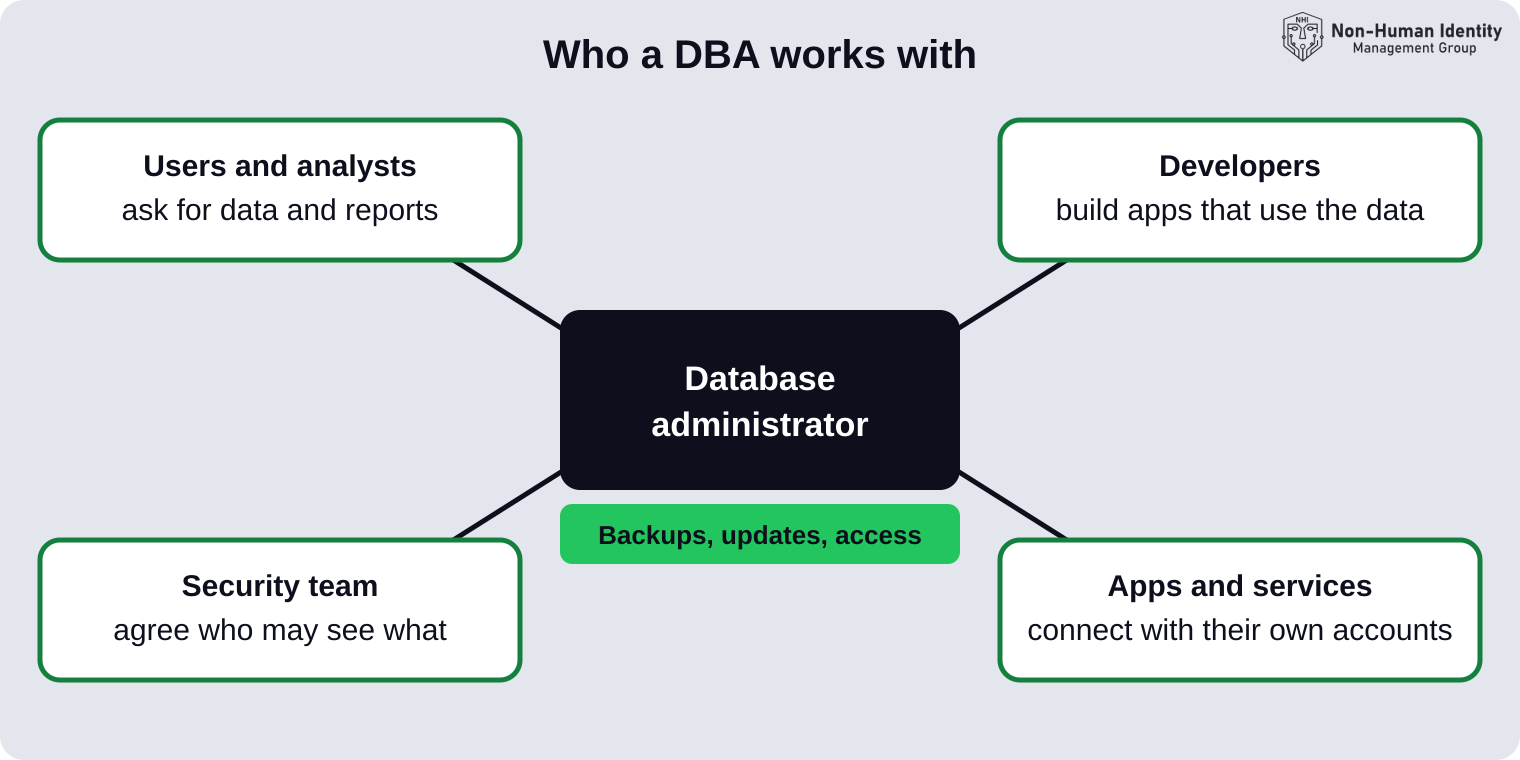
- Understand what people need. The DBA talks to users and developers about what data they must store and find.
- Set up and organise. They build or change the database structure so data is stored in a sensible way.
- Keep it healthy. They watch performance, fix slow queries, test for faults and apply updates.
- Protect it. They make backups, check they can be restored and apply security measures.
- Control access. They decide who and what may read or change data, and remove access that is no longer needed.
Why access matters in this job
DBAs can often read and change everything in a database. That makes their accounts a target for attackers. A good principle is least privilege: give each person or process only the access their task needs.[3]
Apps connect to databases too. They use their own accounts, called non-human identities (NHIs): digital identities given to software, such as service accounts and API keys. A DBA helps make sure each app account has narrow access and a named owner.
Skills and tools
Few people start with all of these. Most build them up over time.
- SQL. The language for asking a database questions and changing data.[1]
- Database systems. At least one common database product, learned through free versions and practice.
- Backups and recovery. How to copy data safely and put it back.
- Attention to detail. The careers service lists it as a key skill, with problem-solving and teamwork.[2]
- Clear talking. Explaining choices to users and developers who are not data experts.
Routes in
In the UK, routes include a degree or higher national diploma, an apprenticeship, or a graduate training scheme.[2] In the US, employers typically look for a bachelor's degree in a computing subject.[1] Many people also move across from IT support.[4] Certifications from database makers can help, and some employers ask for them.[1]
A worked example
Fen Grover is a DBA at Meadow Joinery, a fictional furniture maker that sells online. She moved from IT support three years ago.
At 8.30 she checks the night's work. The backup of the orders database finished. Her notes show the last restore test was five weeks ago, so she books a test for the afternoon.
At 10.00 the sales team complain that a stock report takes almost a minute. Fen looks at the query behind it. She adds an index, a kind of shortcut that helps the database find rows faster. The report now runs in a few seconds.
At 11.30 an access request arrives. Hugo Lomax in marketing wants to see all customer records. Fen asks what he needs. He only needs names and the date of the last order, so she gives him a view with just those two columns. His manager approves it in the ticket.
After lunch she runs the restore test on a spare server. The copy comes back complete. She records the result.
Before she logs off, she tackles an old problem. Three developers still share one admin login. Fen sets up a personal login for each of them, then disables the shared one. From now on, the records should show who made each change.
Myths and mistakes
| What people think | What is true |
|---|---|
| A DBA just runs backups. | Backups are one task among many, alongside performance, updates, design and access control.[1] |
| If the backup finished, the data is safe. | A backup helps only if it can be restored. Check that restores work and contain everything important.[5] |
| You need a degree to become a DBA. | A degree is common, but UK routes also include apprenticeships, and many people move across from IT support.[2][4] |
| A DBA should have full access to everything, all the time. | The least privilege principle says access should match the task. Many teams grant extra access only when needed and record it.[3] |
| Security is someone else's job. | Keeping data secure and managing user permissions are listed as core DBA duties.[1] |
What can I do this week?
- Install a free database product on your own computer and create a small table.
- Learn three basic SQL commands: one to read data, one to add it and one to change it.
- Back up your practice database, delete it, then restore it from the copy.
- Read the official careers profile for the job in your country.
- Ask someone in IT who can see the customer data at your workplace, and how that is decided.
Checklist
- I can explain what a DBA does in plain words.
- I know what a database, a backup and SQL are.
- I can describe a typical day in the job.
- I know why a backup should be tested by restoring it.
- I can explain why each person and app should have its own account.
- I know at least two routes into the role.
- I have chosen one skill to practise first.
Common questions
Is a DBA the same as a data analyst?
No. A data analyst studies data to answer business questions. A DBA looks after the systems that hold the data, keeping them working, backed up and secure. The two work closely, and analysts often ask DBAs for access or help with slow queries.
Do I need to be good at maths?
Some maths helps. The UK careers service lists maths knowledge as useful. Day to day, the job leans more on logic, careful checking and problem-solving than on advanced maths. Learning SQL well matters more for most starters.
Is a DBA a security job?
Not mainly, but it touches security every day. DBAs keep data secure, manage permissions and look after backups. They also hold powerful access themselves. Good DBAs work closely with the security team, most of all when something goes wrong.
Will the job involve being on call?
It can. The UK careers service notes the role can involve being on call. Databases often support services that run all day, so some teams take turns to respond to problems out of hours. Ask about this at interview.
How much does the job pay?
Pay varies by country, sector and experience, so we do not quote figures here. For a fair picture, check your official careers service or national statistics office. They publish current pay data for this job in your country.
Where next?
Ready for the detail? Read the practitioner guide: Database Security Guide. It goes further into hardening settings, encryption choices and how to monitor database activity.
Also useful:
- Database Backup Security Guide
- SQL Injection for Beginners
- Data Security Analyst for Beginners
- Cybersecurity Careers Guide
Related NHI Mgmt Group resources: Non-Human Identities for Beginners · Database Security for Beginners · Career Change into Cyber Security Guide
Key terms
- Database administrator (DBA)
- The person who keeps an organisation's databases working, backed up and secure.
- Backup
- A spare copy of data kept elsewhere, so it can be restored if the original is lost.
- SQL
- The common language used to ask a database for data or change it.
- Database role
- A named set of permissions inside a database, given to people or apps.
- Least privilege
- Giving each person or program only the access it needs, for only as long as needed.
- Non-human identity (NHI)
- A digital identity given to software, such as a service account or API key, so it can connect to systems.
- SQL injection
- A flaw where an attacker's input is treated as part of a database question, letting them read or change data.
Sources and further reading
- Database Administrators and Architects, Occupational Outlook Handbook. US Bureau of Labor Statistics. https://www.bls.gov/ooh/computer-and-information-technology/database-administrators.htm, accessed 28 Nov 2026.
- Database administrator, job profile. National Careers Service (UK). https://nationalcareers.service.gov.uk/job-profiles/database-administrator, accessed 28 Nov 2026.
- Least privilege, Glossary. NIST Computer Security Resource Center. https://csrc.nist.gov/glossary/term/least_privilege, accessed 28 Nov 2026.
- IT support technician, job profile. National Careers Service (UK). https://nationalcareers.service.gov.uk/job-profiles/it-support-technician, accessed 28 Nov 2026.
- Backing up your data, Small organisations guide to cyber security. National Cyber Security Centre (UK). https://www.ncsc.gov.uk/collection/small-organisations-guide-to-cyber-security/backing-up-your-data, accessed 28 Nov 2026.