An incident responder is a person who takes charge when a cyber attack happens and helps an organisation recover.
This guide is for anyone curious about this kind of security work, or thinking about it as a career. You do not need a technical background to read it. If your organisation is ever attacked, these are the people you will be working with.
In short
- Incident responders step in when an attack is found. They work out what happened, stop it spreading and help put things right.
- Much of the job happens before any attack: writing plans, running practice drills and checking that records are kept.
- A forensic analyst is a close cousin. They study the evidence in depth, while the responder leads the wider effort.
- Calm under pressure, clear writing and good teamwork matter as much as technical skill.
What you will learn
- Explain what an incident responder does in one sentence.
- Spot the main stages of handling a cyber attack.
- Explain how a responder differs from a forensic analyst.
- Ask good questions about a response job before you apply.
- A security emergency (incident)
- an event that harms, or threatens, an organisation's computers or data.
- Stopping the spread (containment)
- steps that keep an attack from reaching more systems.
- Digital clues (evidence)
- records and files that show what an attacker did.
What is an incident responder?
Think of a fire crew. When the alarm goes, they arrive, stop the fire spreading, make the building safe and then help work out how it started.
An incident responder does the same job for a cyber attack. The attack is called an incident (a security emergency). It might be ransomware locking files, a stolen password or data sent to a stranger.
The responder leads the work to understand it, contain it and recover. Containment means stopping the attack from reaching more systems. They also keep the evidence, the digital clues that show what the attacker did.
Some responders work inside one organisation. Others work for specialist firms that companies call in after an attack.[2]
Where the comparison stops working: a fire is easy to see. A cyber attack may have been quietly running for weeks before anyone notices. The responder often has to find out where it started and how far it spread.
Why does it matter?
How an attack is handled in the first hours shapes how bad it gets. A calm, planned response can limit the damage and the cost.[1]
If you are thinking about this career
What could happen: you picture constant drama and miss that most weeks are spent on plans, drills and reports.
Check this: ask a responder how their time splits between live attacks and preparation.
If you are a SOC analyst now
What could happen: you escalate cases every week but never see what happens next.
Check this: ask to shadow the response team on the next real case or drill.
If you run a small organisation
What could happen: an attack hits and nobody knows who to call or who decides what.
Check this: write down who you would call, and keep it somewhere you can reach if your computers are down.
What does it look like?
Responders keep a running record of everything they find and do. Here is a made-up page from one.
Example only. All values are made up.
CASE EXAMPLE-0000   Opened: Tue 06:40
06:40  Booking system files locked, note demands payment   (1)
06:55  Laptop LT-0000 taken off the network, left powered on (2)
07:10  Copy of laptop memory saved, handed to R. FAKE       (3)
07:30  Shared admin password changed                        (4)
08:00  Update sent to managers: what we know, what we don't (5)
- The first sign. In a real file, this line would say who reported it and when.
- Containment: cut off from the network, but not switched off, so clues held in memory are kept.
- Evidence collected, with a note of who now holds it.
- A likely way in is closed.
- A short, honest update for decision makers.
Why this is risky: in a panic, people often wipe or rebuild a machine straight away. That can destroy the clues that show how the attacker got in, so the same door may stay open.
The safer way: follow the plan. Isolate first, save the evidence, write down each step with the time, then clean up. A clear record also helps if the case goes to insurers, regulators or the police.
How does it work?
Every organisation has its own plan, but responders usually work through stages like these.[1]
- Prepare. Before any attack, they write plans, list who to call and run practice drills.
- Detect and assess. An alert or report comes in. They work out if it is a real incident and how serious it is.
- Contain. They cut off affected machines or accounts so the attack stops spreading, while keeping the evidence.
- Remove and recover. They remove what the attacker left behind and bring systems back safely, often from backups.
- Learn. They write up what happened and what to change, so the same attack is less likely to work again.
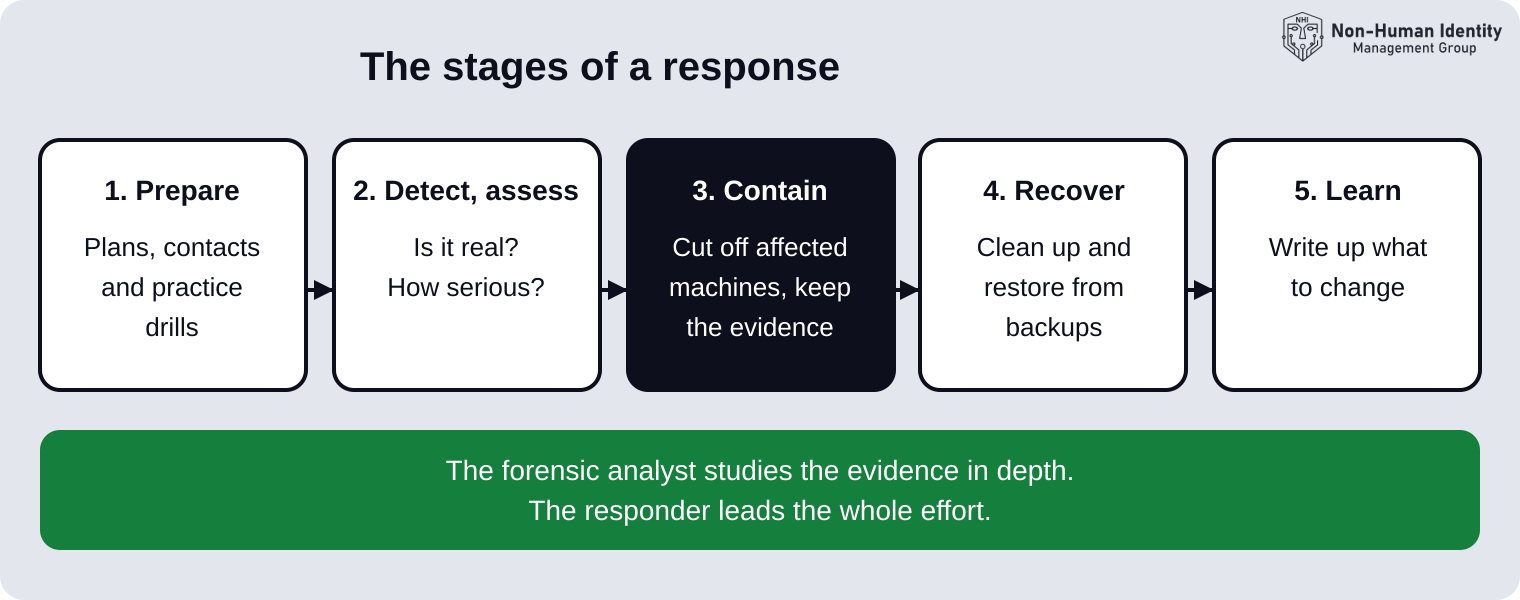
Responder or forensic analyst? The two jobs overlap, and in small teams one person often does both. The responder leads the whole effort. They decide what to cut off, who to tell and when systems can come back. A forensic analyst focuses on the evidence. Digital forensics means collecting, keeping and studying digital evidence carefully, so it can support an investigation or a court case. Many people call the combined field DFIR, short for digital forensics and incident response.
Responders also spend time talking. They brief managers, work with lawyers and keep staff informed. In the UK, the national cyber security agency runs a scheme that checks outside response firms against its standards.[2]
A worked example
Mei Ling Tan is an incident responder at Quayline Ferries, a fictional ferry company. She joined from the security monitoring team two years ago.
At 6:40 on a Tuesday, the booking team rings. Their files will not open, and a note on screen demands payment. Mei Ling thinks of the fire crew: stop the spread first, then find the cause.
She opens the response plan and starts a case record. She asks the IT team to unplug the affected laptop from the network but leave it switched on. Her colleague Finn Andersen saves a copy of its memory and logs who holds it.
By 7:30 they have a likely way in. A shared admin password had been reused on an old remote access system. Mei Ling has it changed and the old system turned off.
At 8:00 she briefs the managers. She tells them what is known, what is not yet known and what she needs from them. They agree to restore bookings from the backup taken on Sunday night.
Finn spends the next two days on the evidence. He confirms how the attacker got in and finds no sign of data being copied out in the records available to him.
A week later, Mei Ling runs a short review. The team agrees three changes: no shared admin passwords, an up-to-date list of remote access systems and a practice drill every quarter.
Myths and mistakes
| What people think | What is true |
|---|---|
| Responders spend all day fighting live attacks. | Much of the job is preparation: plans, drills, tools and reports. |
| The first step is to wipe the infected machine. | Isolate it and save the evidence first, or you may lose how the attacker got in. |
| It is purely a technical job. | Clear updates for managers, staff and outside bodies are a big part of it. |
| Incident response and forensics are the same job. | They overlap. The responder leads the effort, the forensic analyst studies the evidence in depth. |
| Once systems are back, the job is done. | The review afterwards is where the lasting fixes come from. |
What can I do this week?
- Read our Incident Response for Beginners guide.
- Read two incident responder job adverts and note what they ask for.
- Find out if your workplace has an incident plan, and who owns it.
- Take part in, or ask to watch, a practice drill.
Checklist
- I can explain what an incident responder does in one sentence.
- I can name the main stages of a response.
- I know why evidence is saved before machines are cleaned.
- I can explain how a responder differs from a forensic analyst.
- I know the job can involve on-call work and long days during an attack.
- I have checked official sources for pay, not just job boards.
- I have a plan for one first learning step.
Common questions
How do people become incident responders?
Usually by moving across from another security or IT job. Many start as SOC analysts, system administrators or network engineers, then join a response team. Some join specialist response firms after training. Practice drills, home labs and certifications can help show you are ready.
Is the job on call?
Often, yes. Attacks do not keep office hours, so many responders take turns being on call. During a big incident, days can be long. Good teams share the load and plan rest. Ask how a team handles this before you accept a job.
What is the difference between a responder and a forensic analyst?
The responder leads the whole effort, from first alert to recovery. The forensic analyst studies the evidence in depth, often to a standard that could be used in court. In smaller teams one person may do both. See Incident Responder vs Digital Forensic Analyst.
How much does an incident responder earn?
Pay varies by country, sector and experience, so we do not quote a figure here. Use official sources. In the US, the closest official page is the government's job outlook for information security analysts.[3] In the UK, see the National Careers Service.[4]
Is the job stressful?
It can be, especially during a big attack. People are worried, and decisions have to be made with only part of the picture. Plans, drills and clear roles make it easier. See Incident Responder Wellbeing.
Where next?
Ready for the detail? Read the practitioner guide: DFIR Analyst Career Guide. It goes further into the core skills and tools, certifications that help and how people progress in response and forensics work.
Also useful:
- Incident Responder vs Digital Forensic Analyst
- Incident Response for Beginners
- Digital Forensics for Beginners
- DFIR Analyst Interview Questions
- SOC Analyst for Beginners
Related NHI Mgmt Group resources: Cybersecurity Careers Guide · Digital Forensics (DFIR) Guide · Incident Responder Wellbeing
Key terms
- Incident response
- The planned work to find, contain, investigate and recover from a security incident.
- Incident responder
- A person who contains, investigates and helps recover from security incidents.
- Containment
- The stage that stops an incident spreading while keeping the evidence needed to investigate it.
- Digital forensics
- Collecting, keeping and studying digital evidence so it can support an investigation.
- Chain of custody
- A record of who collected and handled each piece of evidence, and when.
- Root cause analysis
- Working back from the damage to the weakness that let the incident happen.
Sources and further reading
- Incident Response Recommendations and Considerations for Cybersecurity Risk Management: A CSF 2.0 Community Profile (NIST SP 800-61 Rev. 3). National Institute of Standards and Technology, 3 April 2025. https://csrc.nist.gov/pubs/sp/800/61/r3/final, accessed 28 Nov 2026.
- NCSC assured Cyber Incident Response (CIR) scheme. National Cyber Security Centre (UK). https://www.ncsc.gov.uk/information/cir-cyber-incident-response, accessed 28 Nov 2026.
- Information Security Analysts, Occupational Outlook Handbook. US Bureau of Labor Statistics, last modified 27 August 2026. https://www.bls.gov/ooh/computer-and-information-technology/information-security-analysts.htm, accessed 28 Nov 2026.
- Explore careers. National Careers Service (England). https://nationalcareers.service.gov.uk/explore-careers, accessed 28 Nov 2026.