A smart contract auditor reads blockchain code before launch to find mistakes that could lose people money.
This guide is for developers, students and the curious who want to know what this job involves day to day. You do not need to know blockchain to start reading. If you have ever wondered who checks the code behind a crypto app, this is the role.
In short
- A smart contract is a program that runs on a blockchain and often holds or moves money.
- Auditors read that code line by line, run tests and tools, and write up the problems they find.
- An audit lowers risk but does not catch every bug, so it is one layer among several.
- Many auditors start as developers. Others build a public track record through open audit contests and bug bounties.
What you will learn
- Explain what a smart contract auditor does in one sentence.
- Spot the main stages of an audit.
- Check which skills you would need to build first.
- Ask good questions about audit contests and first jobs.
- Self-running program (smart contract)
- code on a blockchain that follows its rules on its own once it is live.
- Code check (audit)
- an independent review of code to find mistakes before people rely on it.
- Write-up (finding)
- one problem the auditor found, with how serious it is and how to fix it.
What is a smart contract auditor?
Think of a building surveyor who checks a house before you buy it. They look for cracks, damp and bad wiring, then write a report.
A smart contract auditor does the same for code. A smart contract is a program that runs on a blockchain, a shared record kept by many computers. These programs often hold or move money. The auditor reads the code, looks for mistakes and writes a report of what they found.[1]
The audit is an independent review. The aim is to make sure the code is safe and free of design errors before people trust it with their funds.[1]
Where the comparison stops working: a house can be repaired after you move in. Many smart contracts are built so their logic cannot be changed once they go live.[2] Also, anyone in the world can read the code and try to misuse it.[5]
Why does it matter?
A small mistake in a smart contract can let someone take money that is not theirs. Because the code is public and hard to change, finding mistakes before launch matters a lot.
If you are a developer
What could happen: you write working code that still has a hidden flaw, because you only tested what you expected.
Check this: read a public audit report for a project you know and see what the auditors spotted.
If you are a student
What could happen: you jump into audit contests without the coding basics and lose heart quickly.
Check this: list the programming skills you have today and the ones adverts ask for.
If you use crypto apps
What could happen: you trust an app because it says "audited", without knowing what that covered.
Check this: look for the audit report, its date and whether the problems were fixed.
Next: DeFi Risk Guide
What does it look like?
The main thing an auditor produces is a written finding. Here is a made-up one, as it might appear in a report.
Example only. All values are made up.
FINDING  EXAMPLE-01
Severity:  High                                   (1)
Where:     Vault.withdraw()  (FAKE project)       (2)
Problem:   Anyone can call the "pause" switch,    (3)
           not just the project owner.
Impact:    A stranger could freeze all deposits.
Fix:       Allow only the owner role to pause.    (4)
Status:    Fixed, re-checked on 0000-00-00        (5)
- How serious it is, so the team fixes the worst first.
- The exact place in the code. In a real file, this line would name the real function.
- The problem in plain words.
- A suggested fix the developers can follow.
- Proof that the auditor checked the fix afterwards.
Why this is risky: a vague finding, such as "access could be better", gives the developers nothing to act on. A flaw like this one may then go live.
The safer way: say where, what, how bad and how to fix it, then re-check the fix before the report is final.
How does it work?
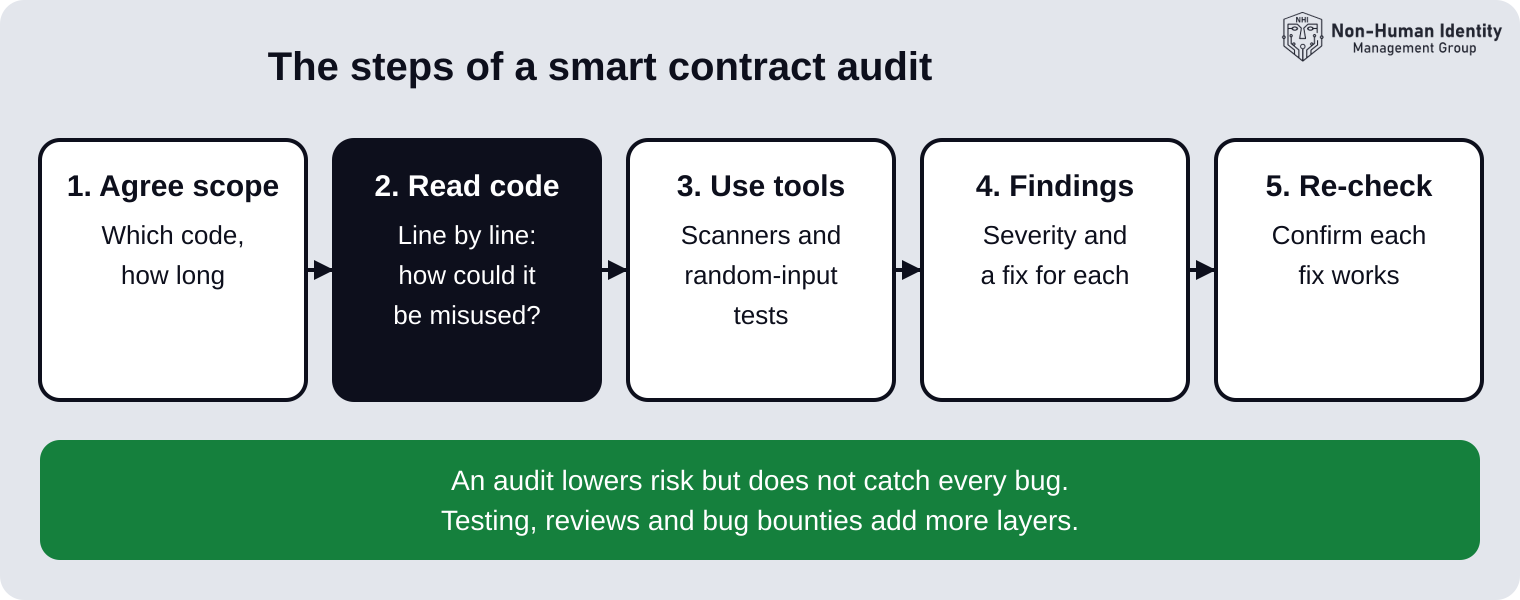
Each firm has its own method, but an audit often follows these steps.
- Agree the scope. The project says which code is in the audit and how long the review will take.
- Read the code. The auditor works through it line by line, asking "how could someone misuse this?"
- Use tools. They run tools that scan the code without running it, called static analysis. They also run tools that feed in random inputs, called fuzzing.[1]
- Write the findings. Each problem gets a severity rating and a suggested fix.
- Re-check the fixes. The team fixes the code, and the auditor checks the changes before the final report.
Auditors often check for well-known mistakes. One public list from a security community names ten common ones. They include weak access rules, logic errors and a trick called reentrancy, where a contract is called back before it has finished updating its records.[3][5]
Skills and tools
- Programming. Comfort reading and writing code, often in Solidity, the language many Ethereum contracts use.
- How blockchains work. Accounts, transactions and why the code is public.[5]
- Known mistake types. Knowing common weak spots well, and spotting new ones.[3]
- Testing tools. Scanners, fuzzers and test frameworks.[1]
- Clear writing. Findings that a busy developer can act on.
- Patience. Reading the same code many times, looking for the one odd path.
Routes in
There is no single route. Many auditors start as software developers. Some join audit firms as juniors. Others build a public record through audit contests. In these, projects put up a prize pool, many researchers review the code, and judges rate each finding.[4] Bug bounties, which pay people who report flaws, are another route.[1]
How the role connects to others
Auditors work closely with the project's developers. They also connect with bug bounty hunters, people who watch live contracts for odd activity and incident teams. Some move into security research, tool building or running an audit team.
A worked example
Pia Haddad is a junior smart contract auditor at a fictional audit firm. Before this, she spent two years building websites, then taught herself Solidity in the evenings.
On Monday, her team starts a two-week audit for a fictional savings app. The lead auditor, Ivo Abara, shares the scope: three contracts and about a thousand lines of code.
Pia reads the first contract slowly. She thinks of the building surveyor. A house can look fine from the street, so she checks the hidden corners. Who can call each function? What happens if someone calls them in an odd order?
On Wednesday, she runs a scanner and a fuzzing tool. The scanner flags twenty items. Most are harmless, and she notes why for each one.
On Thursday, she spots something the tools missed. A setting that controls fees can be changed by any account, not just the project's owner. She writes it up with the exact place in the code, why it matters and a suggested fix. Ivo reviews it and agrees it is high severity.
The developers fix the problem the following week. Pia re-checks the change and confirms the new rule works. The final report lists the issue as fixed.
Ivo reminds her that the report is not a promise of safety. The app still needs good testing, monitoring and a bug bounty once it goes live.
Myths and mistakes
| What people think | What is true |
|---|---|
| An audited contract is safe. | Audits won't catch every bug. They are one layer among testing, reviews and bounties.[1] |
| Tools do the audit. | Tools help, but many serious flaws are logic mistakes that need a person to spot. |
| You need a computer science degree. | Many auditors are self-taught developers with a public track record. |
| Auditors are hackers who attack live apps. | Auditors review code with the owner's permission, before or around launch. |
| A long report means a good audit. | Clear, accurate findings with fixes matter more than length. |
What can I do this week?
- Read our Smart Contract Security for Beginners guide.
- Read one public audit report and list three findings in your own words.
- Skim the list of common smart contract mistakes from the OWASP community.
- Write and test a tiny contract in a free practice tool, using test networks only.
Checklist
- I can explain what a smart contract auditor does in one sentence.
- I know what a smart contract is and why its code is public.
- I know the main steps of an audit.
- I know an audit lowers risk but can miss some bugs.
- I have read at least one real audit report.
- I know which programming skills I still need to build.
- I have a plan for one first learning step.
Common questions
Do I need to be a programmer first?
Yes, in practice. Auditors read code all day, so you need to be comfortable writing and testing it. Many people spend time as developers first. Others learn a smart contract language on their own, then practise on old audit contests before applying for paid work.
What is an audit contest?
An audit contest is an open, time-limited review. A project puts up a prize pool, and many security researchers look at the code at the same time. Judges decide which findings are valid and how serious each one is, and rewards follow from that.[4]
Is this a stable job?
It varies. Some auditors are salaried at audit firms or crypto companies. Others work freelance or earn mainly from contests and bug bounties, where income goes up and down. Demand also tends to follow the state of the crypto market. Ask about pay structure before you commit.
Is it legal to look for bugs in smart contracts?
Yes, when you have permission. Audits are paid by the project, and contests and bug bounties set out rules for what you may test. Testing someone's live contract without permission, or taking funds, can be a crime. Stay inside the published rules.
Where can a smart contract auditor job lead?
Several places. Some auditors become lead auditors or start their own firm. Others move into security research, building analysis tools or wider application security work. The habit of reading code with an attacker's eye is useful in many security jobs.
Where next?
Ready for the detail? Read the practitioner guide: Smart Contract Security Guide. It goes further into common flaw types, testing methods and the controls teams use before and after launch.
Also useful:
- Smart Contract Auditor Career Guide
- OWASP Smart Contract Top 10 Guide
- Smart Contract Audit Readiness and Choosing an Auditor Guide
- Bug Bounty Hunter for Beginners
Related NHI Mgmt Group resources: Cybersecurity Careers Guide · Blockchain and Distributed Ledger Security Guide · Smart Contract Deployment Security Checklist
Key terms
- Smart contract
- A program on a blockchain that runs its rules on its own once it is live.
- Smart contract audit
- An independent review of blockchain code to find logic, access and coding mistakes before launch.
- Static analysis
- Checking code for risky patterns without running it.
- Fuzzing
- Testing by feeding a program many random inputs to find ones that break it.
- Reentrancy
- A flaw where a contract is called back before it finishes updating its records.
- Bug bounty
- A reward paid to people who find and responsibly report security flaws.
Sources and further reading
- Smart contract security. ethereum.org developer documentation. https://ethereum.org/en/developers/docs/smart-contracts/security/, accessed 28 Nov 2026.
- Upgrading smart contracts. ethereum.org developer documentation. https://ethereum.org/en/developers/docs/smart-contracts/upgrading/, accessed 28 Nov 2026.
- OWASP Smart Contract Top 10 (2025). OWASP Foundation. https://owasp.org/www-project-smart-contract-top-10/, accessed 28 Nov 2026.
- Code4rena documentation: overview and roles. Code4rena. https://docs.code4rena.com/, accessed 28 Nov 2026.
- Security Considerations. Solidity documentation. https://docs.soliditylang.org/en/latest/security-considerations.html, accessed 28 Nov 2026.