A threat hunter is a security worker who searches for hidden attackers that the alarms have missed.
This guide is for anyone curious about security jobs, or thinking about a move into one. You do not need a technical background to read it. If your organisation has a security team, hunting is one way it looks for trouble before trouble announces itself.
In short
- Most security tools wait for something to set off an alert. A threat hunter goes looking instead.
- A hunt starts with an idea that can be tested, such as "someone may be using an old staff account".
- Hunters search records from computers and networks, then pass real problems to the response team.
- Many hunters start in a security monitoring team first. Curiosity, patience and clear notes matter a lot.
What you will learn
- Explain what a threat hunter does in one sentence.
- Spot the steps of a simple hunt.
- Check which of your skills the job uses.
- Ask good questions about a hunting role before you apply.
- Searching for hidden attackers (threat hunting)
- looking through records on purpose for signs of an attacker that no alert has flagged.
- Testable hunch (hypothesis)
- a clear idea about what an attacker might be doing, which records can prove or disprove.
- Activity records (logs)
- the records computers keep of who did what, and when.
What is a threat hunter?
Think of a night watch patrol. The building has alarms, but a careful intruder can slip past them. So a guard walks the halls, checking doors and looking for anything out of place.
A threat hunter does this for computer systems. Security tools raise alerts when they spot known warning signs. A hunter does not wait for an alert. They pick an idea about what an attacker might be doing, then search for signs of it. This is called threat hunting.
The idea is called a hypothesis (a testable hunch). One example is that a thief with a stolen password might log in at odd hours. The hunter then looks through logs, the activity records computers keep, to test it.
A US government security catalogue describes hunting as an active defence. It contrasts this with tools that sit and wait, such as firewalls.[1]
Where the comparison stops working: a guard can see the whole hall at once. A hunter sees only what the records show. If a system keeps no records, the hunter cannot check it, so part of the job is asking for better records.
Why does it matter?
Some attackers work quietly and try to look like normal users. Hunting gives a team a chance to find them earlier, before they do more harm.[1]
If you work in a security monitoring team
What could happen: you close the same alerts each day and wonder what the alerts are missing.
Check this: ask whether your team runs hunts, and if you can join one.
If you are changing careers
What could happen: you see "threat hunter" adverts and are unsure if it is an entry-level job.
Check this: read several adverts and note how much experience they ask for.
If you manage a security budget
What could happen: you pay for hunting, but the team lacks the records it needs to hunt well.
Check this: ask which systems keep logs, and for how long.
What does it look like?
Many hunters write a short plan before they start. Here is a made-up one.
Example only. All values are made up.
HUNT 0000-EXAMPLE
Idea:     An attacker may be using old staff      (1)
          accounts that should be switched off.
Records:  Sign-in logs, last 30 days              (2)
Look for: Sign-ins to accounts of people who     (3)
          left more than 2 weeks ago
Result:   (to fill in)                            (4)
Next:     (to fill in)                            (5)
- The hypothesis. It is clear enough that records can prove or disprove it.
- The records the hunter needs, and how far back to look.
- What counts as a sign. This keeps the search focused.
- What the hunter found, written in plain words.
- What happens next: hand over, fix a gap or close the hunt.
Why this is risky: a hunt with no clear idea can turn into hours of scrolling through records with nothing to show for it.
The safer way: write the idea, the records and the signs first. Note the result even when it is "nothing found", so others can learn from it.
How does it work?
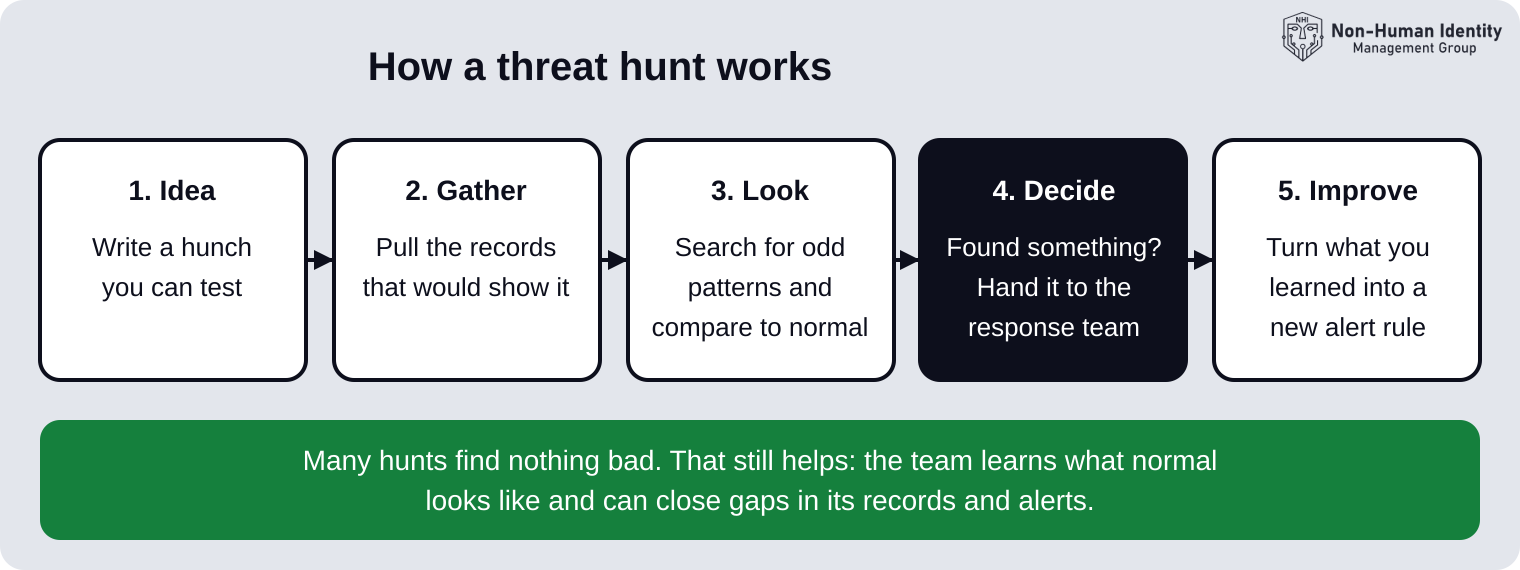
Teams hunt in different ways, but many hunts follow steps like these.
- Pick an idea. Ideas often come from news about how attackers behave. A public library of attacker methods, called MITRE ATT&CK, is a common source.[2]
- Gather records. The hunter pulls the logs that would show the behaviour, often from a SIEM (a tool that gathers security records in one place).
- Look for the odd one out. They search for patterns that do not fit normal work, and check each one.
- Decide. If they find a real attack, they hand it to the incident response team at once.
- Improve. They turn what they learned into a new alert, so the tools can catch it next time. Hunting can also produce intelligence to share with other organisations.[1]
MITRE, a US research organisation, describes hunting based on attacker methods. The idea is that attackers have a limited set of ways to act once inside, so hunters can look for those.[3]
Skills and tools
Hunters use a mix of skills and a few core tools:
- Knowing what normal looks like. They understand how computers and networks usually behave, so odd activity stands out.
- Writing searches. They write searches in the query language of their tools and read records quickly.
- A SIEM. This tool gathers security records from many systems in one place, ready to search.
- MITRE ATT&CK. This free library of attacker methods is a common source of hunt ideas.[2]
- Clear writing. Their findings go to other people, so notes must be plain and complete.
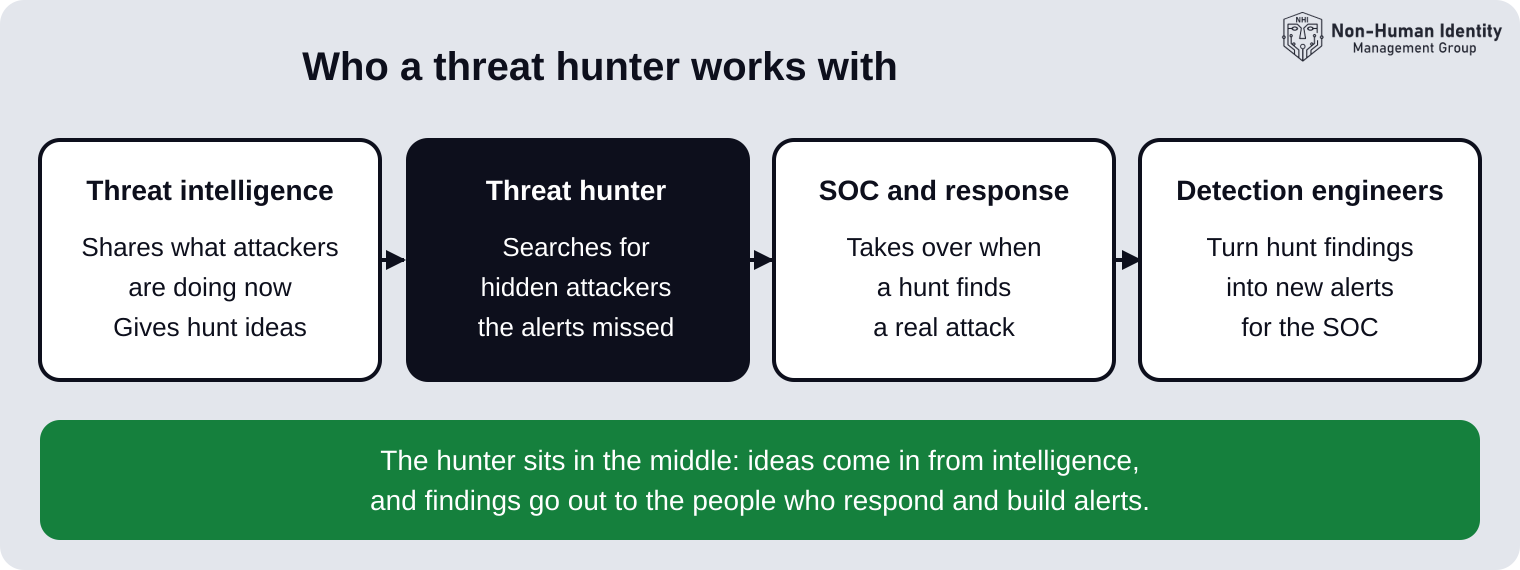
Hunters rarely work alone. Figure 2 shows who they work with most.
A worked example
Noor Al-Sayed is a threat hunter at Brightwater Charity, a fictional national charity with offices, shops and many volunteers. She spent three years in the security monitoring team before moving into hunting.
Her day starts with a short team meeting. Theo Marchetti, the threat intelligence analyst, mentions a report. Attackers have been signing in to charities with old staff accounts that were never switched off.
Noor thinks of the night patrol. The alarms watch the doors, but nobody checks which old keys still work. She writes a hunt plan: look for sign-ins to accounts of people who left more than two weeks ago.
She pulls thirty days of sign-in records and a list of leavers from HR. By late morning she has a short list of five accounts. Four are false alarms. A manager borrowed one for a handover, which breaks the rules but is not an attack.
The fifth account belonged to a fundraising worker who left in the spring. It signed in twice last week, late at night, from an unknown address. Noor writes down what she found and hands it to the incident response team. They lock the account and start their own checks.
In the afternoon, Noor works with a detection engineer. Together they turn her search into a new alert, so the SOC hears about leaver sign-ins in future. She also asks HR to tell IT the same day someone leaves.
Before she goes home, she writes up the hunt in plain words, including the four false alarms.
Myths and mistakes
| What people think | What is true |
|---|---|
| Threat hunters hack back at attackers. | Hunters search their own organisation's records. They defend, they do not attack. |
| A hunt that finds nothing is a waste. | It shows what normal looks like, tests the records and can lead to better alerts. |
| It is a typical first job in security. | Many adverts ask for earlier work in monitoring or response. Check what each employer wants. |
| Hunting replaces alerts. | Hunting works alongside alerts. Good hunts often create new ones. |
| You need to know every tool. | Knowing how systems normally behave matters more than any one tool. |
What can I do this week?
- Read three threat hunter job adverts and list the skills they share.
- Open the event records on your own computer and find your last sign-in.
- Browse the MITRE ATT&CK website and pick one attacker method to read about.
- Read our Threat Hunting for Beginners guide.
Checklist
- I can explain what a threat hunter does in one sentence.
- I know what a hypothesis and a log are.
- I understand how hunting differs from handling alerts.
- I have looked at real job adverts and the experience they ask for.
- I have checked official sources for pay, not just job boards.
- I can show I keep clear notes, from work, study or a hobby.
- I have one first learning step planned.
Common questions
How do people become threat hunters?
Most move in from another security job. A common path starts in a security monitoring team, called a SOC. Next comes response work or a senior analyst post, then hunting. Some come from IT jobs where they learned how systems usually behave. Practice at home with free tools also helps.
Do I need a degree?
Not always. In the US, the usual route into security analyst work is a degree in computing or a close subject. Some people start with a school diploma plus industry training and exams.[4] Employers often care most about hands-on time with records and tools.
How much does a threat hunter earn?
Pay varies by country, sector and experience, so we do not give a figure here. Use official sources. In the US, see the government's job outlook page for information security analysts.[4] In the UK, see the National Careers Service.[5]
Is threat hunting the same as threat intelligence?
No, but they work closely. Threat intelligence studies what attackers do in the wider world. Hunting searches your own systems for signs of it. Intelligence often gives hunters their ideas. See Threat Intelligence vs Threat Hunting.
Where can a threat hunting job lead?
Many hunters move on to build alerts, lead response teams or design security for whole systems. Some lead hunting teams. Reading records and spotting odd behaviour is a skill that helps in most defence jobs. See Threat Hunting vs Detection Engineering.
Where next?
Ready for the detail? Read the practitioner guide: Threat Hunter Career Guide. It goes further into the skills employers test, certifications, home lab practice and how hunters progress.
Also useful:
- Threat Hunter Interview Questions
- Threat Hunting for Beginners
- SOC Analyst for Beginners
- Threat Intelligence Analyst for Beginners
- MITRE ATT&CK for Beginners
Related NHI Mgmt Group resources: Cybersecurity Careers Guide · Threat Hunting Guide · Threat Hunt Hypothesis and Report Template
Key terms
- Threat hunting
- Actively searching systems and records for attackers that existing tools have not flagged.
- Threat hunter
- A security worker who plans and runs hunts and hands real findings to the response team.
- Hypothesis-driven hunting
- Hunting that starts from a clear, testable idea about what an attacker might be doing.
- SIEM
- A tool that collects security records from many systems in one place and raises alerts.
- Baseline
- A picture of normal activity, used to spot what looks out of place.
- False positive
- Something that looks like a problem but turns out to be harmless.
- MITRE ATT&CK
- A free public library of the methods attackers have been seen to use.
Sources and further reading
- SP 800-53 Rev. 5, Security and Privacy Controls for Information Systems and Organizations, control RA-10 Threat Hunting. National Institute of Standards and Technology (NIST). https://csrc.nist.gov/pubs/sp/800/53/r5/upd1/final, accessed 28 Nov 2026.
- MITRE ATT&CK. The MITRE Corporation. https://attack.mitre.org/, accessed 28 Nov 2026.
- TTP-Based Hunting. The MITRE Corporation. https://www.mitre.org/news-insights/publication/ttp-based-hunting, accessed 28 Nov 2026.
- Information Security Analysts, Occupational Outlook Handbook. US Bureau of Labor Statistics. https://www.bls.gov/ooh/computer-and-information-technology/information-security-analysts.htm, accessed 28 Nov 2026.
- Explore careers. National Careers Service (England). https://nationalcareers.service.gov.uk/explore-careers, accessed 28 Nov 2026.