A threat intelligence analyst studies what attackers are doing and tells their organisation what it means for them.
This guide is for anyone curious about security jobs, or thinking about a move into one. You do not need a technical background to read it. If your organisation gets security warnings or briefings, an analyst like this may be behind them.
In short
- A threat intelligence analyst collects information about attackers and turns it into advice people can act on.
- The work starts with questions from leaders and teams, not with a pile of data.
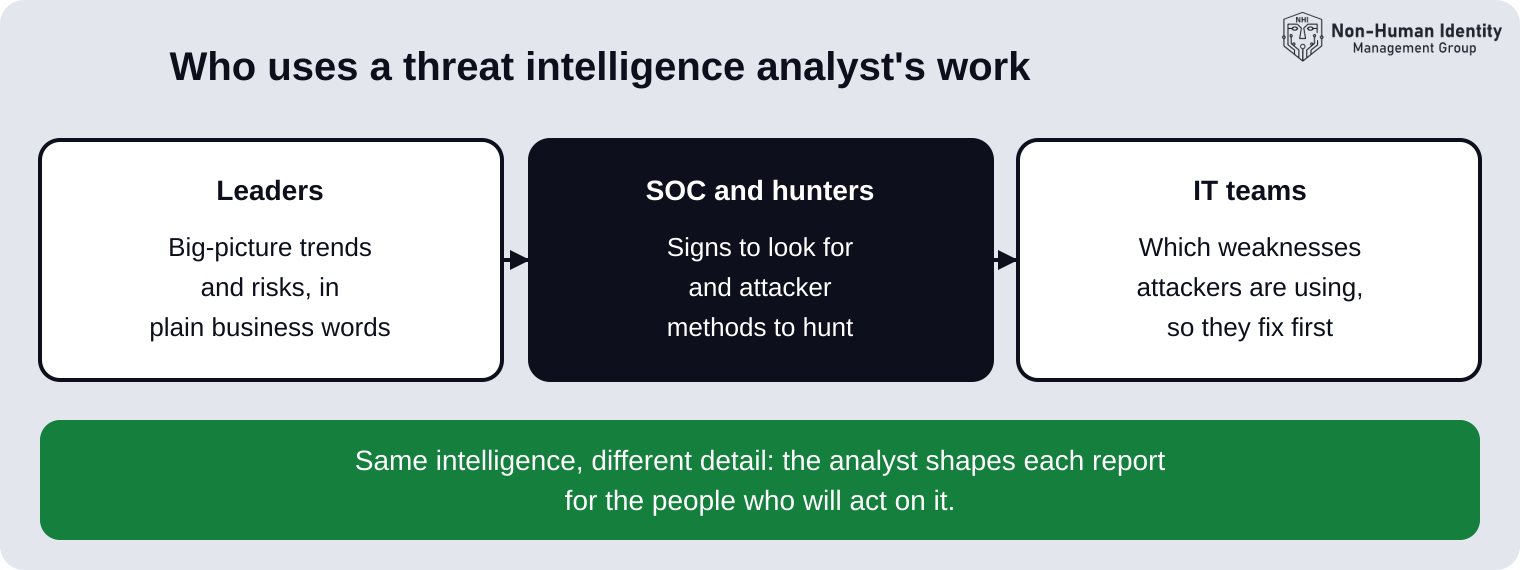
- Analysts write for different readers: plain summaries for leaders, detailed signs for defenders.
- Research, clear writing and careful judgement matter as much as technical skill.
What you will learn
- Explain what a threat intelligence analyst does in one sentence.
- Spot the main steps of intelligence work.
- Check which of your skills the job uses.
- Ask good questions about an intelligence role before you apply.
- Useful knowledge about attackers (threat intelligence)
- information about attackers that has been checked and explained, so people can make decisions.
- Warning sign (indicator of compromise)
- a clue that an attacker may have been in a system, such as a known bad web address.
- Sharing label (Traffic Light Protocol)
- a colour label that tells readers how widely they may share a report.
What is a threat intelligence analyst?
Think of a weather forecaster. They gather readings from many places, study the patterns and tell people what is likely to come. Farmers, pilots and families each need a different part of that forecast.
A threat intelligence analyst does this for cyber attacks. They read reports, news, shared warnings and their own records. Then they ask: which attackers might target us, how do they work and what should we do?
Raw facts are not yet intelligence. A list of bad web addresses is just data. It becomes threat intelligence once someone checks it, explains what it means and says what to do. A US government guide says threat information is anything that helps a firm spot, judge and deal with threats.[1]
Where the comparison stops working: weather does not change its plans because of the forecast. Attackers do. When defenders block one method, attackers may switch to another, so the analyst's picture needs regular updating.
Why does it matter?
No team can defend against everything at once. Good intelligence helps an organisation choose what to fix and watch first, based on who is likely to attack it.
If you like research and writing
What could happen: you rule out security work because you think it is all coding.
Check this: read a public threat report and see how much of it is research and plain writing.
If you work in a security monitoring team
What could happen: you receive long lists of warning signs, with no idea which ones matter to you.
Check this: ask where your team's threat feeds come from and who checks them.
If you lead a business
What could happen: you get technical warnings you cannot act on, so they are ignored.
Check this: ask for a short monthly summary of the threats most likely to affect your sector.
What does it look like?
Much of the job is writing short, clear reports. Here is a made-up one.
Example only. All values are made up.
THREAT NOTE 0000-EXAMPLE         TLP:AMBER     (1)
Summary:  A criminal group is sending fake       (2)
          invoice emails to credit unions.
Why us:   We are a credit union. Two staff got   (3)
          similar emails this week.
Signs:    Sender domain invoices-example.invalid (4)
Confidence: Medium                               (5)
Actions:  Block the domain. Remind finance staff (6)
          to check invoices by phone.
- A sharing label. Amber means share only inside your organisation and with clients who need it.[2]
- The main point first, in plain words.
- Why this matters to this organisation, not just in general.
- A warning sign defenders can search for and block.
- How sure the analyst is. Honest confidence helps readers decide.
- What to do. A report without actions is easy to ignore.
Why this is risky: a note with no "why us" and no actions reads like general news. Busy teams may skip it.
The safer way: lead with the point, explain why it matters here, state how sure you are and say what to do.
How does it work?
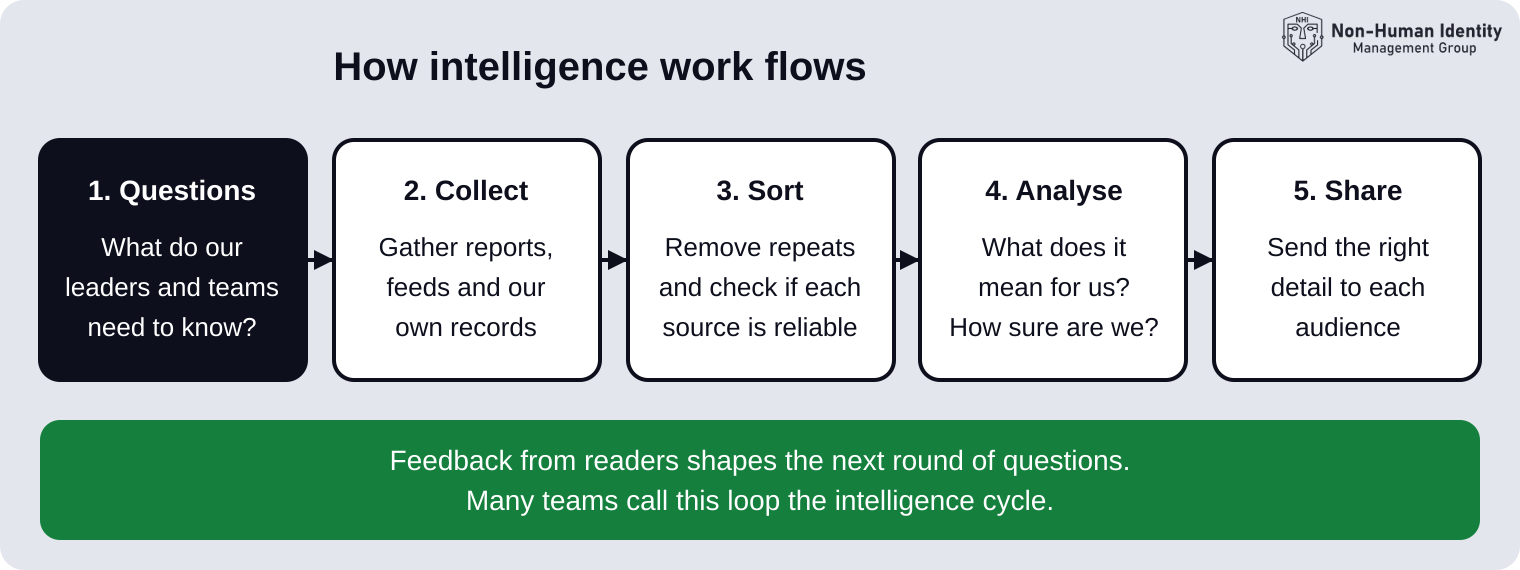
Teams work in different ways, but most intelligence work follows a loop like this.
- Ask the questions. The analyst agrees with leaders and teams what they need to know. These are often called intelligence requirements.[3]
- Collect. They gather reports, shared warnings, news and their own organisation's records.
- Sort. They remove repeats and judge how reliable each source is.
- Analyse. They work out what it means for their organisation, and how sure they are.
- Share. They send the right detail to each reader, then ask for feedback.
Analysts often describe attackers using a shared public library called MITRE ATT&CK. It lists the methods attackers have been seen to use in real attacks.[4] Using the same names helps hunters and alert builders act on the analyst's reports.
Sharing is a big part of the job. Analysts swap warnings with partners, industry groups and government bodies. Shared reports often carry a colour label from the Traffic Light Protocol, which says how widely they may be passed on.[2]
Skills and tools
The skills mix research, judgement and writing. A US skills framework lists tasks such as watching threat activity, writing threat reports and spotting attacker methods.[5]
- Research. Reading reports, shared warnings and news, and judging how reliable each source is.
- Knowing how attacks work. Enough to explain them, and to stay honest about what they do not know.
- Clear writing. Short notes that lead with the point and say what to do.
- MITRE ATT&CK. A shared library for naming attacker methods.[4]
- The Traffic Light Protocol. Colour labels that say how widely a report may be shared.[2]
A worked example
Priyanka Nair is a threat intelligence analyst at a fictional credit union with twelve branches. She joined from a research job and learned security on the way.
Her morning starts with reading. She skims shared warnings from an industry group, two news reports and the overnight notes from the security monitoring team.
One shared warning stands out. A criminal group is sending fake invoice emails to small lenders. Priyanka thinks of the forecaster: is this storm heading for us? She checks the email records. Two finance staff got similar emails this week.
That makes it relevant. She writes a one-page note. It gives the main point, why it matters here, the sender addresses to block and her confidence level. She marks it amber, so it stays inside the organisation.
She sends the signs to Tobias Keller, who runs the email filters. Tobias blocks the addresses within the hour. Priyanka also asks a threat hunter to search for anyone who clicked a link in those emails.
In the afternoon, she writes a short summary for the leadership team. It has no technical detail, only the risk and the one thing staff should do: check new invoices by phone.
At the end of the week she asks her readers what was useful. The finance manager asks for warnings sooner, so Priyanka adds finance to her daily list.
Myths and mistakes
| What people think | What is true |
|---|---|
| Threat intelligence means buying a feed of bad addresses. | A feed is raw data. Intelligence is the checked, explained advice built from it. |
| Analysts spend their days on the dark web. | Most time goes on reading, checking sources, writing and talking to colleagues. |
| More data means better intelligence. | Too much data buries what matters. Good analysts start with clear questions. |
| Naming the attacker is the main goal. | Knowing how attackers work, and what to do, is usually more useful than knowing who they are. |
| You need to be a coder. | Some coding helps, but research and clear writing are central to the job. |
What can I do this week?
- Read one free public threat report and write a three-line summary for a manager.
- Read three threat intelligence analyst job adverts and list the skills they share.
- Look up the Traffic Light Protocol and learn what each colour means.
- Read our Threat Intelligence for Beginners guide.
Checklist
- I can explain what a threat intelligence analyst does in one sentence.
- I know the difference between raw data and intelligence.
- I can name the steps of the intelligence loop.
- I have looked at real job adverts for the role.
- I have checked official sources for pay, not just job boards.
- I have a sample of my own clear writing to show.
- I have one first learning step planned.
Common questions
How do people become threat intelligence analysts?
There are several routes. Some move in from security monitoring or response work. Others come from research jobs or government training schemes for analysts. In the UK, the National Careers Service lists degrees and apprenticeships as common routes into cyber intelligence work.[6]
Do I need a technical background?
It helps, but it is not the only way in. You need to understand how attacks work well enough to explain them. Many analysts learn the technical side on the job. Strong research and writing skills are hard to teach, so employers value them.
How much does a threat intelligence analyst earn?
Pay varies by country, sector and experience, so we do not give a figure here. Use official sources. In the UK, see the National Careers Service profile for cyber intelligence officers.[6] In the US, see the government's job outlook page for information security analysts.[7]
Is threat intelligence the same as threat hunting?
No. Intelligence studies attackers in the wider world and explains what they do. Hunting searches your own systems for signs of them. The two work closely: intelligence often gives hunters their ideas. See Threat Hunter for Beginners
Where can a threat intelligence job lead?
Many analysts become senior or lead analysts, or run an intelligence team. Some move into threat hunting, risk work or security leadership. The skill of turning complex facts into clear advice is useful in most senior security roles.
Where next?
Ready for the detail? Read the practitioner guide: Threat Intelligence Analyst Career Guide. It goes further into the skills employers test, certifications, training resources and how analysts progress.
Also useful:
- Threat Intelligence Analyst Interview Questions
- Threat Intelligence for Beginners
- Threat Hunter for Beginners
- Tactics, Techniques and Procedures for Beginners
- MITRE ATT&CK for Beginners
Related NHI Mgmt Group resources: Cybersecurity Careers Guide · Threat Intelligence Guide · Threat Intelligence Report Template
Key terms
- Threat intelligence
- Information about threats that has been collected, checked and explained so people can act on it.
- Threat intelligence analyst
- A person who studies attackers and turns what they learn into advice for their organisation.
- Priority intelligence requirements
- The most important questions an intelligence team has agreed to answer for its organisation.
- Indicator of compromise
- A clue that an attacker may have been in a system, such as a known bad web address.
- TTPs
- Short for tactics, techniques and procedures: how an attacker goes about an attack.
- Threat actor
- A person or group that carries out or plans cyber attacks.
- MITRE ATT&CK
- A free public library of the methods attackers have been seen to use.
Sources and further reading
- SP 800-150, Guide to Cyber Threat Information Sharing. National Institute of Standards and Technology (NIST), October 2016. https://csrc.nist.gov/pubs/sp/800/150/final, accessed 28 Nov 2026.
- Traffic Light Protocol (TLP) version 2.0. FIRST (Forum of Incident Response and Security Teams), August 2022. https://www.first.org/tlp/, accessed 28 Nov 2026.
- Cyber Threat Intelligence Curriculum. FIRST CTI Special Interest Group. https://www.first.org/global/sigs/cti/curriculum/, accessed 28 Nov 2026.
- MITRE ATT&CK. The MITRE Corporation. https://attack.mitre.org/, accessed 28 Nov 2026.
- NICE Framework work role: Threat Analysis. NICCS, US Cybersecurity and Infrastructure Security Agency (CISA). https://niccs.cisa.gov/tools/nice-framework/work-role/threat-analysis, accessed 28 Nov 2026.
- Cyber intelligence officer, job profile. National Careers Service (England). https://nationalcareers.service.gov.uk/job-profiles/cyber-intelligence-officer, accessed 28 Nov 2026.
- Information Security Analysts, Occupational Outlook Handbook. US Bureau of Labor Statistics. https://www.bls.gov/ooh/computer-and-information-technology/information-security-analysts.htm, accessed 28 Nov 2026.