An information security manager runs the day-to-day work that keeps an organisation's information safe.
This guide is for anyone curious about the job, thinking of moving into it, or working alongside one. You do not need a security job to be affected: the security manager shapes the rules, training and checks that everyone at work follows.
In short
- The security manager turns the organisation's security plan into real work: rules, projects, training and checks.
- Most of the job is organising people, tracking risks and keeping evidence, not fixing computers.
- In smaller firms it is often the most senior security job. In larger ones it usually reports to a CISO.
- People often arrive from IT, audit or risk work, or from a hands-on security role.
What you will learn
- Explain what an information security manager does in one sentence.
- Describe a typical week in the role.
- Spot the skills and tools the job uses most.
- Choose a first step if you want to work towards it.
- List of things that could go wrong (risk register)
- a shared list of risks, each with an owner and a plan.
- Written rules (security policy)
- the organisation's agreed rules for keeping information safe.
- Formal check (audit)
- a review, often by an outsider, of whether the rules are really followed.
What is an information security manager?
Think of a site manager on a building project. The architect draws the plan, but the site manager makes it happen. They book the trades, check the work and keep the safety records.
An information security manager plays that part for security. Senior leaders, sometimes led by a chief information security officer (CISO), set the direction. The security manager turns it into a working programme.
In plain words, they make sure the right protections exist, that people know the rules, and that there is proof it all works. They also help the organisation get ready for a bad day, such as a cyber attack.
Where the comparison stops working: a building is finished one day. Security work never is, because threats, systems and staff keep changing.
Why does it matter?
Good plans fail when nobody owns the follow-through. The security manager is often that owner. Boards are expected to make sure risk management runs through the whole organisation, and someone has to do that work day to day.[4]
If you are thinking about the career
What could happen: you aim for a technical job, then find you enjoy organising and explaining more.
Check this: read real job adverts for the title and note which tasks appeal to you.
If you work in IT
What could happen: the security manager asks you for evidence before an audit, at short notice.
Check this: ask which records they need from your team, and keep them as you go.
If you run a small business
What could happen: security jobs land on whoever has time, and nobody tracks them.
Check this: name one person who owns security tasks, even part time.
What does it look like?
Most security managers keep a simple list of the work in hand. Here is a made-up weekly view for a chain of chemists.
Example only. All values are made up.
SECURITY PROGRAMME TRACKER   EXAMPLE-0000   week 00
Risk R-0001  staff reuse passwords        owner: IT lead      (1)
  action: two-step sign-in for all staff  due: FAKE-DATE
Policy       password rules, yearly review   status: draft    (2)
Training     phishing course, 68 of 90 staff done             (3)
Audit        supplier check, 2 records missing               (4)
Incident     lost laptop, encrypted, closed                   (5)
- A risk from the list of risks, with an owner and a plan.
- A written rule that is due for its check each year.
- How many staff have done the course. In a real file, this line would show the true count.
- Proof an auditor will ask for. Two items are still missing.
- A small problem, written down and closed, so the lesson is kept.
Why this is risky: without a list like this, jobs slip and people forget. Nobody can show an auditor what was done.
The safer way: each item has an owner, a date and a status. The manager goes through it each week with the people involved.
How does it work?
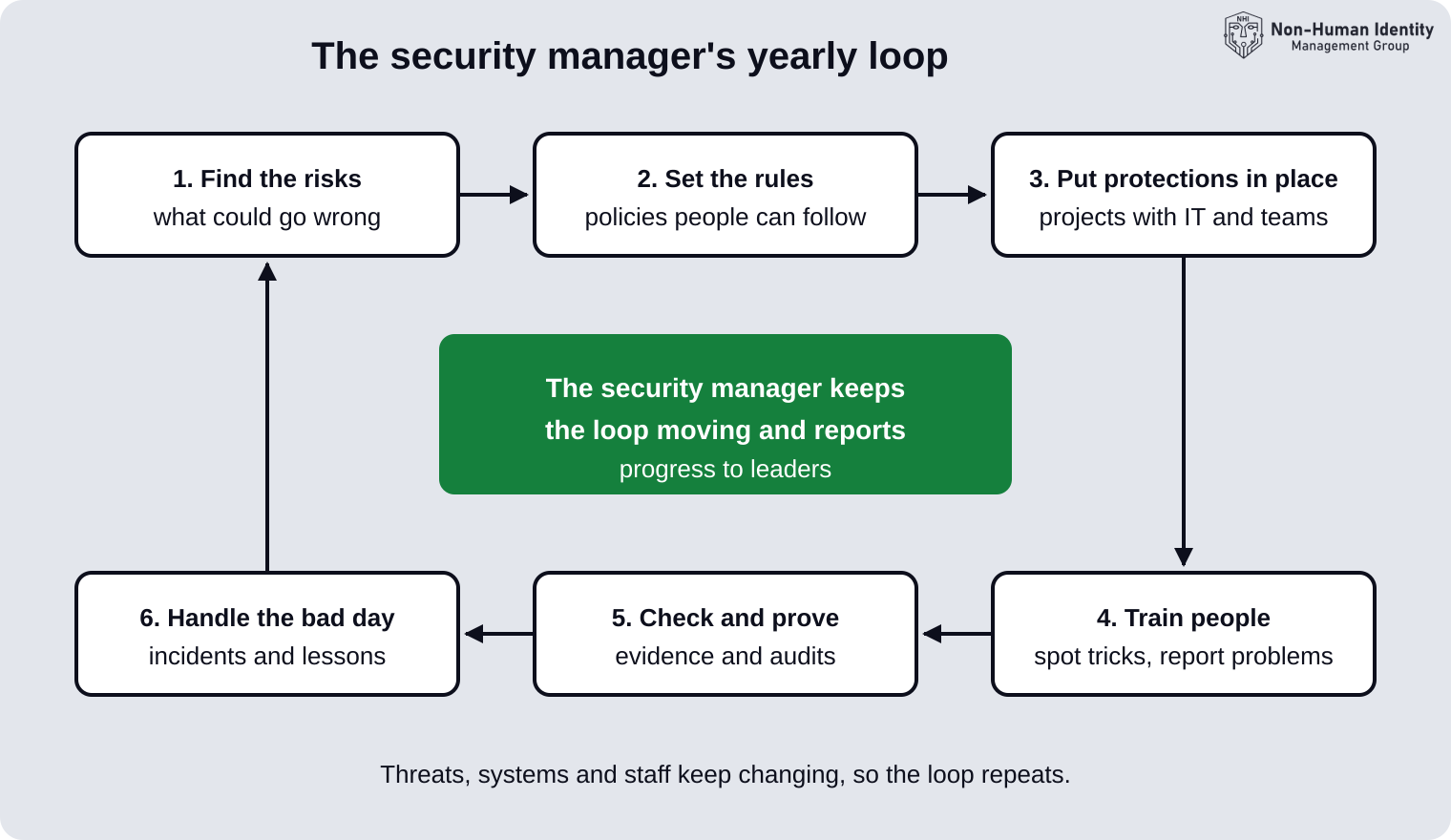
The job varies by organisation, but the work usually runs in a loop through the year.
- Find the risks. Work out what could go wrong and how much it would hurt. This is called a risk assessment.
- Set the rules. Write and update security policies that people can actually follow.
- Put protections in place. Agree projects with IT and other teams, such as stronger sign-in or better backups.
- Train people. Run awareness training so staff can spot tricks and report problems.
- Check and prove. Gather evidence, run reviews and support audits.
- Handle the bad day. Keep an incident plan ready, help run it and learn from what happened.
Many organisations build this loop around a published international standard. It describes an information security management system. That is a planned way of running security, with rules, owners and regular checks.[2] Some firms seek a formal certificate against it, and the security manager often leads that work.
Skills and tools
- Organising work. Planning projects, chasing actions and keeping many tasks moving at once.
- Judging risk. Weighing how likely a problem is against how much harm it would cause.
- Explaining clearly. Turning technical issues into plain choices for managers and staff.
- Enough technical knowledge. Knowing how networks, cloud services, sign-in and data work, well enough to ask good questions.
- Everyday tools. A risk register, policy documents, a task tracker, training records and reports. Some teams use governance, risk and compliance (GRC) software to hold these in one place.
Routes in
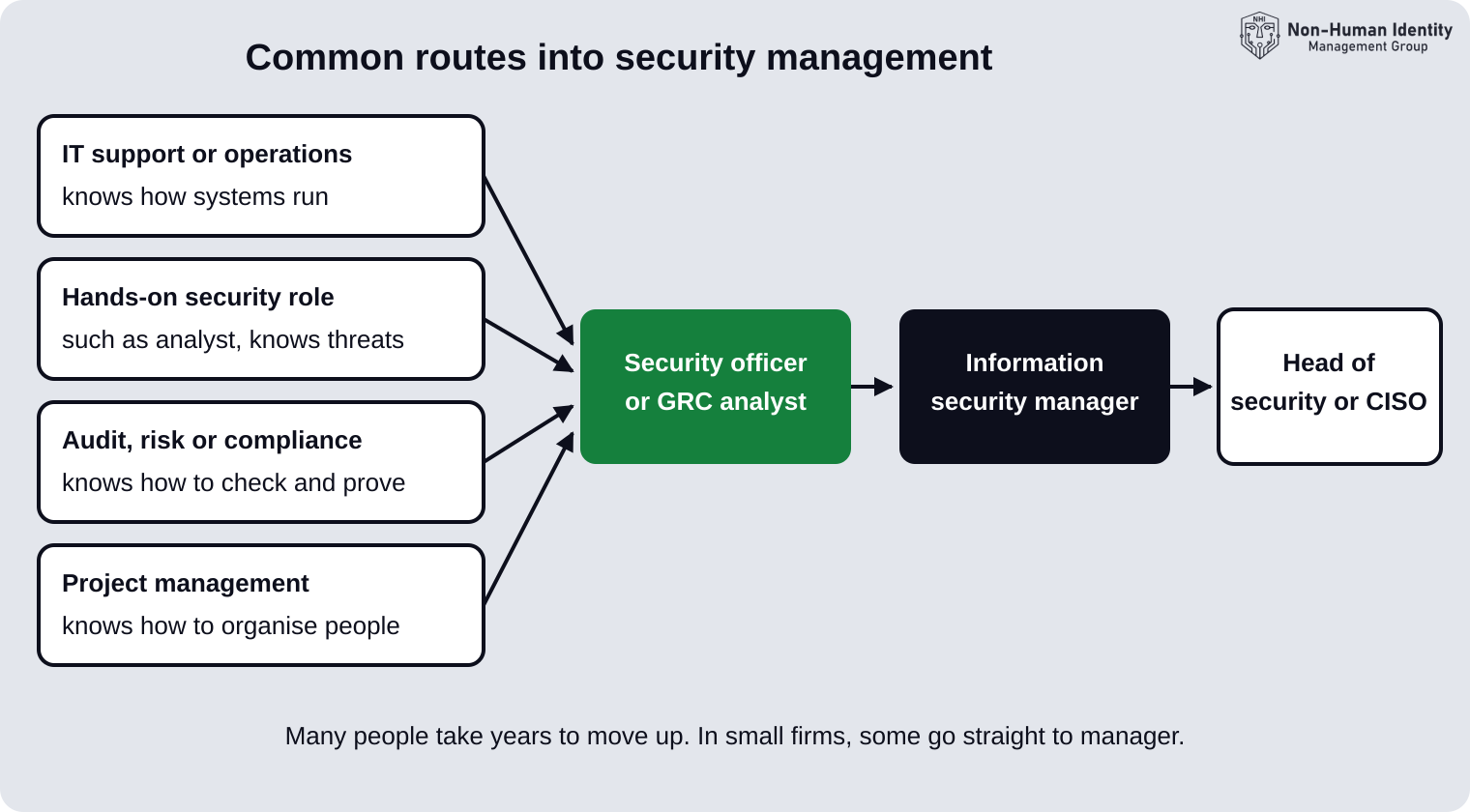
There is no single path. Many security managers start in IT support, networks or a hands-on security role such as analyst. Others come from audit, risk or compliance work. Some arrive from project management. A US government framework describes security jobs in common words, which can help you compare roles.[3] Certificates can help once you have some experience. One closely linked to this job covers governance, risk, the security programme and incident handling.[1] Pay varies widely by country and sector, so check official job market data for your area.
A worked example
Orla Abara is the information security manager at Marigold Pharmacy, a fictional chain of twelve chemists. Here is a typical week.
On Monday she reviews her tracker. Two-step sign-in is late, so she calls the IT lead to agree a new date and finds out what is blocking it.
On Tuesday she rewrites the password policy. She cuts it from six pages to two, because staff were not reading it.
On Wednesday a pharmacist reports a strange email asking for a delivery password. Orla checks it with the IT team. It is a phishing attempt, so they block the sender and warn all branches.
On Thursday she meets Quinn Iyer, who works on the IT help desk and wants a career in security. Orla asks Quinn to help gather evidence for next month's audit. It is a good way to learn how the checks work.
On Friday she writes a one-page update for the managing director. It lists the top three risks, what changed this week and one decision she needs.
By Friday evening the tracker is shorter, and the two-step sign-in has a firm date. Orla rarely touches a server. Her week is mostly meetings, writing, checking and explaining. That is normal for the role.
Myths and mistakes
| What people think | What is true |
|---|---|
| A security manager is a hacker in a suit. | Most of the job is planning, writing, checking and explaining. Hands-on technical work is usually done by others. |
| It is the same job as a CISO. | In larger firms the CISO sets direction and the manager runs the programme. In small firms one person may do both. |
| You need a computer science degree. | Many people come from IT support, audit or project work. Experience and clear communication count for a lot. |
| Passing an audit means you are secure. | An audit checks that agreed rules are followed. It does not prove every risk is covered. |
| Security is the manager's job alone. | The manager organises it, but every team owns part of it, from IT to the front desk. |
What can I do this week?
- Read three job adverts for "information security manager" and list the tasks they share.
- Find out who owns security at your workplace, and ask them what a normal week looks like.
- Read your organisation's security policy and note one rule that is hard to follow.
- Learn what a risk register is, and sketch one for your home or club.
- Offer to help with one piece of security evidence or training at work.
Checklist
- I can explain the difference between a security manager and a CISO.
- I know what a risk register, a security policy and an audit are.
- I have looked at real job adverts for the role.
- I know which route in fits my current experience.
- I have talked to someone who does security work.
- I have found one small way to help with security where I work now.
Common questions
What is the difference between a security manager and a CISO?
A CISO is usually the top security leader. They set the direction and report to the board. A security manager runs the work day to day and often reports to the CISO. In small organisations one person may hold both jobs. See The CISO Role for Beginners.
Do I need to be very technical?
No, not very. You need enough to ask good questions and spot weak answers. You do not usually set up systems yourself. Being good at organising, writing and working with people matters just as much, because most of the work is getting others to act.
Which certificate should I get first?
Start with an entry-level security certificate. Management certificates usually expect several years of work in security before you can hold them, so they come later. See Information Security Manager Career Guide for the options.
Can I move into this job from outside IT?
Yes, but it usually takes a step in between. People from audit, risk or project work often move first into a junior security job, such as a GRC analyst. That job checks rules and risks. It builds the security know-how a manager needs.
Is it a stressful job?
It can be at busy times, such as during an attack or before an audit. Much of the year is steady planning and checking. A good task list, clear owners and a tested plan for attacks make the hard days easier.
Where next?
Ready for the detail? Read the practitioner guide: Information Security Manager Career Guide. It goes further into the skills employers test, the gap each route in has to close, and the certificates and interviews for the role.
Also useful:
- The CISO Role for Beginners
- First Time Security Manager Guide
- ISO 27001 for Beginners
- Cyber Risk Management for Beginners
- Cybersecurity Careers Guide
Related NHI Mgmt Group resources: CISO vs CSO vs CIO · Path to CISO Career Guide · GRC Analyst for Beginners
Key terms
- Risk register
- A shared list of risks, each with an owner, a rating and a plan.
- Risk assessment
- Working out what could go wrong, how likely it is and how much harm it would do.
- Information security policy
- The organisation's written rules for keeping its information safe.
- Information security management system
- A planned way of running security, with rules, owners and regular checks.
- Internal audit
- A check, run inside the organisation, of whether rules and protections work as intended.
- Governance, risk and compliance
- The work of setting rules, managing risk and showing that laws and standards are met.
- CISM
- A certificate from ISACA aimed at people who manage security programmes.
Sources and further reading
- CISM: Certified Information Security Manager. ISACA. https://www.isaca.org/credentialing/cism, accessed 28 Nov 2026.
- ISO/IEC 27001 Information Security Management System. BSI. https://www.bsigroup.com/en-GB/products-and-services/standards/iso-iec-27001-information-security-management-system/, accessed 28 Nov 2026.
- NICE Framework Resource Center. National Institute of Standards and Technology (NIST). https://www.nist.gov/itl/applied-cybersecurity/nice/nice-framework-resource-center, accessed 28 Nov 2026.
- Cyber Security Toolkit for Boards. National Cyber Security Centre (NCSC). https://www.ncsc.gov.uk/collection/board-toolkit, accessed 28 Nov 2026.