A CSIRT is a team that helps an organisation or a country handle cyber attacks and security problems.
This guide is for students, small business owners and managers who keep hearing about CSIRTs and CERTs. You do not need a security team to need one: if your business is attacked, knowing who to call is the first job.
In short
- A CSIRT, or Computer Security Incident Response Team, is the group that steps in when a cyber attack or security problem happens.
- CERT is an older name for much the same thing, and many national teams still use it.
- There are three main kinds: your own team, outside responders you hire, and national teams run by government.
- Small firms rarely have a full team, so they should decide in advance who they would call.
What you will learn
- Explain what a CSIRT does in one sentence.
- Spot the difference between your own team, a hired team and a national team.
- Check who your business would call on a bad day.
- Ask the right questions before you sign up for outside help.
- Security problem (incident)
- something that harms, or could harm, your systems or data, such as a break-in or a ransomware attack.
- Response team (CSIRT)
- the people who take charge when an incident happens.
- Help on standby (retainer)
- a deal agreed in advance with an outside firm, so they can help you quickly.
What is a CSIRT?
Think of the fire brigade. You hope never to call it, but you know the number. When a fire starts, trained people arrive with a plan and the right kit.
A CSIRT is the fire brigade for computer problems. The letters stand for Computer Security Incident Response Team. An incident is a security problem, such as a hacked account, stolen data or a ransomware attack (malware that locks files and demands payment).
FIRST, a worldwide forum of response teams, describes a CSIRT as a team or capability that serves a defined group, called its constituency. It helps that group avoid, spot and respond to incidents.[1] The group might be one company, a university, a sector or a whole country.
You will also see the word CERT, short for Computer Emergency Response Team. It is an older name. One early team, the CERT Coordination Center, grew up at a US university from 1988. Many national teams still use the name today.[8]
Where the comparison stops working: the fire brigade comes to anyone who calls. A CSIRT usually serves only its own constituency. A national team may give advice and warnings, but it will not usually come and fix a small firm's computers.
Why does it matter?
In the first hours of an attack, people often lose time working out who should do what. Knowing your response team, and who backs it up, saves that time.
If you run a small business
What could happen: your files are locked one morning and nobody knows who to call.
Check this: write down one inside contact, one outside firm and where to report.
If you are a manager
What could happen: your team waits for approval while the attacker keeps going.
Check this: agree in advance who can call outside help and spend money on it.
If you are a student thinking about a career
What could happen: you mix up a CSIRT and a security operations centre and apply for the wrong roles.
Check this: a monitoring centre watches alerts all day; a CSIRT takes charge of real incidents.
What does it look like?
Here is a made-up contact card that a small firm might keep on paper and on the office wall.
Example only. All values are made up.
WHO WE CALL IN A CYBER INCIDENT (EXAMPLE)
Inside lead:     Office manager, call first        (1)
Back-up lead:    Director                          (2)
Outside help:    FAKE Response Ltd, contract 0000  (3)
IT supplier:     [email protected]                  (4)
Report to:       national cyber reporting service  (5)
Insurer:         policy 0000-FAKE                  (6)
- The person who takes charge and makes first decisions.
- Someone who can step in if the lead is away.
- In a real file, this line would contain the outside firm's name and contract number.
- Your IT supplier, who knows your systems.
- Where the law or good practice says you should report.
- Many cyber insurance policies want to be told early and may name firms to use.
Why this is risky: if this card only lives on the computer that has been attacked, nobody can read it on the day.
The safer way: keep a printed copy and a copy on a phone. Check the numbers twice a year, and make sure the back-up lead knows the plan too.
How does it work?
Most incidents go through the same broad stages, whoever handles them.
- Someone notices. A staff member, a tool or a customer spots something odd and reports it.
- The team sorts it. They decide how serious it is. This sorting is called triage.
- The team stops the spread. For example, they take an infected laptop off the network. This is called containment.
- Help arrives if needed. Outside responders investigate what happened and how far it reached.
- Reports go out. The right people are told, such as a regulator, the national team, customers or the insurer.
- Everyone learns. The team fixes the weak spot and updates the plan.
US government guidance links incident response to everyday risk management, so preparing before an attack matters as much as reacting to one.[6] The UK's National Cyber Security Centre (NCSC) makes the same point: good preparation is what helps most.[5]
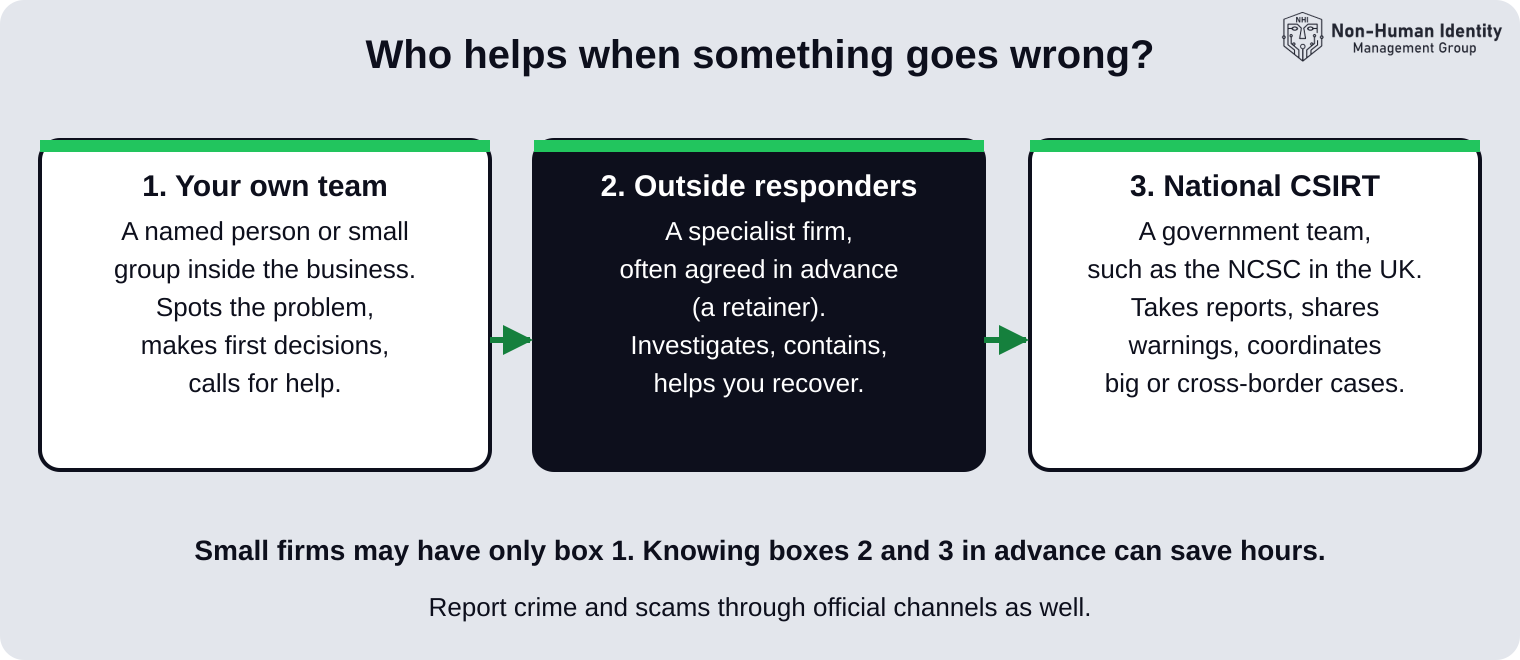
There are three common kinds of CSIRT:
- Your own team. Large firms often have staff for this. In a small firm it may be one named person plus the IT supplier.
- Outside responders. Specialist firms you hire. Many firms agree a retainer in advance. In the UK, the NCSC runs a scheme that checks such firms against its standards and recommends that UK organisations use an assured provider.[4]
- National teams. Many countries have a national CSIRT. It coordinates other teams and shares warnings.[1] In the EU, national teams work together in a network set up under EU cyber security law.[3] In the US, CISA takes reports through an online form.[7]
Teams also talk to each other. FIRST, founded in 1990, brings response teams from government, business and universities together to share what they learn.[2]
A worked example
Gita Achterberg runs Cedar Lettings, a fictional letting agency with fifteen staff. Last spring she made a contact card with her IT supplier. It names her as lead, her deputy as back-up and an outside response firm. The firm is on a small retainer through her cyber insurance.
On a Monday morning, staff find they cannot open any files. A message on screen demands payment. Gita remembers the fire brigade. You do not fight a big fire alone, and you call early.
She tells staff to unplug their laptops from the network but not to switch them off. Then she rings the insurer's helpline, which brings in the response firm. Within the hour, a responder called Petra Zeller joins a call.
Petra asks simple questions. When did it start? What does the message say? Which systems are still working? She asks Gita not to pay or reply to the attackers yet, and not to wipe anything, because the evidence matters.
Over the next two days, Petra's team finds how the attackers got in: an old remote access account with a weak password. They help restore files from the backups, which were kept separately.
Gita's IT supplier reports the incident through the national reporting service. Because tenants' details may have been seen, Gita also checks with her data protection adviser about telling the regulator.
Afterwards, Gita adds two lines to the card: "Old accounts closed every quarter" and "Practise this plan once a year".
Myths and mistakes
| What people think | What is true |
|---|---|
| Only big companies have a CSIRT. | A small firm's "team" can be one named person, the IT supplier and an outside firm on call. |
| The national CERT will come and fix our systems. | National teams mainly coordinate, warn and take reports. Hands-on help usually comes from your own team or a hired firm.[1] |
| A CSIRT and a security operations centre are the same. | A monitoring centre watches for alerts. A CSIRT takes charge when a real incident happens. Some firms combine them. |
| We can find a response firm when we need one. | On the day, you lose time on contracts and checks. Agreeing a retainer or a named firm in advance saves those hours. |
| Switching everything off is the safest first step. | Disconnecting from the network is usually better. Switching off can destroy evidence the responders need. |
What can I do this week?
- Name one person to lead if there is a cyber incident, and a back-up.
- Find out whether your insurer or IT supplier gives you access to an outside response firm.
- Look up where to report a cyber incident in your country and add it to a contact card.
- Print the card and keep a copy away from your computers.
Checklist
- We have a named incident lead and a back-up.
- We know which outside firm we would call, and how.
- Someone has authority to approve outside help and its cost.
- We know where to report incidents, and to whom, in our country.
- Our contact card is printed and stored away from our computers.
- Our insurer's rules on who to call first are written down.
- We practise the plan at least once a year.
Common questions
What is the difference between a CSIRT and a CERT?
Very little in practice. Both are teams that respond to security incidents. CERT is the older name and is still used by many national teams. CSIRT is the more general term, often used for teams inside companies, universities and sectors.
Is a CSIRT the same as a SOC?
Not quite. A security operations centre, or SOC, watches for alerts, often around the clock. A CSIRT takes charge of real incidents, coordinates the response and works with outside parties. In smaller firms one team may do both jobs.
Does a small business need a CSIRT?
It needs the function, not a big team. Name a lead and a back-up, agree which outside firm you would call and know where to report. That small set-up does the job of a CSIRT for most small firms.
What is an incident response retainer?
It is an agreement with an outside response firm made before anything goes wrong. It usually sets how fast they will respond and what it costs. Some cyber insurance policies include access to a named firm, so check your policy first.
Who do I contact first in a cyber attack?
Your own incident lead or IT supplier first, then the outside help you agreed in advance. If you have cyber insurance, call its helpline early. Report to your national cyber or crime reporting service as well, and to a regulator where the law requires it.
Where next?
Ready for the detail? Read the practitioner guide: Building a CSIRT Guide. It goes further into a team's mandate and charter, choosing its services and staffing models.
Also useful:
- Incident Response for Beginners
- Internal CSIRT vs IR Retainer
- CSIRT vs SOC
- Security Operations Centres for Beginners
- Cyber Incident Reporting for Beginners
Related NHI Mgmt Group resources: Incident Response Retainer Buyer's Guide · FIRST CSIRT Services Framework Guide · Incident Response Plan Template
Key terms
- CSIRT
- A team that helps an organisation or country handle security incidents.
- CERT
- An older name for a response team, still used by many national teams.
- Incident response
- The steps taken to find, contain, investigate and recover from a security problem.
- Triage
- Quickly sorting alerts or incidents by how urgent and serious they are.
- Containment
- Stopping an incident from spreading while keeping the evidence safe.
- Incident response retainer
- A deal agreed in advance with an outside incident response firm, so they can help quickly.
- SOC
- A security operations centre, the team that watches for alerts and suspicious activity.
Sources and further reading
- CSIRT Services Framework, version 2.1. FIRST (Forum of Incident Response and Security Teams). https://www.first.org/standards/frameworks/csirts/csirt_services_framework_v2.1, accessed 28 Nov 2026.
- About FIRST. FIRST. https://www.first.org/about/, accessed 28 Nov 2026.
- CSIRTs Network. ENISA, the EU Agency for Cybersecurity. https://www.enisa.europa.eu/topics/eu-incident-response-and-cyber-crisis-management/csirts-network, accessed 28 Nov 2026.
- Cyber Incident Response (CIR) scheme. National Cyber Security Centre (UK). https://www.ncsc.gov.uk/information/cir-cyber-incident-response, accessed 28 Nov 2026.
- Incident management collection. National Cyber Security Centre (UK). https://www.ncsc.gov.uk/collection/incident-management, accessed 28 Nov 2026.
- NIST SP 800-61 Rev. 3: Incident Response Recommendations and Considerations for Cybersecurity Risk Management: A CSF 2.0 Community Profile. NIST, April 2025. https://csrc.nist.gov/pubs/sp/800/61/r3/final, accessed 28 Nov 2026.
- Report a cyber issue. Cybersecurity and Infrastructure Security Agency (CISA). https://www.cisa.gov/report, accessed 28 Nov 2026.
- CERT Division. Software Engineering Institute, Carnegie Mellon University. https://www.sei.cmu.edu/about/divisions/cert/, accessed 28 Nov 2026.