AI safety is the work of making sure AI systems do not cause harm, by mistake or through misuse.
This guide is for members of the public, students and managers who keep hearing the term and want a plain answer. You do not need to build AI to be affected: if you use a chatbot or your business puts one in front of customers, its safety matters to you.
In short
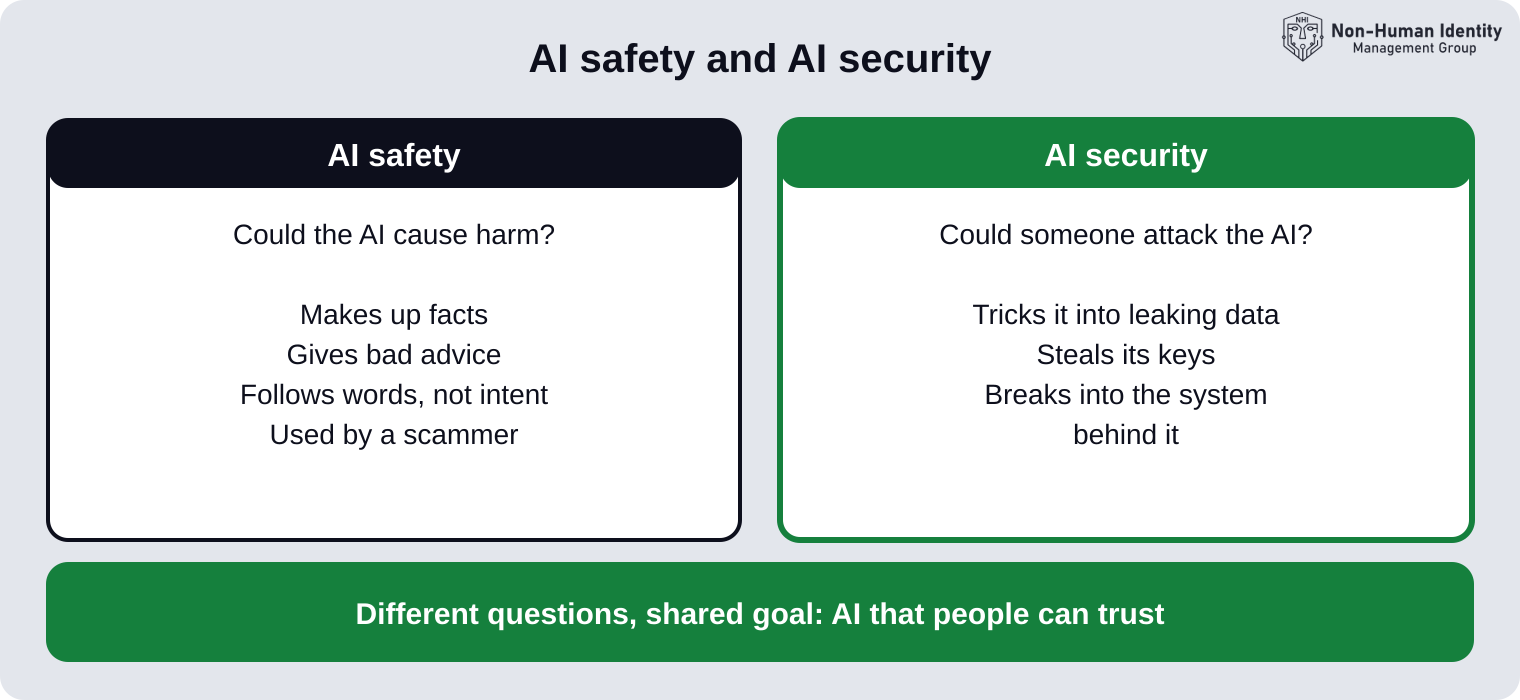
- AI safety asks: could this AI hurt people, money, property or the world around us?
- AI security asks a different question: could someone attack this AI or the data and systems behind it?
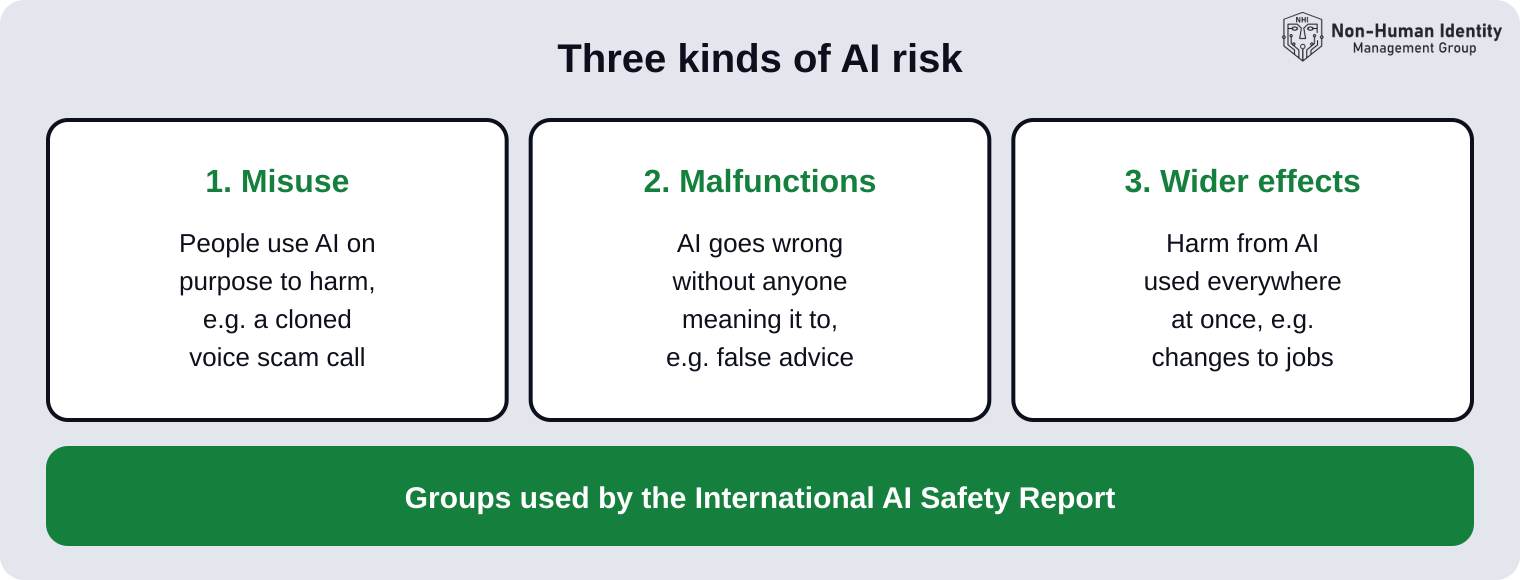
- An international expert report groups AI risks into misuse, malfunctions and wider effects on society.
- Safety measures reduce harm but are not perfect, so people still need to check what AI does.
What you will learn
- Explain what AI safety means in one sentence.
- Tell the difference between an AI safety problem and an AI security problem.
- Spot the three main kinds of AI risk.
- Ask simple safety questions about an AI tool you use or buy.
- Keeping AI from causing harm (AI safety)
- stopping AI from hurting people or things, whether by accident or because someone misuses it.
- Keeping attackers out (AI security)
- protecting AI systems and their data from people who try to break in or trick them.
- Doing what we meant (alignment)
- making sure an AI's goals and actions match what people actually intended.
What is AI safety?
Think of a public swimming pool. Lifeguards, depth signs and non-slip floors are there so swimmers do not get hurt by accident. The locked gate at night is there to keep out people who mean harm.
AI safety is like the lifeguards and the depth signs. It is about the harm an AI system could cause through its own behaviour, or because people use it for bad ends. A US government framework describes a safe AI system as one that should not put human life, health, property or the environment in danger.[1]
AI security is more like the locked gate. It protects the system from attack, so that data stays private and the system keeps working as it should.[1]
A key safety idea is alignment, which means making sure the AI does what people meant, not just what they literally said.
Where the comparison stops working: a pool's dangers are well known. With AI, experts are still finding new ways systems can go wrong, so the rules keep changing.
Why does it matter?
AI now writes emails, answers customers and gives advice. An international expert report says current safety measures do not reliably stop harm in all settings.[2]
If you use chatbots at home
What could happen: a chatbot gives you confident but wrong health or money advice.
Check this: check important answers with a trusted source or a qualified person.
If you manage a team using AI
What could happen: an AI tool sends customers wrong information, and your business has to put it right.
Check this: decide which AI outputs a person must check before they go out.
If you are a student
What could happen: you mix up safety and security in an essay or interview and lose marks.
Check this: ask whether the harm comes from the AI itself, or from someone attacking it.
What does it look like?
Here is a made-up sorting card. It helps you decide whether a problem is mainly about safety or about security.
Example only. All values are made up.
EXAMPLE sorting card: safety or security?
A. Chatbot invents a refund rule        -> SAFETY   (1)
B. Stranger tricks chatbot into
   showing other customers' orders      -> SECURITY (2)
C. Scammer uses AI to fake a voice      -> SAFETY (misuse) (3)
D. AI tool is told to "cut costs at
   any price" and cancels orders        -> SAFETY   (4)
- The AI went wrong on its own. No attacker was involved. This is a malfunction.
- Someone attacked the system to reach data. This is mainly a security problem, though harm can follow.
- The AI worked as designed, but a person used it to hurt others. Experts call this misuse.
- The AI followed the words, not the intent. This is an alignment problem.
Why this is risky: some teams call every AI problem "security". Then nobody owns the mistakes the AI makes on its own. Other teams call everything "safety", and attackers get missed.
The safer way: give each kind of problem a clear owner, and let the safety and security teams share what they find.
How does it work?
AI safety work usually follows a loop like this.
- Name the harms. List what could go wrong, using three groups: misuse, malfunctions and wider effects on society.[2]
- Test before release. Try the system with hard and unusual requests, a practice often called red teaming, to see where it fails.
- Add safeguards. Put limits on what the AI can say and do, and add human checks for high-stakes decisions.
- Watch it in use. Collect reports of mistakes and harm once real people use the system.
- Fix and repeat. Update the safeguards, because people find new ways round them over time.[2]
A worked example
Darius Erikson manages customer service at Bracken Removals, a fictional removals firm. The firm has just added an AI chatbot to its website to answer questions about prices and dates.
In the first week, a customer complains. The chatbot told her the firm would refund her deposit if it rained on moving day. There is no such rule.
Darius thinks of the swimming pool. Nobody broke in. The AI slipped on its own, so this is a safety problem.
He asks Tomas Zeller, who looks after the firm's IT, to help. Tomas limits the chatbot to answers drawn from the firm's real price list and terms. For anything about refunds, the chatbot now passes the customer to a person.
A few days later, Tomas spots something else in the chat records. Someone has been typing odd instructions to try to make the chatbot show other customers' bookings. That is a security problem, so he checks what data the chatbot can reach and removes access to booking records it does not need.
Darius honours the refund the chatbot promised, because the customer relied on it. He then writes a short note for staff: wrong answers go to him, and strange attempts to trick the bot go to Tomas.
Each month they read a sample of chats together. They look for both kinds of problem.
Myths and mistakes
| What people think | What is true |
|---|---|
| AI safety and AI security are the same thing. | They overlap, but safety is about harm the AI could cause, and security is about protecting it from attack.[1] |
| AI safety is only about robots taking over. | Most safety work deals with everyday harms, such as false information, bad advice and scams.[2] |
| If the AI company says it is safe, I do not need to check. | Expert reviewers say current safeguards do not reliably stop harm in every setting.[2] |
| Safety only matters for the big AI labs. | Any business using AI with customers needs to own the answers it gives. |
| A safety filter fixes the problem once. | People keep finding ways round safeguards, so they need testing and updating.[2] |
What can I do this week?
- List the AI tools you or your team use, and what each one is allowed to do.
- Pick one decision where AI output must be checked by a person before it is used.
- Agree who handles wrong AI answers and who handles attempts to trick or attack it.
- Read the AI provider's published safety information for one tool you use.
Checklist
- We know which AI tools we use and what they can do.
- High-stakes AI outputs are checked by a person before they are acted on.
- Someone owns AI mistakes, and someone owns AI attacks.
- Customers can reach a person when the AI cannot help.
- We test new AI tools with hard and unusual questions before going live.
- We keep records of AI conversations where the law and our privacy notice allow.
- We review a sample of AI outputs on a regular schedule.
Common questions
What is the difference between AI safety and AI security?
Safety is about harm the AI could cause, whether by mistake or through misuse. Security is about protecting the AI, its data and the systems around it from attack. A chatbot that invents facts is a safety problem. Someone tricking it into leaking data is a security problem.
Why did the UK rename its AI Safety Institute?
In February 2025 the UK renamed it the AI Security Institute. The government said the new name shows its focus on serious AI risks to security. Examples include AI being used for cyber attacks or weapons.[3] It said the institute would not focus on bias or freedom of speech.
Is AI safety the same as AI ethics?
Not quite. They overlap a lot. AI ethics asks whether AI is fair and right to use, for example whether it treats groups equally. AI safety focuses on preventing harm. Many organisations handle both under one AI governance programme.
Who is responsible for AI safety?
Everyone in the chain shares it. AI developers build in safeguards and test their systems. Businesses that use AI decide where it is used and who checks it. Governments set rules. Users still need to question answers that matter, rather than trusting them blindly.
Where next?
Ready for the detail? Read the practitioner guide: AI Safety vs AI Security Guide. It goes further into how the main AI labs' safety frameworks handle security, who should own each risk and how to run a joint programme.
Also useful:
- AI Guardrails for Beginners
- AI Risk Management for Beginners
- AI Governance for Beginners
- Deepfakes and AI Fraud for Beginners
Related NHI Mgmt Group resources: AI Red Teaming Guide · Human-in-the-Loop for AI Agents for Beginners · AI Regulation for Beginners
Key terms
- AI safety
- Work to stop AI systems causing harm, whether through their own behaviour or through misuse.
- AI security
- Protecting AI systems, their data and connected systems from attack.
- Alignment
- Making sure an AI system's goals and actions match what people intended.
- Misuse
- Using an AI system on purpose to cause harm, such as faking a voice for a scam.
- Hallucination
- An AI answer that sounds right but is false or made up.
- Red teaming
- Testing a system the way an adversary or a difficult user would, to find where it fails.
Sources and further reading
- Artificial Intelligence Risk Management Framework (AI RMF 1.0), NIST AI 100-1, sections 3.2 Safe and 3.3 Secure and Resilient. National Institute of Standards and Technology, January 2023. https://nvlpubs.nist.gov/nistpubs/ai/NIST.AI.100-1.pdf, accessed 28 Nov 2026.
- International AI Safety Report 2026: Extended Summary for Policymakers. International AI Safety Report, chaired by Yoshua Bengio, 3 February 2026. https://internationalaisafetyreport.org/publication/2026-report-extended-summary-policymakers, accessed 28 Nov 2026.
- Tackling AI security risks to unleash growth and deliver Plan for Change. UK Government, GOV.UK, 14 February 2025. https://www.gov.uk/government/news/tackling-ai-security-risks-to-unleash-growth-and-deliver-plan-for-change, accessed 28 Nov 2026.