A zero-knowledge proof lets you prove something is true without showing the private details behind it.
This guide is for students, product managers and anyone who has seen the term and wants a plain answer. You do not need to know any maths: if a website ever asks you to prove your age, this idea may change what you have to hand over.
In short
- A zero-knowledge proof shows that a statement is true, such as "I am over 18", without revealing the data behind it.
- The checker learns the answer, and that the proof works, but not your birth date or other details.
- The proof is only as good as its starting point: someone trusted still has to check your ID first.
- Digital identity wallets in Europe and elsewhere are starting to use the idea for age checks.
What you will learn
- Explain what a zero-knowledge proof is in one sentence.
- Spot where it could replace sharing a whole document.
- Explain what it can and cannot prove.
- Ask better questions about how an app checks your age or identity.
- The person proving (prover)
- the side that knows the secret and wants to show a fact is true.
- The checker (verifier)
- the side that wants to be sure the fact is true.
- Signed digital ID (credential)
- a set of facts about you, such as your birth date, signed by a trusted body.
What is a zero-knowledge proof?
Picture a big "Where's Wally?" poster. You want to prove you have found Wally, but you do not want to show your friend where he is.
So you cover the poster with a huge sheet of card that has one small hole in it. You line the hole up over Wally. Your friend sees Wally through the hole, so they know you found him. They still have no idea where on the poster he is.
A zero-knowledge proof does the same thing with maths. One side, the prover, knows a secret. The other side, the verifier, wants to be sure a statement about that secret is true. The proof convinces the verifier, but the secret itself is not shared.[1]
Researchers describe three things a good proof must do. If the statement is true and both sides follow the rules, the checker accepts it. If the statement is false, the checker is not convinced. And the checker learns nothing else beyond the fact that it is true.[2]
Where the comparison stops working: with the poster, your friend could guess roughly where Wally is from the edges of the card. A well-designed zero-knowledge proof is built so the checker learns nothing more than the answer.
Why does it matter?
Many online checks ask for more than they need. To prove you are an adult, you might upload a passport photo that also shows your name, address and document number. Every copy of that data is something that could leak.
Zero-knowledge proofs let a service ask one question and get one answer. Europe's digital identity work describes using them to prove a person is over 18 without revealing the exact birth date.[3]
If you are asked to prove your age online
What could happen: you hand over a full ID document when the site only needed a yes or no.
Check this: see whether the site offers a privacy-friendly option, such as a digital ID wallet.
If you are a product manager
What could happen: your product collects and stores ID scans it never really needed.
Check this: list each fact you check, and ask whether a proof of that fact would do.
If you are a student
What could happen: you hear the term in a lecture or a crypto news story and assume it is only about coins.
Check this: notice that the same idea is used for age checks and digital ID.
What does it look like?
You rarely see the maths. What you see is a short exchange between a website and an app on your phone. Here is a made-up one.
Example only. All values are made up.
Request from: shop.example.com
Question:     Is the holder 18 or over?            (1)
Your wallet:  birth date 0000-00-00 (FAKE)         (2)
Sent to shop: proof that the answer is YES         (3)
Shop checks:  proof works, issuer EXAMPLE-ID-AUTH  (4)
Shop learns:  YES, and nothing else                (5)
- The shop asks one narrow question, not for your whole ID.
- In a real message, this line would show your birth date. It stays on your phone.
- Your wallet builds a proof from your signed digital ID.
- The shop checks the maths and that a body it trusts signed the original ID.
- The shop gets the answer it needs, without your name or birth date.
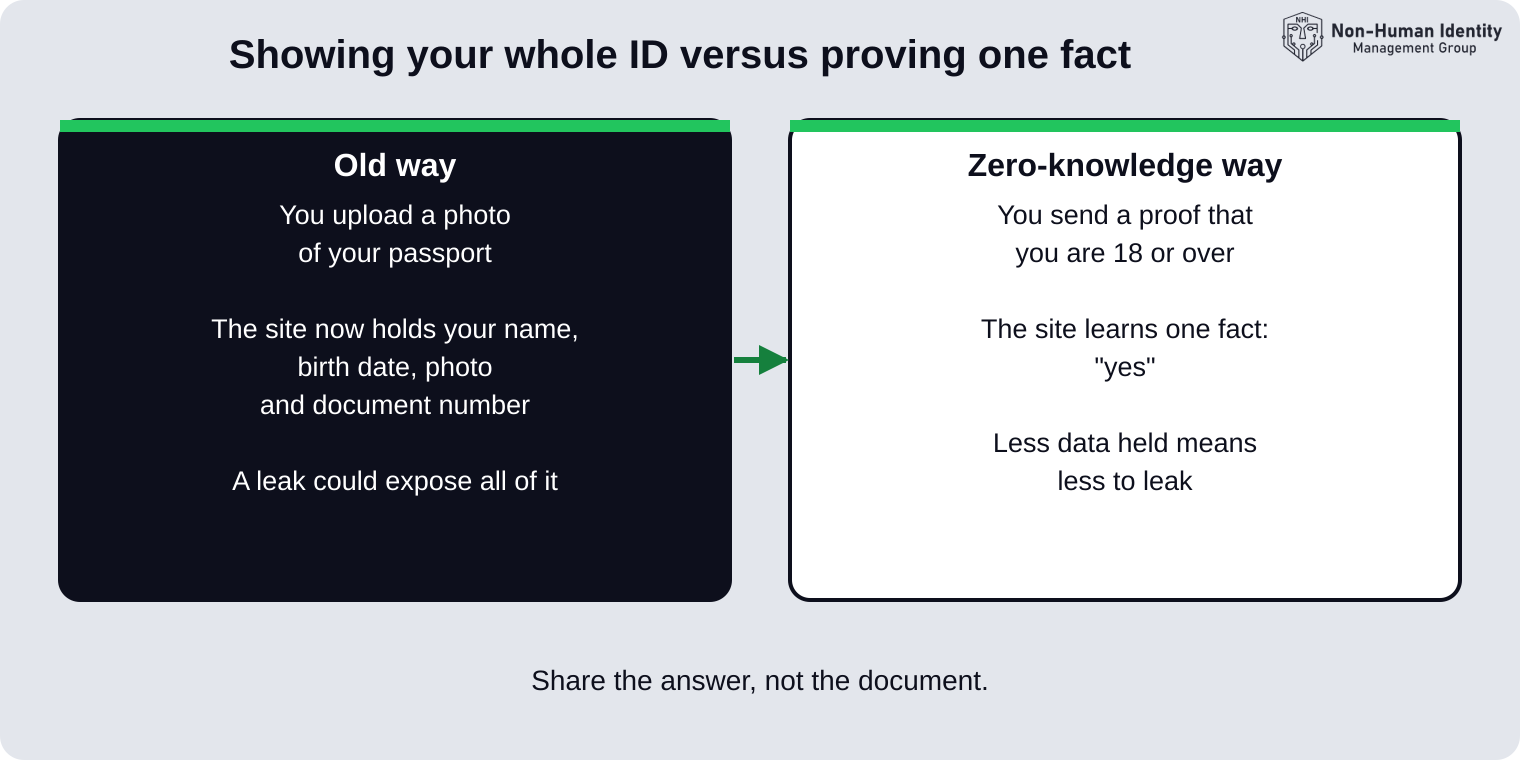
Why this is risky: the old way is to upload a photo of a passport or driving licence. The shop then holds far more than it needs, and a leak of its files could expose all of it.
The safer way: the shop asks a yes or no question and accepts a proof. It keeps far less data, so there is far less to lose. This idea of sharing only what is needed is called selective disclosure.
How does it work?
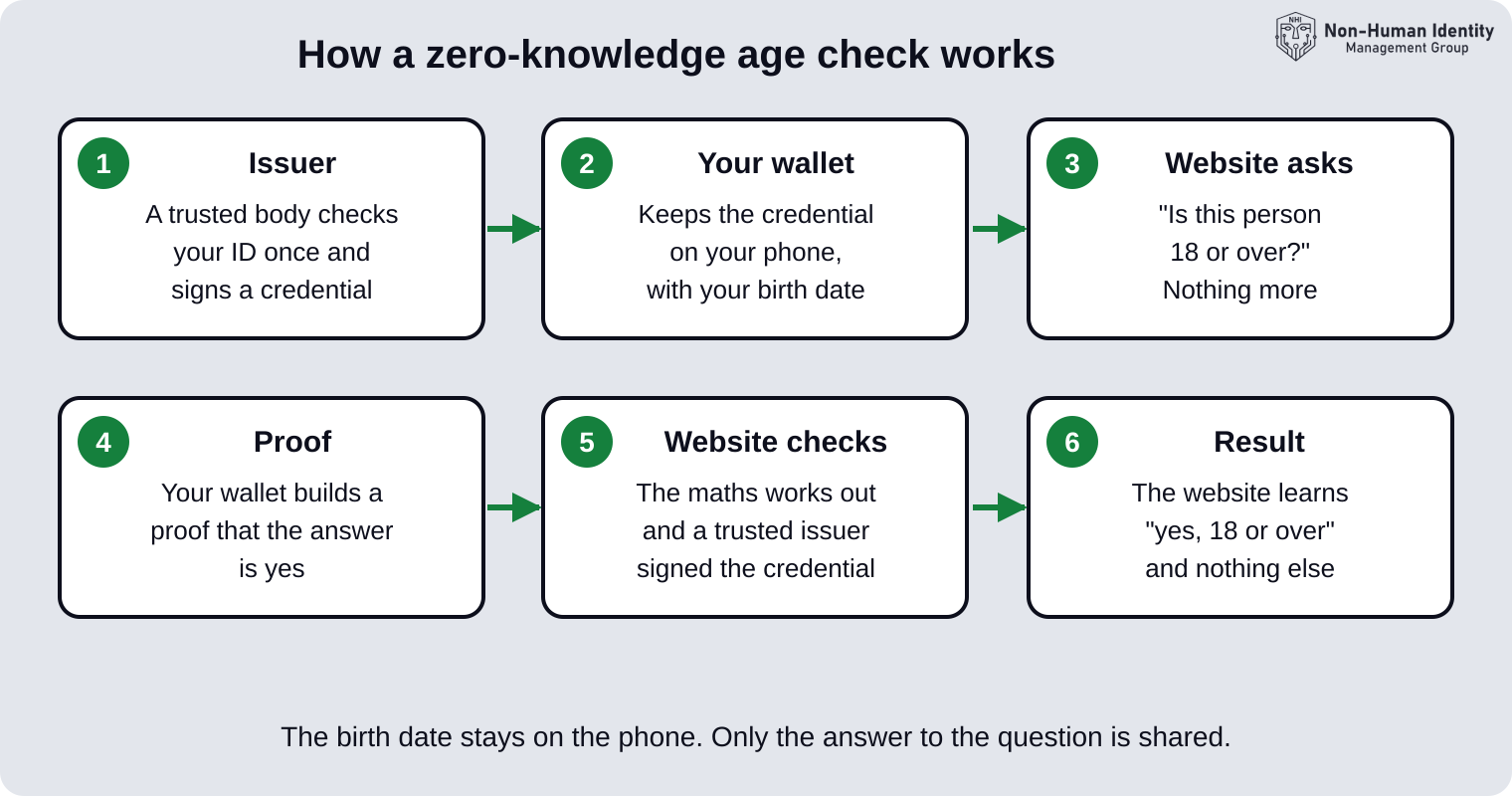
Here is the age check from the sample, step by step.
- A trusted body checks you once. A government or bank checks your ID and gives you a signed digital ID, called a credential.
- Your wallet keeps it. A digital identity wallet (an app that stores signed digital IDs) holds the credential on your phone.
- A website asks one question. For example, "Is this person 18 or over?"
- Your wallet builds a proof. It uses your credential to create a proof that the answer is yes. The proof does not contain your birth date.[3]
- The website checks the proof. It confirms the maths works out and that the credential came from a body it trusts. It learns the answer and not the detail behind it.[2]
Some proofs involve a back and forth of messages. Others are a single message from the prover, which suits apps and websites.[2] The same idea can prove other things too, such as that you hold a private key (a secret digital key) without showing it.[1]
Real projects are under way. Google says it has published its zero-knowledge code as open source to help with privacy-friendly age checks.[4] The code is designed to work with existing digital ID formats.[5] In Europe, plans to add zero-knowledge proofs to the EU digital identity wallet were still a discussion paper in 2025. Support is expected after the wallet launches.[3]
A worked example
Hana Pajari is a university student in Helsinki. She wants to buy a ticket for an over-18 music event from a fictional online shop.
The last time she did this, a different site asked her to upload a photo of her passport. She did it, but felt uneasy. The photo showed her full name, birth date and passport number, and she had no idea how long the site would keep it.
This time the shop offers another way. A button says: "Prove your age with your digital ID wallet". Hana already has a wallet app, set up when her bank checked her ID.
She taps the button. Her wallet shows a message: "The shop wants to know if you are 18 or over. It will not see your name or birth date." Hana approves.
Behind the scenes, her wallet sends a proof. The shop checks that the maths works and that the ID came from a body it trusts. It gets a simple yes.
Hana remembers the Wally poster. The shop saw Wally through the hole, and that was all it needed.
Later she reads the shop's privacy notice. It says the shop keeps a record that an age check passed, not her personal details. If the shop is ever breached, there is much less about her to lose.
One thing she notes: the proof only says what her bank's check said. If that first check had been wrong, the proof would be wrong too.
Myths and mistakes
| What people think | What is true |
|---|---|
| Zero-knowledge proofs are just encryption. | Encryption hides data so only the right person can read it. A zero-knowledge proof shows a fact is true without handing over the data at all. |
| A proof shows that my data is accurate. | It shows a statement about the data is true. The result depends on whoever issued the credential checking it properly in the first place.[2] |
| It is only for cryptocurrency. | Some blockchains use it, but it is also being built into digital ID and age checks.[3] |
| Using one makes me fully anonymous. | It limits what one check reveals. Other details, such as your device or account, may still identify you. |
| Every website already supports it. | Support is still growing. Many sites still ask for a document upload or other checks. |
What can I do this week?
- Next time a site asks for ID, look for an option that shares less, such as a wallet or a yes or no check.
- Read the privacy notice of one site that holds your ID and check how long it keeps it.
- If you build products, list the personal facts you collect. Mark the ones a yes or no answer could replace.
- Explain the Wally example to a friend. It is a good test of your own understanding.
Checklist
- I can explain a zero-knowledge proof in one sentence.
- I know the difference between proving a fact and sharing a document.
- I know the proof depends on a trusted first check of my ID.
- I look for privacy-friendly options before uploading ID documents.
- I check how long a service keeps my ID data.
- Product teams I work with ask "do we need the data, or only the answer?"
Common questions
Is a zero-knowledge proof the same as encryption?
No. Encryption scrambles data so only someone with the right key can read it, and the data can later be unlocked. A zero-knowledge proof never hands over the data. It only convinces the checker that a statement about the data is true.
Can a zero-knowledge proof be faked?
A well-designed proof is built so a false statement does not convince the checker. Researchers call this soundness. The weak points are usually elsewhere: a wrong first ID check, a stolen phone or a flawed app. Good design still needs careful building and review.
Where are zero-knowledge proofs used today?
They are used in some blockchain systems and are being added to digital identity, especially age checks. Google has published open-source code for this, and the EU has discussed adding the idea to its digital identity wallet.
Do I need special software to use one?
Usually you need a digital identity wallet app that supports it, and a website that accepts it. You do not need to understand or run the maths yourself. The wallet and the website handle that in the background.
Does the website learn nothing at all about me?
It learns the answer to its question, such as "yes, 18 or over", and that a trusted body issued the credential. It may still see ordinary details, such as your device, your account or the time of your visit.
Where next?
Ready for the detail? Read the practitioner guide: Zero-Knowledge Proofs Guide. It goes further into proof systems, signature schemes used for selective disclosure and the standards work behind digital identity wallets.
Also useful:
- Privacy Enhancing Technologies for Beginners
- Digital Identity Wallets for Beginners
- Decentralised Identity and Verifiable Credentials for Beginners
- Public Key Cryptography for Beginners
Related NHI Mgmt Group resources: Privacy-Enhancing Technologies Guide · Identity Proofing and Verification for Beginners
Key terms
- Zero-knowledge proof
- A way to prove a statement is true without revealing the secret or data behind it.
- Prover
- The side that knows the secret and creates the proof.
- Verifier
- The side that checks the proof and decides whether to accept it.
- Selective disclosure
- Sharing only the facts needed for a decision, not the whole record.
- Digital identity wallet
- An app that stores signed digital IDs and shares proof from them when you choose.
- Age verification
- Checking whether a person is above or within a required age.
- Private key
- The secret half of a key pair, used to prove who you are or to sign things.
Sources and further reading
- Zero-Knowledge Proofs (ZKProof). Privacy-Enhancing Cryptography project, NIST Computer Security Resource Center. https://csrc.nist.gov/projects/pec/zkproof, accessed 28 Nov 2026.
- ZKProof Community Reference, version 0.3. ZKProof, 17 July 2022. https://docs.zkproof.org/reference.pdf, accessed 28 Nov 2026.
- Topic G: Zero Knowledge Proof, discussion paper, version 1.4. European Digital Identity Cooperation Group, EUDI Wallet Architecture and Reference Framework, 30 March 2025. https://github.com/eu-digital-identity-wallet/eudi-doc-architecture-and-reference-framework/blob/main/docs/discussion-topics/g-zero-knowledge-proof.md, accessed 28 Nov 2026.
- Opening up Zero-Knowledge Proof technology to promote privacy in age assurance. Google, The Keyword, 3 July 2025. https://blog.google/technology/safety-security/opening-up-zero-knowledge-proof-technology-to-promote-privacy-in-age-assurance/, accessed 28 Nov 2026.
- longfellow-zk: Google zero-knowledge library for identity protocols. GitHub. https://github.com/google/longfellow-zk, accessed 28 Nov 2026.