An AI impact assessment is a written check of how an AI system could affect people, before and during use.
This guide is for anyone whose organisation is buying, building or using an AI tool, and for students new to AI governance. You do not need to be technical: if an AI tool helps decide who gets a job, a loan or a service, the people it judges deserve this check.
In short
- An AI impact assessment asks who an AI system could help or harm, and what you will do about it.
- It is different from a privacy check, which looks mainly at personal data.
- A 2025 international standard gives guidance on how to do one.
- The EU AI Act asks some users of high-risk AI, such as public bodies, for a similar check on people's rights.
What you will learn
- Explain what an AI impact assessment is in one sentence.
- Tell it apart from a privacy check and a rights check.
- Spot the questions a good assessment answers.
- Ask who in your organisation owns these checks.
Status: correct as at 28 November 2026, based on ISO's page for ISO/IEC 42005 and the text of the EU AI Act. Laws change; check the official text.
This guide explains the topic in general terms and is not legal advice.
- Effects on people (impact)
- the good and bad ways a system could change people's lives.
- The organisation using the AI (deployer)
- the firm or body that puts an AI tool to work, even if someone else built it.
- Strict-rules AI (high-risk AI system)
- AI used for important decisions, which a law treats with extra care.
What is an AI impact assessment?
Think of the checks before a new road is built. Planners ask who lives nearby, what the noise will do and who loses a footpath. They write it down, then change the plan to reduce the harm.
An AI impact assessment does the same for an AI tool. Before a team switches it on, they ask who it will affect and how. They write down the likely benefits and harms, and what they will do to reduce the harms.
A good one asks plain questions. What will the tool be used for? Who will it make choices about? What could go wrong for those people? Who checks its work? How can someone complain?
An international standard, published in May 2025, gives guidance on doing this. It covers effects on individuals, groups and society, across the whole life of the system.[1]
Where the comparison stops working: a road is built once and stays the same. An AI tool can change after an update, or behave differently as the people using it change. So the check is repeated, not done once.
Why does it matter?
AI tools now help sort job applicants, flag fraud and decide who is offered a service. A mistake can repeat across thousands of people before anyone notices.
If your team is buying an AI tool
What could happen: the tool treats some groups of people unfairly, and nobody checked before it went live.
Check this: ask the supplier what they know about the tool's limits and who it was tested on.
Next: AI Bias for Beginners
If you work in a public body
What could happen: an AI tool used for a public service affects people's rights, and the law asks for a written check.
Check this: ask your legal or data protection team whether the EU AI Act rights check applies to you.
Next: EU AI Act for Beginners
If you are a student or new to AI governance
What could happen: you meet three similar names, AIIA, DPIA and FRIA, and mix them up.
Check this: ask what each check is about: AI effects, personal data, or rights.
What does it look like?
Many assessments start with a short summary card. Here is a made-up one for an AI tool that sorts job applications.
Example only. All values are made up.
AI IMPACT ASSESSMENT: summary card
System: CV-Sorter EXAMPLE v0.0                 (1)
Used for: ranking job applications for review   (2)
Who it affects: job applicants, hiring staff    (3)
Possible harm: some groups ranked lower unfairly (4)
Human check: a recruiter reads every rejection  (5)
How to complain: applicants can ask for a review (6)
Next review: after any update, and every 6 months (7)
- In a real file, this line would contain the product name and version being assessed.
- The purpose. The assessment only covers this use, not every possible use.
- The people it will make choices about, and the people who use it.
- A harm the team thinks is likely enough to plan for.
- Human oversight: a person who can spot and fix the tool's mistakes.
- A way for people affected to challenge a decision.
- The assessment is a living record, so it has a review date.
Why this is risky: a card like this is a good start, but it can become a box-ticking form. If nobody tests whether the harm in line 4 is real, the card gives false comfort.
The safer way: back each line with evidence, such as test results or supplier information. Name an owner, and repeat the check when the tool or its use changes.
How does it work?
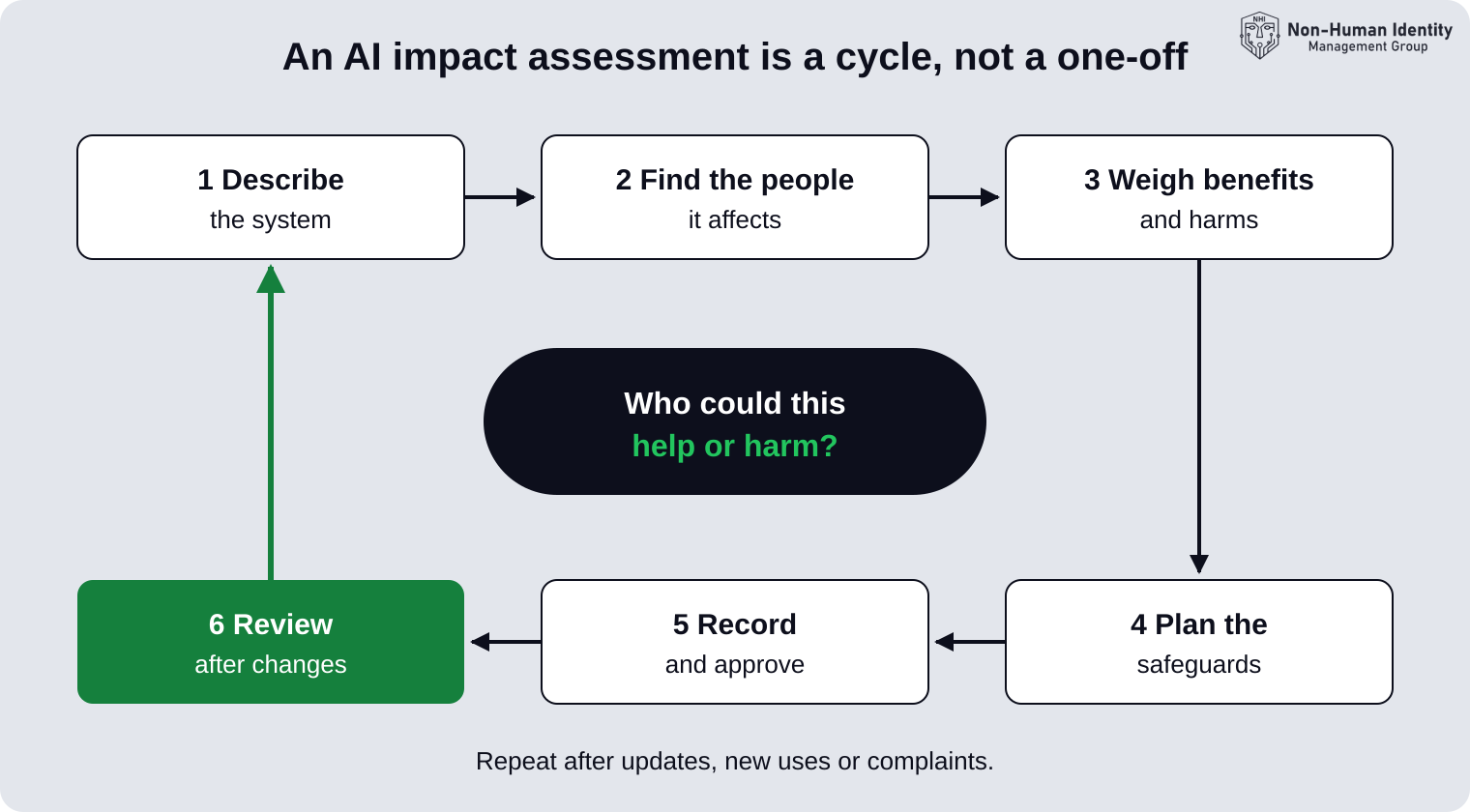
Here is a common way to run one, in plain steps.
- Describe the system. Write down what the tool does, what data it uses and what it will be used for.
- Find the people affected. List everyone it could touch, including people who never use it directly.
- Weigh benefits and harms. For each group, ask what could go well and what could go wrong, and how likely that is.
- Plan the safeguards. Decide on human checks, limits on use and a way for people to complain.
- Record and approve. Someone with authority signs off, or says no.
- Review it. Repeat the check after updates, new uses or complaints.
An AI impact assessment often sits next to two other checks with similar names. They overlap, but each has its own focus.
- AI impact assessment (AIIA): how the AI system could affect people and society. This is the subject of the ISO/IEC 42005 guidance.[1]
- Data protection impact assessment (DPIA): a privacy check on how personal data is used. In the UK, the data regulator says most uses of AI that involve personal data are likely to need one.[4]
- Fundamental rights impact assessment (FRIA): a check on people's basic rights, such as fair treatment. Under the EU AI Act, some organisations using high-risk AI must do one before first use. These include public bodies and private firms providing public services.[2]
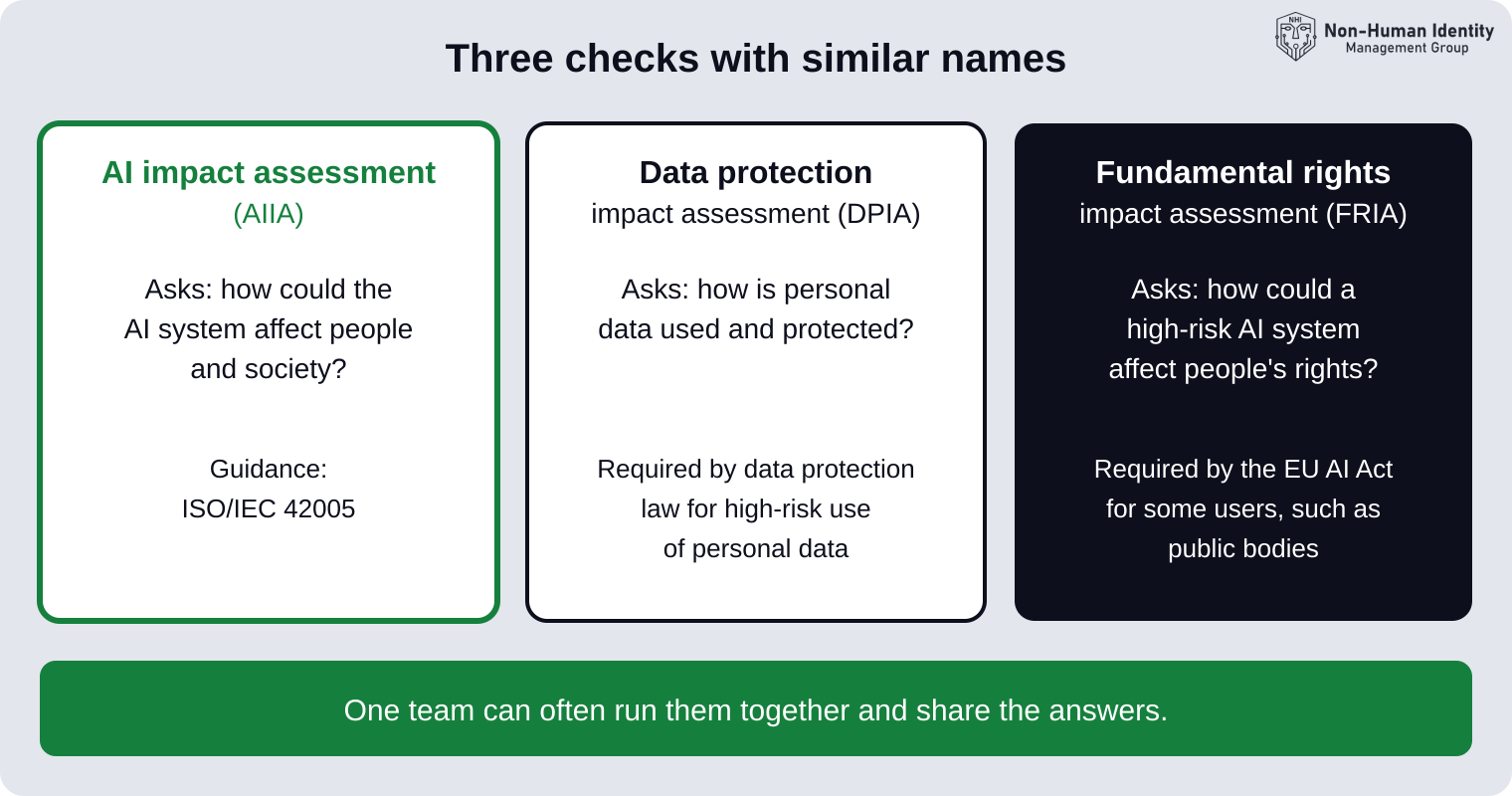
The EU rights check does not replace a privacy check. The Act says it should complement a DPIA, and parts can be shared between them.[2] For most high-risk uses, the AI Act's timetable, as changed in 2026, applies these duties from 2 December 2027.[3]
Some governments use their own version. Canada's government, for example, has an online questionnaire called the Algorithmic Impact Assessment. It sorts systems into four impact levels, from little impact to very high impact.[5]
A worked example
Ivo Lindahl runs a small recruitment agency, a fictional firm with fifteen staff. He wants an AI tool that ranks CVs, so his team can reply to applicants faster.
Before signing, Ivo asks Vida Ulrich, who looks after compliance, to run an AI impact assessment. Vida thinks of the road planners. Who lives next to this tool?
She lists the people it touches. Applicants are the obvious group. But hiring managers at client firms are affected too, because they only see the shortlist.
Next, she asks the supplier how the tool was tested. The answers are thin. Vida notes a possible harm: people with career gaps, such as carers, could be ranked lower.
Farah Yeboah, a senior recruiter, suggests a safeguard. A person will read every CV the tool ranks low before anyone is rejected. Applicants will be told that AI helps sort CVs, and how to ask for a human review.
Vida checks the law with the firm's adviser. Personal data is involved, so a privacy check is likely to be needed as well, and she runs the two together. The EU rights check is aimed at public bodies and some other users, so it may not apply to them, but the adviser will confirm.
Ivo approves the tool for a three-month trial. Vida sets a review date. At the review, she will compare who was shortlisted before and after the tool.
Myths and mistakes
| What people think | What is true |
|---|---|
| Our privacy check already covers it. | A DPIA looks mainly at personal data. An AI impact assessment also asks about fairness, safety and effects on society. |
| We bought the tool, so the supplier did the assessment. | The supplier knows the tool. You know how you will use it and who it will affect. Both views are needed. |
| It is a one-off form before launch. | AI tools and their uses change. The check should be reviewed after updates and new uses.[1] |
| Following the international standard means we meet the law. | It is guidance on method. Legal duties, such as the EU rights check, have their own required contents.[2] |
| Only big tech firms need to do this. | Any organisation using AI to make choices about people can benefit. The standard is meant for organisations of any size.[1] |
What can I do this week?
- List the AI tools your team uses that make or shape choices about people.
- Pick one and write down who it affects, in one paragraph.
- Ask who owns AI, privacy and legal checks in your organisation.
- Ask the supplier of one tool what they know about its limits.
Checklist
- Each AI tool that affects people has a named owner.
- The assessment describes the tool's purpose and the data it uses.
- Every group of people affected is listed, not just users.
- Likely harms are written down with a plan to reduce each one.
- A person can check and override the tool's decisions.
- People affected have a clear way to complain or ask for a review.
- Privacy and legal checks are linked to the AI assessment.
- There is a review date, and a rule to review after changes.
Common questions
Is an AI impact assessment required by law?
Sometimes. The general practice is usually a choice. But some laws ask for related checks. The EU AI Act asks some users of high-risk AI for a rights check. Data protection law asks for privacy checks in some cases. Ask your legal team which apply to you.
What is the difference between an AIIA and a DPIA?
A DPIA is a privacy check on how personal data is used. An AI impact assessment looks wider, at how the AI system could affect people and society, including fairness and safety. Many teams run them together and share the answers.
What is ISO/IEC 42005?
It is an international standard, published in May 2025, that gives guidance on how to carry out an AI system impact assessment. It is meant for any organisation that builds, provides or uses AI. It works alongside ISO/IEC 42001, the AI management system standard.[1]
When should we do the assessment?
Start before the tool goes live, ideally while you are still choosing it, so the findings can still change the plan. Then review it after updates, new uses or complaints. Canada's government, for example, asks for its assessment at the design stage and again before going live.[5]
Who should take part?
The tool's owner leads, with input from the people who will use it, privacy and legal staff, and the supplier. Where possible, hear from the people it will affect, or groups who represent them. The UK data regulator also suggests consulting affected people for privacy checks.[4]
Where next?
Ready for the detail? Read the practitioner guide: AI Impact Assessment Template. It goes further with a ready-to-use form, scoring for harms and the sign-off and review steps.
Also useful:
- AI Impact Assessment vs DPIA vs FRIA
- ISO/IEC 42005 AI System Impact Assessment Guide
- EU AI Act Fundamental Rights Impact Assessment
- Data Protection Impact Assessments for Beginners
- AI Risk Management for Beginners
Related NHI Mgmt Group resources: ISO 42001 for Beginners · AI Risk Assessment vs AI Impact Assessment · Responsible AI for Beginners
Key terms
- AI impact assessment
- A structured review of how an AI system may affect people, recorded with the steps taken to reduce harm.
- DPIA
- A data protection impact assessment: a privacy check before starting higher-risk use of personal data.
- Fundamental rights impact assessment
- A check of how a system may affect people's rights, which the EU AI Act asks of some users of high-risk AI.
- High-risk AI system
- An AI system that the EU AI Act places in its high-risk group, with extra rules.
- Deployer
- The organisation that puts an AI system to use, even if it did not build it.
- Human oversight
- A person staying responsible for checking and correcting what an AI system does.
- Algorithmic impact assessment
- Another name for a review of an automated system's purpose, risks and likely effects.
Sources and further reading
- ISO/IEC 42005:2025 Information technology, Artificial intelligence, AI system impact assessment. International Organization for Standardization, May 2025. https://www.iso.org/standard/42005, accessed 28 Nov 2026.
- EU AI Act, Article 27: Fundamental rights impact assessment for high-risk AI systems (consolidated text). Future of Life Institute, artificialintelligenceact.eu. https://artificialintelligenceact.eu/article/27/, accessed 28 Nov 2026.
- EU AI Act, Article 113: Entry into force and application (consolidated text). Future of Life Institute, artificialintelligenceact.eu. https://artificialintelligenceact.eu/article/113/, accessed 28 Nov 2026.
- Guidance on AI and data protection: What are the accountability and governance implications of AI? Information Commissioner's Office (ICO). https://ico.org.uk/for-organisations/uk-gdpr-guidance-and-resources/artificial-intelligence/guidance-on-ai-and-data-protection/what-are-the-accountability-and-governance-implications-of-ai/, accessed 28 Nov 2026.
- Algorithmic Impact Assessment tool. Government of Canada. https://www.canada.ca/en/government/system/digital-government/digital-government-innovations/responsible-use-ai/algorithmic-impact-assessment.html, accessed 28 Nov 2026.