Anonymisation and pseudonymisation are ways to make data less likely to point to a real person.
This guide is for anyone who shares, studies or reports on data about people. If your work turns customer, patient or staff records into reports, this affects you, even if you never write code.
In short
- Pseudonymisation swaps names for codes, but someone can still link the codes back to people. It is still personal data for anyone who holds that link.
- Anonymisation goes further, so people are not reasonably likely to be identified. Done well, UK data protection law no longer applies to the result.
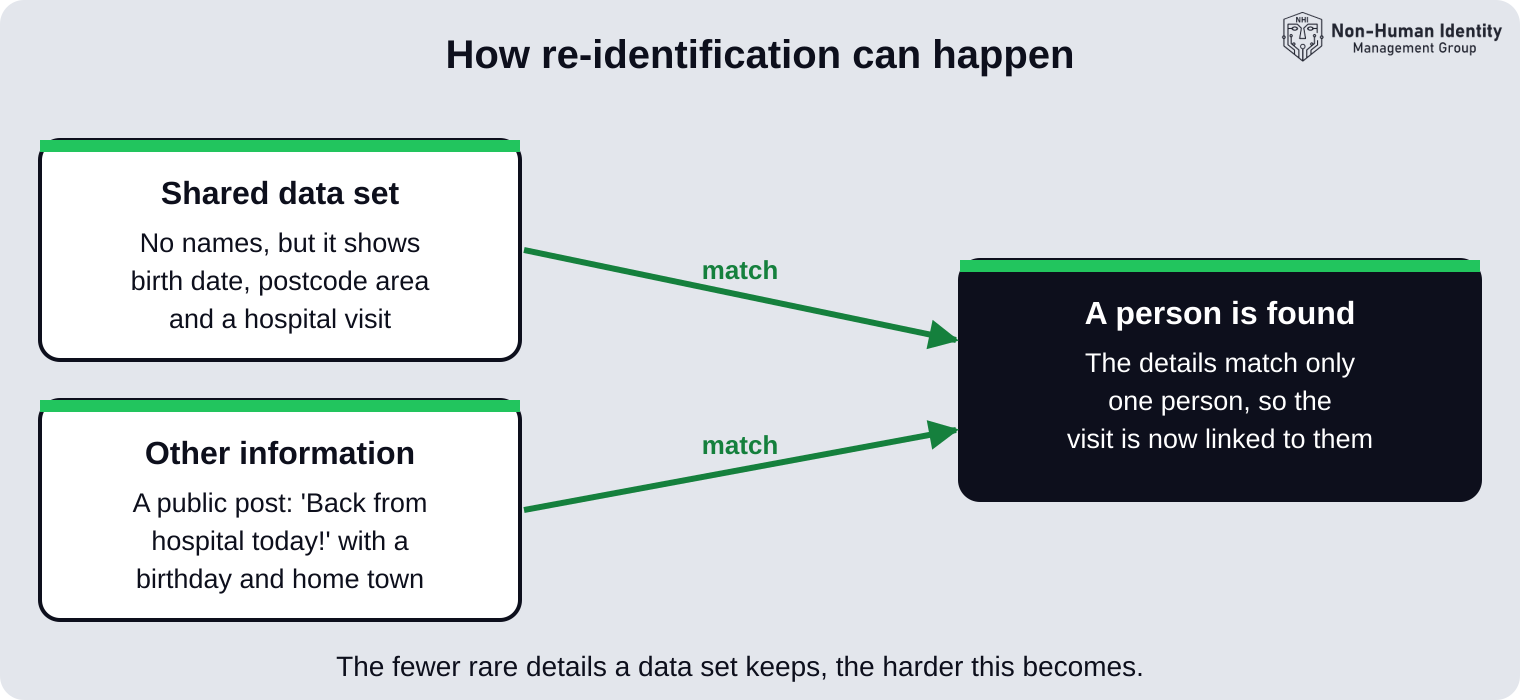
- Removing names is rarely enough. Details like birth date and postcode area can single people out when matched with other information.
- Whether data is truly anonymous depends on context: who gets it and what else they can find.
What you will learn
- Explain the difference between anonymised and pseudonymised data.
- Spot details in a data set that could still identify someone.
- Check whether "anonymised" data you are given is likely to be anonymous.
- Ask the right questions before you share data about people.
Status: correct as at 28 November 2026, based on the UK Information Commissioner's Office anonymisation guidance, which the regulator says is under review after the Data (Use and Access) Act. Laws change; check the official text.
This guide explains the topic in general terms and is not legal advice.
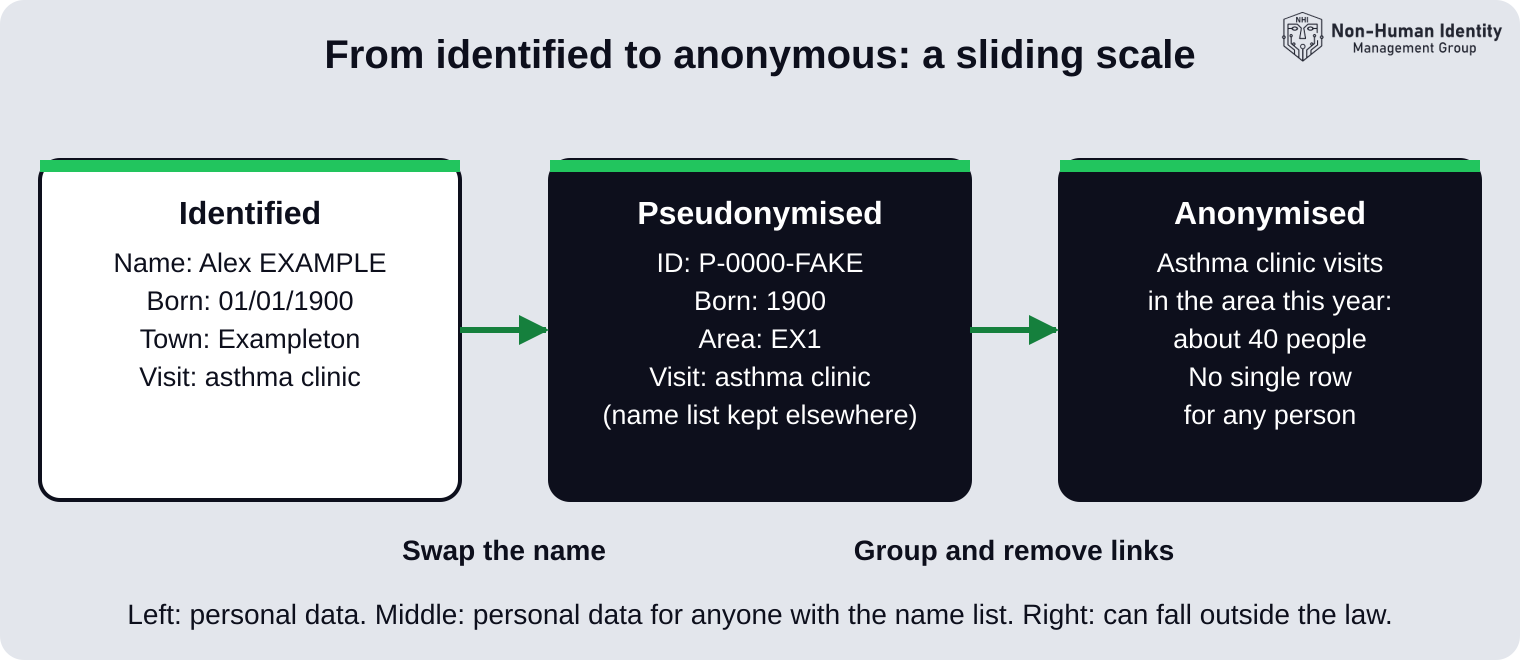
- Swapping names for codes (pseudonymisation)
- replacing details that name a person with a code, while the link back is kept separately.
- Making data anonymous (anonymisation)
- changing data so people are not reasonably likely to be identified from it.
- Finding someone again (re-identification)
- working out who a person is in data that was meant to hide them.
What are anonymisation and pseudonymisation?
Think of a coat in a cloakroom. You hand it over and get ticket 47. The coat rack shows numbers, not names, but the attendant can still match ticket 47 to you.
That is pseudonymisation. Names become codes, and the list that links them back is kept somewhere else. The UK regulator says pseudonymised data is still personal data for anyone who holds that extra information.[1]
Anonymisation is more like counting the coats and throwing away the tickets. You can say "40 coats tonight", but nobody can trace one coat back to its owner. The regulator says data protection law does not apply to truly anonymous information.[2]
Where the comparison stops working: a coat has no clues on it. Data rows often do, such as a birth date or a postcode area. Those clues can point back to a person, even with no name.
Why does it matter?
People share data every day for research, reports and testing. If they call it "anonymous" when it is not, real people can be exposed. One study found that about 87% of the US population could likely be singled out by ZIP code, gender and full date of birth alone.[4]
If you share data with partners or researchers
What could happen: a file you were told was anonymous lets the receiver work out who someone is.
Check this: ask what was removed, what was kept and who else will see it.
If you build reports or dashboards
What could happen: a table with very small counts, such as "1 person aged 90+ in this area", points to one person.
Check this: group small numbers together before you publish.
If you test software with real records
What could happen: a test copy with codes instead of names still sits beside the lookup list, so anyone with access can reverse it.
Check this: is the lookup list stored separately, with tighter access?
If you manage data in a small organisation
What could happen: you treat pseudonymised data as outside the law, and skip the care it still needs.
Check this: label pseudonymised files as personal data in your records.
Next: UK GDPR for Beginners
What does it look like?
Example only. All values are made up.
Shared file: clinic_visits_FAKE.csv  ("anonymised")
ID          Born        Area   Visit
P-0001-FAKE 01/01/1900  EX1    asthma clinic   (1)
P-0002-FAKE 02/02/1900  EX1    asthma clinic
P-0003-FAKE 03/03/1900  EX9    rare condition  (2)
Lookup list: lookup_FAKE.csv, same folder       (3)
- The name is gone, but a full birth date plus an area can narrow it to one person.
- A rare condition in a small area can be enough on its own. In a real file, this row could point to a single patient.
- The list that turns codes back into names is in the same folder, so this is pseudonymised, not anonymised.
Why this is risky: the file is called "anonymised", but the codes can be reversed and the details are specific enough to match.
The safer way: keep the lookup list elsewhere with tighter access. Share birth year, not full date, and group rare rows together or leave them out.
How does it work?
Making data less likely to point to a person usually takes a few steps, done in this order.
- Decide the purpose. Work out what the people using the data really need. Leave out everything else.
- Remove direct identifiers. These are details that name a person on their own, such as name, email or account number.
- Swap in codes if you need to link records. This is pseudonymisation. Keep the lookup list separate and secure.[1]
- Blur the clues that remain. Use birth year instead of birth date, a wider area, or totals instead of single rows. This moves the data towards anonymous.
- Test it like an outsider. The regulator describes a motivated intruder: a reasonably able person, using things like the internet and public records, who tries to identify someone. Ask whether they could succeed.[3]
The UK regulator calls identifiability a spectrum. Between "clearly identified" and "anonymous", the risk depends on the data and the situation.[3] It also says the risk does not have to be zero. It must be reduced to a sufficiently remote level.[3] The EU GDPR draws a similar line between pseudonymised and anonymous data.[5]
A worked example
This story is made up to show how it can happen.
Effie Dahl is an analyst at a small health charity in Bristol. A university asks for data on people who use the charity's support groups.
Her first draft removes names and email addresses. Each person gets a code, and the lookup list stays on the charity's own system. Effie knows this is pseudonymised data, so it is still personal data.
Before sending, she reads the file as a stranger would. She notices full birth dates, home postcodes and the rare conditions some members have.
She tries a simple test. Could someone who knows a member, or reads their public posts, spot that person? For a few rows, the honest answer is yes.
So she changes the file. Birth dates become age bands. Postcodes become wide regions. Rare conditions are grouped under "other". Groups with fewer than ten people are merged.
The university still gets what it needs for its study. Effie asks the charity's data protection lead to review the file and record the decision. The university also agrees in writing not to try to identify anyone.
What made the difference: Effie did not stop at removing names. She asked what else in the file, or in the world, could point back to a person.
Myths and mistakes
| What people think | What is true |
|---|---|
| Removing names makes data anonymous. | Other details, like birth date and postcode area, can still identify people when matched with other information.[4] |
| Pseudonymised data is outside data protection law. | It is still personal data for anyone who holds the extra information needed to reverse it.[1] |
| Anonymisation means zero risk. | The UK regulator says the risk must be sufficiently remote, not zero.[3] That is why context and checks matter. |
| Once anonymous, always anonymous. | New public data or new tools can change the risk. Review shared data sets from time to time. |
| Scrambling data with encryption makes it anonymous. | Encrypted data can be unlocked by anyone with the key, so it is still personal data to them. Encryption protects data, but it is a different job. |
What can I do this week?
- Find one data set your team shares and check whether it is called "anonymised".
- List what it still contains: dates, places, rare details and small counts.
- Check where any lookup list is kept and who can open it.
- Ask your data protection lead how your organisation decides that data is anonymous.
Checklist
- I know the difference between pseudonymised and anonymised data.
- Pseudonymised files are treated as personal data in our records.
- Lookup lists are kept separately, with tighter access.
- Shared data has only the details the receiver needs.
- Exact dates and small areas are widened before sharing, where possible.
- Small groups are merged or left out of published tables.
- Someone checks whether a motivated outsider could identify people.
- The decision to call data anonymous is written down and reviewed.
Common questions
Is anonymised data really anonymous?
Sometimes, but not always. Data is only anonymous if nobody who gets it is likely to work out who people are. Many files called "anonymised" just swap names for codes. Others keep clues, like a birth date, that can be matched with other facts.
Which is better, anonymisation or pseudonymisation?
Neither is best every time. Swapping names for codes keeps a link back. That helps when you need to follow the same person over time. Making data anonymous lowers the risk more, but you lose the link. Choose by what the data is for.
Does anonymisation itself count as using personal data?
Yes. The UK regulator says that making personal data anonymous is itself a use of personal data. So the law applies while you do the work. The finished anonymous data is then outside the law.[2]
What is a motivated intruder test?
It is a test of your data. Picture a fairly skilled person with the internet and public records. Could they find out who someone is? The UK regulator uses this test to judge if anonymisation works.[3]
Is masking the same as anonymising?
Not quite. Masking hides some values, often on screen or in test copies. The full data usually still exists somewhere. So masked data is only anonymous if what is left gives no clues, and nobody using it can reach the original.
Where next?
Ready for the detail? Read the practitioner guide: Anonymisation and Re-identification Risk Guide. It goes further into the legal tests, ways to measure re-identification risk and how to run a motivated intruder test.
Also useful:
- Data Masking vs Anonymisation vs Pseudonymisation
- Privacy Enhancing Technologies for Beginners
- Differential Privacy Guide
- Data Privacy for Beginners
Related NHI Mgmt Group resources: UK GDPR for Beginners · GDPR for Beginners · AI and Privacy for Beginners
Key terms
- Anonymisation
- Changing personal data so that people are not reasonably likely to be identified from it, by anyone who might get it.
- Pseudonymisation
- Replacing details that identify a person with a code, while the information needed to link the code back is kept separately and secure.
- Re-identification
- Working out who a person is in data that was meant to hide their identity, often by matching it with other information.
- Personal data
- Any information about a person who can be identified, directly or with other details.
- Data minimisation
- Collecting and sharing only the personal data needed for a clear purpose.
- Privacy-enhancing technology
- A tool or method that lets people use data while revealing less about the individuals in it.
Sources and further reading
- Pseudonymisation (Anonymisation guidance). Information Commissioner's Office (ICO). https://ico.org.uk/for-organisations/uk-gdpr-guidance-and-resources/data-sharing/anonymisation/pseudonymisation/, accessed 28 Nov 2026. The ICO notes this guidance is under review after the Data (Use and Access) Act.
- Introduction to anonymisation (Anonymisation guidance). Information Commissioner's Office (ICO). https://ico.org.uk/for-organisations/uk-gdpr-guidance-and-resources/data-sharing/anonymisation/introduction-to-anonymisation/, accessed 28 Nov 2026.
- How do we ensure anonymisation is effective? (Anonymisation guidance: spectrum of identifiability, motivated intruder test). Information Commissioner's Office (ICO). https://ico.org.uk/for-organisations/uk-gdpr-guidance-and-resources/data-sharing/anonymisation/how-do-we-ensure-anonymisation-is-effective/, accessed 28 Nov 2026.
- Sweeney, L. Simple Demographics Often Identify People Uniquely. Carnegie Mellon University, Data Privacy Working Paper 3, 2000. Summary at Data Privacy Lab: https://dataprivacylab.org/projects/identifiability/, accessed 28 Nov 2026.
- Regulation (EU) 2016/679 (General Data Protection Regulation), Recital 26 and Article 4(5). EUR-Lex. https://eur-lex.europa.eu/eli/reg/2016/679/oj/eng, accessed 28 Nov 2026.