The LGPD is Brazil's main law on how organisations collect, use and protect information about people.
This guide is for students, small business owners and anyone new to Brazil's data law. You do not need a legal background. If you sell to people in Brazil, even from abroad, the law can apply to you.
In short
- The LGPD covers any information linked to a person, online or on paper.
- It can apply to a firm outside Brazil that offers goods or services to people in Brazil.
- An organisation needs one of ten legal reasons to use the data, and people can ask to see, fix or delete it.
- Serious leaks must usually be reported to the regulator and the people affected within three working days.
What you will learn
- Explain what the LGPD covers and who it applies to.
- Spot the personal data in an everyday business task.
- Check that each use of data has one of the legal reasons behind it.
- Ask the right questions when a person asks what you hold about them.
Status: correct as at 28 November 2026, based on the official LGPD text published by the Brazilian government and the regulator's 2024 rules on reporting leaks. Laws change; check the official text.
This guide explains the topic in general terms and is not legal advice.
- Information about a person (personal data)
- anything linked to a person who can be identified, such as a name, tax number or phone number.
- The person it is about (data subject)
- the customer, worker or visitor the information describes. The law calls them the titular.
- The privacy contact (encarregado)
- the person a firm names to answer people and the regulator about data.
What is the LGPD?
Think of a cloakroom at a theatre. You hand over your coat for one reason, and staff must keep it safe. You can ask for it back, and they should not lend it to anyone else.
The LGPD works the same way for personal data. The letters stand for Lei Geral de Proteção de Dados, which means General Data Protection Law. It was passed in August 2018, and fines could be issued from 1 August 2021.[1]
Personal data means any information about a person who is identified or can be identified. Some data gets extra care, called sensitive personal data. This includes health, religion, political views, ethnic origin, and genetic or biometric data such as fingerprints.[1]
Two roles matter most. The controller is the organisation that makes the decisions about the data. The processor (operador in the law) handles the data on the controller's behalf, such as a payroll firm or a cloud service.[1]
The law reaches beyond Brazil. It applies when data is handled in Brazil or was collected there. It also applies when the aim is to offer goods or services to people in Brazil. Where the firm is based does not change this.[1]
Where the comparison stops working: you can see your coat on the rail. You usually cannot see your data, or who has copied it. So the law asks firms to explain what they do and to keep proof.
Why does it matter?
Brazil is a large market, and almost every business there holds personal data. The law has no minimum size, so small firms are covered too.
If you run a small business in Brazil
What could happen: you keep old customer records with tax numbers, and a leak exposes all of them.
Check this: list the customer data you hold, where it sits and when you delete it.
If you sell to Brazil from abroad
What could happen: you assume only your home country's law applies, and miss Brazil's rules.
Check this: ask whether your shop or app offers goods or services to people in Brazil.
If you are a student or new to IT work
What could happen: a leak happens on a Friday and nobody knows the report is due within days.
Check this: find out who decides whether a leak is reported, and how to reach them.
What does it look like?
Here is a made-up "Am I affected?" card for a small online shop planning a loyalty scheme.
Example only. All values are made up.
Plan: loyalty points for EXAMPLE Loja
Data we collect: name, email, tax number 000.000.000-00 (1)
Customers live in: Brazil and Portugal                 (2)
Legal reason: running the loyalty contract             (3)
Who else sees it: points tool at points.example.com    (4)
How long we keep it: 2 years after last purchase       (5)
Privacy contact: [email protected]           (6)
- Names, emails and tax numbers are personal data. In a real file, this line would list every field you collect.
- The customers in Brazil bring the shop under the LGPD, wherever it is based.
- Each use needs one of the ten legal reasons. Here the points scheme is a contract with the customer.
- The points tool handles data for the shop, so it acts as a processor.
- A clear end date shows the shop keeps data only while it needs it.
- The law asks firms to publish the name and contact details of their privacy contact.
Why this is risky: many plans skip lines 3 to 6. Without them, the shop cannot show why it holds the data, who has it or who answers questions.
The safer way: fill in a short card like this before you collect anything new, and keep it with your records.
How does it work?
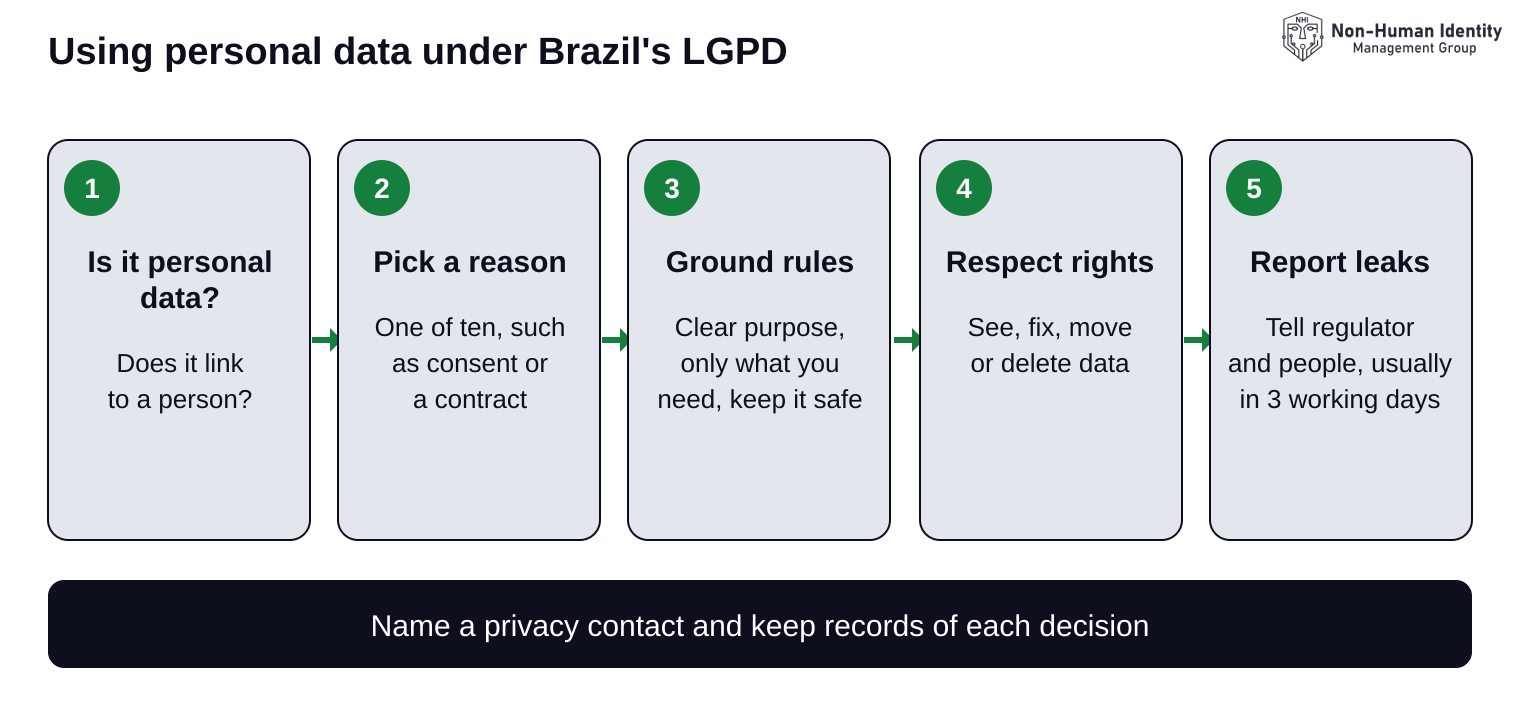
The law is long. For a new use of personal data, it comes down to five questions.
- Is it personal data? If it links to a person, the law applies. A few uses are left out, such as purely private, non-business use and some journalism.[1]
- Pick a legal reason. The law lists ten. They include consent, a contract, a legal duty, protecting someone's life, a fair business interest and protecting credit.[1]
- Follow the ground rules. Use data only for a clear purpose and collect only what you need. Be open about it, keep it secure and do not use it to discriminate.[1]
- Respect people's rights. People can ask whether you hold their data, see it, fix it, move it or have it deleted. A full reply to a request for access is due within 15 days.[1]
- Deal with leaks. If a leak may cause real risk or harm, tell the regulator and the people affected. The regulator's rules set three working days from when you learn personal data was involved.[2]
Not every leak must be reported. The regulator looks at whether the leak could badly affect people. Leaks of sensitive data, children's data, money data or passwords and other login details are among the warning signs.[2]
The regulator can warn a firm, publish its name, block data or stop processing. A simple fine can reach 2% of the firm's revenue in Brazil, up to 50 million reais for each breach of the law.[1]
A worked example
Farah Pereira runs Casa Verde, a made-up plant delivery shop in São Paulo. She wants to send customers care tips by text message after each delivery.
First, she asks whether this is personal data. It is: names, phone numbers and addresses link to real customers.
Next, she picks a legal reason. Deliveries already rely on the contract with each buyer. For the care tips, she adds a separate box at checkout, so the reason is consent. Each text explains how to stop the messages.
She then follows the ground rules. She thought about asking for birthdays, but the tips do not need them, so she leaves them out. She sets a rule to delete text sign-ups a year after the last order.
She names her business partner as the privacy contact and puts the contact details on the website. She also checks that the text message service only uses the numbers to send her messages.
A month later, a customer asks what Casa Verde holds about her. Farah exports the order history and sign-up record. She sends a full reply in eight days, inside the 15-day window.
Then a staff laptop is stolen. Farah checks what was on it. The files were encrypted and held no passwords or sensitive data. She writes down why she judged the risk low, and asks an adviser to confirm whether a report is needed.
Casa Verde is not perfect. But Farah can show what she holds, why, for how long and who to ask. That is what the law asks of her.
Myths and mistakes
| What people think | What is true |
|---|---|
| The LGPD only applies to Brazilian companies. | It can apply to firms anywhere that offer goods or services to people in Brazil, or collect data there.[1] |
| The LGPD is just the GDPR in Portuguese. | They share ideas, but the LGPD has ten legal reasons, a 15-day access window and its own leak rules.[1] |
| You always need consent. | Consent is one of ten reasons. A contract or a legal duty is often a better fit.[1] |
| Every leak must be reported. | Only leaks that may cause real risk or harm. Record your reasons either way.[2] |
| Small firms are exempt. | The law has no size limit. Some of the regulator's rules are lighter for small firms. |
What can I do this week?
- List what you hold. Write down your main sets of personal data and where each one lives.
- Write a legal reason next to each one, picking from the ten in the law.
- Name your privacy contact and put their contact details on your website.
- Agree who decides on leaks and write down the three working day deadline where your team can see it.
Checklist
- I can explain in one sentence what personal data is.
- We know whether we offer goods or services to people in Brazil.
- We know what personal data we hold, where it is and who can see it.
- Each use of personal data has a written legal reason.
- Our privacy contact is named and easy to reach.
- We can answer a full request for access within 15 days.
- Suppliers that handle data for us have a contract that covers it.
- We know who decides whether a leak is reported, and how fast.
Common questions
Does the LGPD apply to a business outside Brazil?
It can. The law covers firms anywhere that offer goods or services to people in Brazil. It also covers data collected in Brazil.[1] If you sell, ship or market to Brazil, check the detail.
Who is the regulator?
The ANPD, Brazil's national data protection regulator. It writes the detailed rules, takes leak reports, handles complaints and can issue fines.[1] Its website, linked in the sources, has guidance and the forms for reporting a leak.
Do I need a privacy contact?
In most cases, yes. The law asks controllers to name a person, called the encarregado, and publish their contact details. This person answers people and the regulator, and advises staff.[1] The regulator's rules may ease this for some small firms, so check before you decide.
How fast must we answer a request for someone's data?
A simple reply can be given straight away. A full, detailed reply is due within 15 days of the request.[1] That is shorter than the one-month window many people know from Europe, so plan who handles requests.
Does the LGPD apply to my family photos or address book?
No. The law leaves out data used by a person for purely private reasons, with no business purpose.[1] If you run a side business from home, that business use is covered.
Where next?
Ready for the detail? Read the practitioner guide: Brazil LGPD Guide. It goes further into the regulator's rules on leaks, transfers and fines, and a step-by-step plan for security teams.
Also useful:
- GDPR vs LGPD
- GDPR for Beginners
- Latin America Data Protection Laws for Beginners
- Data Protection Laws Around the World for Beginners
Related NHI Mgmt Group resources: Global Privacy Regulatory Map · Brazil AI Bill (PL 2338/2023) · Brazil Central Bank Cybersecurity Resolution Guide
Key terms
- Personal data
- Any information linked to a person who is identified or can be identified.
- Sensitive personal data
- Data that needs extra care, such as health, religion or biometric data.
- Data subject
- The person that a piece of personal data is about.
- Data controller
- The organisation that makes the decisions about how personal data is used.
- Data processor
- An organisation that handles personal data for a controller, following its instructions.
- Lawful basis
- The legal reason for using personal data; the LGPD lists ten.
- Data protection officer
- The named privacy contact, called the encarregado in Brazil, who answers people and the regulator.
Sources and further reading
- Lei nº 13.709, de 14 de agosto de 2018, Lei Geral de Proteção de Dados Pessoais (LGPD), compiled text, Articles 1, 3, 4, 5, 6, 7, 18, 19, 41, 46, 48, 52 and 65. Presidência da República, Brazil. https://www.planalto.gov.br/ccivil_03/_ato2015-2018/2018/lei/l13709.htm, accessed 28 Nov 2026.
- Incidentes de segurança com dados pessoais: comunicar é preciso, mas nem sempre (on Resolução CD/ANPD nº 15, de 24 de abril de 2024). Agência Gov, from Serpro, 16 July 2025. https://agenciagov.ebc.com.br/noticias/202507/incidentes-de-seguranca-com-dados-pessoais-comunicar-e-preciso-mas-nem-sempre, accessed 28 Nov 2026.