Latin America's data protection laws are national rules on how organisations collect, use and protect people's personal data.
This guide is for students, newcomers and small firms with customers or staff in Argentina, Chile, Colombia or Mexico. You do not need a legal background. If you sell online across the region, each country's law may apply to you separately.
In short
- Argentina, Chile, Colombia and Mexico each have their own national privacy law and their own regulator.
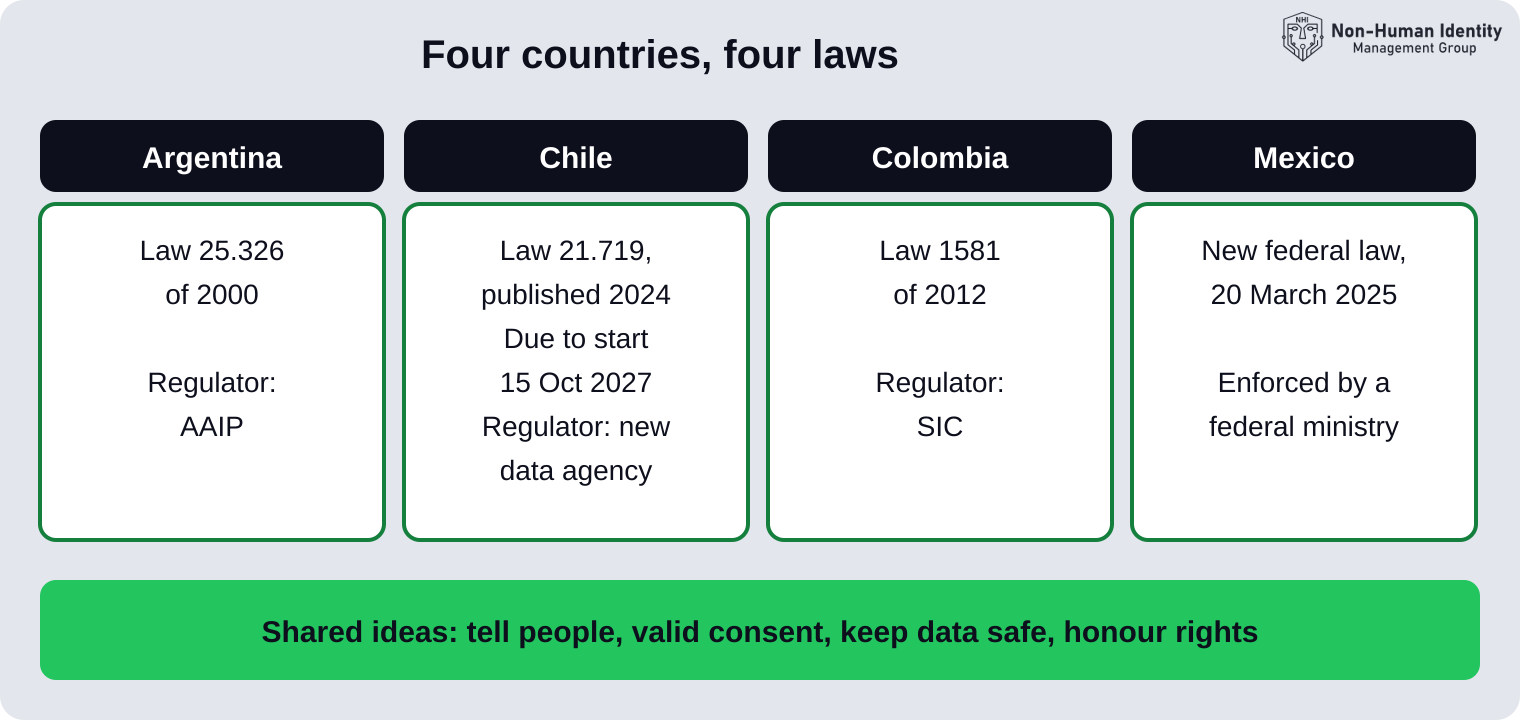
- All four share core ideas: tell people what you do, get valid consent where needed, keep data safe and honour people's rights.
- Mexico replaced its law in March 2025, and Chile's new law is due to start on 15 October 2027.
- Sending data to another country has its own rules, which differ from country to country.
What you will learn
- Explain the shared ideas behind the four laws.
- Spot the main law and regulator in each country.
- Check which recent changes matter for your team.
- Ask the right questions before you collect or move data across the region.
Status: correct as at 28 November 2026, based on the official law texts of Argentina, Chile, Colombia and Mexico. Laws change; check the official text.
This guide explains the topic in general terms and is not legal advice.
- Personal details (personal data)
- information about a person who can be identified from it.
- The data's owner (data subject)
- the person the details are about. Spanish texts often say "titular".
- Extra-care details (sensitive data)
- details such as health or religion, which need stronger protection.
What are Latin America's data protection laws?
Think of plug sockets as you travel between countries. The electricity does the same job everywhere, but the socket shape changes at each border. You need the right adapter for each one.
The four laws on this page work in a similar way. They share the same purpose: to give people control over their personal data. But each country has its own law, its own regulator and its own details. Countries are listed alphabetically.
- Argentina: the Personal Data Protection Law of 2000. The Agency for Access to Public Information, known as AAIP, oversees it.[1][2]
- Chile: a new law, Law 21.719, published in December 2024. It creates a national Personal Data Protection Agency.[3]
- Colombia: Law 1581 of 2012. The Superintendence of Industry and Commerce, known as SIC, enforces it.[4]
- Mexico: a new federal law on personal data held by private firms, published on 20 March 2025. A government ministry for anti-corruption and good government now enforces it.[5]
Brazil has its own large law, the LGPD, with its own beginner guide.
Where the comparison stops working: a travel adapter is a one-off purchase. Privacy laws change over time, as Mexico and Chile show, so you need to check them again.
Why does it matter?
Many firms serve customers in several of these countries from one website or app. A process that suits one country's law may fall short in another.
If you sell online across the region
What could happen: you use one sign-up form everywhere, but it misses a notice or consent step one country expects.
Check this: list which countries your customers live in, and compare your form with each law.
If you work in IT or customer support
What could happen: a customer asks for a copy of their data, and nobody knows the deadline to reply.
Check this: write down who handles these requests, and how fast each country expects an answer.
If you are a student or new to privacy work
What could happen: you learn one country's law and assume its neighbours work the same way.
Check this: learn the shared ideas first, then each country's main differences.
What does it look like?
Here is a made-up "Am I affected?" card. A small firm might fill it in before it speaks to an adviser.
Example only. All values are made up.
Firm: Example Lessons SRL (based in Argentina)
Customers in: [x] Argentina [x] Chile [x] Colombia [x] Mexico   (1)
[x] We collect names, emails, phone numbers                     (2)
[ ] We collect health or religion details                       (3)
[ ] Some customers are children                                 (4)
[x] Our files are stored by a cloud firm abroad                 (5)
Privacy notice last checked: 0000-00-00 (fake)
- Each country ticked may bring its own law into play.
- Ordinary personal data. You need to tell people and have a valid reason to use it.
- Sensitive data would need stronger consent and care in all four countries.
- Children's data has extra limits, for example in Colombia.
- Storing data abroad can count as a transfer, with its own rules.
Why this is risky: a firm may check only its home country's law and miss the duties of the others.
The safer way: fill in a card like this, then check each official law or ask a qualified adviser.
How does it work?
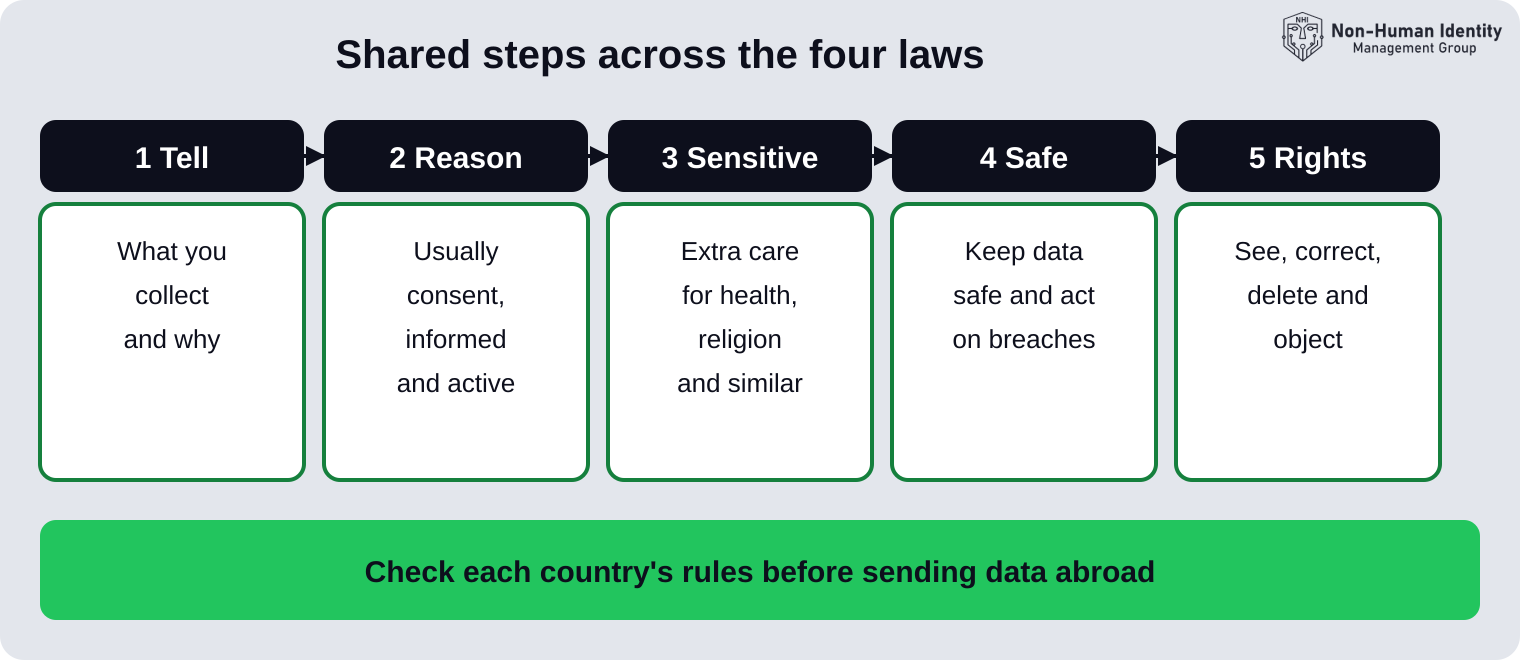
- Tell people. Explain what you collect, why, and who will receive it. In Mexico this is a required privacy notice.[5]
- Have a valid reason. Consent is central in all four laws. Argentina asks for free, express and informed consent, recorded in writing or an equivalent way.[1] Colombia asks for prior, express and informed authorisation.[4] Chile's new law adds other reasons, such as a contract or legitimate interests.[3]
- Take extra care with sensitive data. Details such as health or religious views get stronger protection. In Mexico, using them needs express written consent.[5]
- Keep data safe and act on breaches. Mexico's law says serious breaches must be reported to the people affected straight away.[5] Chile's new law requires reporting to its agency without undue delay where there is a reasonable risk to people.[3]
- Honour people's rights. People can ask to see, correct or delete their data, and to object. In Mexico these are called ARCO rights, and firms must reply within 20 days.[5]
- Check before sending data abroad. Argentina and Colombia limit transfers to countries without adequate protection, with some exceptions.[1][4]
A worked example
Xena Pereira runs a small online Spanish school from Buenos Aires. Her students live in Argentina, Chile, Colombia and Mexico. Bea Delmar handles bookings and student questions part time.
A student in Mexico emails Bea. He asks for a copy of all the data the school holds about him. Bea is not sure how quickly she must reply, so she asks Xena.
Xena checks Mexico's 2025 law. Requests like this must be answered within 20 days, and the school needs a clear privacy notice.[5] Bea sends the student his booking history, contact details and lesson notes within the deadline.
The request makes Xena look wider. Her sign-up form has one pre-ticked consent box for all countries. She changes it, so each student actively agrees and can see what the school does with their data. She writes one privacy notice that covers all four countries, in plain Spanish.
Next, she checks where data is stored. Lesson recordings sit with a cloud firm in another country. Xena asks an adviser whether this needs extra steps under Argentina's and Colombia's transfer rules.
Finally, she notes that Chile's new law is due to start in October 2027. She sets a reminder to review the school's process before then.
Myths and mistakes
| What people think | What is true |
|---|---|
| Latin America has one privacy law. | Each country has its own law and regulator. The ideas are similar, but the details differ. |
| If our home country's law is met, we are covered everywhere. | Another country's law may also apply when you serve people there. Chile's new law, for example, reaches firms abroad that offer goods or services to people in Chile. |
| Mexico's old privacy law still applies. | Mexico published a new federal law on 20 March 2025, and a government ministry now enforces it. |
| Chile's new law is already in force. | It was published in December 2024, but its main changes are due to start on 15 October 2027. |
| One tick box covers everything. | Consent needs to be informed and, in several countries, express. Sensitive data needs stronger consent. |
What can I do this week?
- List the countries your customers and staff live in.
- Read your privacy notice as a customer in each country would.
- Check that consent is a clear, active yes, not a pre-ticked box.
- Write down who answers data requests, and the deadline in each country.
- Note where your data is stored, and whether it leaves the country.
Checklist
- We know which of the four countries' laws may apply to us.
- Our privacy notice says what we collect, why and who receives it.
- Consent is informed and active, and recorded where the law asks.
- Sensitive data is listed and gets stronger protection.
- Children's data is identified and handled with extra care.
- We can answer requests to see, correct or delete data on time.
- Transfers abroad are listed and checked against each country's rules.
- We have a date to review Chile's new law before it starts.
Common questions
When does Chile's new law start?
It is due to start on 15 October 2027. The law was published in December 2024 with an earlier start date. In November 2026 Chile's Congress approved a delay, and the official text now shows the October 2027 date.[3][6]
Who enforces Mexico's privacy law now?
A federal ministry for anti-corruption and good government. Mexico's 2025 law gives it the power to check compliance, decide on people's complaints and impose sanctions.[5] If you have a question about your data in Mexico, start with the firm that holds it.
What is habeas data?
It is a court action. It lets a person find out what data is held about them and ask for it to be corrected or deleted. Argentina's law sets out this action in detail.[1]
How big are the fines in Colombia?
Fines can reach the value of 2,000 monthly minimum wages. The regulator can also suspend activities for up to six months, or close operations.[4] Other countries set their own penalties, so check each law.
Where next?
Ready for the detail? Read the practitioner guide: Peru, Ecuador and Uruguay Data Protection Laws Guide. It goes further into the neighbouring laws of Peru, Ecuador, Uruguay, Paraguay and Bolivia, including breach clocks and security duties, and links each country page.
Also useful:
- Argentina Data Protection Law Guide
- Chile Data Protection Law Guide
- Colombia Data Protection Law Guide
- Mexico Data Protection Law Guide
- Brazil's LGPD for Beginners
Related NHI Mgmt Group resources: Global Privacy Regulatory Map · Latin America Cybersecurity Laws Guide · International Data Transfers for Beginners
Key terms
- Personal data
- Information about a person who can be identified from it.
- Data subject
- The person the personal data is about.
- Sensitive personal data
- Details such as health or religious views that need stronger protection.
- Consent
- A person's free, informed and clear agreement to a use of their data.
- Data subject rights
- A person's rights to see, correct, delete or object to the use of their data.
- The public body that oversees a country's privacy law.
- Cross-border transfer
- Moving personal data from one country to people or systems in another.
Sources and further reading
- Ley 25.326 de Protección de los Datos Personales (Argentina), consolidated text, see Articles 5, 7, 12, 14, 21 and 33 to 43. InfoLEG, Ministry of Justice of Argentina. https://servicios.infoleg.gob.ar/infolegInternet/anexos/60000-64999/64790/texact.htm, accessed 28 Nov 2026.
- Resolución 47/2018, Agencia de Acceso a la Información Pública (Argentina), 23 July 2018. Argentina.gob.ar. https://www.argentina.gob.ar/normativa/nacional/resolución-47-2018-312662/texto, accessed 28 Nov 2026.
- Ley 21.719 que regula la protección y el tratamiento de los datos personales y crea la Agencia de Protección de Datos Personales (Chile), consolidated text, see Articles 1 bis, 12, 13 and 14 sexies and the transitory articles. Biblioteca del Congreso Nacional de Chile. https://www.leychile.cl/Consulta/obtxml?opt=7&idNorma=1209272, accessed 28 Nov 2026.
- Ley Estatutaria 1581 de 2012 (Colombia), see Articles 5 to 9, 19, 23, 25 and 26. Secretaría General del Senado de la República de Colombia. https://www.secretariasenado.gov.co/senado/basedoc/ley_1581_2012.html, accessed 28 Nov 2026.
- Ley Federal de Protección de Datos Personales en Posesión de los Particulares (Mexico), published 20 March 2025, see Articles 2, 8, 14, 19, 22 to 31 and 39. Cámara de Diputados. https://www.diputados.gob.mx/LeyesBiblio/pdf/LFPDPPP.pdf, accessed 28 Nov 2026.
- News report: La ley se posterga, pero los riesgos siguen (on Congress approving the delay to 15 October 2027). 24horas.cl, 18 November 2026. https://www.24horas.cl/actualidad/nacional/la-ley-se-posterga-pero-los-riesgos-siguen-la-advertencia-proteccio-datos, accessed 28 Nov 2026.