Certification renewal is the ongoing study, records and fees that keep a security certification active after you pass.
This guide is for anyone who has just passed, or is about to sit, a security certification exam. You do not need any background. If your employer pays for your certifications, renewal is part of what they are paying for.
In short
- Many security certifications last about three years. To keep one, you earn learning credits and often pay a fee.
- A learning credit, often called a CPE credit, usually stands for about one hour of learning.
- Courses, webinars, reading, events and teaching can all count, if they fit the certification's topics.
- If you miss the credits or the deadline, the certification can be suspended, and you may need to sit the exam again.
What you will learn
- Explain what a CPE credit is in one sentence.
- Find the renewal cycle, credit total and fee for your own certification.
- Keep a simple record of your learning as you go.
- Spot the dates that cause people to lose a certification.
- Learning credit (CPE credit)
- a unit, usually one hour, that records learning you did to keep a certification active.
- Renewal period (cycle)
- the set number of years in which you must earn your credits.
- Yearly upkeep fee (maintenance fee)
- a fee some certification bodies charge each year or each cycle to keep you certified.
What is certification renewal?
Think of a first aid certificate. You pass the course once, but the certificate only stays valid if you refresh your training before it runs out.
Many security certifications work the same way. Passing the exam starts a renewal period, often three years. During that time you show that you have kept learning, by earning credits. Many bodies call these CPE credits. CPE is short for continuing professional education. CompTIA uses the word CEUs instead.
A certification body is the group that runs the exam and gives out the title. Each body sets its own rules. The number of credits, the length of the cycle, the fee and the deadline can all differ.
Where the comparison stops working: a first aid refresher is usually one course on one day. Security credits are often earned bit by bit across the whole cycle, and you record them yourself.
Why does it matter?
Security changes fast, so the bodies want people to keep up. The rules also help keep the title worth having. A lapsed certification may not count for a job that asks for it.
If you have just passed your first exam
What could happen: you forget about renewal and find out after the deadline that your title has lapsed.
Check this: find your cycle end date in your account on the body's website this week.
If you manage a team
What could happen: a contract needs a certified person, and the certification of the person you named has lapsed.
Check this: keep a simple list of each person's certifications and end dates.
If you are studying for your first exam
What could happen: the yearly fee and study time surprise you after you pass.
Check this: read the body's renewal rules before you book the exam.
What does it look like?
Most people keep a short learning log. Here is a made-up one for the first few months of a three-year cycle.
Example only. All values are made up.
Learning log: Hal (EXAMPLE)    Cycle ends: 31 Mar 2029
Date        Activity                          Credits
12 Apr 26   Webinar: cloud identity basics     1      (1)
03 May 26   Local security meetup, 2 hours     2
20 Jun 26   Online course: incident response   6      (2)
15 Jul 26   Wrote a blog post on passkeys      0      (3)
Running total: 9 of 120 (FAKE target)                 (4)
- One hour of learning usually counts as one credit.
- Keep the certificate or receipt for each activity, in case your record is checked.
- Some activities count only once they are entered on the body's website, so write each one up as you go.
- Track your total against the target, so you can see if you are falling behind.
Why this is risky: a log kept only in your head, or saved up for the last month, is easy to get wrong. Missing proof can cost you credits if your record is checked.
The safer way: add each activity to the body's website soon after you do it. Keep proof in one folder, and set a reminder for each fee and for the cycle end date.
How does it work?
Most renewal schemes follow the same steps.
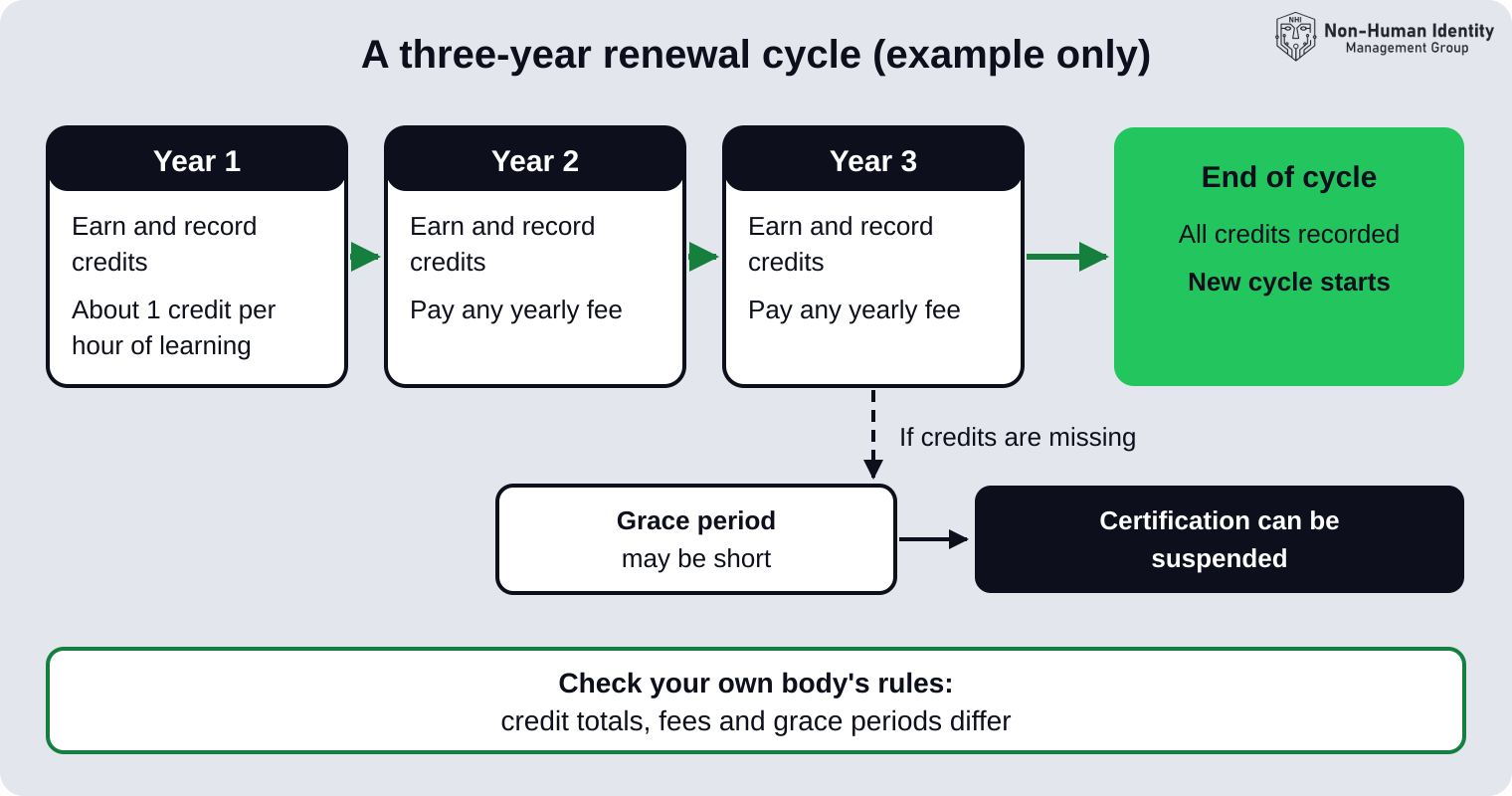
- The cycle starts. Your renewal period usually starts on the day you become certified, and runs for a set number of years. For example, CompTIA Security+ is valid for three years from the date you pass.[1]
- You earn credits. One hour of learning typically earns one credit.[2] Some bodies want most of your credits to match the topics the certification covers.
- You record them. You enter each activity in your account on the body's website, and you keep proof such as a certificate or receipt.
- You pay any fee. Some bodies charge a yearly upkeep fee. Others charge once per cycle. Amounts change, so check the body's own page.
- You renew, or it lapses. If you meet the rules, a new cycle starts. If not, the title may be suspended and, later, ended.[2]
Here is what three well-known bodies publish. They are listed alphabetically, and this is not a ranking.
| Certification body | Example certification | What its own pages say |
|---|---|---|
| CompTIA | Security+ | Valid for three years. Renew with 50 CEUs, an approved course, or a higher-level exam.[1] |
| ISACA | CISA, CISM and others | 120 CPE credits over three years. From 1 January 2027, at least 90 must match the certification's topics.[3] |
| ISC2 | CISSP | 120 CPE credits over three years, with 40 a year suggested, plus a yearly upkeep fee.[2] |
Rules do change. ISACA, for example, has announced new rules from 1 January 2027.[3] So always check the body's current page, not an old forum post.
A worked example
Hal Nakamura is a junior security analyst at a fictional insurance firm. He passed his first certification exam in March. His manager, Dario Novak, paid for the exam.
At the end of his first month, Dario asks Hal a simple question. "When does your certification run out, and what do you need to keep it?"
Hal is not sure. He thinks of the first aid course he took at a summer job. The trainer said the certificate lasted three years, and that most people forgot until it had expired.
So Hal signs in to his account on the certification body's website. He finds his cycle end date, his credit target and the date of his first yearly fee. He puts all three in his calendar, with reminders a month ahead.
Next, he starts a learning log. He adds a webinar he watched last week, with its certificate. He also asks the body's help page which activities count, so he does not guess.
Dario adds Hal to the team's list of certifications and end dates. He agrees that Hal can spend two hours a month on approved learning at work, which covers most of the credits he needs.
By the end of the first year, Hal has logged a bit more than a third of his target. He is not worried about the last month, because there is very little left to do.
Myths and mistakes
| What people think | What is true |
|---|---|
| Once I pass, I am certified for life. | Many security certifications must be renewed, often every three years. A few do not expire, so check yours. |
| Any learning counts. | Credits usually need to match the certification's topics. Some bodies cap general learning.[3] |
| I can log everything in the last month. | You can, but it is risky. Some bodies suggest a yearly amount, and missing proof is hard to fix later.[2] |
| If I miss the date, I just pay a late fee. | A lapsed title can be suspended, and you may need to sit the exam again.[1][2] |
| Two certifications mean double the work. | Often one course can count for several titles. Check each body's rules. |
What can I do this week?
- Sign in to your certification account and note your cycle end date.
- Write down your credit target and any yearly fee date.
- Set calendar reminders a month before each fee and the end date.
- Start a learning log, and add anything you have already done.
- Read the body's page on which activities count.
Checklist
- I know my cycle end date for each certification I hold.
- I know how many credits I need, and any yearly suggested amount.
- I know the fee, when it is due and how to pay it.
- My learning is logged on the body's website soon after I do it.
- I keep proof of each activity in one place.
- I have reminders set for fees and the end date.
- I have checked the body's current rules this year.
Common questions
What does CPE stand for?
CPE stands for continuing professional education. A CPE credit records learning you did after passing the exam, to keep your certification active. One hour of learning usually earns one credit.[2] CompTIA uses the name CEU, continuing education unit, for a similar idea.
What counts as a CPE credit?
Usually, learning linked to the certification's topics. That can include courses, webinars, conferences, reading, teaching, mentoring and writing.[4] Some bodies also allow a share of general skills, such as leadership. Each body publishes its own list, so check it before you rely on an activity.
What happens if my certification lapses?
The title can be suspended, and you may not use it while it is suspended. The details vary by body. ISC2 describes a 90-day grace period, then suspension.[2] CompTIA says the only way back after expiry is to pass the exam again.[1]
Do I have to pay every year?
For some certifications, yes. ISC2 charges a yearly upkeep fee.[2] Other bodies charge once per cycle, or as part of a renewal course. Amounts change, so check the body's current fee page, and ask your employer whether they cover it.
Can one course count for two certifications?
Often, yes, if the course fits the topics of both. You usually record it separately with each body. Keep the proof, because each body may ask to see it. The practitioner guide below explains how this works for several bodies.
Where next?
Ready for the detail? Read the practitioner guide: Certification Renewal and CPE Requirements Guide. It goes further into cycle lengths, credit totals and fees for five bodies, how several certifications combine, and grace periods.
Also useful:
- Cyber Security Certifications for Beginners
- CISSP for Beginners
- CompTIA Security+ for Beginners
- CISM for Beginners
Related NHI Mgmt Group resources: Cybersecurity Certifications Guide · CISSP Certification Guide · Entry Level Security Certifications Compared
Key terms
- Continuing professional education
- Formal learning that certified people do to keep their certification and skills current.
- CPE credit
- A unit, usually one hour, that records continuing education towards a certification.
- Continuing education unit (CEU)
- A unit of credit for structured learning, used by some bodies such as CompTIA.
- Continuing professional development
- The ongoing work of updating your skills and knowledge after you qualify.
- Digital badge
- An online marker of an achievement, such as a certification, that others can check.
- CISSP
- A widely recognised security certification from ISC2, aimed at experienced professionals.
Sources and further reading
- How Long Does the CompTIA Security+ Certification Last? CompTIA, 18 December 2024. https://www.comptia.org/en-em/blog/how-long-does-the-comptia-security-certification-last/, accessed 28 Nov 2026.
- Certification Maintenance Handbook. ISC2, 2024 (footer dated January 2026). https://edge.sitecorecloud.io/internationf173-xmc4e73-prodbc0f-9660/media/Project/ISC2/Main/Media/documents/members/MEM-Certification-Maintenance-Handbook-Digital.pdf, accessed 28 Nov 2026.
- CPE policy updates for 2027. ISACA. https://www.isaca.org/credentialing/cpe-2027, accessed 28 Nov 2026.
- How to earn CPE. ISACA. https://www.isaca.org/credentialing/how-to-earn-cpe, accessed 28 Nov 2026.