A business security certification is outside proof that a company protects its systems and data to a set standard.
This guide is for founders, small suppliers and new staff who have been asked "Are you certified?" by a customer. You do not need a technical background. If you sell to larger firms or the public sector, the answer can decide whether you win the work.
In short
- Customers ask for a badge so they can trust you with their data without checking everything themselves.
- Four names come up most often: Cyber Essentials, ISO 27001, PCI DSS and SOC 2.
- Which one you need depends on where your customers are, what you sell and whether you take card payments.
- Ask the customer which badge they accept before you pay for one, and check what it covers.
What you will learn
- Explain what a business security certification is in one sentence.
- Spot the difference between a certificate and an audit report.
- Check which badge your customers are likely to ask for.
- Ask the right questions before you start.
Status: correct as at 28 November 2026, based on the scheme owners' official pages. Schemes change; check the official text.
This guide explains the topic in general terms and is not legal advice.
- Badge (certification)
- a certificate that says an outside checker found you meet a set standard.
- Checker's letter (audit report)
- a written report from an auditor that describes your controls and what they tested.
- What is covered (scope)
- the parts of the business, the systems and the time period that the check looked at.
What is a business security certification?
Think of the food hygiene rating sticker in a café window. It tells you an inspector visited and checked the kitchen. You do not have to look in the fridge yourself.
A business security certification works the same way. An outside checker looks at how a company protects its computers and data. If the company meets the standard, it gets a certificate or a report it can show to customers.
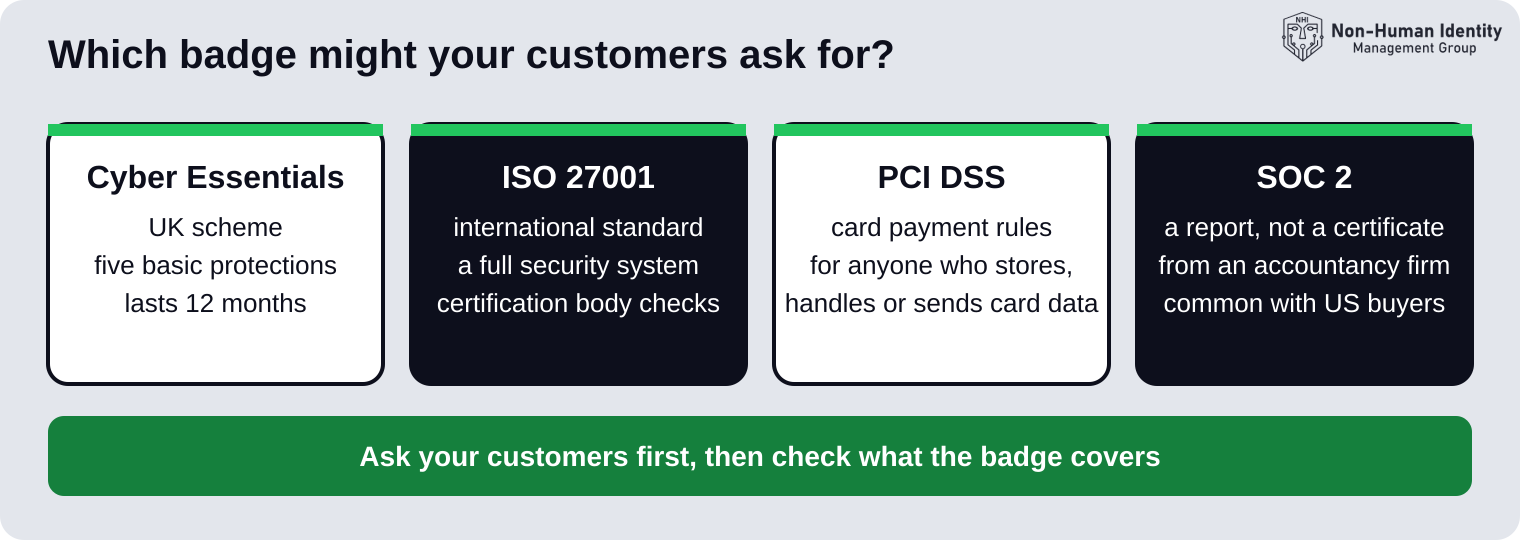
The four names you will hear most are:
- Cyber Essentials: a UK scheme that checks five basic protections, such as firewalls and software updates. There is a basic level and a Plus level with hands-on testing.[1]
- The international standard: a worldwide standard for running security as an ongoing system of rules, owners and checks. It is known by its number, shown in Figure 1.[3]
- PCI DSS: a set of security rules for anyone who stores, handles or sends payment card data.[6]
- SOC 2: a report from a US-style accountancy firm on a service company's controls. It is a report, not a certificate.[4]
Where the comparison stops working: a hygiene sticker covers the whole kitchen. A security badge may cover only one office, one product or one period of time. You have to read what it covers.
Why does it matter?
Customers need to know their data is safe with you. A recognised badge can answer many of their questions at once. Many organisations now ask suppliers to hold Cyber Essentials before they can bid for work.[1] UK central government made it a must for some contracts from October 2014.[7]
If you are starting a business
What could happen: you pay for a badge your customers do not ask for.
Check this: ask your first few customers which badge they accept.
If you sell to the UK public sector
What could happen: you cannot bid because you lack the basic UK badge.
Check this: read the tender papers for Cyber Essentials or Cyber Essentials Plus.
If you sell software to US firms
What could happen: the buyer's security team asks for a SOC 2 report and the deal stalls.
Check this: ask if they accept another badge while your SOC 2 work is under way.
Next: SOC 2 for Beginners
If you take card payments
What could happen: you handle card details without knowing the payment card rules apply to you.
Check this: ask your payment provider what you need to do to show you follow the rules.
Next: PCI DSS for Beginners
What does it look like?
Here is a made-up "Which badge?" card that a small supplier might fill in.
Example only. All values are made up.
Which badge? (Example Studio Ltd, example.com)
Customers in the UK public sector?   YES  -> Cyber Essentials   (1)
Customers asking for ISO 27001?      YES  -> plan ISO 27001     (2)
US software buyers?                  NO   -> no SOC 2 for now   (3)
Do we take card payments ourselves?  NO   -> payment provider   (4)
                                             handles card data
Certificate number: EXAMPLE-0000-FAKE
- If a tender needs it, the papers usually name Cyber Essentials.
- A large customer has asked for it, so it goes on the plan.
- No buyer has asked for SOC 2 yet, so it waits.
- Using a payment provider can reduce how much of the card rules apply. Ask the provider to confirm.
Why this is risky: without a card like this, firms often buy the badge they have heard of most, not the one their customers need.
The safer way: start from what your customers ask for. Then check what each badge covers and how long it lasts.
How does it work?
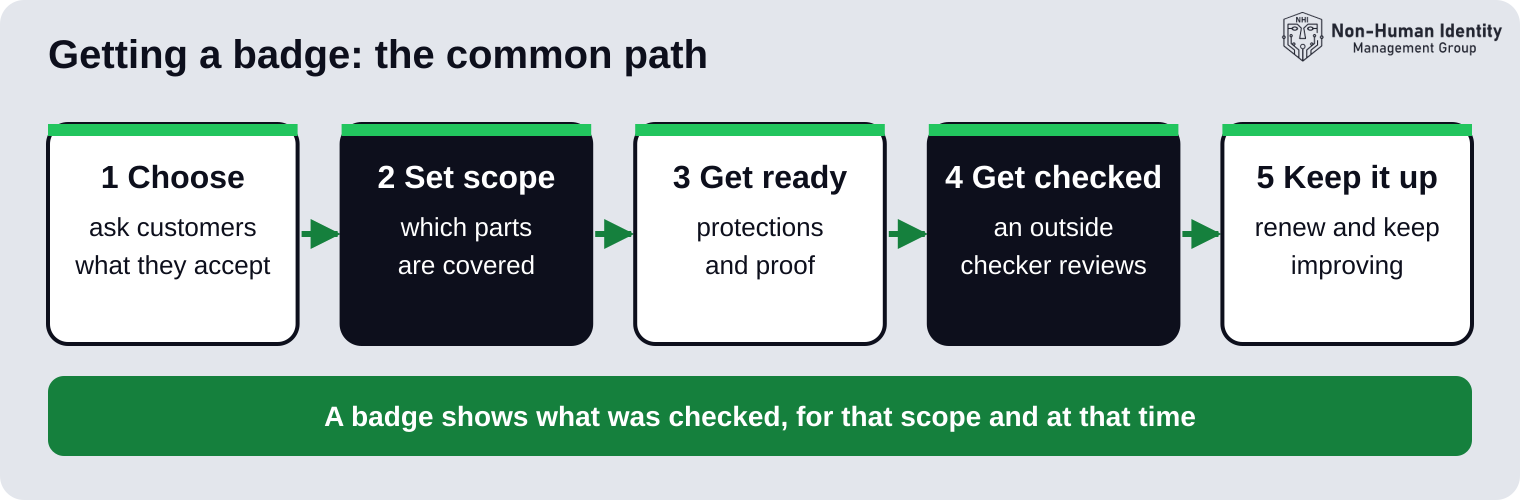
Most badges follow the same basic path.
- Choose. Ask customers which badge they accept, and pick the one that fits.
- Set the scope. Decide which parts of the business the check will cover.
- Get ready. Put the required protections in place and keep proof that they work.
- Get checked. An outside checker reviews you. For ISO 27001 this is a certification body, because ISO itself does not certify.[3] For SOC 2 it is a licensed accountancy firm (CPA firm).[4]
- Keep it up. Badges need renewing. A Cyber Essentials certificate is valid for 12 months.[2]
There are two kinds of SOC 2 report. A Type 1 report looks at how controls are designed at one point in time. A Type 2 report also tests whether they worked over a period.[5] Buyers often prefer Type 2 because it shows controls in action.
A worked example
Petra Falk runs Juniper Studio, a fictional design agency with 14 staff in Manchester. Juniper builds websites and keeps some client files.
A large health charity wants to hire Juniper. Its buyer, Soren Rosen, sends a form. One question reads: "Which security certifications do you hold?"
Petra has heard of ISO 27001 and assumes she needs it. Before she pays anyone, she thinks of the café sticker. Customers trust the sticker they know. So she asks Soren which badges the charity accepts.
Soren replies that Cyber Essentials is the minimum for all suppliers. ISO 27001 would be welcome but is not needed for this contract.
Petra reads the NCSC page on Cyber Essentials. She sees it covers five basic protections and that a certificate lasts 12 months.[1][2] Her IT supplier helps her turn on automatic updates, remove old user accounts and check the office firewall.
She applies and gets the certificate. She puts the renewal date in her diary.
Juniper does not take card payments itself, because clients pay by bank transfer. So the card rules are not a concern for now. No one has asked for SOC 2.
Petra adds a line to her standard answers. It says Juniper holds Cyber Essentials and renews it every year. If more large clients ask, she will look at ISO 27001 next year.
Myths and mistakes
| What people think | What is true |
|---|---|
| A badge means we cannot be hacked. | A badge shows a checker found you met a standard at that time. Attacks can still happen. |
| ISO certifies companies. | ISO writes the standard. Separate certification bodies do the checking.[3] |
| A SOC 2 is a certificate. | SOC 2 is an auditor's report that describes controls and, for Type 2, test results.[5] |
| Once certified, always certified. | Badges need renewing. Cyber Essentials lasts 12 months.[2] |
| A supplier's badge covers the service we buy. | Read the scope. It may cover only one site, team or product. |
What can I do this week?
- Ask your three biggest customers which security badges they accept.
- Check recent tender papers for Cyber Essentials or other named badges.
- Ask your payment provider how the card rules apply to you.
- Write a two-line answer for forms that ask what certifications you hold.
Checklist
- We know which badges our customers ask for.
- We have checked what each badge would cover in our business.
- We know who would check us, and that they are recognised.
- We know how long each badge lasts and when to renew.
- We know whether the card payment rules apply to us.
- We keep a short, honest answer ready for customer forms.
- When we ask a supplier for a badge, we read its scope.
Common questions
Which security certification does a small business need first?
In the UK, Cyber Essentials is a common first badge, because many buyers ask for it and it covers basic protections. If you sell software to US firms, they may ask for SOC 2. Ask your main customers before you choose.
What is the difference between ISO 27001 and SOC 2?
ISO 27001 is an international standard that ends in a certificate if a certification body finds you meet it. SOC 2 is a report from an accountancy firm describing your controls. SOC 2 is most often asked for by US buyers.
Is PCI DSS a certification?
Not exactly. PCI DSS is a set of rules for protecting payment card data. Businesses that handle card data must follow it. How you show you follow it is set by the card brands and your payment provider, so ask them what you need to do.[6]
How long does a security certification last?
It varies. A Cyber Essentials certificate is valid for 12 months.[2] ISO 27001 certificates usually include check-up audits, so ask your certification body about its timetable. A SOC 2 report covers a past period, so buyers usually want a fresh one each year.
Can we just fill in the customer's questionnaire instead?
Sometimes, yes. Many buyers send a security questionnaire to suppliers who hold no badge. A badge can make questionnaires shorter, but it rarely replaces them. Keep a set of honest, ready answers about how you protect data.
Where next?
Ready for the detail? Read the practitioner guide: Third-Party Attestation Comparison Map. It goes further into six schemes side by side, who issues each one, how scope and validity differ and how one audit can serve several buyers.
Also useful:
- ISO 27001 for Beginners
- Cyber Essentials vs ISO 27001
- Answering Security Questionnaires as a Small Supplier
- How to Read a SOC 2 Report Guide
Related NHI Mgmt Group resources: Cyber Essentials Readiness Checklist · ISO 27001 Certification Readiness Checklist · Security Ratings vs SOC 2 Reports
Key terms
- Cyber Essentials
- A UK government-backed scheme that checks five basic security protections.
- Cyber Essentials Plus
- The higher level of Cyber Essentials, where a checker tests the protections by hand.
- ISO/IEC 27001
- An international standard for building and running a security management system.
- PCI DSS
- Security rules for organisations that store, handle or send payment card data.
- SOC 2 Type 2
- An auditor's report that tests whether a firm's controls worked over a set period.
- Attestation
- A statement backed by evidence, such as an auditor's report on a firm's controls.
- Scope
- The parts of a business, systems and time period that a check covers.
- Security questionnaire
- A set of questions a buyer sends to check a supplier's security.
Sources and further reading
- About Cyber Essentials. National Cyber Security Centre (NCSC). https://www.ncsc.gov.uk/cyberessentials/overview, accessed 28 Nov 2026.
- Cyber Essentials. IASME Consortium (NCSC Cyber Essentials delivery partner). https://iasme.co.uk/cyber-essentials/, accessed 28 Nov 2026.
- ISO/IEC 27001: Information security management systems. International Organization for Standardization (ISO). https://www.iso.org/isoiec-27001-information-security.html, accessed 28 Nov 2026.
- System and Organization Controls: SOC suite of services. AICPA & CIMA. https://www.aicpa-cima.com/resources/landing/system-and-organization-controls-soc-suite-of-services, accessed 28 Nov 2026.
- SOC 2 Reporting on Controls at a Service Organization: Relevant to Security, Availability, Processing Integrity, Confidentiality, or Privacy, Chapter 1 Introduction and Background (publisher's excerpt). AICPA Guide, 2018. https://catalogimages.wiley.com/images/db/pdf/9781945498602.excerpt.pdf, accessed 28 Nov 2026.
- PCI DSS. PCI Security Standards Council. https://www.pcisecuritystandards.org/standards/pci-dss/, accessed 28 Nov 2026.
- Procurement Policy Note 09/14: Cyber Essentials scheme certification. Cabinet Office, GOV.UK, 26 September 2014. https://www.gov.uk/government/publications/procurement-policy-note-0914-cyber-essentials-scheme-certification, accessed 28 Nov 2026.