Contact centre security means protecting the calls, people, recordings and card details in a customer phone team.
This guide is for anyone who runs, works in or pays for a team that answers customer calls. You do not need a big call centre to be affected: if your business takes orders or card payments by phone, these risks apply to you too.
In short
- A contact centre is where money and personal details change hands by phone, chat or email.
- The main risks are tricked staff, misused staff access and card details stored in call recordings.
- Card payment rules say the three or four digit security code must not be kept in recordings after the payment goes through.
- Check callers carefully, give staff only the access they need, and keep card details out of the call where you can.
What you will learn
- Explain what contact centre security covers in one sentence.
- Spot the places where card details can leak during a phone payment.
- Check how your team confirms that a caller is who they say they are.
- Ask your phone or payment supplier the right questions.
- Phone trick (vishing)
- a phone call in which someone pretends to be a person you trust, to get information or money.
- Card security code (CVV)
- the three or four digits printed on a payment card, used to check the card is present.
- Call recording
- a saved copy of a phone call, often kept for training, quality or disputes.
What is contact centre security?
Think of a shop counter that customers phone instead of visit. Money changes hands there, people share their address, and staff can see the till.
A contact centre is a team that handles customer calls, chats and emails. It might be fifty people in an office, or two people at a garden centre taking phone orders. The staff who answer are often called agents.
Contact centre security protects four things. These are the callers, the agents, the records the team keeps, and the payments it takes. A call recording (a saved copy of a call) is one of the records that needs the most care.
Where the comparison stops working: at a real counter you can see the customer's face. On the phone you only hear a voice, and a voice is easy to fake or borrow.
Why does it matter?
Agents can often see a lot about each customer. That makes them a target for tricks and for bribes. In May 2025, Coinbase told US regulators that criminals had paid support staff outside the United States to copy customer data from its systems.[6] US officials have also warned that criminals phone help desks to talk staff into resetting passwords and login checks.[5] Read our Coinbase support agent breach page for the full story.
If you run a small business that takes phone orders
What could happen: card numbers and security codes end up in your call recordings or on scraps of paper.
Check this: ask your phone supplier whether calls are recorded, and what happens during the payment part.
Next: PCI DSS for Beginners
If you manage a contact centre team
What could happen: a caller talks an agent into changing an account's email or phone number, then takes over the account.
Check this: make sure there is a written way to check callers before any account change.
If you have just started as an agent
What could happen: a friendly or angry caller pushes you to skip a check "just this once".
Check this: learn what you must not share on a call, and who to pass a pushy caller to.
What does it look like?
Here is a made-up note typed during a phone order. It shows a mistake that is easy to make.
Example only. All values are made up.
Order note, Juniper Nursery phone desk
Caller: EXAMPLE CUSTOMER, 00 Fake Lane
Card: 0000 0000 0000 0000  exp 00/00   (1)
Security code: 000                     (2)
Call recorded: yes, whole call         (3)
Address change requested by caller     (4)
- In a real file, this line would contain the full card number, typed into a notes box.
- In a real file, this line would contain the card security code. Card rules say it must not be kept after the payment.
- The recording also captured the caller reading out the card details.
- A change made without checking who is calling.
Why this is risky: anyone who can read the notes or play back the call can copy the card details. Card industry guidance says storing the security code in any audio recording after the payment is approved breaks its rules.[1] The industry counts that code as secret checking data, along with PINs.[4]
The safer way: the customer types their card number on their own phone keypad, and the sounds are hidden from the agent and the recording. If that is not possible, the recording is paused during payment and card details are never written down.[2]
How does it work?
A safer phone payment and account change usually follows these steps.
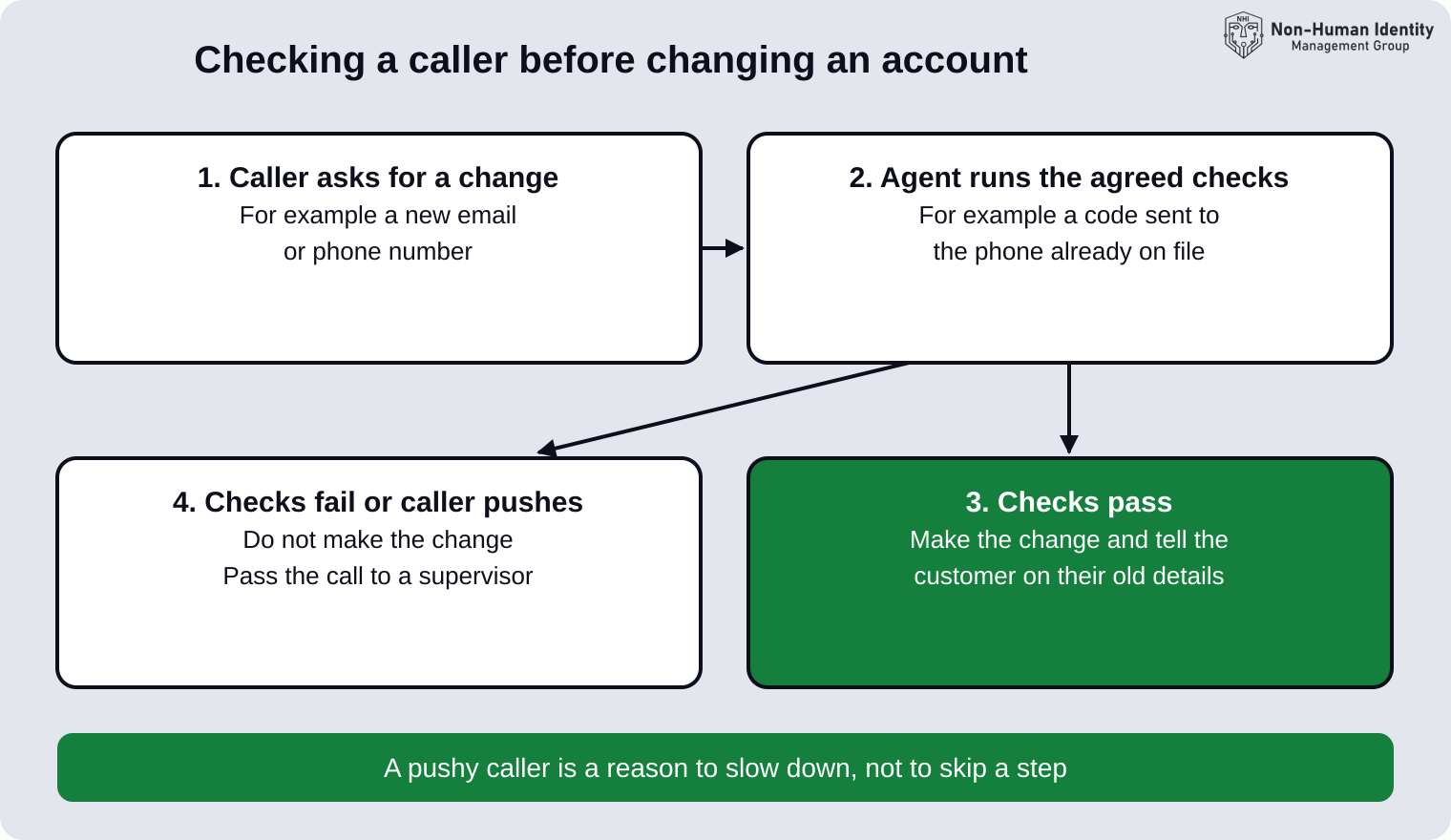
- Check the caller. The agent confirms who is calling using steps agreed in advance, not just a name and date of birth.
- Limit what the agent sees. Each agent can open only the customer details their job needs. This idea is called least privilege (only the access the job needs).
- Keep card details out of the call. The customer keys in their card number. Tone hiding (called DTMF masking) swaps the keypad sounds for flat tones, so the agent and recording do not capture them.[2]
- Protect the recordings. Recordings and transcripts are kept only as long as needed, and only a few people can play them back.[3]
- Watch for warning signs. Managers look for unusual lookups, such as one agent opening hundreds of accounts in an hour.
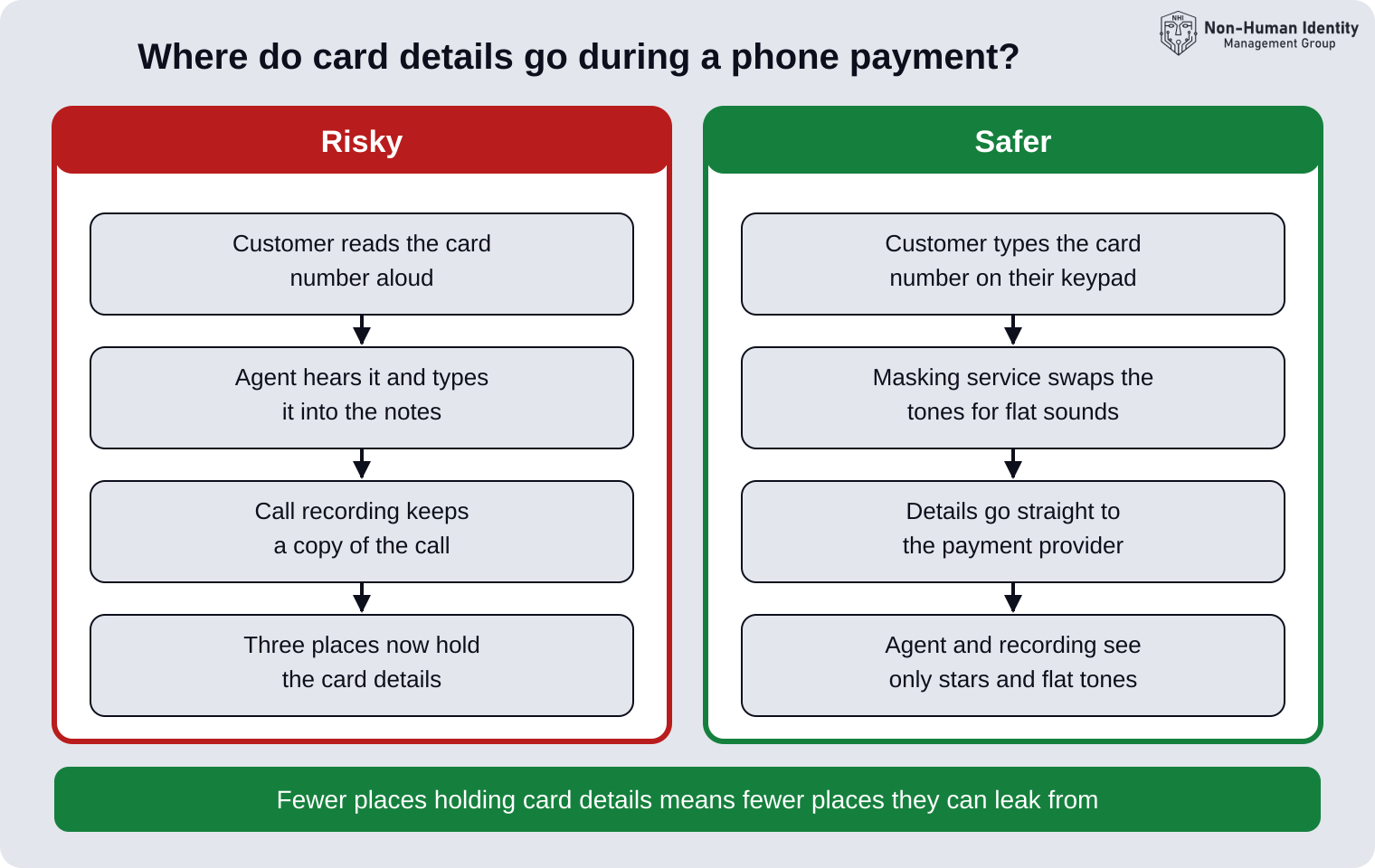
Some teams use pause and resume instead. The recording stops while the card details are given, then starts again. Card industry guidance notes that when agents do this by hand, they can forget to pause or forget to restart.[2] Pausing also does nothing to stop the agent hearing the card number.
A worked example
Calla Achterberg runs Juniper Nursery, a fictional plant nursery that takes about forty phone orders a week. Two staff answer the phone, and every call is recorded for training.
Her new starter, Kofi Whitlock, asks a simple question. "When people read out their card, should I write it on the pad first?"
Calla stops and thinks about the shop counter. At her real till, nobody writes card numbers down. So why does the phone desk?
She checks with her phone supplier. They confirm the whole call is recorded, including the moment customers read out their card. She asks her payment provider about options. They offer a service where customers key in their card number and the tones are hidden from staff and the recording.
While that is set up, Calla makes three quick changes. Staff stop writing card details on paper. The old pads are shredded. Staff pause the recording for the payment part and say "recording paused" aloud, so the habit sticks.
She also asks her supplier to delete or edit older recordings that may hold card details. She checks whether any law means some recordings must be kept.
A month later, a caller asks Kofi to change the delivery address on a big order. He sends a code to the phone number already on the account. The caller hangs up. Kofi tells Calla, and she rings the real customer on the number she has on file.
No money is lost. Calla adds the call to her training notes.
Myths and mistakes
| What people think | What is true |
|---|---|
| We are too small to need contact centre security. | Any business that takes card details by phone has the same card rules to follow.[3] |
| Recording every call keeps us safe. | Recordings can hold card details and personal data. They need the same care as any other sensitive record.[1] |
| Pausing the recording solves card security. | It helps the recording, but the agent still hears the number, and manual pausing can be forgotten.[2] |
| If a caller knows the account details, they must be the customer. | Account details can be stolen or bought. Use checks that a stranger is unlikely to pass, such as a code sent to the phone on file. |
| Our staff would never misuse customer data. | Most will not, but bribes and pressure happen. Limit what each agent can see and watch for unusual lookups.[6] |
What can I do this week?
- Ask your phone supplier whether calls are recorded and whether card details end up in recordings.
- Stop staff writing card details on paper or in notes fields.
- Write down the steps agents must follow before changing an email, phone number or address.
- Check who can play back recordings, and remove anyone who does not need to.
- Tell agents who to pass a pushy or suspicious caller to.
Checklist
- Card details are keyed in by the customer with the tones hidden, or the recording is paused during payment.
- Card security codes are not stored in recordings, notes or screenshots.
- There is a written caller check for account changes and password resets.
- Agents can see only the customer details their job needs.
- Recordings are kept only as long as needed, and playback is limited to a few named people.
- Staff logins use a second check, such as a code from an app, especially for home workers.[3]
- Someone looks for unusual activity, such as one agent opening far more accounts than usual.
- Agents know they will be backed up for slowing down a pushy caller.
Common questions
Can I record calls where customers give card details?
You can record calls, but card industry guidance says the card security code must not be kept in any recording after the payment is approved. The safest approach is to keep card details out of the recording in the first place, using tone hiding or a pause during payment.
What is DTMF masking?
It hides the beeps a phone keypad makes. The customer keys in their card number, and the system swaps each beep for a flat tone. The agent and the recording hear only the flat tones, while the real digits go to the payment provider.
Is chat or email safer than phone for card payments?
Not by itself. A card number typed into a chat or an email is saved in the chat history or inbox. We suggest sending customers a secure payment link from your payment provider instead, so the card details do not pass through your team at all.
How should agents check a caller is genuine?
Use checks agreed in advance and that a stranger is unlikely to know or receive. A common example is a one-time code sent to the phone already on the account. A name, address and birthday alone are weak checks. They are often easy to find.
Do home-based agents need extra care?
Yes. A home desk may be shared or overheard, and the computer may be personal. Card industry guidance asks firms to assess the extra risk of home workers and to use a second login check for remote access.
Where next?
Ready for the detail? Read the practitioner guide: Contact Centre Platform Security Guide. It goes further into agent desktop design, telephone payment options and how to secure call transcripts and analytics.
Also useful:
- Caller Authentication in Contact Centres
- Card Payment Security for Beginners
- Business Phone Systems for Beginners
- Insider Threats for Beginners
Related NHI Mgmt Group resources: Vishing and Smishing Guide · Vishing and Help Desk Social Engineering Awareness Guide · Payment Card Data Elements
Key terms
- Vishing
- A phone call in which someone pretends to be a trusted person to get information, access or money.
- Tricking people into giving away information or access, rather than breaking into systems.
- Call recording
- A saved copy of a phone call, kept for training, quality checks or disputes.
- Card security code (CVV)
- The three or four digits printed on a payment card, used to check the card is present.
- PCI DSS
- The card industry's security rules for any business that takes, stores or handles card payments.
- Least privilege
- Giving each person or program only the access it needs for its job.
- Insider threat
- Harm caused by someone inside an organisation, on purpose or by mistake, using access they already have.
Sources and further reading
- Are audio/voice recordings permitted to contain sensitive authentication data? PCI Security Standards Council FAQ, June 2025. https://www.pcisecuritystandards.org/faq/articles/Frequently_Asked_Question/are-audio-voice-recordings-permitted-to-contain-sensitive-authentication-data, accessed 28 Nov 2026.
- Information Supplement: Protecting Telephone-Based Payment Card Data, version 3.0. PCI Security Standards Council, November 2018. https://listings.pcisecuritystandards.org/documents/Protecting_Telephone_Based_Payment_Card_Data_v3-0_nov_2018.pdf, accessed 28 Nov 2026.
- Industry Guidance on Accepting Telephone Payments Securely. PCI Security Standards Council blog, 27 November 2018. https://blog.pcisecuritystandards.org/industry-guidance-on-accepting-telephone-payments-securely, accessed 28 Nov 2026.
- Glossary: Sensitive Authentication Data and Card Verification Code. PCI Security Standards Council. https://www.pcisecuritystandards.org/glossary/, accessed 28 Nov 2026.
- Scattered Spider, joint cybersecurity advisory AA23-320A. CISA and FBI, 16 November 2023. https://www.cisa.gov/news-events/cybersecurity-advisories/aa23-320a, accessed 28 Nov 2026.
- Coinbase Global, Inc. Form 8-K. US Securities and Exchange Commission, 15 May 2025. https://www.sec.gov/Archives/edgar/data/1679788/000167978825000094/coin-20250514.htm, accessed 28 Nov 2026.