The cyber kill chain is a model that splits a cyber attack into seven stages, from the attacker researching a target to the attacker reaching their goal, so that defenders can look for ways to stop the attack at each stage.
The model sits under threat intelligence: the work of understanding how attackers operate so you can make better defence decisions. If you are new to that idea, start with Threat Intelligence for Beginners. This page is for newcomers, students, career changers and managers who keep hearing the term and want a plain English explanation, with a worked example and simple first steps.
By the end of this guide you will be able to:
- Explain the seven stages of the cyber kill chain in your own words.
- Describe why breaking any one stage can stop an attack.
- Identify where the model is useful and where newer models such as MITRE ATT&CK fit better.
Key takeaways
- Attacks happen in stages. The kill chain names seven: reconnaissance, weaponisation, delivery, exploitation, installation, command and control, and actions on objectives.
- Defenders only need to win once. An attacker has to get through every stage, so stopping any one of them can break the attack.
- Earlier is cheaper. Blocking an attack at delivery costs far less than cleaning up after data has been stolen.
- It is a starting point, not the whole picture. Real attacks loop back and skip steps, so most teams pair the kill chain with the more detailed MITRE ATT&CK framework.
What it is, in plain English
The term "kill chain" comes from the military, where it describes the steps needed to find and strike a target. Analysts at Lockheed Martin, a US defence company, applied the idea to computer intrusions. Their paper, by Eric Hutchins, Michael Cloppert and Rohan Amin, argued that an intrusion has to succeed at every phase to reach its goal, so one effective defence can break the chain.[3] Lockheed Martin presents the Cyber Kill Chain as part of what it calls its Intelligence Driven Defense model, and says the steps identify what attackers must complete to reach their objective.[1]
A helpful comparison is a burglary. A burglar walks past the house to look for an open window, gathers tools, gets into the garden, forces the window, hides inside, keeps in touch with a partner outside, and finally takes the valuables. A locked gate, a neighbour who notices, or an alarm at any point can end the job. Where the analogy breaks down: a burglar has to be physically present, while a cyber attacker can try thousands of "houses" at once from anywhere, and can come back months later using access they set up quietly.
Why it matters: the model gives a whole team a shared language. Instead of "we were hacked", you can say "the attack got past delivery because the email filter missed it, and we caught it at command and control". That tells you which defence worked and which one to improve.
How it works, step by step
Lockheed Martin's own short descriptions of the seven phases are given in quotation marks below.[2] The plain English notes and defender ideas are our explanation.
- Reconnaissance, "Identify the Targets". The attacker gathers information: staff names from social media, email address formats, and which internet-facing systems the organisation runs. Defender idea: limit what you publish and know what you expose to the internet.
- Weaponisation, "Prepare the Operation". The attacker gets the attack ready, for example by pairing malicious code with a document or link. This happens on the attacker's side, so defenders rarely see it directly. Defender idea: use threat intelligence about the tools attackers are currently using.
- Delivery, "Launch the Operation". The attack reaches the victim, for example as a phishing email, a malicious website or an attack on an exposed server. Lockheed Martin calls this the first and most important opportunity for defenders to block the operation.[2] Defender idea: email filtering, web filtering and staff who know how to report suspicious messages.
- Exploitation, "Gain Access to Victim". The attacker uses a weakness, such as an unpatched flaw or a person tricked into running a file, to get a foothold. Defender idea: keep software updated and limit who can run what.
- Installation, "Establish Beachhead at the Victim". The attacker sets up a way to stay, such as hidden software that survives a restart. Defender idea: endpoint protection that watches for new or unusual programs.
- Command and control, "Remotely Control the Implants". The compromised device contacts the attacker's systems to receive instructions. Lockheed Martin describes blocking this channel as the defender's last best chance to block the operation.[2] Defender idea: watch network traffic for devices talking to unknown or suspicious destinations.
- Actions on objectives, "Achieve the Mission's Goal". The attacker does what they came for: stealing data, encrypting files for ransom or moving to other systems. Defender idea: detect large data transfers and unusual access, and have an incident response plan ready.
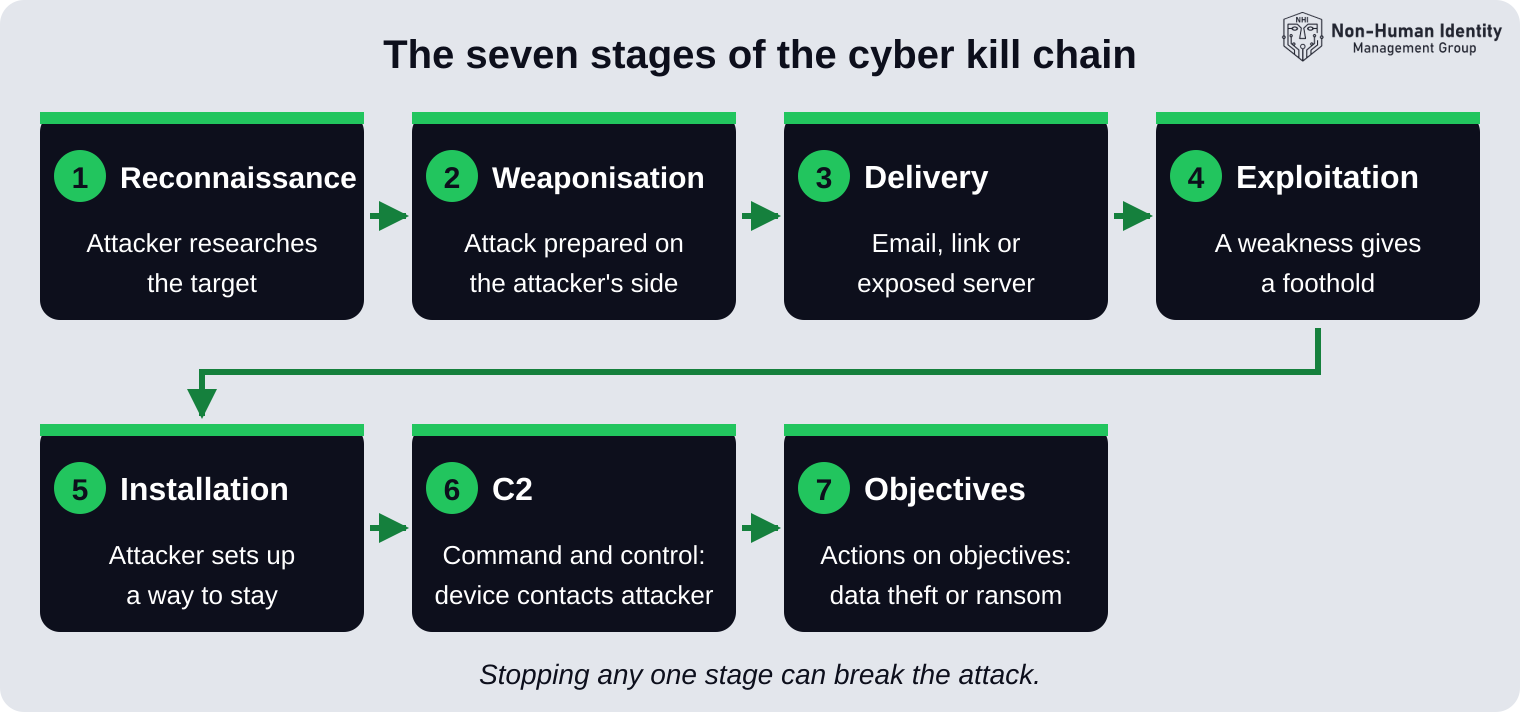
The original paper paired each phase with defensive actions such as detect, deny and disrupt. For example, host-based intrusion detection can detect an exploit, patching can deny it, and memory protections can disrupt it once it starts.[3]
Kill chain and MITRE ATT&CK
MITRE ATT&CK is a free knowledge base of attacker behaviour based on real attacks. MITRE describes the two models as complementary: ATT&CK describes behaviour at a lower, more detailed level, and its tactics are unordered and may not all occur in one intrusion, while the kill chain uses ordered phases to describe high-level attacker objectives.[4] The Enterprise matrix in ATT&CK v20 has 15 tactics, including Reconnaissance (TA0043), Initial Access (TA0001), Lateral Movement (TA0008), Command and Control (TA0011) and Exfiltration (TA0010).[5]
| Question | Cyber kill chain | MITRE ATT&CK |
|---|---|---|
| Level of detail | Seven broad phases | Tactics broken down into hundreds of techniques |
| Order | Ordered, start to finish | Unordered; not every tactic appears in every attack |
| Best for | Explaining an attack to a non-specialist and spotting where a defence is missing | Mapping detections and testing coverage against specific behaviours |
A worked example
Harbour Freight Supplies is a fictional wholesaler with 60 staff. One Monday, Leah in accounts receives an email that appears to come from a regular supplier, with an "updated invoice" attached.
- Reconnaissance: the attacker had found Leah's name and role on a business networking site and guessed the email format.
- Delivery: the email filter did not catch the message, so this stage succeeded.
- Exploitation: Leah opened the attachment, but the company had switched off macros in documents from the internet, so the hidden code did not run. Leah thought the file looked odd and reported it with the "report phishing" button.
Tom, the IT lead, used the kill chain to write up what happened. Delivery got through; exploitation was blocked by a settings change. He searched for other copies of the email, found two more in staff inboxes, removed them and added the sender to the block list. His one-line lesson for the board was: "Our email filter missed it, our device settings and an alert member of staff stopped it." The company did not assume it was now safe; Tom added a check of email filter rules to his monthly review.
Common mistakes
| Mistake | What to do instead |
|---|---|
| Putting all the effort into the first stages, as if keeping attackers out is enough. | Assume something will get through. Keep defences at later stages too, such as monitoring for unusual network traffic and data leaving. |
| Treating the seven stages as a strict order that every attack follows. | Use the stages as a checklist of opportunities. Attackers who log in with stolen passwords can skip several stages entirely. |
| Thinking the model only covers malware. | Apply the same thinking to stolen accounts, misuse of cloud services and abuse of trusted suppliers. |
| Using the kill chain alone for detailed detection work. | Pair it with MITRE ATT&CK when you need to map specific attacker behaviours to specific detections. |
| Forgetting what happens after the first foothold. | Watch for lateral movement between systems, which the seven phases do not show in detail. |
Key terms
- Cyber kill chain
- A seven-stage model of a successful intrusion, from reconnaissance to the attacker's final goal, used to decide where an attack can be interrupted.
- Reconnaissance
- Gathering information about a target before acting, such as staff names or internet-facing systems.
- Weaponisation
- Turning a weakness into a working attack, such as malicious code ready to deliver.
- Exploitation
- Using a weakness to gain unauthorised access to or control of a system.
- Command and control (C2)
- The channel and systems an attacker uses to send instructions to compromised devices and receive data back, tracked in ATT&CK as tactic TA0011.
- Actions on objectives
- The steps an attacker takes after gaining access to reach their goal, such as stealing data or disrupting operations.
- Lateral movement
- The techniques an attacker uses to move from a first foothold to other systems, tracked in ATT&CK as tactic TA0008.
- MITRE ATT&CK
- A knowledge base of observed attacker tactics, techniques and procedures, used to map detections and hunt for activity.
First steps
Three things you can do this week:
- Take your last security incident or near miss and write down, stage by stage, how far it got and what stopped it.
- List one defence for each stage. A blank row shows where you depend on luck.
- Check you can see command and control. Ask whether anyone would notice a laptop talking to an unknown internet address every few minutes.
Checklist
A simple checklist:
- We know which of our systems are reachable from the internet.
- Email and web filtering are switched on and reviewed.
- Staff have an easy way to report suspicious messages.
- Software updates are applied promptly, starting with internet-facing systems.
- Endpoint protection is installed on every laptop and server.
- Someone reviews alerts about unusual outbound network traffic.
- We have a written plan for what to do if an attacker reaches their objective.
Suggested learning pathway
- Start with the wider topic in Threat Intelligence for Beginners.
- To learn who runs these attacks and why, read Threat Actors for Beginners.
- For the most common delivery route, read Phishing for Beginners.
- For what gets installed, read Malware for Beginners.
- For what to do when an attack gets through, read Incident Response for Beginners.
- For the practitioner view, including the Diamond Model, see the Cyber Kill Chain and Diamond Model Guide.
- For detailed attacker behaviours, see the MITRE ATT&CK Guide for Defenders.
Standards and references
- The Cyber Kill Chain. Lockheed Martin. https://www.lockheedmartin.com/en-us/capabilities/cyber/cyber-kill-chain.html, accessed 27 Nov 2026.
- Gaining the Advantage: Applying Cyber Kill Chain Methodology to Network Defense. Lockheed Martin, 2015. https://www.lockheedmartin.com/content/dam/lockheed-martin/rms/documents/cyber/Gaining_the_Advantage_Cyber_Kill_Chain.pdf, accessed 27 Nov 2026.
- Intelligence-Driven Computer Network Defense Informed by Analysis of Adversary Campaigns and Intrusion Kill Chains. Eric M. Hutchins, Michael J. Cloppert and Rohan M. Amin, Lockheed Martin. https://www.lockheedmartin.com/content/dam/lockheed-martin/rms/documents/cyber/LM-White-Paper-Intel-Driven-Defense.pdf, accessed 27 Nov 2026.
- ATT&CK FAQ: What is the relationship between ATT&CK and the Lockheed Martin Cyber Kill Chain? MITRE. https://attack.mitre.org/resources/faq/, accessed 27 Nov 2026.
- Enterprise Tactics, MITRE ATT&CK v20. MITRE. https://attack.mitre.org/tactics/enterprise/, accessed 27 Nov 2026.
Related NHI Mgmt Group resources: Cyber Kill Chain and Diamond Model Guide · MITRE ATT&CK Guide for Defenders · ATT&CK Command and Control Tactic