A threat actor is any person or group that deliberately tries to harm an organisation's computers, data or people, whether for money, for a government, for a cause or out of a grudge.
Security teams talk about threat actors so they can ask a practical question: who is likely to come after us, and what do they want? This guide is for newcomers, students, career changers and managers who are not security specialists. It explains the main types of threat actor, what drives each one, how an attack unfolds at a high level, and how knowing the "who" helps you choose sensible defences. It stays at the level of groups and motives, not individuals or attack techniques in detail.
Turning information about attackers into decisions is a separate skill, covered in Threat Intelligence for Beginners.
By the end of this guide you will be able to:
- Explain what a threat actor is.
- Describe the main types of threat actor and their usual motives.
- Understand why the same group can have several names.
- Identify which actor types matter most for your own organisation.
Key takeaways
- Motive is the best starting point. Criminals want money, state-backed groups want intelligence or influence, hacktivists want attention for a cause, and insiders often act from discontent.
- Most organisations face criminals first. Financially motivated attackers hit organisations of every size, often by chance rather than by careful choice.
- Different actors, similar ways in. Phishing, stolen logins and unpatched systems are used by almost every type, so basic defences help against all of them.
- Names vary between companies. One group can have several names because each security company tracks and names activity in its own way.
- Attribution is for experts. Deciding exactly who was behind an attack is slow and uncertain; your first job is to detect, contain and recover.
What it is, in plain English
NIST, the US standards body, defines a threat actor simply as an individual or a group posing a threat.[1] In everyday security work the term means someone acting on purpose. A storm that floods your server room is a threat, but it is not a threat actor.
The Canadian Centre for Cyber Security groups threat actors into six broad types by what drives them: nation-states (geopolitically motivated), cybercriminals (financially motivated), hacktivists (ideologically motivated), terrorist groups (often motivated by ideological violence), thrill-seekers (often motivated by satisfaction) and insider threats (often motivated by discontent).[2] It also notes that these categories are only a rough guide, because actors can overlap.[2]
A helpful comparison is the people who might try to get into a shop. A passing opportunist tries the door to see if it is unlocked. An organised gang plans a raid on the safe. A protester wants to cause a scene in the window. A disgruntled employee already has a key. You would not defend against all four in exactly the same way, but a good lock and an alarm help with every one. Where the analogy breaks down: online, an attacker can try millions of doors at once from anywhere in the world, so even the "opportunist" can reach you.
| Type | Usual motive | Typical goals | Skill level |
|---|---|---|---|
| Nation-state (state-backed) | Geopolitical | Spying, long-term access, disruption of other countries | Often the most capable, with dedicated resources[2] |
| Cybercriminal | Financial | Ransomware, data theft for extortion, fraud | Varies widely; organised groups can be highly skilled[2] |
| Hacktivist | Ideological | Taking websites offline, defacing them, leaking data to embarrass | Generally lower, often using easy-to-use tools[2] |
| Terrorist group | Ideological violence | Disruption and publicity | Low, relying on widely available tools[2] |
| Thrill-seeker | Satisfaction, curiosity, status | Proving they can get in | Low, relying on widely available tools[2] |
| Insider | Often discontent; sometimes money or a mistake | Data theft, sabotage, or accidental exposure | Varies; dangerous because they already have access[2] |
Why it matters to you
- If you run a small business: you are unlikely to be a spy agency's target, but criminals scan the internet for any weak point and send phishing emails to everyone. Defending against them is the priority.
- If you are new to a security job: you will meet group names in news stories, alerts and reports. Knowing the main types helps you judge quickly whether a story is relevant to your organisation.
- If you are a manager: knowing who is likely to target your sector helps you decide where to spend: a hospital, a defence supplier and a local shop face different mixes of attackers.
Thinking about threat actors turns vague fear into specific questions. What do we hold that someone would want? Who would want it? How would they most likely try to get it? Those answers help you rank risks and pick controls, which is the heart of cyber risk management.
How it works, step by step
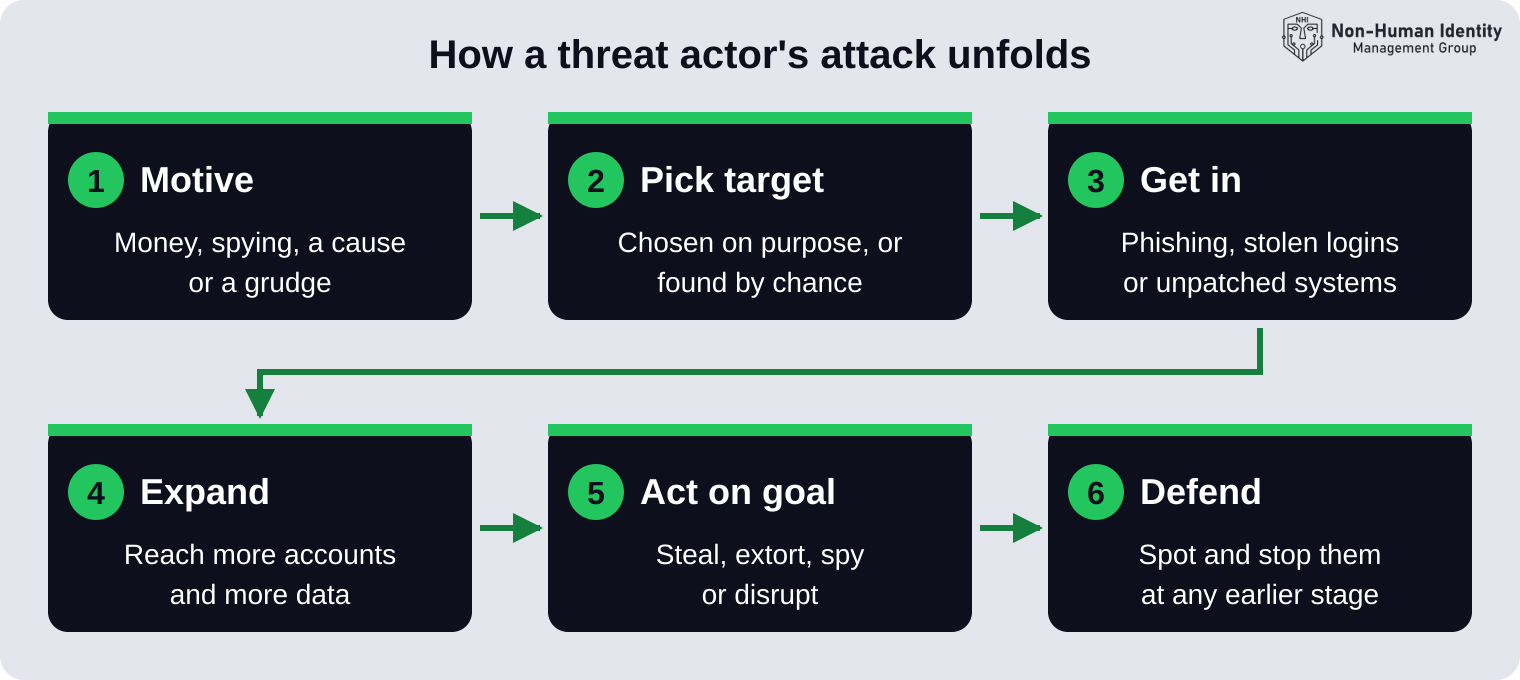
Every actor type is different, but most attacks follow a similar broad shape. This is a high-level view for defenders, not a description of any technique.
- Motive. The actor has a reason: money, intelligence, a cause or a grievance. The motive shapes everything that follows.
- Pick a target. A targeted attack is aimed at a specific organisation chosen for what it holds. An opportunistic attack hits whoever turns out to be vulnerable, for example anyone who clicks a mass phishing email.
- Get in. Common ways in are phishing, logging in with stolen or guessed passwords, tricking help desk staff, and exploiting systems that have not been updated.
- Expand. Once inside, the actor tries to reach more accounts, more systems and more valuable data.
- Act on the goal. Criminals may steal data and demand payment, or deploy ransomware. State-backed groups may quietly copy information for months. Hacktivists may publish what they took or knock a website offline.
- Defenders respond. Defenders can spot and stop the actor at any of the earlier stages. The earlier, the less damage.
Real groups, described by official sources
MITRE ATT&CK, a free public knowledge base of attacker behaviour, describes groups as activity clusters tracked by a common name in the security community, and notes that organisations may define groups differently.[3] Three examples show the main types:
- Cybercriminal: MITRE describes Scattered Spider (G1015) as a native English-speaking cybercriminal group active since at least 2022.[4] A joint FBI and CISA advisory says the group poses as IT staff to trick employees into sharing sign-in codes, and persuades help desk staff to reset passwords or multi-factor sign-in, then steals data for extortion and has deployed ransomware.[5]
- State-backed, spying: MITRE says APT28 (G0007) has been attributed to a unit of Russia's military intelligence service and has been active since at least 2004.[6]
- State-backed, with money as a goal too: MITRE describes Lazarus Group (G0032) as a North Korean state-sponsored group, active since at least 2009.[7] It shows that motives can mix.
Why one group has several names
Security companies each track activity and give it their own names. Microsoft, for example, names actors after weather: Typhoon for China-based nation-state actors, Blizzard for Russia, Sandstorm for Iran, Sleet for North Korea and Tempest for financially motivated actors. It uses "Storm" with a four-digit number as a temporary name for a cluster it does not yet understand well.[8] MITRE lists the names it links to each group as "Associated Groups", and says these are not exact matches.[3]
A worked example
Northfield Water Supplies is a fictional company with 120 staff that sells pumps and pipes to farms and local councils. Dan, its new IT and security lead, is asked by the board: "Who would actually attack us?"
Dan lists what the company holds that someone might want: customer payment details, staff records, designs for a pump control system sold to councils, and an online shop the business depends on. He then matches those to actor types:
- Cybercriminals: the most likely. They want money and would target the payment details, the staff records or the whole network with ransomware.
- Insiders: possible. A departing employee could take customer lists, or a careless one could leak data by mistake.
- Hacktivists: low but real, because the company supplies councils and could be caught up in a local dispute about water.
- State-backed groups: unlikely to target Northfield for its own sake, but the pump control designs used in public water systems make it worth noting.
Dan's plan focuses first on what defends against criminals and insiders, because those are both likely and damaging: multi-factor sign-in, tested offline backups, prompt updates and removing leavers' access on their last day. He notes the design files as a special case and restricts who can open them. He tells the board honestly that this plan reduces the risk of a damaging attack but does not remove it, and that he will review the list once a year or when the business changes.
Myths and misunderstandings
| What people think | What is true |
|---|---|
| Hackers are lone teenagers in hoodies. | Many attacks come from organised criminal groups or state-backed teams that work like businesses. |
| We are too small to be a target. | Opportunistic criminals attack whoever is vulnerable, regardless of size. |
| Only nation-states are sophisticated. | Some criminal groups are highly skilled; the Canadian Centre for Cyber Security notes that the APT label is sometimes used for very proficient organised crime groups too. |
| We need to know exactly who attacked us before we can respond. | Detecting, containing and recovering come first. Attribution can come later, if at all. |
| Insiders are always malicious. | Many insider incidents are mistakes, such as sending data to the wrong person. |
| Different group names mean different groups. | Each security company has its own naming scheme, so one group can carry several names. |
Key terms
- Threat actor
- Any person or group that intentionally attempts to compromise systems, data or trust relationships.
- Nation-state actor
- A threat actor backed by, directed by or acting for a government, usually after intelligence, influence, sabotage or long-term access.
- Advanced persistent threat (APT)
- A long-running intrusion by a skilled adversary that aims to stay hidden while stealing data or building access.
- Cybercrime
- Criminal activity that uses computers or networks as the target or the tool, to steal, disrupt, extort or damage.
- Hacktivist
- A person or group that uses cyber attacks to advance a political, social or ideological cause.
- Insider threat
- Risk created by a trusted person or account that misuses access, deliberately or by mistake.
- Targeted attack
- A deliberate attack aimed at a specific organisation, system or person, usually after studying the target first.
- TTPs
- Tactics, techniques and procedures: the goals, methods and specific ways an attacker operates.
- Attribution
- Establishing who is responsible for an action, such as which group carried out an attack.
- Initial access broker
- A criminal who gains footholds, such as stolen logins, and sells them on to other threat actors.
Common questions
What is the difference between a threat and a threat actor?
A threat is anything that could cause harm, including floods and power cuts. A threat actor is a person or group causing harm on purpose.
What is the most common type of threat actor?
For most organisations, financially motivated criminals are the type they meet most often, because they attack widely and opportunistically. Your sector can change the mix.
What does APT mean?
Advanced persistent threat: a skilled actor that targets a specific organisation over a long period and tries to stay hidden. The label is usually used for state-backed groups and very capable criminal groups.[2]
Can criminals and states work together?
Categories overlap. Some state-backed groups also pursue money, and criminal groups can buy access from one another, for example from initial access brokers.
Should a small business try to work out who attacked it?
We suggest focusing on containing the incident and recovering, and reporting it to the national authority in your country. Leave attribution to specialists and law enforcement.
Where can I read reliable profiles of groups?
Government advisories from bodies such as CISA and the NCSC, and MITRE ATT&CK's group pages, are good starting points. The Threat Actor Landscape Guide goes deeper.
First steps
Three things you can do this week:
- List what an attacker would want. Write down your most valuable data and the systems the business cannot run without.
- Match each item to likely actor types. Use the table above to decide which types matter most for you, and rank them.
- Check the basics that work against all of them: multi-factor sign-in on email and remote access, tested backups kept separately, prompt updates for internet-facing systems, and removing leavers' access on time.
Checklist
- We know which data and systems an attacker would most want.
- We have named the two or three actor types most relevant to us.
- Our defences cover the common ways in: phishing, stolen logins and unpatched systems.
- Help desk staff verify identity before resetting passwords or multi-factor sign-in.
- We have a way to spot unusual access by staff and contractors.
- Someone reads government security advisories relevant to our sector.
- Our incident plan says who to call and how to report an attack.
- We review our list of likely actors at least once a year.
Check your understanding
1. What usually drives a cybercriminal, and what drives a hacktivist?
Answer: a cybercriminal is usually driven by money; a hacktivist is driven by a political, social or ideological cause.
2. What is the difference between a targeted and an opportunistic attack?
Answer: a targeted attack is aimed at a chosen organisation; an opportunistic attack hits whoever happens to be vulnerable.
3. Why might one group appear under several different names?
Answer: because each security company tracks activity and names groups in its own way.
4. After an attack, what should a small organisation do before worrying about who did it?
Answer: detect and contain the attack, recover systems and data, and report it. Attribution can wait.
Suggested learning pathway
- Next, learn how information about attackers becomes decisions: Threat Intelligence for Beginners.
- For the most common way in: Social Engineering for Beginners.
- For the tools many actors use: Malware for Beginners.
- For the criminal business model: Ransomware for Beginners.
- For what to do when an attack happens: Incident Response for Beginners.
- For the full practitioner picture, see the Threat Actor Landscape Guide.
- To compare the three main types in depth: APT vs Cybercrime vs Hacktivists.
- For the people already inside: Insider Threat Programme Guide.
Standards and references
- Glossary: threat actor (from NIST SP 800-150). NIST Computer Security Resource Center, National Institute of Standards and Technology. https://csrc.nist.gov/glossary/term/threat_actor, accessed 27 Nov 2026.
- An introduction to the cyber threat environment. Canadian Centre for Cyber Security, 28 October 2022. https://www.cyber.gc.ca/en/guidance/introduction-cyber-threat-environment, accessed 27 Nov 2026.
- Groups. MITRE ATT&CK, MITRE. https://attack.mitre.org/groups/, accessed 27 Nov 2026.
- Scattered Spider (G1015). MITRE ATT&CK, MITRE. https://attack.mitre.org/groups/G1015/, accessed 27 Nov 2026.
- Scattered Spider, Cybersecurity Advisory AA23-320A. CISA and FBI, 16 November 2023, updated 21 November 2023. https://www.cisa.gov/news-events/cybersecurity-advisories/aa23-320a, accessed 27 Nov 2026.
- APT28 (G0007). MITRE ATT&CK, MITRE. https://attack.mitre.org/groups/G0007/, accessed 27 Nov 2026.
- Lazarus Group (G0032). MITRE ATT&CK, MITRE. https://attack.mitre.org/groups/G0032/, accessed 27 Nov 2026.
- How Microsoft names threat actors. Microsoft Learn, Microsoft, last updated 18 Aug 2026. https://learn.microsoft.com/en-us/unified-secops/microsoft-threat-actor-naming, accessed 27 Nov 2026.
Related NHI Mgmt Group resources: Hacktivism Guide · Threat Actors Targeting SaaS and Cloud Identity Guide · Insider Risk vs Insider Threat