A data broker is a company that collects details about people and sells or shares them with others.
This guide is for anyone who has found their address or phone number on a website they never signed up to. It also helps small firms that buy mailing lists to understand where that data comes from.
In short
- Data brokers gather details from public records, public social media and other companies, then build a profile under your name.
- People search sites are one kind of data broker. Anyone who pays can look you up.
- Most sites let you opt out for free, one site at a time, but details can come back later.
- Your rights depend on where you live. Californians can send one deletion request to many brokers at once.
What you will learn
- Explain what a data broker does with your details.
- Spot a people search listing about you.
- Check which opt-out and deletion routes you can use.
- Ask a company to delete your data.
Status: correct as at 28 November 2026, based on the California Privacy Protection Agency's data broker pages and the UK Information Commissioner's Office guidance. Laws change; check the official text.
This guide explains the topic in general terms and is not legal advice.
- Details about you (personal data)
- any information that can point to you, such as your name, address or phone number.
- Asking to be left out (opt-out)
- telling a company to stop selling or sharing your details.
What is a data broker?
Think of someone who goes through every recycling bin on your street. They keep the scraps that mention you, file them in a folder with your name, and sell copies of the folder. A data broker does this with information online.
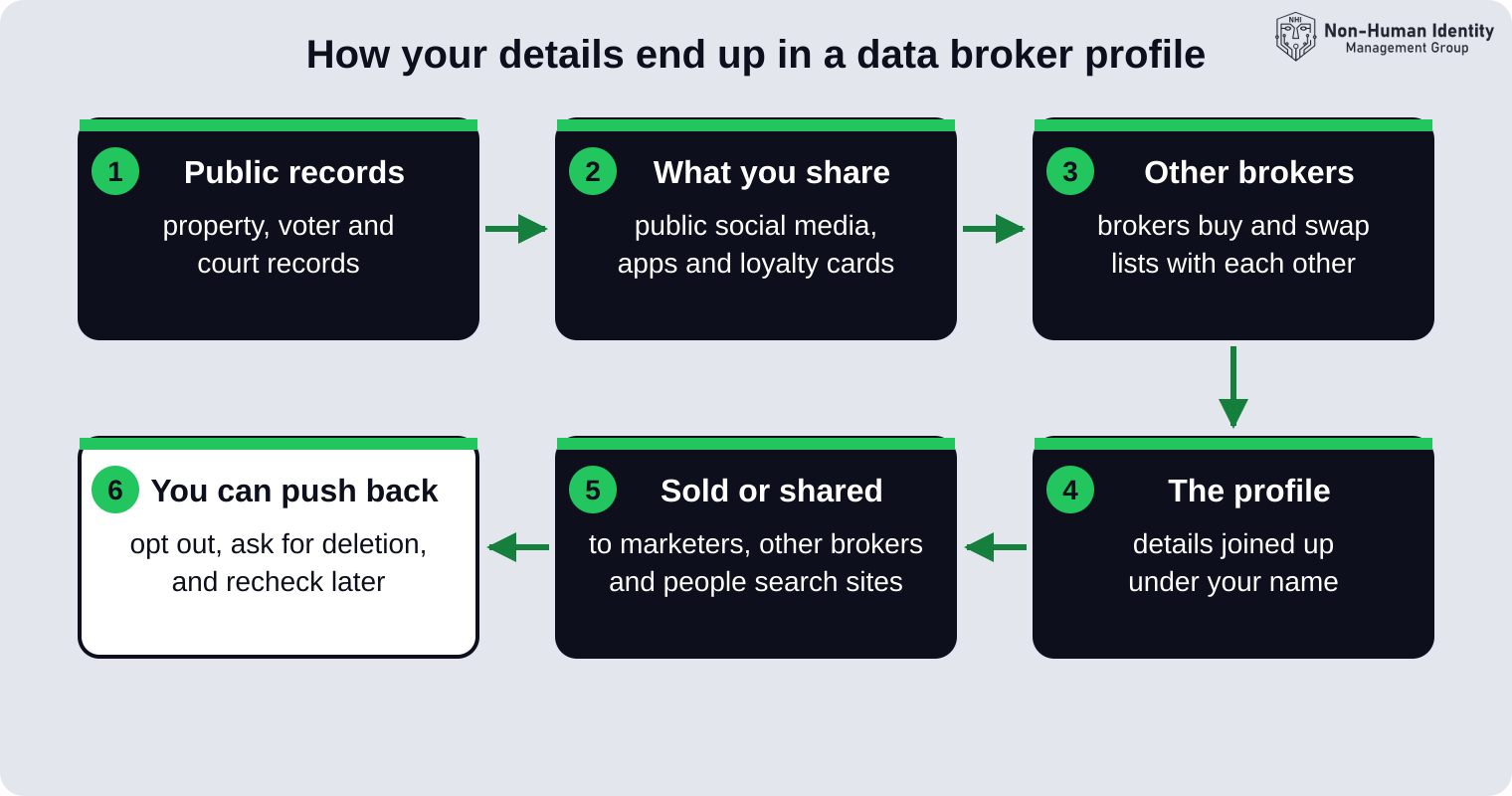
The scraps come from many places. They include public records such as property and voter lists, public social media profiles, and lists bought from other companies.[1] The broker joins them up into one profile.
The buyers vary. They can be marketers, other brokers, or people search websites that sell short reports about named people.[1] Most of the time, you have never dealt with the broker directly.[2]
Where the comparison stops working: you can see someone at your bins. A data broker works out of sight, and the same folder can be copied and sold many times.
Why does it matter?
A joined-up profile can make you easier to find, contact and pretend to be. Many people do not know these profiles exist.
If you want to keep your address private
What could happen: a stranger pays a few pounds or dollars for a report that shows where you live.
Check this: search your own name on the main people search sites in your country.
If you get a lot of scam calls or texts
What could happen: your number and age appear on lists that are sold on, so more strangers contact you.
Check this: ask companies you deal with to stop using your data for marketing.
If you run a small business that buys contact lists
What could happen: you send marketing to people who never agreed to it, and break privacy rules.
Check this: ask the seller where the data came from and what people agreed to.
What does it look like?
Example only. All values are made up.
FakePeopleFinder.example.com - Report preview
Name:      Alex EXAMPLE, age 40s             (1)
Lives at:  00 Example Road, Faketown         (2)
Phone:     0000 000 000                      (3)
Relatives: Sam EXAMPLE, Jo EXAMPLE           (4)
Unlock full report: $0.00                    (5)
- Your name and rough age, often from public records.
- A home address. On a site like this, it could be a current or past address.
- A phone number, sometimes bought from other lists.
- Names of family members, which links you to them.
- A small fee for the full report, open to anyone who pays.
Why this is risky: one page brings together where you live, how to reach you and who you are related to. That makes it easier for a stranger to find you or to sound convincing in a scam.
The safer way: use the site's opt-out page to ask for the listing to be removed. Then check the other big sites too.
How does it work?
- Collecting. Brokers pull details from public records, public social media and other brokers.[1]
- Joining up. They match the scraps to one person and build a profile.
- Selling or sharing. They sell the profile, or parts of it, to other companies.[2]
- Showing up. People search sites turn profiles into reports that anyone can buy.[1]
- Pushing back. You can opt out site by site, use your privacy rights, or pay a service to do it for you.[1]
What you can do depends on where you live. In the UK, you can ask a company to delete your data. It applies in set cases, such as when you object to direct marketing, and the company usually has one month to reply.[4]
In California, a state tool called DROP lets residents send one deletion request to all active data brokers. Brokers had to start acting on these requests from 1 August 2026.[2] The state also keeps a public list of registered brokers.[3]
A worked example
This story is made up to show how it can happen.
Teodor Okonkwo is a teacher in Sacramento, California. He moved house last spring and told only family and close friends.
One evening a parent he does not know sends him a message. It mentions his new street by name. Teodor is unsettled and wants to know how the parent found it.
He searches his own name. On the first page of results is a people search site with his new address, his phone number and his sister's name. A full report costs a few dollars.
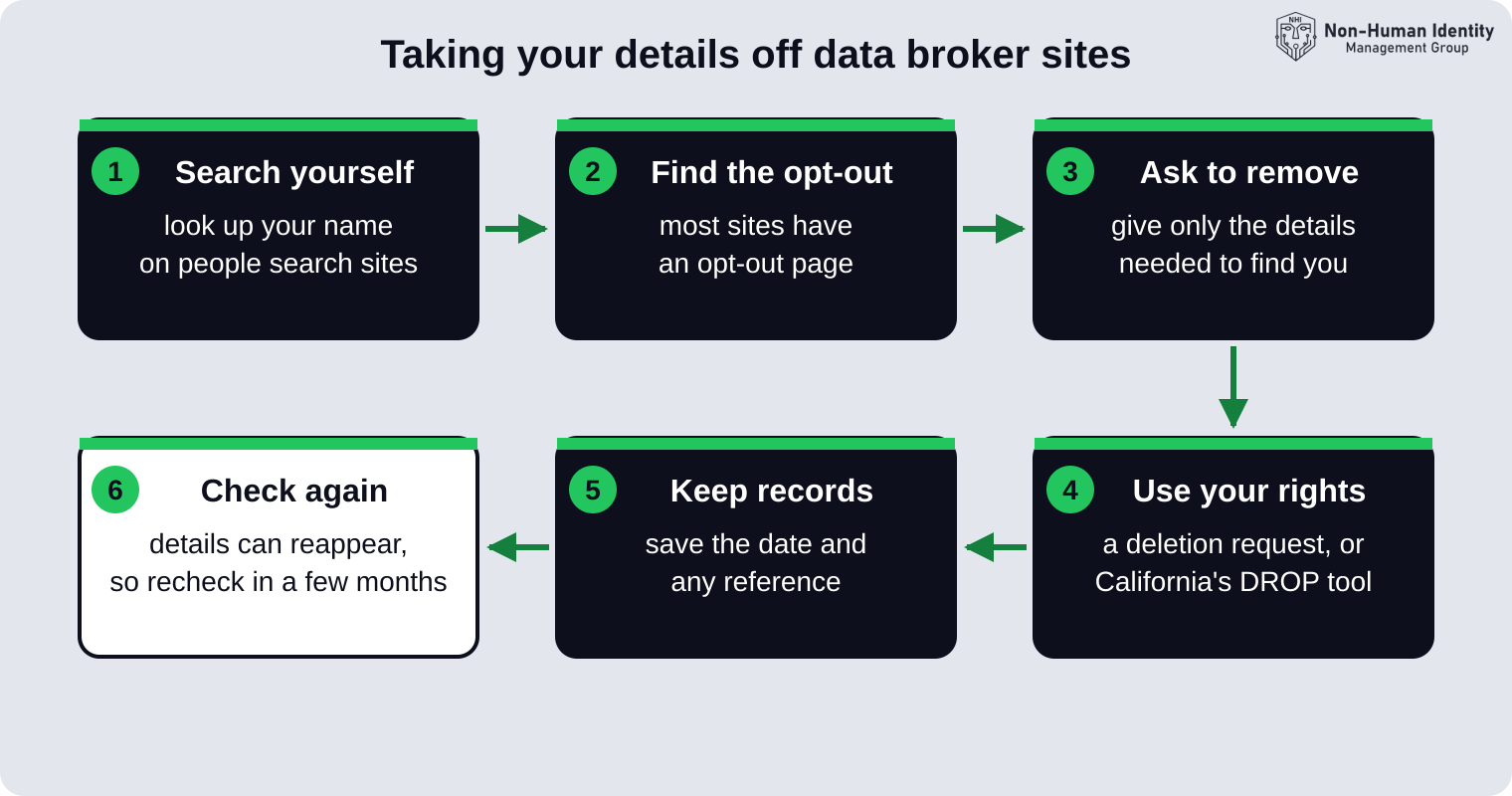
Teodor finds the site's opt-out page. He fills it in with only the details it needs to find his listing, and saves the confirmation. He checks three other big people search sites and finds himself on two of them. He opts out of those too.
Next, he goes to the state's DROP website. As a California resident, he sends one deletion request that goes to all the active brokers at once.[2] He notes the date in his calendar.
A month later his listings have gone from the sites he contacted. He sets a reminder to search his name again in three months, because public records can put details back on sale.[1]
What made the difference: Teodor searched for himself, used both the site opt-outs and the state tool, and planned to check again.
Myths and mistakes
| What people think | What is true |
|---|---|
| Data brokers only have what I gave them. | Most never dealt with you. They collect from public records, social media and other companies.[1] |
| Once I opt out, my details are gone for good. | Opting out stops that site selling your current details. New public records can put you back on sale.[1] |
| Opting out deletes my public records. | It does not. Records such as property or court records stay with the government body that holds them.[1] |
| I have to pay someone to remove my details. | You can do it yourself for free, site by site. Paid services can save time, so check which sites they cover.[1] |
| A deletion request must be on a special form. | In the UK you can ask verbally or in writing. Writing is better, because it gives you a record.[4] |
What can I do this week?
- Search your full name and town, and note every people search site that lists you.
- Use each site's opt-out page, giving only the details needed to find your listing.
- If you live in California, send one request through the state's DROP website.
- Make your social media profiles private, or remove your address, birthday and phone number from them.
- Set a reminder to search your name again in three months.
Checklist
- I have searched my own name on the main people search sites.
- I have opted out of every listing I found.
- I have kept the date and confirmation of each request.
- My public social media does not show my address, birthday or phone number.
- I have asked firms I deal with to stop using my data for marketing, where I want that.
- I know which privacy rights apply where I live.
- I have a reminder to check again in a few months.
Common questions
Are data brokers legal?
Generally, yes. In many places, selling personal data is allowed within privacy rules. Some places add more rules. California, for example, requires data brokers to register each year and to act on deletion requests sent through its DROP tool.[2][3]
Can I use DROP if I do not live in California?
No. DROP is for California residents. Elsewhere, use each site's opt-out page and the privacy rights where you live. In the UK, you can ask a company to delete your data in set cases, and it usually has one month to reply.[2][4]
Are paid data removal services worth it?
They can save time, but you can do the same steps yourself for free. Before you pay, check how many sites a service covers. Ask if it tells you which sites it contacted, and how often it checks again.[1]
What if a UK company ignores my deletion request?
Complain to the company first, in writing. If you are still unhappy, you can complain to the Information Commissioner's Office. It is the UK's data protection watchdog. You can also go to court, ideally after getting your own legal advice.[4]
Where next?
Ready for the detail? Read the practitioner guide: California Delete Act and Data Broker Registration Guide. It goes further into who counts as a data broker, what registered brokers must do, and the deadlines and penalties.
Also useful:
- Digital Footprint for Beginners
- Data Privacy for Beginners
- US Privacy Laws for Beginners
- UK GDPR for Beginners
- Subject Access Requests for Beginners
Related NHI Mgmt Group resources: CCPA and CPRA · Identity Theft Recovery Guide · Executive Protection and Digital Footprint Guide
Key terms
- Data broker
- A company that collects personal data about people from many sources and sells or shares it.
- Personal data
- Information that can identify a person, such as a name, address, account number or location.
- People search site
- A website, and a kind of data broker, that sells reports about named people.
- Right to erasure
- A legal right, in some places, to ask an organisation to delete your personal data in set cases.
- Delete Request and Opt-out Platform (DROP)
- California's state tool that sends one deletion request from a resident to data brokers.
- California Delete Act
- A California law that created one central way for residents to ask data brokers to delete their data.
Sources and further reading
- What To Know About People Search Sites That Sell Your Information. Federal Trade Commission (FTC), Consumer Advice. https://consumer.ftc.gov/articles/what-know-about-people-search-sites-sell-your-information, accessed 28 Nov 2026.
- DROP for data brokers. California Privacy Protection Agency (CalPrivacy). https://privacy.ca.gov/data-brokers/, accessed 28 Nov 2026.
- Data Broker Registry. California Privacy Protection Agency (CalPrivacy). https://cppa.ca.gov/data_broker_registry/, accessed 28 Nov 2026.
- Your right to get your data deleted. Information Commissioner's Office (ICO). https://ico.org.uk/for-the-public/your-right-to-get-your-data-deleted/, accessed 28 Nov 2026.