Identity theft is when someone steals your personal details and uses them to pretend to be you.
This guide is for anyone who thinks someone may be using their name, or who wants to know what to do if it happens.
In short
- A thief uses your name, address and date of birth to open accounts, borrow money or buy things.
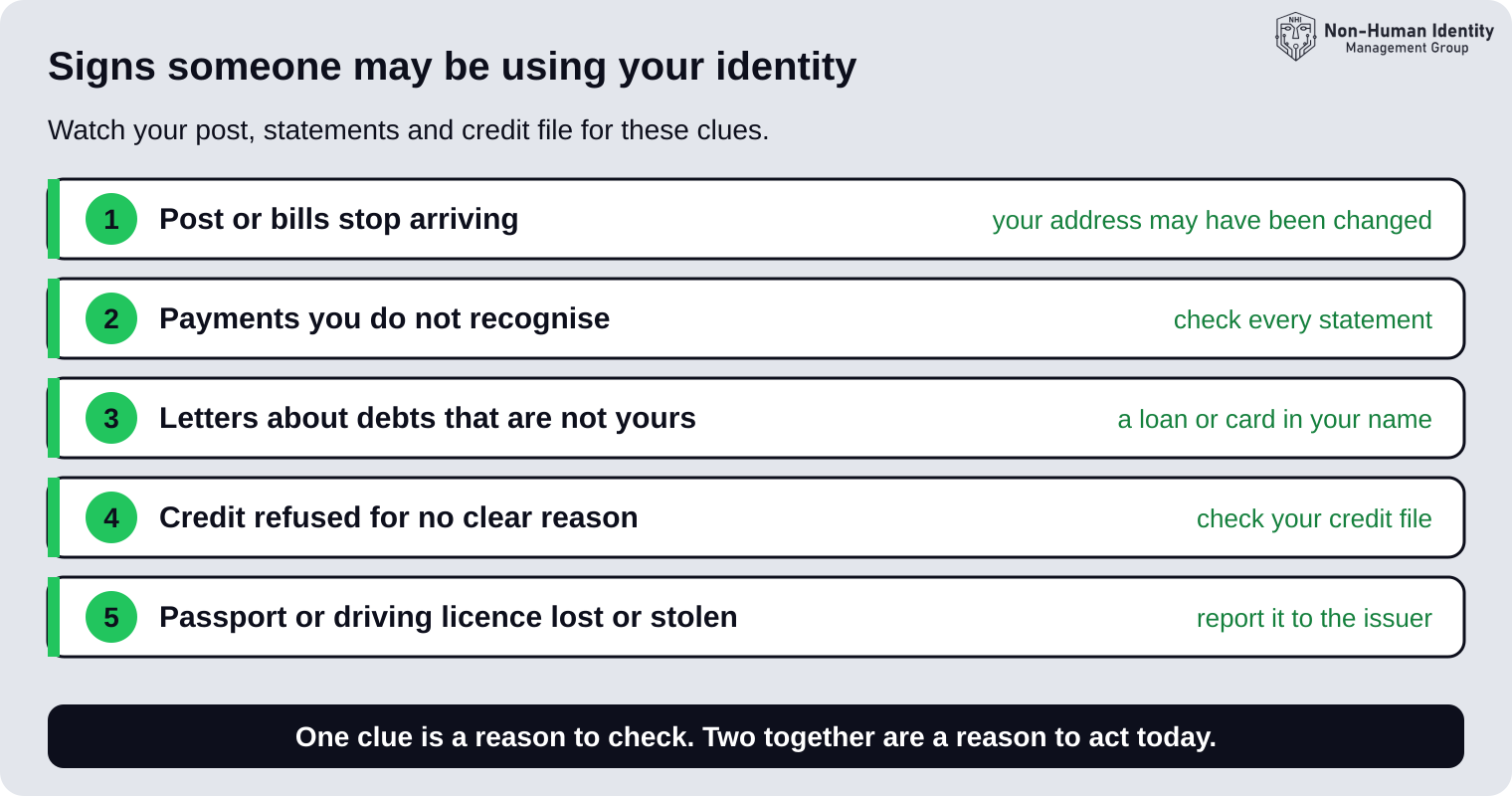
- Common clues are post that stops arriving, payments you did not make and letters about debts that are not yours.
- Act fast: call your bank, change key passwords and report it to get a reference number.
- Then protect your credit file so new credit is harder to open in your name.
What you will learn
- Explain what identity theft is in one sentence.
- Spot the signs that someone is using your details.
- Check your statements and credit file for clues.
- Ask the right people for help, in the right order.
- Your money record (credit file)
- a record of your loans, cards and bills that lenders check before they say yes.
- Extra checks flag (fraud alert)
- a note on your record that asks lenders to take more care before opening anything in your name.
What is identity theft?
Think of someone who copies your signature and then signs things in your name. Each form looks like yours, so shops and banks may believe it. Identity theft works the same way with your personal details.
The thief collects facts about you. These can be your name, address, date of birth or bank details. Some thieves also use a stolen passport or driving licence.
Then they use those facts to act as you. They might open a credit card, take out a loan or order a phone contract. The bills come to you, or to an address they chose.
The theft and the use are two steps. Taking your details is identity theft. Using them to trick a bank or shop is often called identity fraud. You can see the word used both ways.
Where the comparison stops working: a forged signature leaves a paper trail you can see. A stolen identity can be used for months before a letter or a refused loan shows you anything is wrong.
Why does it matter?
It happens a lot. In 2024 the US Federal Trade Commission received more than 1.1 million identity theft reports through its reporting website.[6]
The harm is not just money. It can take time to clear your name and fix your credit file.
If you have just moved home
What could happen: post left at your old address is read, and the details are used to open a card in your name.
Check this: ask Royal Mail or your postal service to redirect your post, and update your address with your bank.
If your details were in a data leak
What could happen: your name, email and date of birth are sold, and a thief uses them to try to pass bank checks.
Check this: change the password on the leaked account and turn on extra sign-in checks.
If you help an older relative
What could happen: a scam caller gets their details, and loans appear in their name that they do not know about.
Check this: offer to look at their statements and credit file with them once in a while.
What does it look like?
Example only. All values are made up.
FakeLend Ltd                           (1)
Dear Ms EXAMPLE,
Welcome! Your new loan of 0000.00 is ready.
Account ref: FAKE-0000-0000            (2)
First payment due: 01/01/2000
Delivery address: 1 Example Street,    (3)
  Nowhere, EX0 0XX
- A letter from a lender you have never used.
- A reference number for an account you did not open.
- An address you do not know. The thief chose it so the cards and post go to them.
Why this is risky: it is easy to bin this as junk mail. But a welcome letter for a loan you never asked for can mean someone has used your name.
The safer way: do not call the number on the letter. Find the lender's number on its own website, call it and say the account is not yours. Then follow the steps below.
How does it work?
This is a simple view so you can spot it and respond. It is not a guide to doing it.
- They collect your details. Thieves get them from stolen post, lost documents, data leaks or scam messages that ask you to "confirm" your details.
- They act as you. They apply for credit, a phone contract or goods in your name. Some change the address on your bank account, so you stop seeing letters that would warn you.
- The clues appear. Bills stop coming, odd payments show up on your statement, or a lender writes to you about a debt you do not know.[1][2]
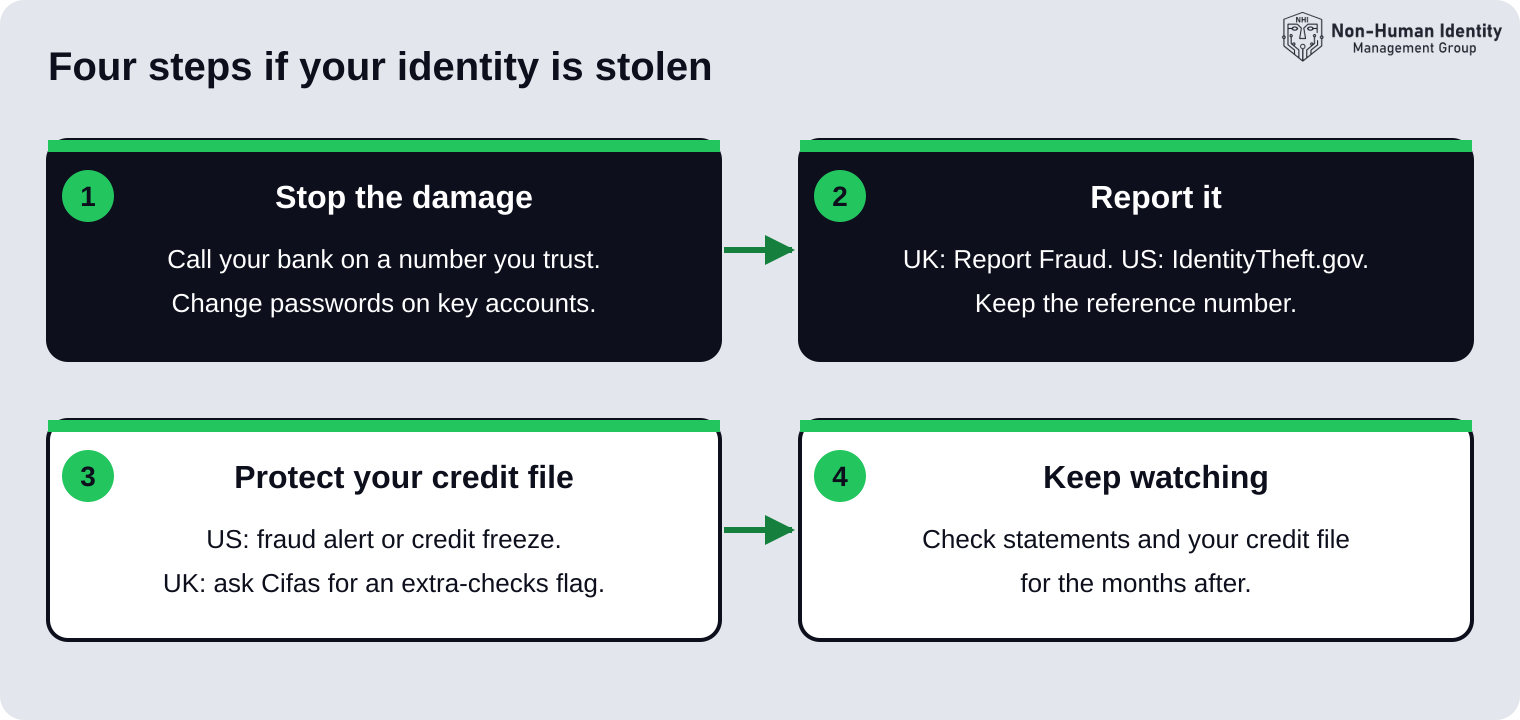
- You stop the damage. Call your bank or card company on a number you trust. Change the passwords on your email and bank, and turn on extra sign-in checks for both.
- You report it. In the US, report it at IdentityTheft.gov, which gives you a recovery plan.[3] In England, Wales and Northern Ireland, report it to Report Fraud. In Scotland, contact Police Scotland.[5] Ask for a crime reference number.[1]
- You protect your credit file. In the US you can place a free fraud alert or a free credit freeze.[2] In the UK you can pay the fraud prevention service Cifas for a flag that asks its member firms to make extra checks.[4]
A worked example
This story is made up to show how it can happen.
Niamh O'Connor is a teaching assistant in Bristol. One week she notices her phone bill has not arrived. She thinks it is late and forgets about it.
Ten days later a letter comes from a loan company she has never heard of. It welcomes her as a new customer. The loan is for a large sum. Niamh did not apply for it.
Her first thought is to ring the number on the letter. Then she stops. She finds the lender's number on its own website and calls that instead. The lender confirms a loan was taken out in her name, with a new address in another city. They mark it as possible fraud.
Next she calls her bank using the number on her card. The bank checks her account. Someone had tried to change her address online the week before. The bank blocks the change and sets up a new password for her online banking.
That evening, Niamh reports it to Report Fraud and writes down her crime reference number. She changes her email password and turns on extra sign-in checks.
The next day she checks her credit file. She finds a credit card application she did not make, and asks the card company to remove it. She also signs up for Cifas protective registration, so lenders should make extra checks before saying yes to anyone using her details.
What made the difference: Niamh treated a missing bill and a strange letter as one warning. She also used phone numbers she found herself, not the ones in the letter.
Myths and mistakes
| What people think | What is true |
|---|---|
| It only happens to people with lots of money. | Thieves want a clean name to borrow against. Anyone with a name, address and date of birth can be a target. |
| A letter about a debt I do not have must be a mistake. | It might be. But official advice lists debt letters that are not yours as a warning sign, so check it.[1] |
| I should call the number on the suspicious letter. | Find the company's number yourself, on its website or a card. A fake letter can carry a fake number. |
| A credit freeze or Cifas flag protects my bank account. | They help stop new credit in your name. They do not cover payments on accounts you already have, so keep checking statements.[4] |
| Once I report it, the problem is fixed. | Reporting gives you a reference number. You still need to contact each company and watch your credit file for the months after. |
What can I do this week?
- Check your bank and card statements line by line for payments you do not recognise.
- Get a copy of your credit file and look for accounts or searches you did not make.
- Shred old letters and bank papers before you throw them away.
- Turn on extra sign-in checks on your email, because it is the key to resetting other accounts.
- Write down your bank's fraud number and keep it somewhere you can find it.
Checklist
- I check my statements at least once a month.
- I have looked at my credit file in the last year.
- My email uses a strong password and an extra sign-in check.
- I shred papers with my name, address or account numbers on them.
- I know where to report identity theft where I live.
- I call companies on numbers I find myself, not numbers in messages.
- I keep my passport and driving licence somewhere safe, and report them quickly if lost.
Common questions
What should I do first if I think my identity was stolen?
Call your bank or card company first, on a number you trust, and tell them. That limits money loss. Then change your email and bank passwords, report it to get a reference number, and check your credit file for accounts you did not open.
Where do I report identity theft?
In the US, report it to the Federal Trade Commission at IdentityTheft.gov. In England, Wales and Northern Ireland, use Report Fraud. In Scotland, contact Police Scotland. Tell your bank and any company where an account was opened in your name.[3][5]
Will identity theft hurt my credit score?
It can, if unpaid debts in your name are added to your file. Tell each lender the account is not yours and give your reference number. Then check your credit file again to make sure the false entries have been removed.
What is the difference between a fraud alert and a credit freeze?
A fraud alert asks businesses to check with you before opening a new account. A credit freeze locks your file, so new credit should not be opened until you lift it. In the US both are free.[2]
Do I need to pay for an identity theft protection service?
Not always. Many steps are free, such as checking statements, reporting and, in the US, fraud alerts and freezes. Paid services can add monitoring and help. Read what is included before you buy, and compare it with what you can do yourself.
Where next?
Ready for the detail? Read the practitioner guide: Identity Theft Recovery Guide. It goes further into a day-by-day recovery plan, protecting your credit file over the months after, and helping someone else recover.
Also useful:
- Credit Freezes and Fraud Alerts Guide
- Identity Fraud for Beginners
- Phishing for Beginners
- Account Takeover for Beginners
Related NHI Mgmt Group resources: Identity Theft Protection Services · Medical Identity Theft Guide · Tax Identity Theft and Tax Scams Guide
Key terms
- Identity theft
- Stealing someone's personal details so they can be used to pretend to be that person.
- Identity fraud
- Using stolen or made-up identity details to trick an organisation into giving money, goods or an account.
- Credit file
- A record of your loans, cards and bills that lenders check before they agree to lend.
- Fraud alert
- A note on your credit file asking businesses to check with you before opening new credit.
- Credit freeze
- A lock on your credit file that stops new credit being opened until you lift it.
- Data breach
- When personal data held by an organisation is seen or taken by someone who should not have it.
Sources and further reading
- Identity theft. Information Commissioner's Office (ICO). https://ico.org.uk/for-the-public/identity-theft/, accessed 28 Nov 2026.
- What To Know About Identity Theft. Federal Trade Commission (FTC), Consumer Advice. https://consumer.ftc.gov/articles/what-know-about-identity-theft, accessed 28 Nov 2026.
- IdentityTheft.gov: report identity theft and get a recovery plan. Federal Trade Commission (FTC). https://www.identitytheft.gov/, accessed 28 Nov 2026.
- Protective Registration. Cifas. https://www.cifas.org.uk/pr, accessed 28 Nov 2026.
- Report Fraud service goes live. Report Fraud (City of London Police), 4 December 2025. https://www.reportfraud.police.uk/news/report-fraud-service-goes-live/, accessed 27 Nov 2026.
- New FTC Data Show a Big Jump in Reported Losses to Fraud to $12.5 Billion in 2024. Federal Trade Commission (FTC), press release, March 2025. https://www.ftc.gov/news-events/news/press-releases/2025/03/new-ftc-data-show-big-jump-reported-losses-fraud-125-billion-2024, accessed 28 Nov 2026.