Smart device security laws set basic safety rules for connected gadgets, such as cameras, speakers and doorbells.
This guide is for shoppers, students and small firms that make or sell connected products. You do not need to read the law to benefit: knowing what the rules ask for tells you what to look for before you buy.
In short
- In the UK, most consumer smart products must not share one factory password, and makers must say how long they will send security updates.
- In the EU, a wider law covers connected products, with its main duties applying from 11 December 2027.
- In the US, the Cyber Trust Mark is a voluntary label, and labelled products were not yet in shops in late 2026.
- Before you buy, check the update period, the password set-up and how to report a problem.
What you will learn
- Explain what the UK, EU and US rules ask of smart device makers.
- Spot the security information on a product page or box.
- Check how long a device will get security updates.
- Ask a seller the right questions before you buy.
Status: correct as at 28 November 2026, based on GOV.UK, the European Commission and the US Federal Communications Commission. Laws change; check the official text.
This guide explains the topic in general terms and is not legal advice.
- Update promise (support period)
- how long the maker says it will send security fixes for a device.
- Factory password (default password)
- the password a device comes with before you set your own.
- Security label (Cyber Trust Mark)
- a US mark meant to show a product meets a set of security checks.
What are smart device security laws?
Think of the energy rating sticker on a new fridge. It does not tell you everything, but it lets you compare products at a glance before you buy.
Smart device security rules do something similar for connected gadgets. A smart device is anything that connects to Wi-Fi, the internet or an app, from a doorbell to a smart TV. These products are often called the Internet of Things, or IoT.
The rules ask makers for a few basics. Do not ship every device with the same password. Tell buyers how long security fixes will last. Give people a way to report a security problem.
Where the comparison stops working: a fridge's energy use stays about the same for years. A smart device's safety can change after you buy it, as new weak spots are found. That is why the update promise matters so much.
Why does it matter?
A connected device that never gets fixes, or that shares one password with thousands of others, can be easy for strangers to take over. The rules aim to make those problems rarer and easier to spot before you pay.
If you are buying a smart device
What could happen: you buy a cheap camera that stops getting fixes a year later.
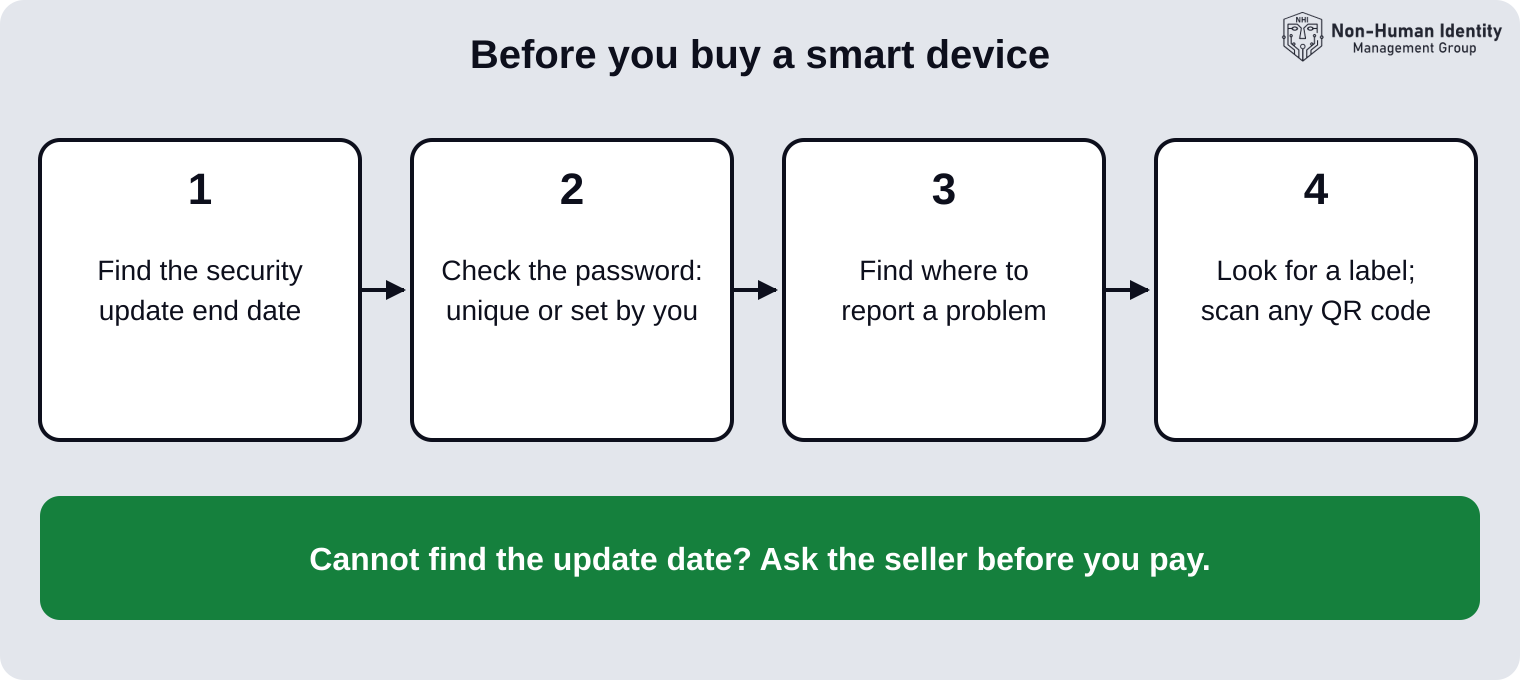
Check this: look for the stated update period before you buy, and compare it with how long you plan to use the device.
If you make or sell connected products
What could happen: your product cannot be sold in the UK or EU because it misses a basic rule.
Check this: list which markets you sell in and which rules apply to each product.
If you are a student or new to security work
What could happen: you mix up a voluntary label with a legal duty, and give the wrong advice.
Check this: for each rule, note whether it is required by law or chosen by the maker.
What does it look like?
Here is a made-up product card for a smart doorbell. It shows the kind of security details the rules point to.
Example only. All values are made up.
EXAMPLE Doorbell Pro (model FAKE-0000)
Price ...................... 00.00
Security updates until ..... 31 December 2099      (1)
Password ................... set by you at first use  (2)
Report a security issue .... example.com/security   (3)
Label ...................... [mark] [QR code]       (4)
- In a real screen, this line would show the end date for security updates. UK makers must publish this.
- In a real screen, this line would explain how the password works. A single shared factory password is not allowed for most UK consumer products.
- In a real screen, this line would show where to report a security problem.
- In the US, the FCC has proposed that the Cyber Trust Mark label include a QR code linking to more security details.[5]
Why this is risky: two doorbells can look the same and cost the same. One may get fixes for five years, and the other for one.
The safer way: treat the update end date like a best-before date. Check it before you buy, and plan to replace or retire the device when fixes stop.
How does it work?
Each region has taken its own route. Here is a plain summary.
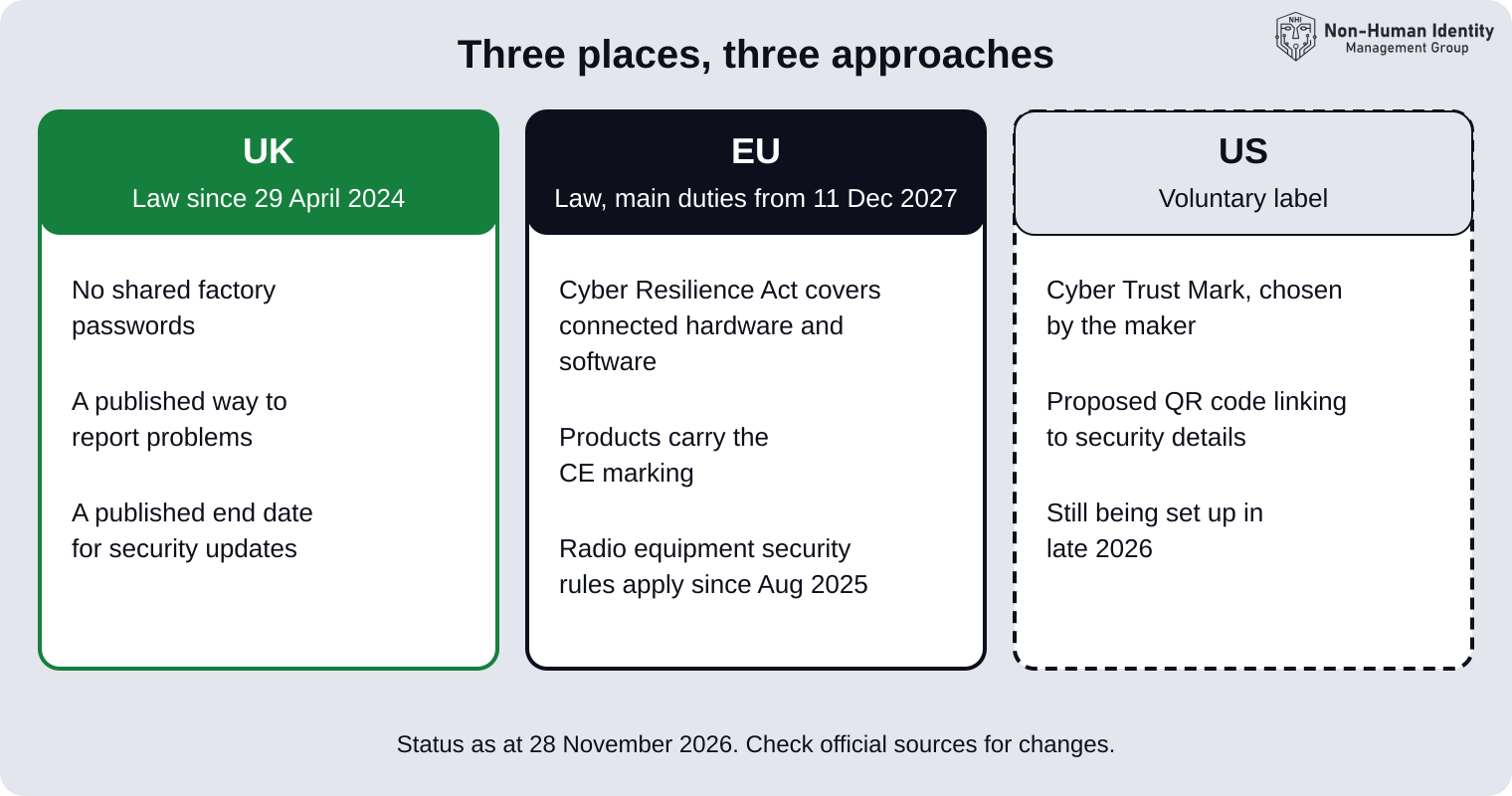
- UK: the PSTI rules. Since 29 April 2024, makers, importers and sellers of most consumer smart products in the UK have had to meet three basic rules. Passwords must be unique per device or set by the user. Makers must publish how to report security issues. They must also publish how long security updates will last, with an end date.[1] The Office for Product Safety and Standards enforces the rules.[1]
- EU: radio equipment rules. Since August 2025, extra security rules have applied to certain wireless products sold in the EU. They cover security, personal data and privacy.[3]
- EU: the Cyber Resilience Act. This wider law entered into force on 10 December 2024. Makers must report actively exploited weak spots from 11 September 2026. The main duties apply from 11 December 2027, and covered products will carry the CE marking to show they comply.[2] On that date, the security part of the radio rules moves across to this law.[3]
- US: the Cyber Trust Mark. This is a voluntary label for consumer wireless smart products, run by the Federal Communications Commission (FCC).[4] In October 2026 the FCC asked for comments on how the label would look and work. Reports said labelled products were not yet in shops.[5][6]
A worked example
Jana Jensen lives in Bristol and wants a video doorbell. She finds two that look almost the same online. One is a little cheaper.
She remembers the fridge sticker idea and looks for the security details. On the first product page, she finds a line saying security updates will last until a date five years away. It also says she will set her own password when she installs it.
The cheaper doorbell is sold through a marketplace by an overseas seller. She cannot find any update date or any way to report a security problem. She messages the seller to ask. The reply says "lifetime support" but gives no date.
Jana knows UK rules expect the maker to publish a clear end date. A vague promise does not tell her much. She decides the small saving is not worth the doubt, and buys the first doorbell.
She also checks the old wireless camera in her garden. The maker's website says its updates ended last year. She moves it off her home Wi-Fi and adds a new camera to her shopping list.
When it arrives, she sets a long, unique password and turns on the app's second sign-in step. She writes the update end date on a sticky note in her filing box, so she remembers to check again before it runs out.
Myths and mistakes
| What people think | What is true |
|---|---|
| A label means the device can never be hacked. | Labels and laws set a minimum. They lower the risk, and you still need to update the device and use a good password. |
| Every smart product in the UK is covered. | Some types of product are left out of the UK rules, so check before you rely on them.[1] |
| The US Cyber Trust Mark is the law. | It is a voluntary label. Makers choose whether to use it.[4] |
| The EU law already applies in full. | Its main duties apply from 11 December 2027. Reporting duties apply earlier, from 11 September 2026.[2] |
| "Lifetime support" is a clear promise. | Ask for a date. UK makers are expected to publish an end date or length of time in clear terms.[1] |
What can I do this week?
- Look up the security update end date for each smart device you already own.
- Change any device that still uses a password printed on a sticker or in the manual.
- Before your next purchase, find the update date and how to report problems.
- If you make or sell devices, check which UK, EU or US rules apply to each product.
Checklist
- I know the security update end date for each smart device I use.
- No device uses a shared factory password.
- I can find where to report a security problem for each device.
- Devices past their update date are replaced or taken off the network.
- I check for labels and scan any QR code before buying, where one is offered.
- Makers and sellers: each product has a published update period, password approach and reporting contact.
Common questions
What is the PSTI Act?
It is the UK law behind the smart product security rules. Since 29 April 2024, most consumer smart products in the UK must avoid shared factory passwords. Makers must also explain how to report problems and how long updates will last. See the UK PSTI Act Product Security Guide.
Can I buy products with the Cyber Trust Mark yet?
Not as of late 2026, based on news reports. The FCC was still consulting on how the label should look and work, and the testing rules were not yet final. An FCC commissioner said in October 2026 she hoped labelled products would reach shoppers within a year.[6]
Does the CE mark mean a product is secure?
Not yet, in most cases. From 11 December 2027, products covered by the EU Cyber Resilience Act will carry the CE marking to show they meet its security rules.[2] Before then, a CE marking shows the product meets the EU rules that already apply to it, which may include the radio equipment security rules.
What should I do when updates stop?
Plan to replace the device, or move it off your main network if you keep using it. Without fixes, new weak spots stay open. Devices that face the internet, such as routers and cameras, are the most important to replace on time.
Do these rules apply to second-hand devices?
Mostly they apply to makers, importers and sellers when products are supplied, not to the device later. Check the original maker's update end date for a used device. A cheap second-hand camera may already be past it.
Where next?
Ready for the detail? Read the practitioner guide: UK PSTI Act Product Security Guide. It goes further into who is covered, the statement of compliance, the routes to show compliance and the penalties.
Also useful:
- EU Cyber Resilience Act for Beginners
- US Cyber Trust Mark Guide
- ETSI EN 303 645 Consumer IoT Guide
- Default Passwords for Beginners
- Internet-Exposed Devices for Beginners
Related NHI Mgmt Group resources: Product Security Laws Map · EU Cyber Resilience Act Guide · EN 18031 Guide
Key terms
- IoT
- Everyday physical devices, such as cameras and speakers, that connect to a network.
- Default password
- The password a device ships with before its owner sets a new one.
- Security update
- A fix from the maker that closes a known weak spot.
- Vulnerability disclosure policy
- A maker's public instructions for reporting a security problem.
- Cyber Trust Mark
- A voluntary US label for connected devices that meet set security checks.
- Cyber Resilience Act
- An EU law setting security rules for products with software that connect to devices or networks.
- CE marking
- A mark showing a product meets the EU rules that apply to it.
Sources and further reading
- The UK Product Security and Telecommunications Infrastructure (Product Security) regime. Department for Science, Innovation and Technology, GOV.UK, first published 29 April 2023, updated 2 May 2024. https://www.gov.uk/government/publications/the-uk-product-security-and-telecommunications-infrastructure-product-security-regime, accessed 28 Nov 2026.
- Cyber Resilience Act. European Commission, Shaping Europe's digital future. https://digital-strategy.ec.europa.eu/en/policies/cyber-resilience-act, accessed 28 Nov 2026.
- Radio Equipment Directive (RED). European Commission, Internal Market, Industry, Entrepreneurship and SMEs. https://single-market-economy.ec.europa.eu/sectors/electrical-and-electronic-engineering-industries-eei/radio-equipment-directive-red_en, accessed 28 Nov 2026.
- Public Safety and Homeland Security Bureau selects ioXt Alliance to serve as new Lead Administrator of the U.S. Cyber Trust Mark Program (DA 26-354). Federal Communications Commission, 13 April 2026. https://docs.fcc.gov/public/attachments/DA-26-354A1.txt, accessed 28 Nov 2026.
- FCC Advances US Cyber Trust Mark Program, Labeling and Certification Requirements. Cooley LLP (law firm summary of FCC Public Notice DA 26-1162), 10 November 2026. https://www.cooley.com/news/insight/2026/2026-11-10-fcc-advances-us-cyber-trust-mark-program, accessed 28 Nov 2026.
- FCC commissioner hopes Cyber Trust Mark products reach shoppers within a year. Nextgov/FCW (news report), 28 October 2026. https://www.nextgov.com/cybersecurity/2026/10/fcc-commissioner-hopes-cyber-trust-mark-products-reach-shoppers-within-year/416878/, accessed 28 Nov 2026.