Reporting a scam means telling your bank and the official reporting service what happened, with the evidence.
This guide is for anyone who has been targeted by a scam, has lost money online, or wants to help a friend or relative who has. You do not need to have lost money to report: a scam message you did not fall for is still worth passing on.
In short
- If money has left your account, call your bank first, using the number on your card.
- Then report to the official service where you live, such as Report Fraud in most of the UK or IC3 in the US.
- Keep screenshots, links, payment details, dates and times, and do not delete the messages.
- You may not hear back, and anyone who charges a fee to get your money back is likely another scammer.
What you will learn
- Explain who to tell first, and why the order matters.
- Check which official reporting service covers where you live.
- Spot the evidence worth keeping before you report.
- Spot a fake "recovery" offer after a scam.
Services named here were checked on 28 November 2026. Reporting services change their names and websites, so check the official page.
- Online trick (scam)
- a lie used to get your money, details or access.
- Crime done using computers (cybercrime)
- crime carried out through the internet, phones or computers.
- Fake rescue (recovery scam)
- a second scam aimed at victims, promising to get lost money back for a fee.
What is reporting scams and cybercrime?
Think of a swimmer who spots a dangerous current at the beach and tells the lifeguard. That swimmer may already be safe. But the lifeguard can now put up a flag and warn everyone else.
Reporting a scam works the same way. You tell the people who can act: your bank, the police fraud service and the companies whose phones or websites the scammer used. Each report adds to a bigger picture of who is behind the scams and how they work.[6]
In most countries there is an official place to report. In England, Wales and Northern Ireland it is Report Fraud, which replaced Action Fraud in December 2025. In Scotland, you report to Police Scotland.[2] In the US, the FBI runs a central site called the Internet Crime Complaint Center (IC3).[6] In EU countries, you report to your national police, and the EU police agency links to each country's reporting site.[8]
Where the comparison stops working: a lifeguard can see the whole beach. A reporting service only sees what people tell it, so scams that nobody reports stay hidden.
Why does it matter?
Speed matters most when money has moved. A bank may be able to stop or reverse a payment if it hears quickly.[7] The FBI says reports can, in some cases, help freeze stolen money.[6]
If you have just lost money
What could happen: you wait, feeling embarrassed, and the money is moved on before your bank can act.
Check this: call your bank now on the number printed on your card, then report.
If you spotted a scam but did not fall for it
What could happen: you delete it, and the same message reaches someone less careful.
Check this: forward scam texts and emails to the official services before deleting them.
If you are helping an older relative
What could happen: they feel ashamed and hide the loss, and a fake "recovery" firm contacts them next.
Check this: sit with them while they call the bank and make the report together.
If you run a small business
What could happen: a fake supplier invoice is paid, and nobody reports it because "it was our mistake".
Check this: agree who calls the bank and who makes the report if it happens.
Next: Invoice Redirection and Supplier Bank Detail Fraud Guide
What does it look like?
Here are made-up notes that someone might write before reporting. Writing it down first makes the report quicker.
Example only. All values are made up.
What happened:  text said my parcel was held, paid "fee"  (1)
When:           Tue 10:42, paid 10:50                     (2)
Sender:         +00 0000 000000 (FAKE)                    (3)
Link:           parcel-example.invalid/pay                (4)
Payment:        card ending 0000, 2.99 plus 499.00 later  (5)
Done so far:    called bank 11:20, card stopped           (6)
- A short, plain account in your own words.
- Dates and times help link your report to others.
- In a real message, this line would contain the number or address it came from.
- The link, copied as text. Do not open it again.
- Every payment, including small "test" amounts.
- What you have already done, so the service does not ask twice.
Why this is risky: without notes, people forget times, delete messages or open the scam link again to check details.
The safer way: take screenshots, write the notes, keep the messages, then report.
How does it work?
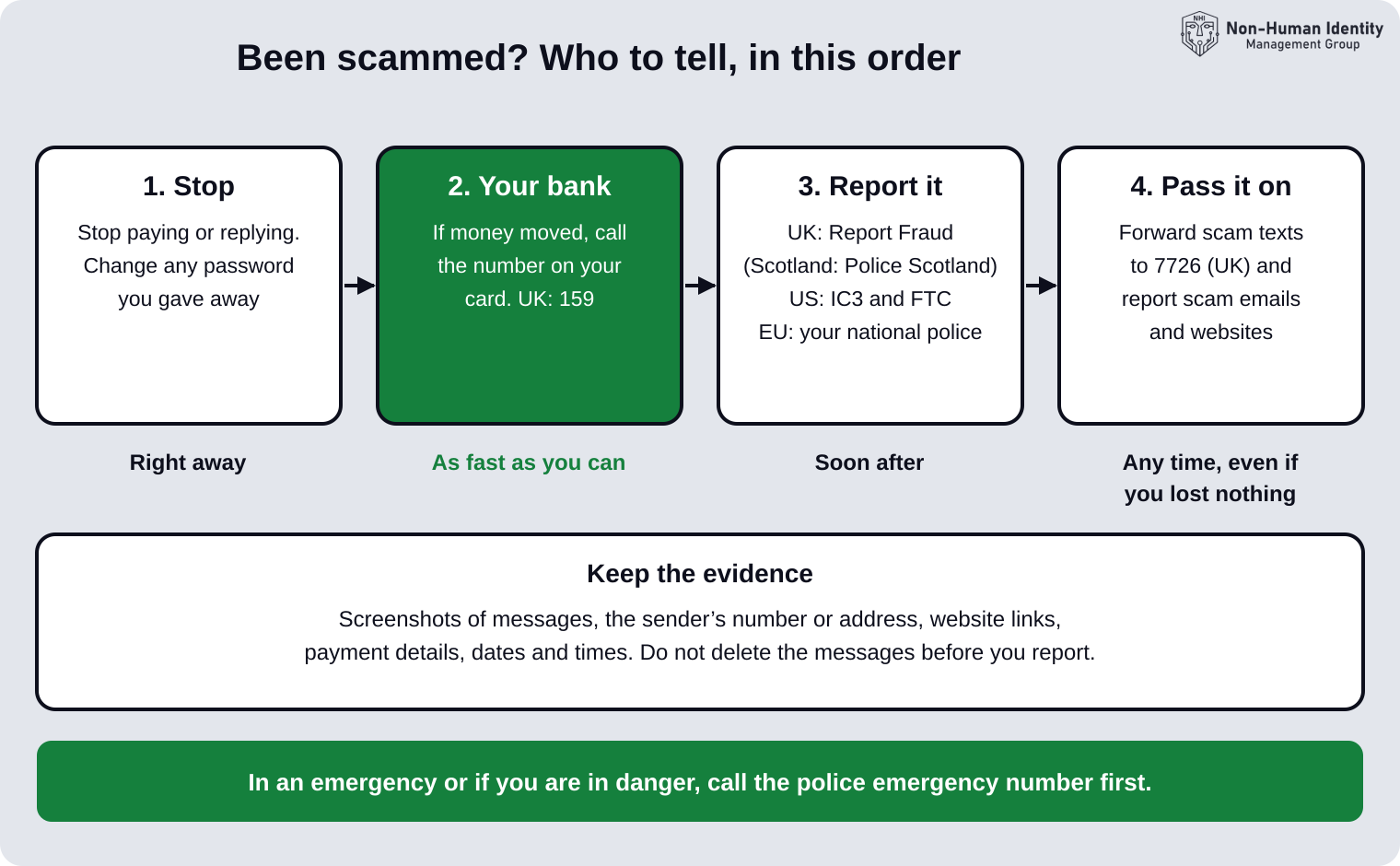
Here is the usual order, wherever you live.
- Stop and secure. Stop paying or replying. If you gave away a password, change it and turn on two-step login.[7]
- Call your bank. If money moved, call the bank or payment service you used straight away and ask them to stop or reverse it.[7] In the UK, the short number 159 reaches most banks safely.[5]
- Report the crime. In most of the UK, use Report Fraud, online or by phone.[1] In the US, report to IC3 and to the Federal Trade Commission (FTC).[6][7] In the EU, go to your national police.[8]
- Pass on the messages. In the UK, forward scam texts to 7726, a free number. Report scam emails and websites to the national cyber security agency.[4][3]
- Watch for follow-ups. Be wary of anyone who contacts you offering to get your money back.
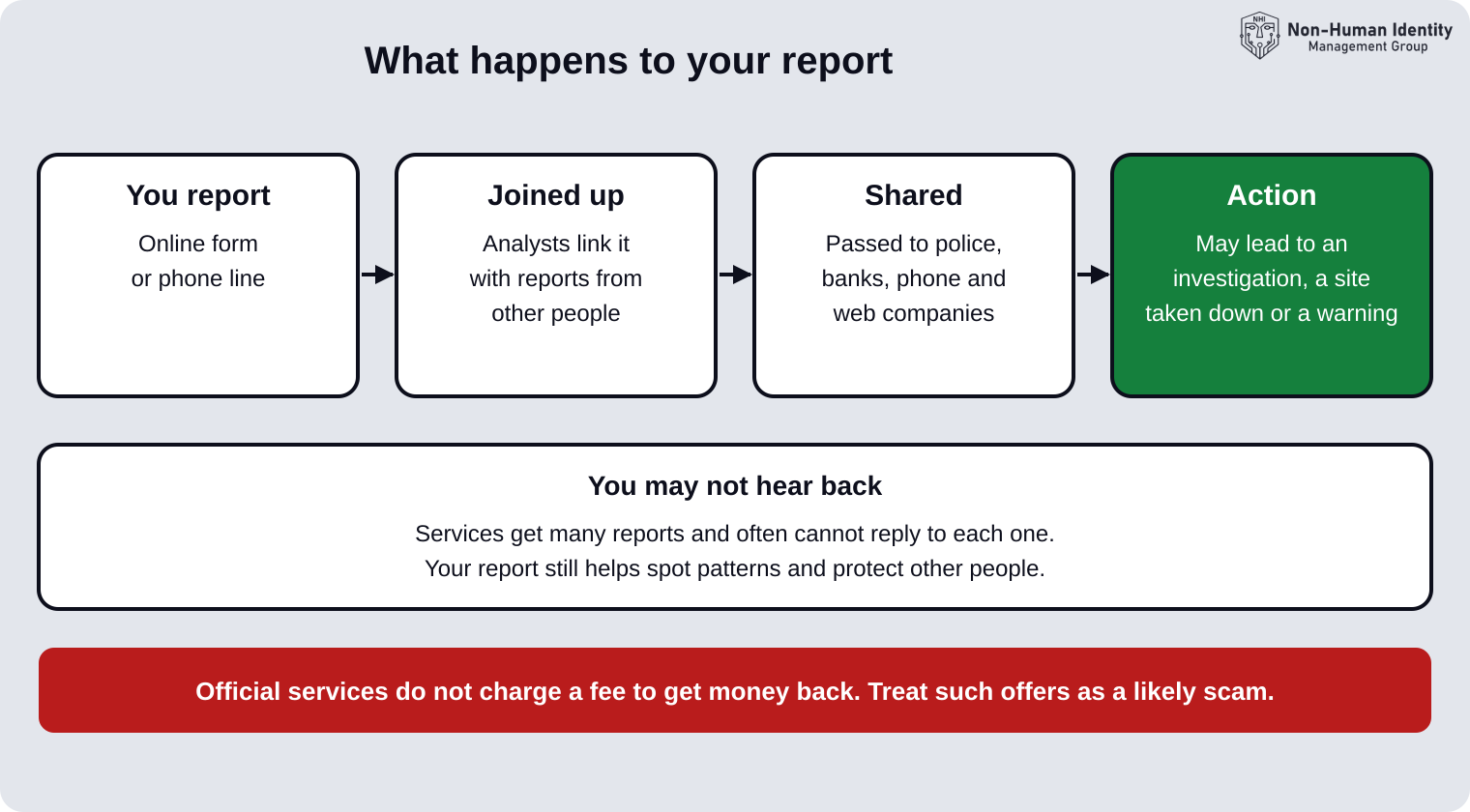
What happens next depends on the service. The UK's email reporting service, for example, checks each message and the websites it links to. It may get harmful sites taken down, but it cannot tell you the outcome.[3] IC3 says it reviews reports and may pass them to police and partner agencies. Because it gets so many, it cannot reply to every one.[6]
A worked example
Leila Thorne, a retired teacher in Leeds, gets a text saying a parcel is held until she pays a small fee. She is expecting a delivery, so she taps the link and enters her card details.
That evening, her banking app shows a payment of nearly 500 pounds she did not make. Her stomach drops. She feels foolish and wants to wait until morning.
Her neighbour, Uma Grover, reminds her of the lifeguard idea. "Telling them quickly helps you and the next person." Leila turns her card over and calls the number printed on the back.
The bank stops her card and starts a claim for the payment. The adviser asks her to report the crime too.
Before she does, Uma helps her take screenshots of the text and the payment. They write short notes with the times, the sender's number and the link, copied as text.
Leila then reports to Report Fraud online. She forwards the text to 7726 so her phone network can act on the sender.[4] She keeps the reference number she is given.
A week later, a caller says he works with the police and can recover her money for a fee. Leila remembers what she read: official services do not ask for money. She hangs up and adds the call to her report.[6]
Her bank later refunds the payment. Leila does not hear back about the report itself, but she knows it is now part of the bigger picture.
Myths and mistakes
| What people think | What is true |
|---|---|
| Only report if you lost lots of money. | Small losses and near misses are worth reporting too. They help link cases together.[6] |
| Report to the police first, then the bank. | If money moved, call the bank first. Speed gives it the best chance to act.[7] |
| Delete the scam message so it cannot hurt you. | Keep it until you have reported it. It is your evidence. |
| If nobody calls me back, my report was ignored. | Many services cannot reply to each report, but they still use it.[3][6] |
| A firm that offers to recover my money is there to help. | IC3 says it does not work with private firms to recover money. Be very wary of anyone who asks for a fee.[6] |
| Falling for a scam means I was stupid. | Scams are designed by professionals to fool people. Reporting is the sensible next step. |
What can I do this week?
- Find the official reporting service for where you live and save its web address.
- Write your bank's number from the back of your card somewhere you can find it fast.
- Forward any scam text or email you receive to the official service, then delete it.
- Talk to an older relative about who they would call first.
Checklist
- I know to call my bank first if money has moved.
- I use the number on my card, not a number given in a message or call.
- I know the official reporting service where I live.
- I keep screenshots, links, payment details, dates and times.
- I forward scam texts and emails before deleting them.
- I keep the reference number from my report.
- I treat anyone offering to recover money for a fee as a likely scammer.
Common questions
Will I get my money back if I report?
Not always. The best chance comes from calling your bank or payment service quickly, because they may be able to stop or reverse the payment. A police report helps investigations and spotting patterns, but it is not a refund service. Ask your bank how its refund rules apply.
Should I report a scam if I did not lose anything?
Yes. Forwarding scam texts and emails helps services find and block the people behind them. In the UK, the email reporting service checks the links and can get harmful websites taken down. It will not tell you the outcome.
Where do I report if I live outside the UK and US?
Start with your bank, then your national police. In EU countries, the EU police agency's website links to each country's own online reporting page. If your country has no online option, it suggests going to a local police station.
Someone says they are from the FBI or police and can help. Is that real?
Be very careful. IC3 warns that scammers pretend to be from IC3, and says it does not contact people directly asking for information or money. Hang up, then contact the official service yourself using details from its own website.
Can I report for someone else?
Often, yes, but it is best if the person who was scammed is part of it. Their bank will usually need to speak to them. Sit with them, help gather the evidence and let them give the details in their own words.
Where next?
Ready for the detail? Read the practitioner guide: FBI IC3 Internet Crime Report. It goes further into what the FBI's yearly report says about reported losses, which crime types cost the most and the limits of complaint-based figures.
Also useful:
- Online Scams for Beginners
- Identity Fraud for Beginners
- Hacked Account Recovery for Beginners
- Phone Scams for Beginners
- Reporting Security Incidents at Work for Beginners
Related NHI Mgmt Group resources: Authorised Push Payment (APP) Fraud Guide · Romance and Investment Scams for Beginners · Payment Fraud Guide
Key terms
- Fraud
- Using lies or tricks to get money, goods or information from someone.
- Phishing
- Fake messages that try to get you to click a link, pay or give away details.
- Smishing
- Phishing sent by text message.
- Vishing
- Phishing done by phone call.
- Recovery scam
- A follow-up scam that promises to get a victim's money back for a fee.
- When a scammer tricks you into sending a payment yourself.
- Identity theft
- When someone uses your personal details to pretend to be you.
Sources and further reading
- Report Fraud: new service from City of London Police. GOV.UK (Serious Fraud Office), 4 December 2025. https://www.gov.uk/government/news/report-fraud-new-service-from-city-of-london-police, accessed 28 Nov 2026.
- Report Fraud service goes live, with full public launch in January 2026. City of London Police, December 2025. https://www.cityoflondon.police.uk/news/city-of-london/news/2025/december/report-fraud-service-goes-live-with-full-public-launch-in-january-2026/, accessed 28 Nov 2026.
- Reporting a scam email. National Cyber Security Centre (UK). https://www.ncsc.gov.uk/collection/phishing-scams/report-scam-email, accessed 28 Nov 2026.
- Report internet scams and phishing. GOV.UK. https://www.gov.uk/report-suspicious-emails-websites-phishing, accessed 28 Nov 2026.
- 159: a safe way to contact your bank. Stop Scams UK. https://stopscamsuk.org.uk/159, accessed 28 Nov 2026.
- Internet Crime Complaint Center (IC3). Federal Bureau of Investigation. https://www.ic3.gov/, accessed 28 Nov 2026.
- What To Do if You Were Scammed. Consumer Advice, Federal Trade Commission. https://consumer.ftc.gov/articles/what-do-if-you-were-scammed, accessed 28 Nov 2026.
- Report cybercrime online. Europol. https://www.europol.europa.eu/report-a-crime/report-cybercrime-online, accessed 28 Nov 2026.